Today we celebrate the birthday of Jesus of Nazareth, widely considered the greatest man who ever lived. His teachings are arguably the most profound, insightful and challenging the world has ever seen. He has inspired countless universities, hospitals, and ministries to the sick, poor, and oppressed. He has inspired the world’s greatest literature, art, and music, not to mention the greatest theological treatises and much of the greatest philosophy in history. He has also inspired countless followers to make extreme sacrifices, many even literally giving up their lives, in his service. So great is his influence on human history, in fact, that this itinerant teacher became the reference point for the world’s dating system. That’s remarkable stuff for a man who never held a political office, never led an army, never authored any books or even a single essay, nor did he even travel more than a few hundred miles from his hometown.
So how did he manage to so profoundly impact human history? For Christians, of course, the answer is that Jesus wasn’t just the greatest man who ever lived. He was something far more than this.
“Now unto him that is able to keep you from falling, and to present you faultless before the presence of his glory with exceeding joy. To the only wise God our Savior, be glory and majesty, dominion and power, both now and ever. Amen.” (Jude 1:24-25)
The doctrine of purgatory is naturally associated with Roman Catholic theology, but some Protestant philosophers and theologians affirm the doctrine (albeit a version of the view which sees purgatory as serving the function of completing sanctification rather than providing final satisfaction for sin). One of the most prominent of these is Jerry Walls, who has published a trilogy of Oxford monographs on personal eschatology, as well as Heaven, Hell, and Purgatory, a single volume treatment of the subject.
Walls, who is a Wesleyan, defends the doctrine of purgatory beginning with the basic idea that salvation is not just about forgiveness of sins but is mainly about spiritual transformation. So if salvation essentially involves transformation, “what becomes of those who plead the atonement of Christ for salvation but die before they have
From http://www.catholiceducation.org/en/
been thoroughly transformed?” Such people, he says, “do not seem ready for a heaven of perfect love and fellowship with God, but neither should they be consigned to hell.” The standard Protestant view is that for such people full sanctification is accomplished immediately and painlessly “by a unilateral act of God at death.” This view, which some scholars call “provisionism” is deeply problematic, according to Walls. One of his arguments appeals to human temporality. Since all human moral growth and maturation on earth is a process that takes time, then it makes sense to assume that our moral progress in the next world will be a temporal process. This suggests something like a purgatorial completion of our sanctification. Walls also uses an argument from human freedom. The idea here is that all human sanctification on earth involves free human choices as we cooperate in the process of moral growth. A unilateral act of God that instantaneously perfects us would be a radical departure from this basic aspect of our experience.
Another Protestant advocate of purgatory is philosopher Justin Barnard. In his Faith and Philosophy article “Purgatory and the Dilemma of Sanctification,” Barnard emphasizes two further considerations. One of these is the problem of personal identity that provisionists face. With such a radical sudden transformation of one’s moral nature, as provisionists propose, how can one be properly considered the same person afterwards? Preservation of personal identity through time requires more gradual change, Barnard would say, and this suggests a slow purgatorial transformation.
But Barnard’s primary concern regards the problem of evil. If God can perfect us morally suddenly after death, then why doesn’t he do it now? The fact that God waits suggests that there is a lot of evil that God cannot remove “without thereby sacrificing any significant good.” Here some appeal to the idea that God refrains from perfecting us on earth in order to respect our free will. But then this implies that God takes away our freedom when he perfects us in heaven. But if that’s not problematic in heaven, then why would it be problematic here? Barnard proposes that the doctrine of purgatory—or his “sanctification” version of the doctrine anyway—avoids this problem, as it says that the process of moral perfection that we begin on earth is simply completed in the afterlife—gradually and eventually completely.
Personally, I am not a proponent of the doctrine of purgatory, but I must admit that such arguments give me pause. While they might never ultimately persuade me to accept the doctrine, I certainly respect the view and see why it has been affirmed by so many great Christian thinkers down through history.
I am happy to announce the release of a two-volume book series entitled Idealism and Christianity, which I edited with the help of my colleagues Steve Cowan, Joshua Farris, and Mark Hamilton. The books are published by Bloomsbury Press and constitute what we hope will be the start of a renaissance of scholarly interest in metaphysical idealism. This is the thesis that mind is most real, and that the entire physical world essentially constitutes the thoughts of that wise and almighty mind—God.
The first volume in the series, entitled Idealism and Christian Theology, explores a variety of issues in theology, including Christology, the resurrection of Jesus, the doctrine of creation, and the knowledge of God. Contributors include Oliver Crisp, William Wainwright, and Keith Yandell. The second volume, Idealism and Christian Philosophy, features essays treating such issues as time, truth, perception, science, miracles, and the mind-body problem. Contributors include Doug Blount, Howard Robinson, Charles Taliaferro, and Keith Ward.
The heroes of the volumes are two 18th century thinkers: George Berkeley and Jonathan Edwards. Both of these great scholars regarded Idealism as amenable to a Christian perspective because it constitutes the most biblical and philosophically plausible way of conceptualizing the world. Idealism effectively addresses skeptical challenges to theism and it provides helpful resources for dealing with all sorts of knotty problems that have plagued philosophers and theologians for centuries.
In addition to the scholarly benefits of Idealism, this perspective also has tremendous personal benefits and is a powerful boon to faith. This was the constant refrain of Bishop Berkeley who concluded his classic defense of Idealism by confessing that his purpose in writing was to “inspire my readers with a pious sense of the presence of God and . . . the better dispose them to reverence and embrace the salutary truths of the Gospel, which to know and to practice is the highest perfection of human nature.” Amen to that, good Bishop!
Another distinction regarding forms of divine wrath is that between what may be called natural and special wrath. By “special” divine wrath I mean any case where the wrathful event is somehow extraordinary, unique, or out of step with the usual course of nature or human events, though not necessarily a violation of the laws of nature. Thus, the cases of the worldwide flood, Sodom and Gomorrah, the Egyptian plagues, Elisha and the bears, and the sudden deaths of Ananias and Sapphira would all qualify as special divine wrath. These are all strikingly special events in that there was nothing routine or predictable about them. Each occurred, as it were, “out of the blue” and, thus, was more easily identified as being divinely orchestrated.
In contrast, what I am calling “natural” wrath does concern events that are in some way ordinary, routine, and predictable, because their natural causes are—at least at this point in scientific history—easily traced and analyzed. However, they may have just as much of a corrective and deterrent effect on those involved as cases of special wrath. They are the sorts of cases to which the biblical proverb applies which says, “there is a way that appears to be right but in the end it leads to death” (Pr. 14:12 and Pr. 16:25) and to which the apostle Paul refers when he declares, “a man reaps what he sows” (Gal. 6:7; see also 2 Cor. 9:6-7). The basic idea is that if you engage in particular kinds of bad behaviors then certain negative consequences will follow. In addition to these general biblical statements we find specific illustrations in Scripture, such as where the deadly effects of adultery are guaranteed in this passage: “For a prostitute can be had for a loaf of bread, but another man’s wife preys on your very life. Can a man scoop fire into his lap without his clothes being burned? Can a man walk on hot coals without his feet being scorched?” (Pr. 6:26-28).
This is what we might think of as a divinely ordained moral law of reciprocity, in the sense that certain forms of conduct bring very unpleasant consequences. Some extra-biblical examples might include the negative effects—physical, psychological, and relational—of alcohol abuse and the tendency of sexual promiscuity to result in venereal disease or other STDs as well as emotional and relational distress.
This distinction between natural and special wrath is potentially controversial. This is because, depending upon one’s view of divine providence, one will be more or less inclined to accept the natural moral law of reciprocity as featuring enough specific divine intent for the pain and suffering that follows from bad behaviors to properly qualify as divine wrath. (For more on the providence debate, see my book The Benefits of Providence.) Those who hold a “high” view of providence which affirms God’s meticulous governance of all things will no doubt be more amenable to this distinction.
In my first post about divine wrath (Sept. 11, 2015) I suggested that God’s chastisement of people, though painful and often even involving death, always serves a redemptive purpose, such as rebuke, discipline, and purification. Such ends are valuable for prodding people to greater virtue. And since to love is to be interested in a person’s growth in virtue, it makes sense to say that divine wrath is consistent with perfect love.
Now there are some distinctions to be made that are potentially helpful in analyzing and categorizing particular instances of chastisement. Thus, we may distinguish between direct and indirect wrath. By “direct” divine wrath I mean those cases where God immediately causes death or suffering, whereas in cases of “indirect” wrath God uses some other agency, whether human, animal, or angelic. Biblical examples of each of these categories are plentiful. Beginning with instances of indirect wrath, we find plenty of wrathful deployments of human beings, such as God’s use of the Israelite army to bring “vengeance” on the Midianites in Numbers 31. Similar instances are to be found throughout the Old Testament and God explicitly declares as much in such passages as Isaiah 10:5 (“Woe to the Assyrian, the rod of my anger, in whose hand is the club of my wrath!”) and Ezekiel 25:14 (“’I will take vengeance on Edom by the hand of my people Israel, and they will deal with Edom in accordance with my anger and my wrath; they will know my vengeance,’ declares the Sovereign LORD.”)
As for divine use of animals to execute wrath, here is one memorable example:
From there Elisha went up to Bethel. As he was walking along the road, some boys came out of the town and jeered at him. “Get out of here, baldy!” they said. “Get out of here, baldy!” He turned around, looked at them and called down a curse on them in the name of the Lord. Then two bears came out of the woods and mauled forty-two of the boys. (2 Kings 2:23-24)
Another case is where the Lord struck the Israelites with venomous snakes in response to their grumbling and complaining during their desert wanderings (see Numbers 21:6).
And as for third category of indirect wrath, where God uses angelic beings to execute his wrath, biblical instances include Exodus 33:2 where God promises to “send an angel before you and drive out the Canaanites, Amorites, Hittites, Perizzites, Hivites and Jebusites” and 2 Sam. 24:15-17, where the angel of the Lord strikes the Israelites.
Possibly the destruction of Sodom and Gomorrah is an instance of divine deputizing of angels, as regarding the city of Sodom the angels declared to Lot, “we are going to destroy this place” (Gen. 19:13). There are also references to God’s use of a “destroying angel” to execute judgment in such passages as 1 Chron. 21:15, Ps. 78:49, and 1 Cor. 10:10.
As for cases of direct divine wrath, apparent examples include the worldwide flood (Gen. 6-9), the Egyptian plagues (Exod. 7-12), the plague on Israel because of their golden calf idol (Exod. 32:35), and the case of Ananias and Sapphira (Acts 5:1-11). I say guardedly that these are “apparent” cases of direct divine wrath because it is possible that God deployed some deputy agency as well to bring these chastisements, though the texts do not inform us of this. This possibility seems evident in the fact that many of the aforementioned cases of indirect wrath are referred to elsewhere in Scripture (and among extra-biblical writers) simply as cases of divine chastisement without any mention of the secondary finite agencies involved. If it makes sense to refer to these cases in such terms, then it is conceivable that all divine wrath is similarly executed through secondary causes.
What duties, if any, do we have toward animals? A new statement on responsible animal care addresses this question in a balanced and biblically informed way. It is being called an “evangelical statement” and appears to be the first such formal document of its kind. You can read and, if you wish, sign the statement here. (Note that clicking on the “sign the statement” button does not commit you to signing it but merely takes you to the page where you can read the statement and have the option to sign it.)
I signed and strongly endorse the statement because I think it achieves a proper moral-theological balance when it comes to animal welfare. There are two extreme positions regarding this issue. There is the No Moral Status view, which says that animals deserve no moral consideration, and humans have no duties regarding them, except as impacts other humans. Modern philosophers such as Descartes and Kant took such a view, still popular today, which encourages us to see animals as natural resources like any other aspect of nature. On the other hand, there is the Strong Animal Rights position, which affirms that animals and humans have the same inherent value and deserve equal moral consideration. Contemporary moral philosophers such as Peter Singer and Tom Regan take such a view, which is championed by activist animal rights groups like PETA (People for the Ethical Treatment of Animals). Advocates of this approach maintain that all use of animal products for food, clothing, experimentation, or entertainment is immoral.
Somewhere between these extremes is a moderate position which affirms that animals have significant moral status, but not the same status as human beings. Accordingly, we have a duty to treat animals humanely. We ought not to treat them cruelly. And by “cruel treatment” I mean the causing of severe and unnecessary suffering. On this view, it is morally appropriate to use animals for food, clothing, experimentation, and entertainment, but only if the animals are not treated cruelly in such contexts. The Every Living Thing statement on responsible animal care effectively achieves such a balance.
Lately, I’ve been thinking a lot about the concept of divine wrath. As often as it is displayed in the pages of Scripture, it is interesting to note how little it is discussed by Christian scholars these days. Why is this? And, more fundamentally, what is divine wrath after all? Does God still exercise his wrath today? If so, is it possible to identify instances of this? And if it is, then what sorts of criteria might one use in order to conclude that a particular event is a case of divine wrath? This November at the annual meeting of the Evangelical Philosophical Society I will present a paper on this subject where I address such questions. I thought it would be an interesting exercise to process my thoughts in the form of blog posts as I prepare for this. So this is the first of what will likely be several installments of my ruminations on the topic. Naturally, I welcome any comments, criticisms, or suggestions you might have to offer.
For starters, it is important to note that there are many instances of divine wrath described in Scripture, and these include both Old Testament and New Testament narratives. Here are some examples:
The worldwide flood (Gen. 6-9)
The destruction of Sodom and Gomorrah (Gen. 19)
The Egyptian plagues (Exod. 7-12)
The death of Ananias and Sapphira (Acts 5:1-11)
The death and illness of those who abused communion (1 Cor. 11:29-31)
There are many other biblical events that may be regarded as instances of divine wrath, but these all seem to be paradigmatic cases, as they all involve the termination of human lives. I select these cases for just this reason, as one might object that narratives where God causes suffering or discomfort without killing anyone (e.g., Paul’s “thorn in the flesh” described in 2 Cor. 12:7-10) are too mild to properly be described as wrathful.
Still, despite the consistent theme of death, there is a certain variety in the narrative accounts listed above. Some involve the killing of thousands of people, while others involve a more surgical strike on one or two people. Some are preceded by warnings, while others seem sudden and unanticipated. Yet what they all have in common is divine chastisement for human sin. Such chastisement appears to serve a number of functions, including retribution, rebuke, discipline, and purification. And it is here where things get especially interesting, as far as I’m concerned, regarding divine wrath and our usual way of viewing it. For at least three of these functions may be construed as potentially redemptive. That is, God’s wrath may be seen as serving a positive or constructive aim, namely to correct, improve, enlighten, or purify people.
Some biblical reinforcement of this idea of a redemptive function of divine wrath can be found in this passage from the book of Jeremiah:
The word of the Lord came to me. He said, “Can I not do with you, Israel, as this potter does?” declares the Lord. “Like clay in the hand of the potter, so are you in my hand, Israel. If at any time I announce that a nation or kingdom is to be uprooted, torn down and destroyed, and if that nation I warned repents of its evil, then I will relent and not inflict on it the disaster I had planned. And if at another time I announce that a nation or kingdom is to be built up and planted, and if it does evil in my sight and does not obey me, then I will reconsider the good I had intended to do for it. Now therefore say to the people of Judah and those living in Jerusalem, ‘This is what the Lord says: Look! I am preparing a disaster for you and devising a plan against you. So turn from your evil ways, each one of you, and reform your ways and your actions.’” (Jeremiah 18:5-11)
Here God’s aim in threatening “disaster” is to prompt Israel’s repentance from the evil in which they currently indulge. In cases where God actually exercises his wrath rather than merely threatening it, the effect can be even greater. Jude tells us that God’s destruction of Sodom and Gomorrah served “as a warning of the eternal fire of God’s judgment” (Jude 1:7). Regarding God’s inflicting sickness and death on those who abused communion, Paul says, “when we are judged in this way by the Lord, we are being disciplined so that we will not be finally condemned with the world.” And in the case of Ananias and Sapphira, Luke tells us that “great fear seized the whole church” when they heard of the sudden death of these two dishonest people (Acts 5:11), which we may assume resulted in an increase of moral seriousness among the early Christians.
So as severe and disturbing as these events must have been to the communities who witnessed them, they do seem to have served the end of prompting repentance and motivating more virtuous living among the people of God. And, of course, this is very redemptive. So if, as I suspect, the reticence of the contemporary church regarding the doctrine of divine wrath is due to the perception that the subject is entirely negative, this is serious mistake. While certainly divine retribution is an uncomfortable idea—as any instance of severe punishment is—we should be encouraged by the notion that God (1) does not tolerate human wickedness indefinitely and (2) he is committed enough to our moral improvement to go to extremes to warn, chide, rebuke, and prod us to greater obedience and virtue. And this certainly seems consistent with genuine love.
Last weekend’s Rethinking Hell conference at Fuller Seminary in Pasadena went extremely well. Greg Stump, Christopher Date, et al. did a superb job organizing and directing it. Those in attendance represented the spectrum of Christian views on the issue: traditionalists, universalists, and conditional immortalists. I was one of six plenary speakers, three of whom (including me) affirm conditional immortalism.
For those not aware, the three views are as follows. Traditionalists maintain that the damned suffer eternal conscious torment in hell. Universalists believe that, though some may suffer in hell for some indeterminate length of time, everyone is ultimately restored to fellowship
Greg Stump, David Instone-Brewer, Jim Spiegel, Oliver Crisp, Jerry Walls, and Robin Parry
with God. And conditional immortalists maintain that the damned suffer for a finite period in hell and are ultimately annihilated (hence the term “annihilationism” that is sometimes applied to conditionalists).
The plenary speakers featured traditionalists Oliver Crisp and Jerry Walls, universalist Robin Parry, and conditionalists David Instone-Brewer, Christopher Date, and myself. All of their presentations were very good and generated substantive discussion with the audience. And I greatly enjoyed the discussion with them in between the sessions.
Jerry Walls is especially enjoyable to engage with, as he is a zealous Arminian and strong critic of Calvinists (like me) and anyone who shows sympathy with Roman Catholicism (like me). But we do agree on much more than we disagree about, especially when it comes to moral and social issues.
Future Rethinking Hell conferences are tentatively planned for the United Kingdom and Australia. And there is also talk of regional Rethinking Hell conferences. Stay tuned!
In the Olivet Discourse in Matthew 24, Jesus describes the hardships of the church in the “last days”:
3 As Jesus was sitting on the Mount of Olives, the disciples came to him privately. “Tell us,” they said, “. . . what will be the sign of your coming and of the end of the age?”
4 Jesus answered: “Watch out that no one deceives you. 5 For many will come in my name, claiming, ‘I am the Messiah,’ and will deceive many. 6 You will hear of wars and rumors of wars, but see to it that you are not alarmed. Such things must happen, but the end is still to come. 7 Nation will rise against nation, and kingdom against kingdom. There will be famines and earthquakes in various places. 8 All these are the beginning of birth pains.
9 “Then you will be handed over to be persecuted and put to death, and you will be hated by all nations because of me. 10 At that time many will turn away from the faith and will betray and hate each other, 11 and many false prophets will appear and deceive many people. 12 Because of the increase of wickedness, the love of most will grow cold, 13 but the one who stands firm to the end will be saved. 14 And this gospel of the kingdom will be preached in the whole world as a testimony to all nations, and then the end will come.
15 “So when you see standing in the holy place ‘the abomination that causes desolation,’ spoken of through the prophet Daniel—let the reader understand—16 then let those who are in Judea flee to the mountains. 17 Let no one on the housetop go down to take anything out of the house. 18 Let no one in the field go back to get their cloak. 19 How dreadful it will be in those days for pregnant women and nursing mothers! 20 Pray that your flight will not take place in winter or on the Sabbath. 21 For then there will be great distress, unequaled from the beginning of the world until now—and never to be equaled again.
22 “If those days had not been cut short, no one would survive, but for the sake of the elect those days will be shortened. 23 At that time if anyone says to you, ‘Look, here is the Messiah!’ or, ‘There he is!’ do not believe it. 24 For false messiahs and false prophets will appear and perform great signs and wonders to deceive, if possible, even the elect. 25 See, I have told you ahead of time.
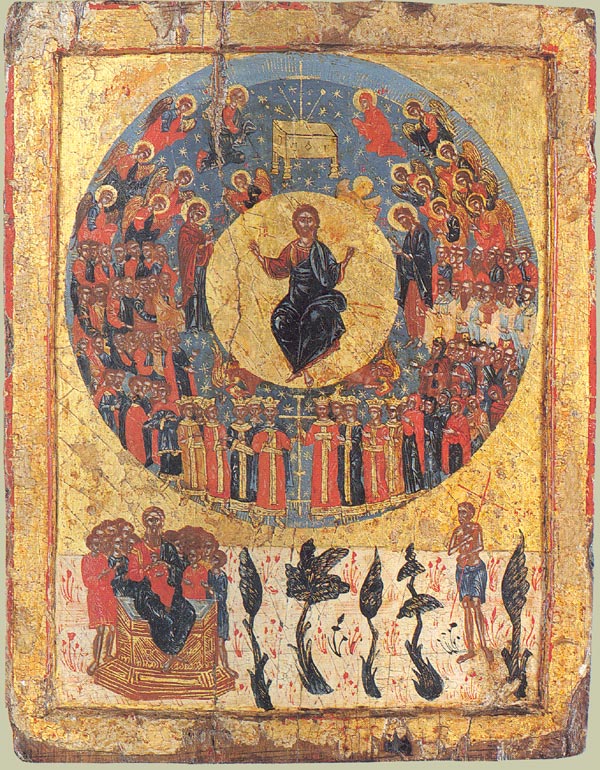
The timing of the events described in this passage is a matter of considerable scholarly debate. Some interpret this passage as describing events that have (at least mostly) already occurred, and other commentators see the “great distress” described there as still (at least largely) in the future, just preceding his return to earth to usher in his Kingdom. I’m inclined to a version of the latter view that life on Earth will be characterized by extreme suffering—worse than ever on this planet, in fact—just prior to Christ’s return. That is, things
Greek icon of Second Coming, c.1700 (Wikipedia)
will get really bad just before they get really good. Moreover, as I read this and other relevant biblical passages, Christians will not be exempt from the suffering (via some sort of “rapture’) but will experience awful tribulation and persecution in the final days.
If this is correct, then it raises an interesting question. Why has God ordained human history to end this way? Why write the narrative in such a way that the dawn of Christ’s eternal reign is preceded by extreme, perhaps unprecedented human—and especially Christian—suffering? One answer, with which I’m sympathetic, appeals to theological aesthetics. There is something beautiful in the passage from darkness to light. Even when we’re not making such an aesthetic judgment about this pattern in human life, we nonetheless often make the observation that “its always darkest just before the dawn.” The beauty of this pattern is evident in many contexts, from the triumph of an inventor after many failures to a sports team that rallies in the final minutes to prevail against adversity. And, in the case of Jesus’ preferred metaphor, childbirth is one of the most vivid illustrations of this. Perhaps no other human experience is marked by such excruciating pain followed by so much joy. And here lies a major aspect of the beauty of the experience. Similarly, one might say, the story of human history is more beautiful overall because the “birth pangs” of extreme human suffering will be swallowed up in the joy of Christ’s return and our “birth” into his blessed Kingdom.
All of this is right, I think, but there is another theological dimension here that I think is relevant, and this concerns the unity of Christ and his church. A recurrent biblical theme is that the church—understood as the collection of Christ’s faithful followers—is in some mystical sense the “body of Christ.” The Apostle Paul makes several references to this metaphor (e.g., 1 Cor. 12:27; Eph. 4:12-15; Col. 1:24). Now to take seriously our deep metaphysical union with Christ is, therefore, to take seriously the notion that we must suffer with him. As the Apostle Paul says, “if we share in his sufferings [then] we may also share in his glory” (Rom. 8:17). Thus, for the church to be fully redeemed, we must be fully united with Christ, and this entails sharing in his experience of suffering and death as well as resurrection. As Paul elsewhere says, “I want to know Christ and the power of his resurrection and the fellowship of sharing in his sufferings, becoming like him in his death, and so, somehow, to attain to the resurrection of the dead” (Phil. 3:10-11). Peter echoes this theme as well when he says, “rejoice that you participate in the sufferings of Christ, so that you may be overjoyed when his glory is revealed” (1 Pet. 4:13).
This much is not particularly controversial biblically speaking, notwithstanding the contemporary American aversion to the biblical notion that Christians must suffer and that God actually ordains this for us (e.g., 1 Peter 1:5-7; James 1:2-4, etc.). But what if the parallel goes even farther than the pattern of the church’s suffering on Earth followed by resurrection into eternal glory? Perhaps even the narrative structure of the “life” of the Christian church parallels that of Jesus’ earthly life. As we know, Jesus’ hardest days were toward the end of his time on earth. No doubt, he faced all sorts of trials throughout his entire life, but his betrayal, unjust trial and condemnation, brutal pre-crucifixion torture and mockery, culminating in a hideous protracted crucifixion were surely the worst experiences of his life. And all of this was followed by the triumphant joy of his resurrection. So if we assume a parallel narrative structure between the life of Christ and the life of his “body” that is his church, then we should actually expect that worldwide Christian suffering will grow increasingly extreme in the last days prior to the second coming of Christ.
Thus, on this view, the tribulation of the church in the last days constitutes a sort of historical recapitulation of the life of Christ on earth—Jesus’s “passion week” writ large in the form of his suffering corporate body, the church. Just as Christ was unjustly persecuted during his last days on earth, his bride—the worldwide Christian community—is persecuted during the last days of her 2000-year “lifetime.” And like her Savior, the church suffers horribly only to be overjoyed upon her resurrection. Hallelujah.
Last year, NFL punter Chris Kluwe made headlines because of his atheism. The reason for his newsworthiness, as the writer of this Psychology Today report on Kluwe notes, is that “open secularity is rare in pro sports.” This is something that has puzzled me since writing my atheism book several years ago. Why are atheist athletes rare?
But try finding a similarly expansive list of atheist athletes. Here’s the best I could do: 19 Famous Athletes Who are Atheist. This is a classic case of exceptions proving the rule. Pretty slim pickings. I found it interesting, for starters, that they couldn’t even find one more to make it an even twenty. (They should add Kluwe, since he’s not included.) And it is supposedly a list of “famous” athletes. Yet, as an avid sports buff, I only recognized five people on the list. Moreover, some of these reach way back, such as to an Italian cyclist from 70 years ago. And another is a WWE wrestler—isn’t that better categorized as acting? After reading through this disappointing list, I discovered the Top 15 Athletes Who are Atheist. But it largely overlaps with the list of 19 “famous” atheists above.
So why are atheists so rare in professional sports? I have a theory, but to explain it I’ll need to start by discussing the primary rationale that atheists and religious skeptics give for not believing in God. This is the problem of evil. Lance Armstrong has been quoted as saying, “If there was a God, I’d still have both nuts.” This statement encapsulates a common intuition about human suffering and religious belief, which essentially constitutes an atheistic argument: God would not want humans to suffer significantly. However, there is a lot of suffering in the world. Therefore, God must not exist. If you were to interview all of the atheists listed in the sites above and ask them why they reject theism, most if not all of them would cite suffering as a major reason. But these men and women are not unique in their awareness of suffering. All serious athletes are well acquainted with pain. And here may lie the clue to understanding why atheist athletes are rare.
To do intense athletic training is to welcome a degree of suffering. Athletes understand the usefulness of pain as a means to physical conditioning and mental toughness, which ultimately means success. No pain no gain, as the saying goes. Consequently, we should expect athletes to be less inclined to see suffering as antithetical to good ends. And to become accustomed to linking these two things—pain and gain—is to gain a deeper existential awareness of how suffering is essential for growth in all of life, not just athletics.
This in turn will enable the athlete to recognize that God can work through painful experiences generally to bring about greater goods in people’s lives. So he or she will be more ready to affirm with the prophet Isaiah that it is good how God gives us “the bread of adversity and the water of affliction” (Isa. 30:20). And just as the difficulties and challenges one faces on the court, diamond or gridiron make one better, the athlete will be likely to affirm with the apostle James that our trials in life have a constructive end, namely to make us “mature and complete, not lacking anything” (Jas. 1:4). Such an attitude might not create a perfect immunity to atheism or religious skepticism, but it certainly could prevent one’s faith from being undermined by the problem of evil. And this might explain why atheist athletes are so rare.