Making an Enemy of Satan

As Christians, we believe that Satan is not only real but the enemy of our souls. This is a clear teaching of Scripture. The Apostle Paul tells us to “put on the full armor of God so that you can take your stand against the devil’s schemes” (Eph. 6:11). And Peter says, “Be sober-minded; be watchful. Your adversary the devil prowls around like a roaring lion, seeking someone to devour” (1 Pet. 5:8). So Satan and other demonic forces are real. They despise us. And they actively seek, and often succeed in causing, our harm.

Many times when going through a severe trial that obviously involves spiritual warfare, I have found myself thinking along these lines: “What did I ever do to these dark entities to warrant their hatred? I have never done anything to harm Satan and his imps. So why do they hate me so much?”

Perhaps you have had the same thought. If not, then at least you now have this thought.  And perhaps you understand my perplexity. But there is a good explanation, which can be summed up as follows.

    • Demonic beings are evil and hate what is good, especially He who is most holy—God.
    • To follow Jesus is to befriend him and join forces with the holy God.
    • To join forces with the holy is to make an enemy of Satan and work against him.
    • To work against Satan is to make him your enemy.
    • To make an enemy of Satan is to elicit attacks from his forces. Such attacks are often painful, frightening, and even devastating. But it’s part of the deal.

So, Christian, are you ready and willing to be an enemy of Satan? Well, actually, that’s a silly question. If you are truly following Christ, you already are.

This, of course, means that, as a Christian, you should expect to suffer. And this is why Jesus tells us we must “take up the cross” and follow him. His suffering, culminating in crucifixion, was a direct and devastating demonic attack. As his children, should we expect anything different? No, we should not. The Scriptures are clear about this. Peter says, “If you suffer for doing good and you endure it, this is commendable before God. To this you were called, because Christ suffered for you, leaving you an example, that you should follow in his steps.” (1 Pet. 2:20-21). And Paul writes, “To you it has been granted for Christ’s sake, not only to believe in Him, but also to suffer for His sake.” (Phil. 1:29).

But what is the use of all of our suffering? Didn’t Jesus do all of that for us? Why must we suffer as well? In short, to share in his glory. Yes, it is a staggeringly wonderful thought. But, again, the biblical writers are clear on this. Paul says, “The Spirit Himself testifies with our spirit that we are children of God, and if children, heirs also, heirs of God and fellow heirs with Christ, if indeed we suffer with Him so that we may also be glorified with Him.” (Rom. 8:16-17). Elsewhere, he writes, “I want to know Christ and the power of his resurrection and the fellowship of sharing in his sufferings, becoming like him in his death, and so, somehow, to attain to the resurrection of the dead.” (Phil. 3:10-11). And Peter tells us to “rejoice that you participate in the sufferings of Christ, so that you may be overjoyed when his glory is revealed.” (1 Pet. 4:13)

Not only this, but we are guaranteed to become better through our suffering. As James says, “Consider it pure joy, my brothers and sisters,  whenever you face trials of many kinds, because you know that the testing of your faith produces perseverance. Let perseverance finish its work so that you may be mature and complete, not lacking anything.” (James 1:2-4)

The true follower of Jesus must suffer. If you are a friend of Jesus you are an enemy of Satan and will be targeted by him. But this only binds you closer to Jesus and will make you better. So your suffering with him means you will share in his glory and be more like him. Again, it is part of the deal—a mind-blowingly wonderful deal.

Saturday Night’s Alright for Fighting

Years ago, my dad sent me S. M. Lockridge’s famous sermon, It’s Friday, but Sunday’s coming. Over time, this has become shorthand between us. Facing hard times? “It’s Friday, but Sunday’s coming.” Frustrated with seemingly unanswered prayers? “It’s Friday, but Sunday’s coming.” It always brings a smile to our faces, but also encouragement and solace as we remember the deep well of comfort Lockridge’s words bring.

If you are unfamiliar with this sermon, it paints a picture of the devastating events of the Friday of Jesus’ betrayal, arrest and crucifixion. The disciples’ abandonment, the accusations of the crowd, the beatings of the Romans. In his beautiful preacher’s voice and cadence, Lockridge layers despair upon despair, until you can practically feel the weight of Jesus’ exhaustion and grief. But he ends each layer with the refrain “Sunday’s coming.”

This week, while discussing a difficult situation with my folks and sister, I threw out the well-worn line and then quipped, “What about poor Saturday? Nobody ever talks about poor Saturday.” I was thinking about “poor Saturday” during the Good Friday service I attended today. Friday gets to be good, Sunday gets TWO names (Palm and Resurrection), but poor Saturday. Nothing. The wallflower of Easter; always a bridesmaid, never the bride.

It seems very human to focus on the dramatic events of Friday and Sunday and not give Saturday another thought. We do this with the events of our own lives as well. We want to rush past the middle of the drama and skip to the part where everything works out, we get the job, the test comes back negative, etc.

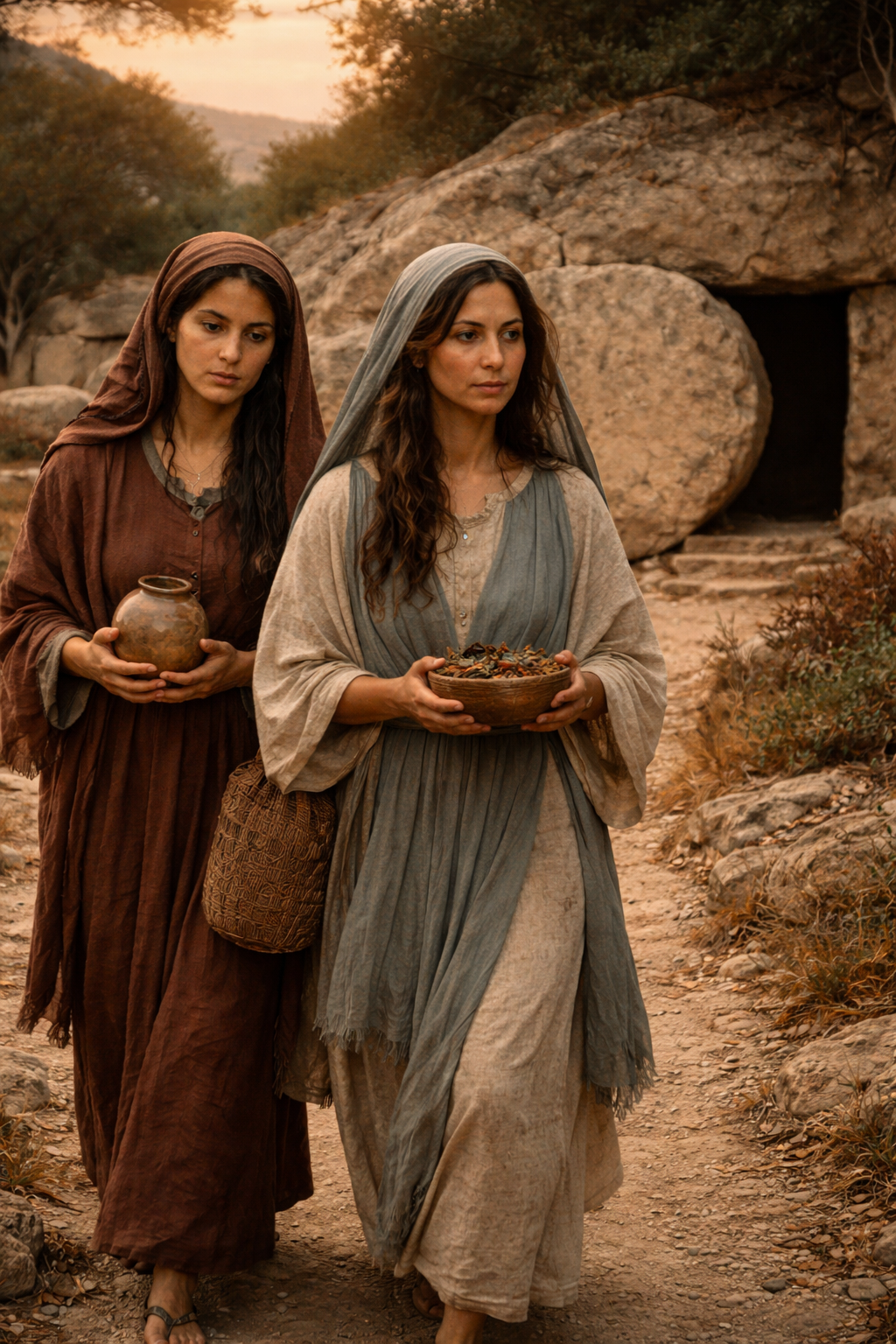
But just for a moment, let’s think about that Saturday. Jesus was dead, so was Judas. The disciples were terrified and without a leader. Peter, I’m sure, was trying not to buckle under the grief and shame of his denials, the bitter tears still hanging in his beard. The women were preparing for Sunday. Not preparing to celebrate with plastic grass and Cadbury eggs. They were preparing to perform as ancient world morticians. To wash away the blood and sweat, cover the stink of death and decay with spices and ointments. Grief and confusion were hanging in the air.

Sure, there had been miraculous signs: unnatural darkness, an earthquake, split rocks, and the Temple’s torn curtain. These are hardly signs to lighten the mood. Tombs were opened and loved ones brought back to life, but this is cold comfort for those whose Hope has just died, naked and crying out to God. At one time, this Hope, this man, had seemed so favored. Heaven had opened, and the Spirit descended on Him while He was proclaimed to be God’s beloved Son.

I don’t know about you, but sometimes Fridays are easier to navigate than Saturdays. During Fridays, I am on high alert, rallying the troops for prayer, seeking wisdom in Scripture and looking for God’s direction. A season of crisis and drama can put me in “hero mode,” at least of a little while. But when the crisis is prolonged, or worse, when it feels like all hope is lost, the tomb of Hope is sealed and guarded, I have a tendency to retreat to habits of consultation, seeking solace in distraction and a good dose of carbohydrates.

But distraction doesn’t prepare me for Sunday. How can I worship if I’m not waiting for the dawn of God’s glory? The women honored to be the first witnesses of Jesus’ resurrection did so because they spent Saturday preparing. Let us do the same. Let us resist the despair of waiting. Let us refuse distraction and the bitterness of unfulfilled expectations. In the words of musical theologian Elton John, “Saturday Night’s Alright for Fighting.” So let us fight the good fight on Saturday. After all, Sunday’s coming.

On Villains, Vengeance, and the Christian Hero

The Christmas story is about a certain Hero. But like all hero tales, the story also has its villains. When King Herod learned that the “king of the Jews” was to be born in Bethlehem, he set about apprehending the baby. This prompted an angel of the Lord to appear to Joseph in a dream, telling him “Rise, take the child and his mother, and flee to Egypt, and remain there until I tell you, for Herod is about to search for the child, to destroy him” (Mt. 2:13). Joseph and Mary obeyed this instruction, which served to fulfill the Old Testament prophecy, “out of Egypt I have called my son” (Hos. 11:1). When he realized he had been outsmarted, Herod was furious and ordered the slaughter of all baby boys in Bethlehem.

There are also villains who opposed Jesus during his three-year ministry. Twice during conversations with the Pharisees, they attempted to kill him. During the Feast of Tabernacles, Jesus proclaimed his equality with God, saying, “before Abraham was, I am.” We are told that his opponents “picked up stones to throw at him, but Jesus hid himself and went out of the temple” (Jn. 8:59). Later, during the Feast of Dedication, Jesus again enraged the Pharisees by asserting his divine identity when he said, “I and the Father are one” (Jn. 10:30). In response,  “the Jews picked up stones again to stone him.” But rather than smiting them, Jesus simply replied, “I have shown you many good works from the Father; for which of them are you going to stone me?” (Jn. 10:32).

At the end of his earthly ministry, there were many more villains who, together, succeeded in killing the Lord. Judas Iscariot betrayed him, the Jewish high priest Caiaphas, along with the Sanhedrin, sought to have Jesus executed for blasphemy, Pontius Pilate ordered the execution—despite his claiming innocence in the process—and Herod Antipas, the crowd, and the Roman soldiers who carried out the execution, all played their villainous roles.

Even after Jesus publicly rose from the dead, there was more villainy from the chief priests, Jewish elders, and Roman soldiers who attempted a cover-up of the resurrection (Mt. 28:11-15).

So many villains, and one Hero. It is easy to overlook the significance of the fact that, despite all of the treachery, lies, and murderous injustice, Jesus never sought revenge. On the contrary, he consistently reasoned with his opponents or else remained silent. He perfectly fulfilled his own radical counsel: “Do not resist the one who is evil. But if anyone slaps you on the right cheek, turn to him the other also” (Mt. 5:39).

The Apostle Paul would later reiterate Jesus’ teaching, saying, “Repay no one evil for evil, but give thought to do what is honorable in the sight of all. If possible, so far as it depends on you, live peaceably with all. Beloved, never avenge yourselves, but leave it to the wrath of God, for it is written, ‘Vengeance is mine, I will repay, says the Lord’” (Rom. 12:17-19). Paul, too, would abide by this counsel, even unto a martyr’s death. He too was a hero.

We all have villains in our lives, and accordingly we all face temptations to take revenge, whether in big or small ways. Even if we succeed in resisting the temptation of vengeance, we will deal with the temptation to resentment and holding grudges. This is essentially mental vengeance and can be just as psychologically and morally self-destructive as vengeful action.

But practicing forgiveness is often extremely difficult. When we struggle in this area, we should keep in mind not only how Jesus modeled forgiveness but also how God used the villains in his life to advance his cause. God parleyed their wickedness into the ultimate triumphant tale. And so it goes for those who obey Jesus—in heart and mind, as well as action—despite wicked opposition. The villains end up unwittingly serving the hero’s greater good.

This is one of the profound lessons of the story of Jesus, from Christmas through Easter. And it can be the story of our lives as well, as we deliver our own villains into the hands of God by loving and forgiving them. This is the way to triumph. It is the way of the Christian hero.

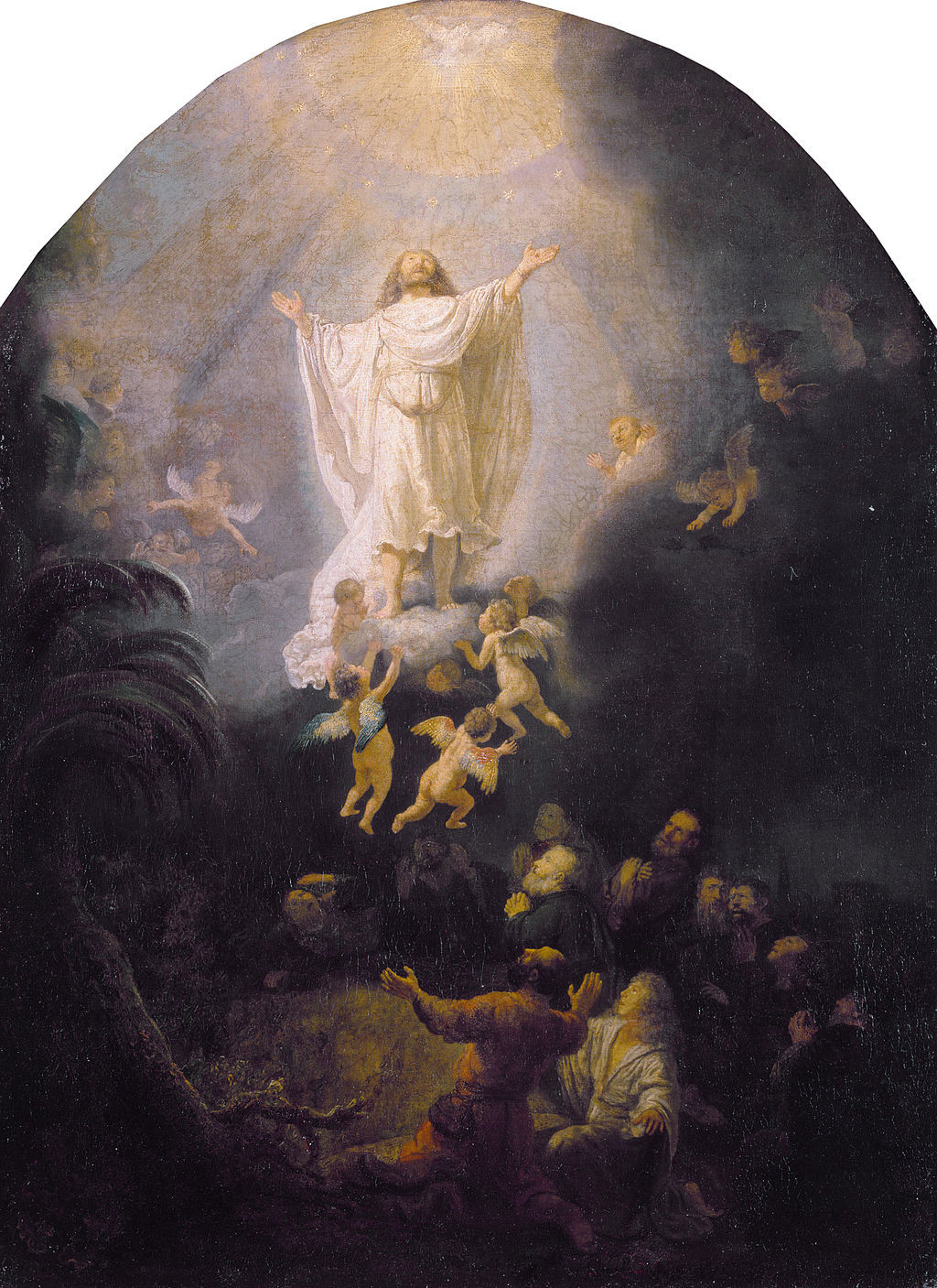
Death vs. Ascension

One of the most fascinating scenes in the New Testament—to my mind, at least—is the ascension of Jesus Christ. As Luke records the event in the book of Acts, he notes that after his resurrection, Jesus appeared to his disciples over a period of forty days and on one occasion:

They gathered around him and asked him, “Lord, are you at this time going to restore the kingdom to Israel?”

He said to them: “It is not for you to know the times or dates the Father has set by his own authority. But you will receive power when the Holy Spirit comes on you; and you will be my witnesses in Jerusalem, and in all Judea and Samaria, and to the ends of the earth.”

After he said this, he was taken up before their very eyes, and a cloud hid him from their sight.

They were looking intently up into the sky as he was going, when suddenly two men dressed in white stood beside them. “Men of Galilee,” they said, “why do you stand here looking into the sky? This same Jesus, who has been taken from you into heaven, will come back in the same way you have seen him go into heaven.” (Acts 1:6-11).

And that was the last they saw of Jesus. It was their final, unceremonious goodbye. And yet, apparently, there was no weeping or wailing. No one cried. No one mourned. In fact, the disciples simply got to work building the church and joyfully proclaiming the Good News.

What a contrast between this and when Jesus died six weeks earlier. And yet, from the standpoint of saying goodbye, at least as far as anyone could tell at the time, the situation was no different. A beloved friend was leaving for good. Why such a different response?

Was it the manner of death? This can’t be the explanation, since it is the loss of our loved ones that we mourn, not their manner of death. This is reflected in the (very reasonable) common expression, “I’m sorry for your loss.” We never say, “I’m sorry your loved one died the way they did.” Yes, an especially painful or violent death may exacerbate the pain of loss. But the essence of sorrow regards the loss of the person, not how they died. And yet, when Jesus ascended, the disciples lost their friend. So why no mourning?

Was it the presence of Jesus’ dead body that made his death so much more painful than his ascension? No, this can’t be it. If your loved one were to die in such a way that their body is out of sight or irretrievable (e.g., sunken in the ocean depths, lost in space, etc.) you would mourn every bit as much as if their lifeless body was present. The presence of a corpse may make some psychological difference (for better or worse), but that’s not the source of our sorrow. Again, it is the loss of the person we mourn.

Or maybe the difference lies in the fact that by the time Jesus ascended, he had proven he was the Messiah, that the disciples’ personal investment in him was not in vain, and that their trust in him was vindicated. Perhaps this is why
the disciples didn’t mourn his ascension. Again, this doesn’t account for the fact that, just as in the case of a physical death, by ascending Jesus was leaving them for good.

Or was he? It seems to me that the key to understanding the different responses is that Jesus’ ascension proved his departure was only temporary. That by his resurrection he proved that he had conquered death and that he could be trusted in his promise that he was going to return and bring about his everlasting kingdom. This meant, again, that the goodbye was not permanent but only temporary.

So the difference has to do with Gospel hope, something that the disciples definitely did not have immediately after Jesus was crucified and buried. In fact, they had lost all hope. But with the fact that the ascension occurred after his resurrection made all the difference. Moreover, his resurrection proved that all death is conquered and that, as Christians, all of our goodbyes are only temporary. And this is why the Apostle Paul would later dare to mock death, saying, “Where, O death, where is your victory? Where, O death, where is your sting?” (1 Cor. 15:55).

Of course, I am not saying that our mourning the death of friends and loved ones is not rational or that we lack faith in doing so. Rather, we mourn with hope. And, as Christians, we understand that our goodbyes really are temporary—that we, too, ascend after death and, like our Lord, we go to await our final reunion with the people of God. That is Gospel hope, and it makes all the difference in the world.

Staying on the Cross

In Martin Scorsese’s film The Last Temptation of Christ, Jesus’s last temptation is represented as the domestic life—to come down from the cross, take a wife, have kids, and live a normal family life. The film is a bit of fanciful celluloid imagination, but it gets this much right: Christ’s final temptation on earth was created by the mockers who challenged him to take himself down from the cross:

“It was nine in the morning when they crucified him. The written notice of the charge against him read: ‘The King of the Jews.’ They crucified two rebels with him, one on his right and one on his left. Those who passed by hurled insults at him, shaking their heads and saying, ‘So! You who are going to destroy the temple and build it in three days, come down from the cross and save yourself!’ In the same way the chief priests and the teachers of the law mocked him among themselves. ‘He saved others,’ they said, ‘but he can’t save himself! Let this Messiah, this king of Israel, come down now from the cross, that we may see and believe.'” (Mark 15:25-32)

Jesus resisted this temptation—something he could very easily have done, to relieve himself of such extreme torment and humiliation. But doing so would have undermined God’s perfect plan for the salvation of humanity. Jesus had to suffer in full in order to provide complete atonement for the human race. So Jesus had to submit completely, and, thankfully, he did.

Sometime before his crucifixion, Jesus told his disciples, “If anyone would come after me, let him deny himself and take up his cross and follow me. For whoever would save his life will lose it, but whoever loses his life for my sake will find it” (Mt. 16:24-26). This remark—like so many cryptic statements by Jesus—must have utterly confused them, not the least because they had no idea what fate shortly awaited Jesus. As we now know, it is not just a quaint, poetic expression but a metaphor we should seriously ponder for how it applies to us as Christ followers.

One application context is personal offense, specifically when a person refuses to apologize for a serious wrong committed against you, especially when this leads to public humiliation. If ever there was a time to urge someone to apologize, the sin of slander would probably be as compelling a reason as any. If you have already taken the steps of personal rebuke prescribed in Matthew 18 but to no avail, it can be tempting to “take matters into your own hands,” such as through spiteful treatment, public shaming, or worse. In the days of social media when discretion is an increasingly rare virtue, this can be especially tempting.

However, if their wronging you put you on this cross, so to speak, then any such responses may essentially be efforts to take yourself down from the cross rather than to “carry” it to the full extent God has ordained for you. When the Matthew 18 steps have been exhausted, I’ve resolved to eschew additional efforts and submit to whatever remaining suffering and slander may be meant for me. If Jesus tells me to deny myself, take up my cross, and follow him, then presumably this means I should be willing to remain on that cross as long as he stipulates.

Of course, there is a time and place to “escape” the torment of others, whatever form that might take, whether physical or psychological abuse, etc. And there is a time to confront people who owe you an apology for injustices and other wrongs that have caused you to suffer (as, again, we know from Matthew 18). But there is also a time to recognize when, humanly speaking, none of this is possible and only God can redeem the situation. Such is the time to remain on the cross and trust God for a moral resurrection within a human heart that only he can effect. That is my resolution, anyway, and it has been a blessed approach.

Risky Business

As Christmas approaches, this mother’s heart is humming with anticipation. All four of our kids, Lord willing and the creek don’t rise, will be spending the holiday break with us this year. As they grow up and out (of the house that is), I am learning not to take being all together for granted. Gone are the days of me hiding in the kitchen pantry, eating chocolate and trying to get five minutes to myself. Most of the time I’m lucky to have more than one of them sitting at the dinner table and last Christmas we suffered an emigration mix up getting Andrew home from his semester in Bolivia and ended up with only half the crew celebrating with us.

Earlier this week, I was listening to Megyn Kelly discussing the case of Kate Cox. If you haven’t heard of the case, Cox is suing the state of Texas for the right to abort her baby. Texas’ recently enacted laws prohibit abortion once a fetal heartbeat is detected with some exceptions. Despite the fact that Cox’s baby has been diagnosed with Trisomy-18 and is highly unlikely to survive to full-term or the birthing process, the lower Texas courts have denied Cox’s application for an exception to be made. Kelly expressed her belief that forcing a woman to carry a dying baby was a form of “torture” and condemned the Texas law as too extreme, a position I strongly disagree with but not, perhaps, for the reasons you might think.

Surely no one who hears this story can fail to sympathize with Cox, although extremists on the left would have a hard time selling their sympathy to me as genuine. Many, though not all, abortion advocates have moved well past the argument for “legal, safe, and rare” and into the space of gleeful celebration at the death of a helpless unborn child. Those on the opposite end of the spectrum should most definitely offer their condolences to Cox and her family; if you are pro-life, you certainly should seek to comfort those who face such a dreadful diagnosis. But for myself, I believe that in seeking an abortion Kate Cox is not escaping “torture,” as Kelly put it, but rather inflicting further wounds to her psyche. She is already the mother of a dying child and having an abortion will not erase that fact. Being the direct cause of her child’s death, rather than allowing her child’s life to unfold, in my opinion, will only add to her grief. The risk of heartbreak is an inherent part of motherhood and a medical procedure cannot remove this from the job description.

We, as mothers, are all the mothers of dying children and our journey through parenthood is a tortuous one. We bring them into this world knowing that one day, hopefully many decades from now, they will leave it. Not only do they face certain death, we also know there will be many pains and traumas along that path. We hold our breath from the moment we feel that first stirring deep inside our wombs, through their first tottering steps and watch with anxiousness as they are off to school and have their first disappointments and heartbreaks and failures. As their worlds widen, our fears only increase. As they grow, so too do the dangers they face.

But so too do their joys. And through them, our joys increase as well. As they say, with great risk comes great reward. There is no joy in mothering without the sorrow; to love is to venture heartbreak. There is no escaping the tortures of motherhood, whether it be carrying a baby you know is destined to die early or carrying a baby you know will face untold perils as he or she grows. Just as in the throes of labor there is no escaping the pain of birth; all you can do as a mother is grit your teeth and know you are giving birth to something worth the pain.

Years ago in my early days of parenthood, I was complaining about not getting a moment to myself, and a friend wisely shared an insight that pierced my heart. He looked down at one of my toddlers and said “If I had known the last time I held my son or daughter was the last time, I would have held them five minutes longer.” We never know when that last time will be so we should cherish each time as if it is the last.

From the news reports I have read, Kate Cox won’t get that last time, or a first. She has pursued an abortion in another state. For that loss, I grieve for her. I’m sure that this Christmas will be a challenging and sad time for her, to say the least. I will certainly pray for her to experience repentance, forgiveness and healing during the season which celebrates not only Jesus but also his mother Mary. Not only Mary in the stable but also Mary at the temple, dedicating her baby to God and being told by Simeon, according to Luke 2, that He would do great things but at the cost of a sword piercing, not just His side, but also her soul. I think of Michelangelo’s Pieta. Mary holding her son for just five minutes more; the pain of His death and her sorrow bring us who believe the greatest of joys.

The End of a Matter

There is a passage in the book of Ecclesiastes that has always fascinated me. It is Ecclesiastes 7:8, which says, “The end of a matter is better than its beginning, and patience is better than pride.” Specifically, the first clause has always struck me. Why is the end of a matter better than its beginning? Why is finishing better than starting? My quest for a better understanding of this idea naturally prompted me to consult biblical commentaries on the passage, but I found that in most cases the commentators skirt past this clause to focus on the second clause which is far easier to understand and explain, however strange it might be to contrast patience with pride (as opposed to impatience).

So I’ve essentially been left to my own devices to understand why the end of a matter is better than its beginning. Fortunately, personal experience has proven to be an effective interpretive tool in this case. As the years have passed, I have been struck by the vivid truth of this passage as it applies to various events in my life and in human experience generally. It hit me again two weeks ago as we celebrated the graduating class of Lighthouse Christian Academy where I serve as head of school. And it hit me a week before that when our oldest son, Bailey, graduated from Taylor University. In both cases, there was a celebration of completion, the attainment of long sought goals, the realization of the telos for which the students strived for so many years. And that is most definitely a very good thing, even better than the beginning of the journey for each of the graduates, however fun or exciting that might have been for them.

Graduations are positive outcomes, of course. But many human experiences are quite negative, even horrifically so. Here again Ecclesiastes 7:8a is clearly applicable. Whether we are talking about a painful trip to the dentist, an unhealthy dating relationship, or any number of other negative experiences, it is certainly good when such things come to an end. After some such event, it is not uncommon to hear people say, “Man, I’m glad that’s over with!” This seems to be a tacit affirmation of the negative pole of the Ecclesiastes 7:8a principle.

So I would sum up my analysis like this. The end of a matter is better than its beginning because any particular “matter” (experience/event/project) is either good or bad. If the matter is bad, then it is good to have it over with. And if the matter is good, then you still benefit from and even enjoy and celebrate the achievement. Either way, then, the end is better than the beginning.

One might object, however, that it is sad when good things end, such as when a virtuous person dies or when a good friend moves away. How could the end of wonderful things like this be better than their beginning? One of Aristotle’s observations about happiness is useful here. He notes that you cannot know you have had a happy life until it is over. This is because until a life is actually completed it is always possible that it can go awry in some way. Only when a person is dead can it be truly said with confidence that that person had an overall good life. And what is true of an entire lifetime is true of particular events (e.g., a good game or a good evening with friends). So for all of the sadness of saying goodbye to a loved one or to a sweet phase in one’s life, it is nonetheless a blessed thing to be able to say with confidence, “Old Joe was a tremendous guy” or “Didn’t we have wonderful times together!”

All of this thinking about “ends” naturally prompts me to think about the ultimate end of things—the culmination of human history as promised in Scripture. Numerous times in the Bible we are reminded that the end of the matter when it comes to the course of history will be marked by the return of Jesus Christ in power and glory. And that will be goodness on a colossal scale. The writer of Genesis says that when God created the heavens and the earth and everything in them, he repeatedly declared them “good.” But as great as that was, it doesn’t compare to what will be achieved in the end—a glory that we are told, often cryptically, is beyond our ability to fathom (cf. Rom. 8:18, 1 Cor. 2:9), a time when “He will wipe every tear from their eyes. There will be no more death or mourning or crying or pain, for the old order of things has passed away.” A time when Christ will rule with perfect justice and righteousness, and perfect joy and fellowship among his people will be established forevermore (Isa. 9:6-7). Now that is an end that is truly better than its beginning!

Why the Last Shall be First

A recurrent theme in Jesus’ teachings in the Gospels is the so-called “upside-down kingdom”—the idea that the stations of human beings in the next world will be the reverse of what they are in this world. For example, in Luke 9 we read that “An argument started among the disciples as to which of them would be the greatest. Jesus, knowing their thoughts, took a little child and had him stand beside him. Then he said to them, ‘Whoever welcomes this little child in my name welcomes me; and whoever welcomes me welcomes the one who sent me. For it is the one who is least among you all who is the greatest’” (vs. 46-48). And in Matthew 20:16 Jesus sums this up by saying “the last will be first and the first will be last.”

I have long wondered why God set it up this way. Why should the least here be the greatest in the kingdom of God?  And for a long time my best answer was that there is a certain beauty in this—that God would choose this way of doing things for aesthetic reasons. Such irony, after all, makes for a more compelling artistic narrative, right? I still think this is true, but now I believe the fundamental reason is more straightforward. It has to do with our proper place as creations of God. In short, we were made to serve, to be God’s subjects. This is a fundamentally humble role, of course. And although plainly biblical, we are chafed by it because we are naturally prideful. (Even many Christian organizations which claim to emphasize servanthood only do so by using the term “servant” as an adjective describing “leadership,” a fact which shows just how problematic “servanthood” is from a marketing standpoint.).

Human beings, like all other beings in the universe, were created to serve God. And as rational, conscious beings, we were designed to choose to serve God. Such humility is, as I have argued in several places, our proper place and highest virtue (as indicated by the Kenosis passage in Phil. 2:5-11). To be among the least, in an intentional and voluntary way, is to demonstrate the will to serve, a desire to assume one’s proper place in a universe ruled by a sovereign God. In short, then, what I am proposing is that the reason for the “upside-down” kingdom, that the last will be first and the least will be greatest, is that choosing to serve effectively demonstrates the will to fulfill one’s created purpose, to do the job God made us to do. Such a commitment, therefore, isn’t just symbolically or metaphorically “great.” It really is true greatness.

The irony we see in this is only due to the fact that, as fallen human beings we are so disinclined to recognize our proper place of humble subjection to God. We have a natural, sinful tendency to want to be first and to have others serve us, not vice versa. And the overwhelming majority of human beings act accordingly. From such a perspective, Jesus’ teaching is strikingly paradoxical and counter-intuitive. But, again, if God is the sovereign ruler of the cosmos who has created all people to serve him, it’s not really paradoxical at all, nor should it be counter-intuitive to those who have embraced and fully interiorized his lordship. It is neither paradox nor even irony. It is just a basic fact of reality.

Unconditional Forgiveness

This Christmas we once again celebrated the arrival to earth of the Messiah, whose mission was to achieve forgiveness of the sins of humanity. Naturally, then, the Advent season should prompt us to reflect on our own sins as well as how we may “pay forward” Christ’s work to others. This involves forgiving one another’s sins.

But to what extent should we forgive others? Should our forgiveness of others’ sins be unconditional? There is some debate about this among Christian theologians and ethicists. For example, Doug Geivett maintains that forgiveness is properly premised on the repentance of the offender, and the writer of this article takes the view that a Christian may forgive the unrepentant but need not do so. Similarly, Roger Olson maintains that unconditional forgiveness is a supererogatory act (above and beyond the call of duty). Then there is Lewis Smedes who took the view that the Christian should be willing to forgive unconditionally. I’m inclined to agree with Smedes, maintaining that the Christian should always and in every case forgive those who sin against them, whether or not they ever repent or apologize. While we have a duty to confront those who sin against us, their failure to repent is not grounds for our withholding our forgiveness. (Also, importantly, this view does not entail that we must maintain a relationship with those whom we forgive.)

Here are some reasons why I take this position. First and foremost, there is the model of Christ’s unconditional forgiveness. Jesus forgave even those who were crucifying him, obviously without repentance, praying “Father forgive them, for they know not what they do” (Lk. 23:34). This a major reason why I find it difficult to imagine that on Judgment Day Jesus will say to me, “You know, Spiegel, one thing you really got wrong is you were just too forgiving.” I certainly can imagine Jesus correcting us for failing to confront people for their sin (cf. Mt. 18:15-17). But rebuking us for being overly forgiving strikes me as absurd.

Secondly, God’s commands to forgive others are unqualified. The Apostle Paul tells us to “Put on . . . compassionate hearts, kindness, humility, meekness, and patience, bearing with one another and, if one has a complaint against another, forgiving each other; as the Lord has forgiven you, so you also must forgive” (Col. 3:12-14). This point is powerfully illustrated in Jesus’s parable of the unmerciful servant in Matthew 18, which concludes with an absolute injunction to forgive others and a sobering warning of coming judgment “unless you forgive your brother from your heart” (v. 35).

Thirdly, consider the Golden Rule. All of us desire to be forgiven by others when we sin against them and not only when we apologize. We naturally desire grace in such cases, the extension of mercy even prior to our repentance. After all, it is sometimes such mercy which prompts our repentance and a deeper resolve to live rightly. Therefore, if we should treat others as we would want others to treat us, then we should extend forgiveness unconditionally.

Finally, forgiving others unburdens one’s soul. Nothing oppresses the mind like a grudge, which as someone once said, is like taking poison and expecting the other person to die. Unfettered resentment corrodes the soul and adversely affects one’s relationships and personal well-being, while forgiveness is beneficial to one’s mental health and physical health. So forgiveness is very much in one’s own self-interest.

Many Christians maintain that forgiveness is properly contingent on the offender’s confession or apology. Why? I believe one reason is the sheer difficulty of forswearing condemnation of someone when they have been abused or otherwise treated in a severely unjust way. It is not easy to surrender resentment in such cases, which is why absolute forgiveness is an act of profound faith and, therefore, a blessed thing, worthy of eternal reward.

Perhaps another reason is that forgiveness seems to let a person “off the hook” and leaves them somehow unaccountable for their sin. But this is not so, since we are all subject to God’s judgment in the end, as we are told repeatedly in Scripture. In Ecclesiastes are told, “Fear God and keep his commandments, for this is the duty of all mankind. For God will bring every deed into judgment, including every hidden thing, whether it is good or evil” (Eccl. 12:13-14). Similarly, Paul says, “For we must all appear before the judgment seat of Christ, so that each of us may receive what is due us for the things done while in the body, whether good or bad” (2 Cor. 5:10). Even if I am completely forgiving of someone, that person still must give account to God for what they have done to me. And this should be a great solace to us, further inducing us to freely forgive others.

Like everyone else, this past year has provided me with plenty of opportunities to be resentful and hold grudges against those who sinned against me. But I rest in the knowledge that God is a perfect judge. Whether I forgive someone, God will still punish or discipline the offender, perhaps even severely. As Jeremiah says, “The Lord is a God of retribution; he will repay in full” (Jer. 51:56b). How could my personal condemnation or grudge ever improve upon God’s perfect justice anyway? This is another reason that resentment is a fool’s game.

This year I have spent a lot of time meditating on Psalm 37, which begins with these powerful lines:

Do not fret because of those who are evil
or be envious of those who do wrong;

for like the grass they will soon wither,
like green plants they will soon die away.

Trust in the Lord and do good;
dwell in the land and enjoy safe pasture.

Take delight in the Lord,
and he will give you the desires of your heart.

Commit your way to the Lord;
trust in him and he will do this:

He will make your righteous reward shine like the dawn,
your vindication like the noonday sun. (Ps. 37:1-6)

These are reassuring and inspiring promises, which effectively fuel the Christian’s will to forgive. In the end, God will have his perfect way with the wicked as well as with misguided fellow believers who sin against us. And if we really have been treated unjustly, he will vindicate us eventually (as he did Joseph in Genesis 50, Daniel in Daniel 6, and, of course, Jesus himself). So we need not fret that justice will not be done or that evil will triumph. God will set things right. Let us forgive unconditionally, then. To do so is an act of great faith, guaranteeing reward in the next life and peace of mind in the present.

Homeland Security

So the past few weeks have been . . . interesting. I feel like the end of August was like a micro-2020 for the Spiegels. We were just going along like any other fall and “Wham!” out of nowhere came a life-altering event.

If you haven’t heard, on August 24, Jim was unexpectedly fired from his tenured position at Taylor University, after 27 years, countless awards and accolades, not to mention decades of relationships and investment. If you want to know more, you can read any number of articles on what happened. Several news outlets have covered the story, including the New York Post, The College Fix, Religion News Service, Ministry Watch, the Todd Starnes Radio Show, and Taylor’s student newspaper The Echo. All I will say here is that Jim is not guilty of any moral failing and has been given the support of an enormous number of Taylor faculty, staff, students and alum.

While I doubt that many of you have experienced the exact same scenario, I am sure you can relate to the feeling of the rug suddenly being pulled out from underneath you. The one-moment-everything-is-fine-the-next-you-are-falling-teacup-over-kettle feeling that comes with a late night phone call, an unexpected diagnosis, or a disappointing fall from grace.

It seems appropriate that I am writing this on the eve of one of our nation’s collective rug-pullings. Anyone old enough to remember can tell you where they were on September 11, 2001 just like generations before us could tell you where they were on December 7, 1941 (the Pearl Harbor attack) or November 22, 1963 (the JFK assassination). I was making pancakes and my sister called. She thought it was just a small plane, and then news started coming in on the radio (we didn’t have a TV at the time). To this day, when I am listening to the radio and I hear confusion in the background, a jolt of fear runs through my veins.

So I am only a few weeks into processing this major life event, which, as major life events go, I have to say is not my favorite. However, it has already taught me something that perhaps I should have learned years ago: “On Christ the solid rock I stand. All other ground is sinking sand.” Think you have a solid career ahead of you? Maybe. Maybe not. Maybe the company goes under. Maybe you underperform and they let you go. Maybe you post a song on YouTube and they fire you. Think you have a secure retirement? Maybe. Maybe not. Maybe a pandemic breaks out and you get trapped in your assisted living facility for months on end.  Maybe you get swindled out of your life savings. Maybe the stock market crashes, taking your dreams of days spent on the golf course with it. Think you have years of health and happiness ahead of you? Maybe. Maybe not. Maybe the test comes back malignant. Maybe the other driver doesn’t see the light turn red. Maybe she decides she doesn’t love you anymore. Our achievements, our possessions, our future plans, hopes and dreams. They are all sinking sand. Nineteen years ago, buildings full of people and all of their hopes and dreams crashed to the ground in a heap of rubble and ash.

But there is a solid rock on which to stand. This rock is sure and unmovable. It will not give way and is the cornerstone on which our faith is built. That doesn’t mean it is comfortable. Or even predictable. It is, however, a rock to which we can cling. It is Christ. He is perfect when I am not. He is sure when I am uncertain. He is steadfast when I am weak. This side of heaven, I can hold fast to Him in times of trouble and use Him as a landmark in times of plenty. On the other side of heaven, He will be the foundation on which my eternity is built. Christ is my ground zero. He is my homeland security. Here I stand. I can do no other.