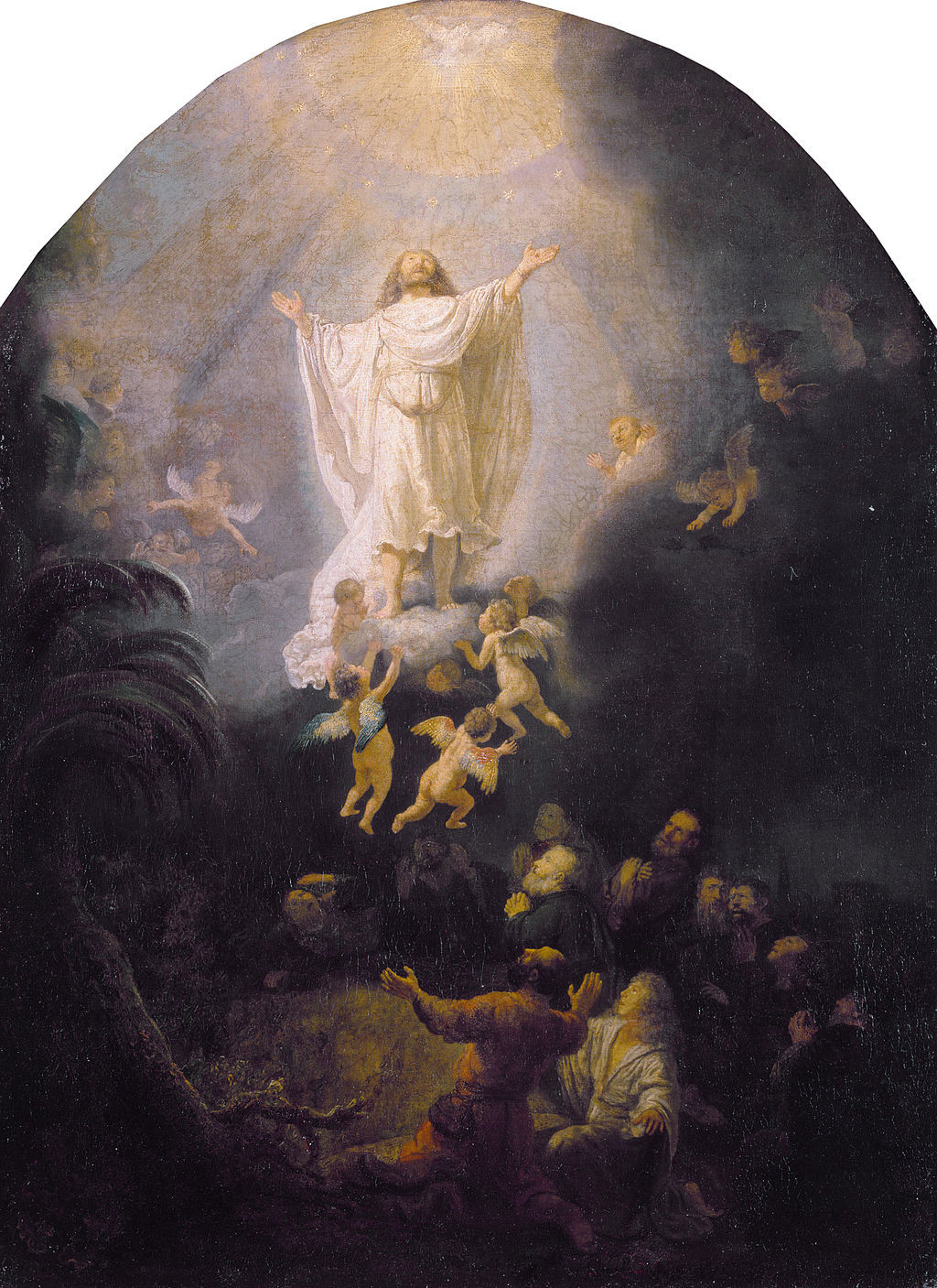
Death vs. Ascension

One of the most fascinating scenes in the New Testament—to my mind, at least—is the ascension of Jesus Christ. As Luke records the event in the book of Acts, he notes that after his resurrection, Jesus appeared to his disciples over a period of forty days and on one occasion:

They gathered around him and asked him, “Lord, are you at this time going to restore the kingdom to Israel?”

He said to them: “It is not for you to know the times or dates the Father has set by his own authority. But you will receive power when the Holy Spirit comes on you; and you will be my witnesses in Jerusalem, and in all Judea and Samaria, and to the ends of the earth.”

After he said this, he was taken up before their very eyes, and a cloud hid him from their sight.

They were looking intently up into the sky as he was going, when suddenly two men dressed in white stood beside them. “Men of Galilee,” they said, “why do you stand here looking into the sky? This same Jesus, who has been taken from you into heaven, will come back in the same way you have seen him go into heaven.” (Acts 1:6-11).

And that was the last they saw of Jesus. It was their final, unceremonious goodbye. And yet, apparently, there was no weeping or wailing. No one cried. No one mourned. In fact, the disciples simply got to work building the church and joyfully proclaiming the Good News.

What a contrast between this and when Jesus died six weeks earlier. And yet, from the standpoint of saying goodbye, at least as far as anyone could tell at the time, the situation was no different. A beloved friend was leaving for good. Why such a different response?

Was it the manner of death? This can’t be the explanation, since it is the loss of our loved ones that we mourn, not their manner of death. This is reflected in the (very reasonable) common expression, “I’m sorry for your loss.” We never say, “I’m sorry your loved one died the way they did.” Yes, an especially painful or violent death may exacerbate the pain of loss. But the essence of sorrow regards the loss of the person, not how they died. And yet, when Jesus ascended, the disciples lost their friend. So why no mourning?

Was it the presence of Jesus’ dead body that made his death so much more painful than his ascension? No, this can’t be it. If your loved one were to die in such a way that their body is out of sight or irretrievable (e.g., sunken in the ocean depths, lost in space, etc.) you would mourn every bit as much as if their lifeless body was present. The presence of a corpse may make some psychological difference (for better or worse), but that’s not the source of our sorrow. Again, it is the loss of the person we mourn.

Or maybe the difference lies in the fact that by the time Jesus ascended, he had proven he was the Messiah, that the disciples’ personal investment in him was not in vain, and that their trust in him was vindicated. Perhaps this is why
the disciples didn’t mourn his ascension. Again, this doesn’t account for the fact that, just as in the case of a physical death, by ascending Jesus was leaving them for good.

Or was he? It seems to me that the key to understanding the different responses is that Jesus’ ascension proved his departure was only temporary. That by his resurrection he proved that he had conquered death and that he could be trusted in his promise that he was going to return and bring about his everlasting kingdom. This meant, again, that the goodbye was not permanent but only temporary.

So the difference has to do with Gospel hope, something that the disciples definitely did not have immediately after Jesus was crucified and buried. In fact, they had lost all hope. But with the fact that the ascension occurred after his resurrection made all the difference. Moreover, his resurrection proved that all death is conquered and that, as Christians, all of our goodbyes are only temporary. And this is why the Apostle Paul would later dare to mock death, saying, “Where, O death, where is your victory? Where, O death, where is your sting?” (1 Cor. 15:55).

Of course, I am not saying that our mourning the death of friends and loved ones is not rational or that we lack faith in doing so. Rather, we mourn with hope. And, as Christians, we understand that our goodbyes really are temporary—that we, too, ascend after death and, like our Lord, we go to await our final reunion with the people of God. That is Gospel hope, and it makes all the difference in the world.

Passing Into History

Recently, I had the sad honor of attending a memorial service for a dear friend’s father who passed away quite unexpectedly. I listened as several people shared their memories of Fred, some funny, some touching, but all laced with the sorrow of his absence. It is a tragic irony of such events that the more beloved and accomplished the person is, the deeper the sense of loss and grief. It struck me that most of us are striving to live life in such a way as to make many people, whom we love, miserable when we are gone. The only thing worse than a funeral for someone for whom everyone is grieving is a funeral for someone for whom no one is mourning.

My friend’s dad was, fortunately, not such a person. There were many tears from the large crowd who gathered to comfort his family and celebrate his life. There was beautiful singing and a truth-filled homily declaring faith in life after death and the hope of resurrection. And then . . .  it was over. We wiped away our tears and hugged one last time. Some of us gathered for a meal and caught up on life. Then we drove home and did chores, walked our dogs and spent time with our families. Of course, the grieving process is not over and for his family and close friends. It never will be, at least this side of heaven. He will be missed at each family event, talked about among those who didn’t have the privilege of knowing him. But as those who had that privilege slip away, so will their memories. So it will be for each of us. One day in the future our lives, however long, will be reduced to an obituary and an afternoon service.

There are, of course, a select few whose lives take on historic relevance, but they are few and far between. Most of us will not be a world leader, a great inventor or the writer of a timeless classic. Even these figures aren’t really remembered as people but more by their accomplishments. Their deeds and works live on in our memories rather than in their personal impact on individual lives.

As I reflected on this truth, I realized that this is actually true for all of us. In the case of my friend’s dad, Fred, his skills will carry on every time his grandson tees up for a round of golf. His smile and kindness will echo through history in the smiles and kindness of each person whom he influenced for good. Each time his daughter stands in front of her class, his love of teaching will continue.

We each have the opportunity to live a historic life, one that ripples through time far after we are gone. Each day presents us with countless opportunities to reach beyond our eventual grave and live on through small acts of kindness or faithful service. There is no telling how you might echo through history, how loudly your life might resonate through time.

Of course, this requires one to think beyond oneself. After all, if I live a life that is primarily focused on myself, then that leaves very little behind after I am gone. While writing this post, the lyrics of the Beatles’ famous Eleanor Rigby kept playing through my mind. The namesake of this famous song which asks “all the lonely people, where do they all come from?” is buried in Liverpool’s St. Peter’s church cemetery. In the song, Eleanor is alone, touching the lives of no one, she is not mourned or missed at the end of her life. According to the gravestone of the real Eleanor, however, she was a beloved granddaughter and wife. One version of Eleanor has been enshrined as a monument to human isolation and loneliness. But the impact of the real Eleanor is quietly rippling through history in who knows how many ways. Let us strive to do the same.

Remembering my Friend, Ben Arbour

Aristotle said there are three kinds of friendships: those based on utility, those based on pleasure, and those based on a shared commitment to the good—wisdom and other moral virtues. Most of our friendships fall into the first two categories. Aristotle tells us that rare are those friendships truly grounded in a mutual pursuit of virtue. So I consider myself blessed to have had several of these friends. Humanly speaking, they are the principal reason I display any virtue or wisdom myself. Such friends are absolute treasures, benefitting us not only here but for all eternity. Because the joy and blessings they bring are so immense, losing them is especially difficult. Last week I lost such a friend—Ben Arbour, as he and his wife, Meg, perished in a car accident near their home in Fort Worth, Texas.

It was nine years ago that Ben introduced himself to me at a meeting of the Evangelical Theological Society. I was instantly struck by his exuberance, wit, and sharp critical mind. “You and I have a lot in common and we need to get to know each other,” he declared. Thus commenced our friendship, which he initially characterized as a mentoring relationship. But the truth is that I learned more from Ben than I ever taught him.

An irrepressible extrovert, Ben had a list of friends whom he would regularly call to discuss whatever was on his mind. And he constantly had a lot on his mind. Sometimes he would hit you with an argument he’d just dreamed up. Sometimes he would have a list of topics to discuss. Other times he would simply have a question. These conversations often pertained to some philosophical point, whether concerning the metaphysics of God and time, the ethics of human sexuality, or a practical implication of Berkeleyan idealism, but just as often his concerns were theological, ecclesial, or pastoral in nature.

I was just one person on Ben’s list of regular interlocutors. His philosophical-theological motor never turned off, seemingly even while he was at work, appropriately enough, as finance manager at Sewell Automotive. And sometimes he would begin these phone conversations by saying, “Jim, I have some great news.” To which I’d reply, “Yeah, what?” Then he would declare, “Jesus has risen from the dead, our sins are forgiven, and we will live forever with him for all eternity. Isn’t that great?” Indeed. And this reminder would suitably frame the discussion, debate, or goofy banter that would follow, just as Ben’s entire life was framed. He was a pure Gospel man.

Ben was also a multitrack thinker, known among his friends and colleagues for playing video games on his iPhone while attending highly technical conference presentations. The first time I witnessed this, I figured Ben was simply fatigued and had tuned out of the presentation. But when the speaker was finished and invited questions from the audience, Ben immediately piped up with the several apposite and incisive comments. This was typical for Ben, as I would eventually discover. It was also Ben’s routine, when especially intrigued or unsatisfied with the presenters’ responses to his questions, to pursue the discussion with the speaker outside of the conference room. And on at least two occasions he followed the presenters into the bathroom while doing so. I am thinking specifically of Robert Audi and Nicholas Wolterstorff, who, I am sure, handled Ben’s indefatigable questioning with grace and good humor.

Another fundamental aspect of Ben’s personality was his love for people, especially fellow Christians. He had a voracious appetite for fellowship, which always included rich conversation, clever wit, and good food. Ben was expert at two of these, and he tried to be a decent chef. I can’t say he always succeeded. But he did try. Thankfully, Meg more than made up for whatever Ben lacked in cooking skills.

Ben was also a sports fan, especially, and rather determinedly, of baseball. He frequently made known his conviction that baseball is the best of all sports (a conviction I share, so the matter occasioned no debate between us). Though seemingly trivial, somehow even this conviction of Ben’s was theological, and this carried through even to his rooting interests. For example, in the most recent World Series Ben pulled intensely for Los Angeles just because he was aware that Dodgers pitcher Clayton Kershaw is a committed Christian.

Ben was a great family man—a dedicated husband and father, and it was a joy to see him interact with his four sweet kids. In my last visit with the Arbours two weeks ago, I was struck by Ben’s tender, Socratic interaction with his youngest son, Noah, about some theological point. Ben’s fatherly care, his readiness to help Meg around the house, and the whole Arbour family dynamic of hospitality were a tangible testament to the man’s humility and genuine servant heart. “Mi casa es su casa,” Ben would say. And he meant it literally. The Arbour house constantly buzzed with guests, all of whom seemed to be special friends. One of Ben’s greatest pleasures was connecting his friends with one another. This was not merely some extrovert compulsion or professional networking but a ministry of catalyzing koinonia. It was a spiritual gift that easily surpassed that of the most socially inclined pastors I have known. Almost unconsciously effected, it was borne out of Ben’s boyish joy in the people of God.

Many a devout Christian talks a good game when it comes to intentionally and compellingly integrating the Gospel of Christ into every aspect of their life. Ben Arbour actually did this—to the delight of many and to the annoyance of some but to the benefit of everyone. Those who were close to Ben know how he was always encouraging, even when offering critical push back. Our final conversation two days before he died provides a good case in point. I had shared with Ben the possibility that I might take a teaching job at a school in Asia, which would require my being away from my family sixteen weeks each year. Rather than bluntly asserting that this was a bad idea, Ben simply said, “I don’t think I could handle being away from my wife that long. But maybe I’m just weak in that way.” This humble way of registering his reservations was particularly impactful. And it vividly illustrates the beauty of Ben Arbour as a third-level Aristotelian friend and faithful Christian brother

At this point I am still in the stage of grief that sometimes lingers in outright disbelief. It seems impossible that Ben is really gone. Eventually it will sink in, and I will grow accustomed to the fact that this world is no longer graced by his presence. In the meantime, I consciously remind myself of what Ben repeatedly reminded me: Jesus Christ has risen from the dead, our sins are forgiven, and we will live forever with him for all eternity. Crushing as it is for those of us who love them, Ben and Meg have together begun the next phase of their everlasting lives with Christ. Even now I can hear Ben’s voice: “Isn’t that great?” Yes, Ben. It surely is.

The Old Grey Mare

Recently, our church held their annual Thanksgiving service and Jim and others in our congregation took a few minutes to share something for which they were thankful. They each did a great job, and as I listened to them I pondered the previous year and thought about gratitude-inspiring experiences, people, and situations I have encountered this year. Of course, there are the usual suspects: health, friends and family. While I certainly don’t mean to discount these blessings, I wanted to find something more specific to this season of life. What I settled on might surprise you.

I discovered that I am truly grateful for getting older. Now, a few decades ago, when birthdays brought new privileges, the ability to drive, to vote, to enjoy adult beverages, advancing in years was much easier to give thanks for. I suppose I still have senior citizens discounts and social security to look forward to, but, in the world’s eyes, there aren’t too many largely recognized perks to being on this side of the hill. And that is why I am so thankful for having been given a different vision through which to see my accumulating grey hairs and wrinkles. While those without hope look at the signs of aging as something to be denied and conquered, I am learning to see them as the scars of battles waged and won, of medals awarded for bravery in the face of the enemy. For those who call this life home, growing older is one step further in a finite journey, while for me and my brothers and sisters in Christ, this life is merely the womb in which we are being shaped and developed, and we are on a journey homeward bound.

This perspective is one I am working to cultivate and grow within myself as I face the indignities of middle age, especially in a culture which worships at the altar of youth. I don’t want to see myself as a clock which is slowly winding down and wearing out. Rather, I want to be a tree that is sending down deep roots, providing shade and shelter for those around her. There is an eternal aspect to trees which grow and produce seeds and eventually die and provide nourishment to the next generation of trees growing around them. They don’t cease to exist but rather take on a new form. The same is true in the life of a believer. My body might be a little slower, my mind not as quick or sharp as it once was, but each day I leave behind a little more of this world and the true me within grows a little bigger, growing to better reflect my true self. “The old grey mare she ain’t what she used to be,” and I say, thank heavens!

This fall, I had the immense honor of sitting with my mother-in-law, holding her hand and reading her the Psalms as she passed from this life to the next. I am infinitely thankful that God arranged circumstances such that I was able to witness this lovely lady going home. As she took her final breath, I felt sorrow at being left behind, but great joy in imagining her arrival in Heaven. She wasn’t leaving but arriving, and one day I will join her. One day, I will die, or in truth one day I will truly be born. And rather than filling me with a sense of dread or fear, this idea is a thrilling one.

Now don’t get me wrong. I am not making plans to go skydiving without a parachute any time soon. Just like a baby in utero, I have some maturing to do before I go head first into the cosmic birth canal. I hope to live to pluck many a chin hair and continue for years doing my best to do my best. But one day this heart will stop beating, these lungs will stop breathing, this brain will stop functioning. And then I will know what it is to truly live. And for this hope and knowledge, I am and will be eternally grateful.

Why Do Churchgoers Live Longer?

Did you know that going to church is linked to living longer?  Check out this Washington Times piece on a study several years ago which found that there is a significant correlation between regular church attendance and good health and, therefore, a longer life.  Director of the study, University of Iowa psychology professor Susan Lutgendorf, commented, “There’s something involved in the act of religious attendance, whether it’s the group interaction, the worldview or just the exercise to get out of the house.  There’s something that seems to be beneficial.”

Another possible explanation is the fact that faithful worshippers are more likely to live temperate lives, particularly as regards eating, drinking, drugs, smoking, and promiscuous sex.  But the researchers said they corrected for such variations in their study.

So how else might one account for this correlation between church attendance and greater longevity?  Here are some factors that come to (my) mind as potentially relevant factors.

1. Regular church-goers are less likely to suffer what I might be called moral stress, that is, the psychological pressures created by shame, grudges, and resentment.   A burdened conscience can cause a lot of psychological havoc and, in turn, one would suspect, health problems.  As for forgiveness, those who experience divine forgiveness are presumably more likely to extend grace to others.  Those who forgive others often report a sense of relief and other emotional benefits.  And it is well documented that forgiveness contributes to the reduction of anxiety and generally better mental and physical health.

2. Perhaps the greater longevity is partly attributable in the fact (if it is a fact) that those who attend church regularly are more likely to be disciplined people overall.  It does, after all, take some discipline to attend church at least once weekly.  And such discipline is a transferable life skill, or virtue, that can increase one’s chances at a longer life.

3. We can’t forget the supernatural dimension here, recalling that God often rewards the obedient with a long life (e.g. 1 Kings 3:14; Eph. 6:2-4).  Obviously, sometimes righteous people die young, and sometimes the wicked live long lives.  However, as this divine blessing works out across a population, perhaps it accounts for the statistical differences found in this study.

I don’t mean to suggest that these explanations are mutually exclusive.  Perhaps, as I suspect, the latter factor pertaining to divine blessing actually supervenes over the various other “natural” factors.  After all, divine providence works through secondary causes.  In any case, these findings provide much food for thought  . . . and yet another reason to make it to church this Sunday.

Death by Easy Craft

Our five-year-old daughter Maggie is, to my great delight, a very independent self-entertainer. She can easily create and populate her own little worlds with all sorts of imaginative characters. (Before you become too envious, the creation of these “little” worlds often involves the dumping out of every drawer and shelf in her room, and cleaning up is not her strong suit.) She is greatly skilled in the arts of blanket fort building, block city building and, most importantly, paper cutting. So when a friend recommended a book chocked full of “easy crafts,” I happily procured the book for her. (It’s a great book made by Kumon—My Book of Easy Crafts available on Amazon for only $6.95 if you are interested.) Now if you don’t have young children, let me interpret “easy craft” for you. “Easy” can be translated as effortless for anyone over the age of twenty-five and therefore entirely too old for making a “craft” which can be translated as a task usually requiring a large amount of tape, glue, and string and which has no purpose other than occupying you, and occasionally your kid, and then will become a serious storage issue. So…in the late afternoon of a recent icy, gray day Maggie and I sat on the schoolroom floor cutting, taping, and stringing. We were creating a school of fish and hooks with which to capture them. I had finished a few fish, and Maggie was happily chatting about her plans. I didn’t know whether to laugh or cry when she sweetly chirped to her new companions, “I’m going to catch some fish and put them in my boat to die so we can eat them.” The contrast between her innocent sing-song tone and the grimness of her words was startling and left me struck by the inevitability of death.

There are, of course, the rather obvious examples of death—the sanitized versions cleaned up and plastic wrapped in our grocery store meat department, the messy (and sometimes stinky) examples on the side of the highway, and the grim reaper waiting at the end of each of our lifetimes. But what struck me was that while we see death as something to be avoided and mourned, it is weaved into every facet of life. For one thing, in many cases, to live something else has to die. We are vegetarians (most of the time) but even we must kill plants in various forms in order to survive. Some of the world’s most admired animals couldn’t live without meat and often that meat looks really cute and cuddly right before it gets gobbled up. Death is even woven into our homes. The house or apartment in which you live was at least partly constructed by wood that came from dead trees. Obviously I wouldn’t put plants in the same category as animals or people but when you see a pattern recurring again and again, you have to consider whether God is speaking. And just what is He trying to say? 

Frankly, I am not really sure. Maybe God is giving us a gentle reminder of the end that is coming for us all. Like little post-it notes carpeting the face of creation reminding us that “This too shall pass.” This could add a rather grim dimension to our enjoyment of the world around us, but it doesn’t have to. Instead of being depressed by these tokens of the macabre, perhaps we should be grateful for God’s reminding us that death is waiting for us all. This knowledge can add an element of sweetness to each moment we experience, knowing that there are only a finite number of them. So the next time one of your house plants dies or you see a graceful gazelle bite the dust under the power of a lion’s jaws on a nature show, just remember that death is stalking you in the tall grass as well. And may it inspire us to savor life and, most of all, to better prepare ourselves for judgment day.

A Series of Deaths

I have a good friend who likes to say that “life is a series of deaths.”  In saying this, he is referring to the fact that our journey on this planet involves many farewells and demands of self-denial—and each of these represents some kind of permanent loss.  As you grow your childhood perishes.  With each graduation during your school years you say goodbye to friends, many of whom you will never seen again.  And the ones with whom you do stay in touch you will never know in that context again.  When you marry, much of your freedom dies, and with the birth of each child you must lay aside worthwhile projects and even some dreams.  And then come the real deaths.  You lose friends to accidents, cancers, and even suicide.  Your parents begin to fail and suddenly you find yourself having to parent them in return, perhaps nursing them into that good night—always half believing its not really happening.  It’s just one death after another.

Sounds pretty bleak, doesn’t it?  Well, it would be if that were the whole story.  And I suppose that if I thought it was, perhaps I’d have gone the way of some of my departed friends by now.  But it’s not the whole story.  Because with each of those deaths has come new life.  God has a way of replacing lost projects and dreams with even greater projects and dreams.  Far beyond the meager imaginings of my youth and even my young adulthood is the joy and satisfaction I’ve found in my wife and children as well as the broader community of which we are a part.  What calling is higher than investing your life in other souls?  Even the pains we feel in this context are, as C.S. Lewis would say, “more precious than all other gains.”

Of course, there are goodbyes ahead for all of these relationships as well.  More deaths to come in a seemingly endless train.  But it’s not really endless.  One day, we are told, all death will cease and God will wipe away every tear.  And, if Scripture is to be trusted, there are good things which emerge from our earthly trials—good things which are endless, such as the virtues we develop in persevering (cf. James 1:2-4; 1 Pet. 1:5-7).  God does not put us through this soul-grind without reason.  He does so to mold us into something wonderful, even the image of Christ.  And if that isn’t worth enduring a series of deaths, then nothing is.

Kitty Heaven and the Challenge of Faith

Recently the kids and I found a stray kitten along the side of the road. When I say kitten, I mean tiny fur-ball-with-tail, fit-in-the-palm-of-your-hand size kitten. While this description may conjure up adorable calendar-worthy pictures in your head, this kitten was—how shall I put it—repulsive. Let’s just say she had eye “issues.” Still, eye infection or no, we couldn’t leave her, so we took her home with us. Since Jim is an animal lover, much more in practice than I am in theory, she settled in to await adoption. (The first order of business was clearing up the eye goo which increased her curb-appeal ten-fold.) We were soon the family to be avoided as the rumor circulated that we were desperately trying to give away a kitten.


Unfortunately, Bootster (admittedly a less than stellar name lovingly bestowed by Sam) didn’t last long enough to know that she was unwanted. One morning a few days after she arrived, Bailey woke us to say that Bootster was dying. Jim and I hurried downstairs to discover the kitten in obvious pain and quickly fading. Jim and Bailey took her to the vet where she was “put to sleep” (a phrase surely created to terrify children into never closing their eyes again). Each of the kids reacted in their own way—Bailey crying, Sam acting as if nothing were the matter, Maggie immediately going to draw a picture for Bootster, and Andrew standing poking at the body and saying “booboo?”


But later in the day things got really interesting. We were holding graveside services for our little furry friend when I suddenly realized that Maggie and Andrew (four and two respectively) had no idea what we were doing. As far as they knew, we were getting ready to bury Bootster alive. I had sudden visions of them trying this out on one another and gently tried to guide them away before Jim threw on the first pile of dirt. Alas, I was too late and Andrew threw his hands up in outrage as he watched Daddy “being mean” to kitty. I tried to explain but as the words were coming from my mouth I realized the absurdity of what I was trying to convince him of. Had it been one of my own would I have so glibly said “Child X (I can’t even bring myself to insert one of their names) is in a better place? He/she is with Jesus and waiting for us in heaven.” Heck no! I would have been right there along side Andrew, throwing my hands up in protest to heaven and begging for him/her to be spared.


As Maggie began to chime in, probing about the process by which we enter paradise, I realized how hypocritical we are with our kids when we try to whitewash death. Or maybe I am not so much a hypocrite but rather one who is greatly lacking in faith. It’s easy to believe that kitty is better off. After all she was a bit smelly and, frankly, a pain in the rear to take care of. But would I be willing to put my money where my mouth is when it comes to those I love, who are a bit smelly as well and often a pain in the rear but who are also the center of my small world? I pondered these things while I watched the kids play at Taylor Lake that afternoon, marveling at how quickly they seemed to recover. I sit here now, calling up each of their dear faces, half paralyzed in fear at the thought of them being taken from me. My conclusion? God knows how small I am and how very limited is my thinking. He doesn’t ask me to understand His ways, only to take His hand as I walk away from the graveside of my expectations, hopes, and dreams and trust that Daddy isn’t really being mean after all.