A Buster Keaton Starter Kit

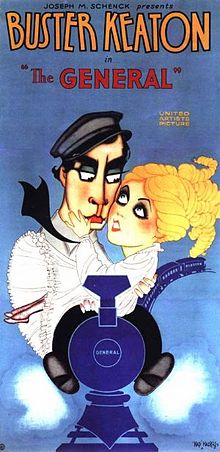
I’m a huge Buster Keaton fan.  He’s one of the three “B” cultural loves of my life, the others being baseball and the Beatles.  I consider Keaton to be the greatest talent in film history (since he was a superb director, producer, cinematographer, screenwriter, actor, set engineer, and stuntman—no other Hollywood auteurs were great in so many critical categories).  Keaton makes you 220px-Busterkeaton_editlaugh and makes you think.  Without the benefit of special effects, he will make you scratch your head in wonder, perhaps even saying out loud, “Wow, how did he do that?”  But his films can be poignant as well.  Keaton’s 1926 masterpiece The General—widely considered one of the greatest films of all time—does all of these things.  Somehow it manages to be an engaging narrative, rollicking adventure, hysterical comedy, and emotionally compelling.

Keaton’s deep influence on entertainers from Lucille Ball, Dick Van Dyke, Jerry Lewis, and Red Skelton to Richard Lewis and Jackie Chan is a testament to the power of his art.  Actor Jim Carrey, also a huge fan, has said about Keaton, “What a creative genius—what an inventor…  A guy like that, you just sit back and say, okay, I’ll never get there.”  So if you’re into film history at all, that should be motivation enough to look into his work.  And if you’re not into film history but just like to be entertained, then Keaton’s comic ingenuity will more than do the trick.

I recommend starting with a few early Keaton shorts:

  • Neighbors — That’s Keaton’s real dad playing his father.  Keaton’s parents were Vaudevillians, and they got him into the act at age three.  When Keaton turned to film in his 20s, his dad was skeptical.  But as the film industry took off, he was persuaded.
  • Cops — An early Keaton classic depicting how small turns of events can mount into cataclysmic disasters.
  • The Boat — The boat in the film is named “Damfino,” which is where the International Buster Keaton Society gets its name.
  • Electric House — Even a century later this little film remains a powerful commentary on modern technology.

And here are some features:

  • Our Hospitality — Check out the famous waterfall scene at the end—you’ll replay this several times, I’m sure.220px-The_General_poster
  • Sherlock Junior — The “special effects” in this one were revolutionary.
  • The General — Here is the AFI’s top 100 films list with The General listed at #18.
  • Steamboat Bill Jr. — Note the famous, life-risking falling façade scene at the 59.00 minute mark.  How many Hollywood stars literally risk their lives for the sake of their art these days?  Not that I’m recommending this, of course.
The shorts are only 10-20 minutes each, which is not a serious time commitment.  And the features are, by today’s standards, also pretty short—usually 60-70 minutes.  So it’s not too time-consuming to dig deeply into the Keaton catalogue.  I should add that all my kids love Keaton films.  So that’s something to keep in mind as well—it makes for good family entertainment and a great way to build your kids’ understanding of film and its history.

Further Reading:

  • Also, some of the Wikiquotes on Keaton are interesting.

My Summer Reading

This summer I spent most of my free time doing home improvement projects and spending time with the family, but I did manage to read a few books.  Here is a quick review of the ones I read.

My Descent into Death: A Second Chance at Life by Howard Storm (Doubleday) — I have an abiding interest in the pervasive phenomenon of near death experiences (NDEs), both from a scholarly standpoint and, perhaps because my own eventual death appears to be inevitable, from a personal standpoint.  Storm’s story is especially interesting because his experience occurred while he was a firmly convinced atheist.  (Today Storm pastors a church in Ohio.)  This book poignantly recounts his NDE, including a detailed conversation with Jesus and some angelic beings.  Fascinating and inspiring stuff.

Consciousness Beyond Life: The Science of the Near Death Experience by Pim van Lommel (HarperOne) —  Where Storm’s NDE account is deeply personal, this study by the renowned Dutch cardiologist is a dispassionate assessment of the evidence for the validity of NDEs.  Building upon the research of previous NDE scholars (e.g., Kenneth Ring, P.M.H. Atwater, Melvin Morse, etc.), Van Lommel shares data gathered from his own research and considers it all in light of the latest insights in brain physiology.  Along the way, Van Lommel repudiates all of the naturalistic accounts of NDEs, such as appeals to the effects of medication, hallucination, or oxygen deprivation.  Those looking for a thorough and rigorous scientific assessment NDEs should start here.

Keaton by Rudi Blesh (Macmillan) — I am very selective when it comes to the biographies I read.  The subjects must be either great artists or paragons of virtue (interestingly, these tend to be mutually exclusive categories), and the authors must be strong stylists or superb scholars (or both).  This first bio of Buster Keaton met these criteria and was a delight to read.  My respect for Keaton the artist grew immensely, as did my pathos for Keaton the man.  (See my August 8, 2010 post for a more extensive discussion of the “Great Stone Face.”)

The Loser Letters: A Comic Tale of Life, Death, and Atheism by Mary Eberstadt (Ignatius) — If you thought that the new atheism was a hopelessly humorless topic, its time to think again.  This cheeky satire is absolutely hysterical.  Eberstadt manages to poke fun at the new atheists while revealing many of the serious problems with their perspective, not to mention some disturbing demographics (e.g., that atheists are far more likely to be men than women—so if atheism is about intellectual enlightenment, what does this imply about women?  Hmm….sexism anyone?).  For someone who is primarily a cultural commentator, Eberstadt displays tremendous insight into religious psychology and philosophy of religion.

Do Hard Things: A Teenage Rebellion Against Low Expectations by Alex and Brett Harris (Multnomah) — American culture is indulgent in many ways, and one of the most damaging forms this takes is the way we coddle our teenagers.  We don’t expect them to be morally serious and do significant work, so we don’t challenge them to do so.  Then when they confirm our low expectations we conclude that they’re not capable of anything more.  Alex and Brett Harris have had enough, and this rousing manifesto has brought throngs of young people, and their parents, to attention.  Way to go, guys.

Why is God Ignoring Me? by Gary Habermas (Tyndale) — Most people of faith have experienced the “dark night of the soul” when it seems that God is absent when we need him most.  In this book, Gary Habermas expounds on the critical resources that believers have to persevere through such times.  The author’s own personal trials inform this study, which is refreshingly realistic about suffering and the biblical perspective on the subject.  I also appreciate Habermas’s emphasis on the spiritual disciplines and other proactive ways of dealing with the problem of divine hiddenness.

The Complete Stories by Flannery O’Connor (Farrar, Straus, and Giroux ) — O’Connor’s fiction is often characterized as dark and grotesque, full of freaks and the bizarre.  Yet when I read her stories I find them to be both hopeful and, in a strange way, realistic (a response which prompts me, at turns, to question her readers’ interpretive sense and my own state of mental health).  In any case, O’Connor’s genius for providing insights into human nature and grace, among other things, is profound.  Her stories are consistently set in the “Christ-haunted South,” but the themes are universal.  And to my mind she succeeds where few other twentieth century fiction writers do—at inspiring virtue and a deeper devotion to the Golden Rule.

Buster Keaton: Film’s Greatest Genius

I’m a long-time fan of Buster Keaton—the “great stone face” of the silent movie era, who churned out classic after classic film throughout the 1920s.  Because of his multifaceted brilliance as a screenwriter, director, actor, comedian, engineer, and even acrobat, I consider him to be not only the greatest talent of his time (yes, even exceeding Charlie Chaplain) but the greatest overall talent in film history.  Think that’s an overstatement?  Check out some of his films, and I expect you’ll become a fan and, if you see enough of them, perhaps even agree with my assessment.

As I have been building my personal collection of Keaton films, I’ve become increasingly interested in Keaton the man.  So this summer I read a Keaton biography:  Keaton (Macmillan, 1966) by Rudi Blesh.  This was the first Keaton bio, written by a man who knew Keaton personally and closely consulted him while writing the book.  Unlike most celebrity bios of our time, which tend to be gossipy and voyeuristic, Blesh’s account focuses on Keaton as an artist.  Another refreshing contrast is Blesh’s prose, full of human insight and sometimes deliciously poetic.  Here’s a representative excerpt describing Keaton’s unique moment in Hollywood history:

“It was a time of unabashed hero (and heroine) worship.  Babe Ruth, in fact—and even Lindbergh—got only the edges of it.  The full treatment went to the movies and to movie stars, the actors and—most particularly—the actresses.  Not merely distance but silence compounded by magic.  Hollywood was Valhalla or an Olympus, a silver-screen abode with goddesses living apart behind a wall of silence.  Their beautiful bodies were ethereal yet real, their lips framed soundless words on a wavelength we could not hear, their gestures stirred a different air, their noble remoteness called us to worship” (p. 104).

The irony is that Keaton had no interest in worship, nor even celebrity and its trappings.  In the end, he was interested in just one thing:  his art.  And his output demonstrates this.  Keaton’s film work included 34 shorts from 1917 to 1923 and 15 full-length features from 1923 to 1929.  This was the golden age of Keaton, during which he produced such classics as Our Hospitality (1923), Sherlock Jr. (1924), The Navigator (1924), and The General (1927), the latter commonly regarded as one of the finest films ever made.  Keaton rightly became an international phenomenon, and he was destined to be a lasting influence in film history, on comedic stars from Jerry Lewis to Jim Carrey.

Blesh puts it as follows:  “His technical and artistic innovations have enriched the cinema.  His native genius for physical action no one else, not even Fairbanks, has ever approached.  His pantomime places him with Chaplin alone.  The depth, irony, and mordant vision of his comedy are all but unique.  It bids fair to be timeless.  Even Chaplin had a dozen imitators, but Keaton’s characterization was so wholly his own that no one ever tried to copy it.  His was the only unsmiling mask.  The term ‘genius’ fits Buster Keaton as it fits Charles Chaplin, with no seams to take in” (p. 363).

To see a Keaton film is to immediately understand why the man had no imitators.  In short, it was too dangerous to imitate him.  Keaton routinely took physical risks in his films, even endangering his life on a few occasions, such as in the famous scene in Steamboat Bill, Jr. (1928) in which the two-ton façade of a building falls upon him, or rather around him, as Keaton is narrowly missed, thanks to the second story window through which he emerges in the rubble, amazingly unscathed.  Like so many scenes in Keaton films, it is breathtaking.  And, as I like to remind my kids—and now they remind me—it was all done without CGI, using only the most rudimentary special effects.

Even if you are not a film buff, you owe it to yourself to check out Keaton’s movies.  If you are a film buff and take a serious interest in film history, well, then its mandatory.  Be warned.  Keaton films are addictive, and you might find yourself, as I have, sparing no expense to build your collection (and I am not one to purchase DVDs).  But be assured—great viewing pleasure awaits you, and your thoughts about the art of film and its history will be permanently changed.