
This semester I have the honor of working as a Templeton Fellow at the Biola University Center for Christian Thought. Each year the CCT focuses on a different topic, and the theme this year is intellectual virtue and civil discourse. My research topic, which fits naturally within this theme, is one that I’ve been working on the last few years—open-mindedness. What does it mean to be open-minded? Why is it a virtue? When is it not virtuous to be open-minded? And is it possible to be simultaneously open-minded and religiously devout? For some of my thoughts about these questions, look here.
In the course of my research, I’ve read some really good stuff on intellectual virtue. So I thought I’d provide a brief introduction to, at least in my assessment, three of the best books on the topic.
 Linda Zagzebski, Virtues of the Mind (Cambridge, 1996) — This book is considered by many to be a contemporary classic in the field of virtue epistemology, and for good reason. Zagzebski not only develops a plausible theory of intellectual virtue, but also offers rich discussions of related and sub-issues along the way, including practical wisdom, understanding, and a critical assessment of Alvin Plantinga’s epistemology. She conceives knowledge as “cognitive contact with reality arising out of acts of intellectual virtue.” Although her account overreaches at times, it is nonetheless insightful at nearly every turn. And, as is the case with all landmark works of philosophy, even her mistakes are instructive.
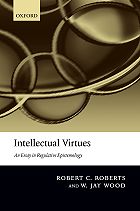 Robert Roberts and Jay Wood, Intellectual Virtues (Oxford, 2007) — Rather than defending a particular theory of virtue epistemology, Roberts and Wood offer what they call a “regulative epistemology” which aims instead to “generate guidance for epistemic practice.” For those who are more interested in the practical implications and applications of virtue epistemology, this is a book to check out, which is chock full of insights about the moral life. After clarifying a number of key concepts, including just what a virtue is, they explore the meaning and practical dimensions of a number of particular intellectual virtues, including intellectual courage, intellectual humility, intellectual autonomy, intellectual generosity, and practical wisdom.
 Jason Baehr, The Inquiring Mind (Oxford, 2011) — In a work that is a bit more theoretical and advanced than the previous two works, Baehr (who is also a CCT fellow this semester) develops and defends what he calls a “personal worth” conception of intellectual virtue. Along the way he argues for the relevance of considerations of intellectual virtue, whatever one’s view, whether one holds to a reliabilist or evidentialist epistemological theory. After making his cases for these theoretical points, he explores in-depth two important intellectual virtues: intellectual courage and open-mindedness. Baehr’s discussion of the latter of these is especially interesting to me, of course.
These are rigorous, enriching texts which provide theoretical and practical insights—improving our understanding regarding both the nature of knowledge and how we ought to live. In word, they make us wiser. Philosophy doesn’t get any richer than this.
