A Christmas Day Reflection

On this Christmas day I have been reflecting on our unity in Christ, which seems increasingly threatened by divisions within the American Church, especially due to disagreements over political issues. This prompted me to think about the following possibility. Suppose, upon our arrival in the Next World, we ask Jesus, “Who was right regarding those early 21st century American political issues which divided us so much, even those of us who followed you, Lord? Was it the conservatives or the progressives?” What if Jesus replies, “Both sides were right and wrong about many things” and then he proceeds to itemize the insights and errors on both sides, to which we respond by saying, “Wow, it’s all so clear now. Why didn’t we see this during those days when we were so caught up in all of those political squabbles?” Then what if He says, “because it was not my will that you would see these things clearly but rather to test you and mature you through such disagreements. Those issues, vital and important as they were, served primarily as means of interpersonal engagement, to catalyze the forging of your souls, to build virtues of patience, generosity, perseverance, humility, and grace. In short, your political debates functioned as props on the stage of human life, the main focus of which was always about making you all more like me, though even you, my precious children, at times lost sight of this. But don’t worry about it, guys. For all is well now. And all manner of things is well.”

What if that is how it will go down in the Next World? And suppose we somehow could know now that this was God’s main purpose regarding all of the political strife which currently grips our nation. How might this change the way we approached all of these divisive issues?
New Publication: “Open-mindedness and Disagreement”

Recently, an article of mine entitled “Open-mindedness and Disagreement” was published in the journal Metaphilosophy. You can access the article here. In the article I consider the relevance of open-mindedness to the problem of peer disagreement. Here is the article abstract:

The current debate about disagreement has as rivals those who take the steadfast view and those who affirm conciliationism. Those on the steadfast side maintain that resolute commitment to a belief is reasonable despite peer disagreement. Conciliationists say that peer disagreement necessarily undermines warrant for one’s belief. This article discusses the relevance of open‐mindedness to the matter of peer disagreement. It shows how both the steadfast and the conciliatory perspective are consistent with a robust and substantive display of open‐mindedness. However, it also turns out that there are more ways to display open‐mindedness on the steadfast view than on the conciliatory view.

In the article I distinguish between two basic accounts of open-mindedness. On the “indifference account,” defended by Peter Gardner, to be open-minded about an issue is to lack any firm commitment about it. Whereas, on the “contest” model, defended by William Hare, to be open-minded is to be willing to have one’s views challenged and thus be critically receptive to alternative perspectives. I see these accounts as constituting distinct but compatible forms of open-mindedness. So, then, when it comes to the two views on peer disagreement—the steadfast view and conciliationism—what role might either form of open-mindedness play in the epistemic lives of persons of each persuasion?

This is one of those articles where, in the course of writing it, I was surprised to see where my reasoning led me. Prior to deeply exploring this issue, I would have thought that the virtue of open-mindedness plays a more significant role in the epistemic life of the conciliationist, but in one sense the opposite turns out to be the case. Although we might naturally think of conciliationists as tending to be more open-minded than steadfastians, there are nonetheless more ways to display this trait on the steadfast view than on the conciliatory view. For in the face of peer disagreement, the conciliationist may only display indifference open-mindedness, but the steadfastian may display either indifference or contest open-mindedness.

The 2015 Annual CCT Conference

Last week I attended the conference of the Biola Center for Christian Thought, which is the annual capstone event at the CCT.  This year’s research theme was “Intellectual Virtue and Civil Discourse,” and the conference featured a number of noteworthy scholars who have done significant work in areas related to the theme.  Among them were Robert Audi (University of Notre Dame),

Robert Audi and Storm Bailey

Jason Baehr (Loyola Marymount University), Elaine Howard Ecklund (Rice University), George Marsden (University of Notre Dame, retired), Robert Roberts (Baylor University), Richard Mouw (Fuller Theological Seminary, retired), and Martin Marty (University of Chicago, retired).  In addition to the presentations by these plenary speakers, there were many other excellent presentations at breakout sessions.

Thanks to the John Templeton Foundation, I was honored to be a CCT research fellow during the Fall semester this past academic year.  My research project regards the virtue of open-mindedness, and I was able to make significant progress on what I hope will culminate in a monograph on the subject.  My presentation at the CCT conference, entitled “Open-

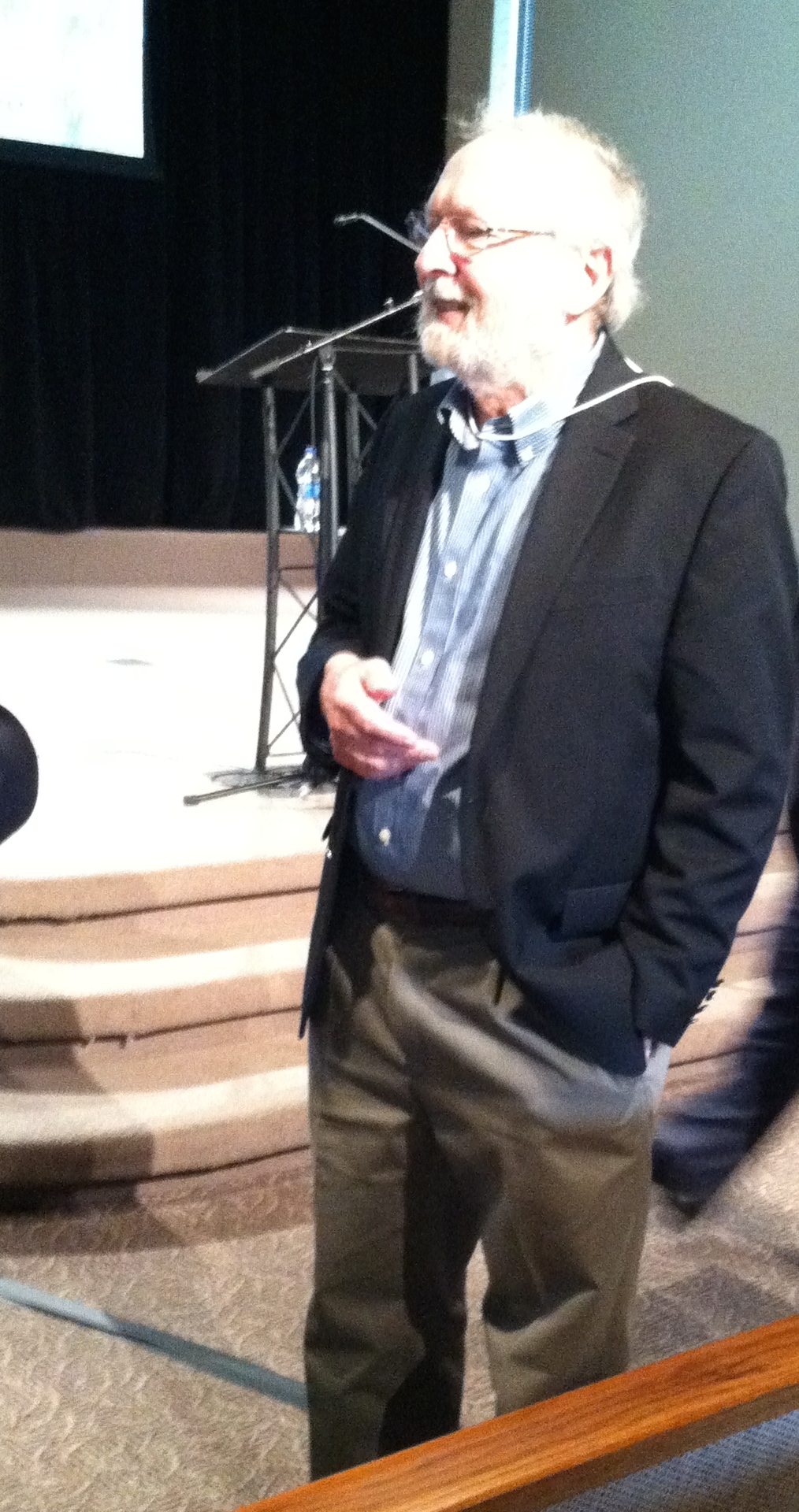
George Marsden
George Marsden

mindedness and Disagreement,” explored the connection between two topics that are germane to this year’s theme.  With regard to the issue of disagreement, the question is whether, or to what extent, confidence in your belief about an issue should be tempered by the fact that some epistemic peers disagree with you.  And, depending upon your view regarding the epistemic implications of peer disagreement, what does it mean to remain open-minded about the issue?  My session was well-attended, and I received helpful feedback, which I am looking forward to implementing in my paper as I revise it and eventually submit it for publication.

The most enjoyable thing about the conference was catching up with some of the scholars I’ve gotten to know through the CCT and other contexts, as well as becoming acquainted with a number of other scholars whom I’d never met before.  Some of these I had only admired from afar, such as the eminent

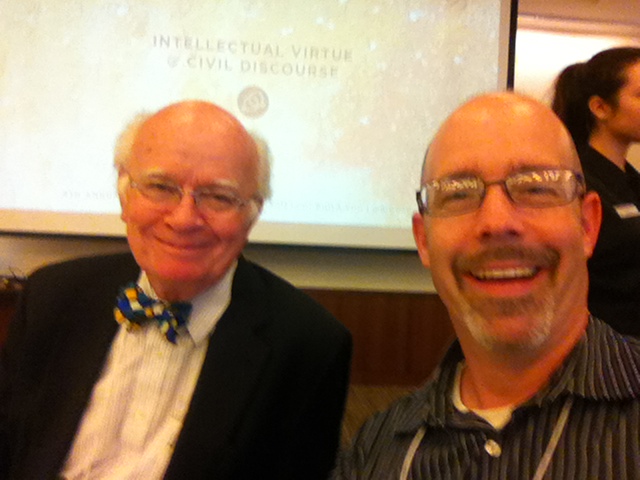
Martin Marty and me
Martin Marty and me

epistemologist Robert Audi and religious scholar Martin Marty, who might be the greatest living scholar in the English speaking world—author of more than 80 books, winner of numerous scholarly awards, member of two U.S. Presidential Commissions, and holder of 80 (yes, eighty) honorary doctorates.  Somehow I ended up sitting next to Marty at the evening banquet at the CCT conference, and I was struck by the warm humor and genuine humility of the man.  What an inspiration.

In fact, the word “inspiring” well captures my entire experience at the Biola Center for Christian Thought this year.  The CCT directors—Thomas Crisp, Steve Porter, and Gregg Ten Elshof—as well as staff members Evan Rosa and Laura Pelser, are all wonderful folks who know how to create a dynamic community atmosphere for rich scholarly research and dialogue.  The Center is currently accepting proposals for the 2016-17 research theme: “Humility: Moral, Religious, and Intellectual.”  If you do work related to this topic and would like an opportunity to dig a lot deeper, then consider submitting a proposal.  I guarantee that the experience would be a highlight of your academic career!