
Moral Lessons from The Godfather Films

Last week I watched the first two Godfather films with one of my sons, and I was struck again at the brilliance of these movies, both as works of cinematic art and for their insightful themes about human nature, especially regarding moral psychology. So here I am going to highlight three of the more significant “lessons” from the Godfather I and II. I will assume that you have already seen both of these films. (If you haven’t done so, then in the name of aesthetic excellence, please do so as soon as possible!)

The first lesson is this: human beings are capable of rationalizing even the worst forms of wickedness. In the Godfather films, Vito, Michael and other members of the Corleone mafia family consistently refer to their illegal activities, including their most gruesome hits on various enemies, as “business.” This handy euphemism enables godfatherthem to see all of their murders as somehow legitimate. As bizarre and alien as this might seem to us as viewers, it is important to remember that this only differs in degree, not kind, from rationalizations of which we are all guilty. We may not glibly refer to murder as “business,” but we might reconceive our arrogance as “self-confidence,” minimize our inconsiderateness as “competitiveness,” or dismiss our temper tantrums as “venting stress.”
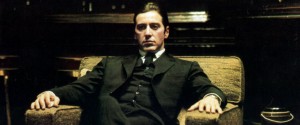
Another important reminder from the Godfather films is that even the best of us is vulnerable to corruption, given the right circumstances. At the start of the film, Vito’s son Michael is the only innocent adult male in the Corleone family. A recent war veteran, Michael is an honorable young man—brave, respectful, self-controlled, and principled. With such virtue, how could he ever be corrupted? Well, when your father is gunned down and you see your family suffering severely as a result, this can tempt anyone to revenge. And, of course, Michael succumbs in dramatic and protracted fashion. Perhaps the only reason you and I have not followed the path of Michael Corleone is—thank God—we’ve never been put in those same circumstances.

Thirdly, some of the most powerful temptations to evil are those which invite us to achieve good consequences. It was Michael’s love for his family and his sense of justice that prompted his outrage at the assassination attempt on his father. And it was this outrage which was the doorway to his corruption. Thus, while the usual temptations to power and wealth were insufficient to turn Michael to the dark side, a reasonable desire to see a wrong made right was sufficient. This serves as a powerful reminder that we are never so virtuous as to be out of the reach of evil, for even our strongest virtues can be leverage points for the most severe moral failures.

The story in the Godfather serves as a cautionary tale about the universal human potential for extreme wickedness. In many ways, the films realistically highlight a significant, if painfully dark, aspect of human nature and the need to guard ourselves in light of this. It is a theme succinctly expressed by the Lord himself in his famous remark to Cain—a man who, like Michael Corleone, faced temptation to murder and who likewise succumbed: “Sin is crouching at your door; it desires to have you. But you must rule over it” (Genesis 4:7). Amen and Amen.

Planned Parenthood and the Banality of Evil

Another video exposing Planned Parenthood’s practice of selling fetal tissue was released today.  You can view it here.  The video features a taped conversation with Mary Gatter, President of the Planned Parenthood Medical Director’s Council, recorded incognito by people with the Center for Medical Progress.  (In case you missed last week’s video, featuring Deborah Nucatola, Planned Parenthood’s Senior Director of Medical Services, you can check it out here).

I was as floored by this new video as I was by the one last week.  Both are excellent examples of what Hannah Arendt (in her study of Adolf Eichmann and the Nazi death camps) called the “banality of evil.”  This is the idea that many horribly wicked acts are performed not with malicious or sadistic intent so much as a blithe adherence to routine procedure within an institutional structure or political system which enables or perhaps even arranges for such evil.  Edward Herman sums it up this way:  “Arendt’s thesis was that people who carry out unspeakable crimes, like Eichmann, a top administrator in the machinery of the Nazi death camps, may not be crazy fanatics at all, but rather ordinary individuals who simply accept the premises of their state and participate in any ongoing enterprise with the energy of good bureaucrats.”

That seems like an apt description of Nucatola, Gatter, and presumably other operatives for Planned Parenthood—an organization that we all help to fund with our tax dollars.

John Hick and Human Progress

An interesting philosophical question concerns whether human beings are making progress.  Great thinkers have fallen on either side of the issue, as you can see here.

Some who take the negative view on this issue use lack of human moral progress as an objection to theism.  After all, wouldn’t God want human beings to improve?  And, being omnipotent, wouldn’t he find a way to ensure that happened?  Thus, the notion that God exists seems to be undermined by the fact that human beings are not making any moral progress.

I happen to agree with the no-moral-progress thesis.  I believe that human beings in the early 21st century are no better, and no worse, than we were a century ago, just prior to the first of two hideous world wars.  And we are no better or worse than we were during the Renaissance, the Dark Ages, or the Iron Age.   From a moral standpoint, human nature has remained constant—since the Fall, anyway—notwithstanding salient eruptions of evil (e.g., the Mongol conquests, the Nazis, etc.) and bursts of goodness (e.g., the birth of the university, the abolition of Western slavery, etc.).

But granting the no-progress thesis regarding the human race generally, it doesn’t follow that there is no significant human moral progress at all.  Just because the human race doesn’t improve as a whole, this doesn’t mean there is no individual progress.  On the contrary, I think such progress is the norm throughout the world.  And it is here that we see the moral work of God on a global scale.

In his classic book Evil and the God of Love, philosopher of religion John Hick insightfully addressed this issue:

Because this is a pilgrimage with in the life of each individual, rather than a racial evolution, the progressive fulfillment of God’s purpose does not entail any corresponding progressive improvement in the moral state of the world. . . .  It is probable that human life was lived on much the same moral plane two thousand years ago or four thousand years ago as it is today.  But nevertheless during this period uncounted millions of souls have been through the experience of earthly life, and God’s purpose has gradually moved towards its fulfillment within each one of them, rather than within a human aggregate composed of different units in different generations. (Evil and the God of Love [Harper & Row, 1966], p. 292)

Hick was a religious pluralist and a universalist, but one need not affirm either pluralism or universalism to see the sense in his proposal here—that God works redemptively in the individual lives of people—perhaps the overarching majority of people worldwide—and this is consistent with the disappointing fact that the human race shows no signs of moral progress.  In fact, Hick even suggests that the lack of aggregate human improvement makes for a better environment for individual moral growth.  After all, as free agents, we all must choose to pursue the good and live faithfully before God, all the while resisting temptation, dealing with strife and disappointment, recuperating from failure, and persevering through suffering in order to do so.  In short, the struggle against evil is precisely how we grow in this world.  This is Hick’s so-called “soul-making” theodicy—an approach to the problem of evil that I find particularly compelling philosophically.  Moreover, it enjoys some biblical support as well, as is evident in such passages as James 1:2-4, Rom. 5:3-4, and 1 Pet. 1:6-7.  While I don’t regard this theodicy as a final and complete solution to the problem of evil, I do think it is an essential part of a Christian response to the problem.

There is also a moral-psychological (or, one might say, existential) benefit in this way of thinking about the human condition.  For if God is ever at work in people, accomplishing his work of redemption in the lives of individuals, then I need not despair over the “current state of the world” or lose hope when considering what appears to be a general moral decline of our society.  Nor should those of us who work to improve human institutions and social structures despair if we see no net improvements.  For God is still at work in the lives of those we meet.  He always has been and he always will be.

Pain, Autonomy, and God

An article of mine entitled “Free Will and Soul Making” was recently published in Philosophia Christi.  My thesis is that the free will defense and soul-making theodicy are complementary, mutually dependent approaches to the problem of evil.  Below is a little dialogue featuring imaginary characters (as realistic as the names might seem) which explores the whole idea of embracing both approaches rather than opting for just one or the other.

PILGESE:  Hello there, Gelespi, how are you today?

GELESPI:  Doing fine, Pilgese.  And you?

PILGESE:  Fine as well, though I’ve been saddened by the news of a recent tragedy, and it has me thinking about theodicy.

GELESPI:  In what respect?

PILGESE:  The greater-good theodicy in particular.  I’m bothered by how some people talk of God intending painful circumstances to bring about greater goods.

GELESPI:  Hmm…  And just why does this bother you?

PILGESE:  I think there is something fundamentally mistaken in thinking that God intentionally causes any pain.

GELESPI:  And why is it wrong for God to cause pain?

PILGESE:  That’s not intuitively obvious to you?

GELESPI:  Not at all.  What makes it so obvious to you?

PILGESE:  Well, because pain is evil.

GELESPI:  Why is pain evil?  It is unpleasant, yes.  But unpleasantness does not imply evil.

PILGESE:  Pain is a lack of goodness, a departure from the way things should be.  And this is the essence of evil.

GELESPI:  But that can’t be right, since this implies that every time I lift weights or fast, then I’m doing evil.  Surely it’s not evil to lift weights or fast?

PILGESE:  That’s different, because you’re imposing that pain on yourself, as opposed to someone else causing your pain.

GELESPI:  And how is that relevant?

PILGESE:  Because self-inflicted pain is an autonomous choice.

GELESPI:  So you mean to say that it’s wrong for God to cause our pain because we’re not autonomously choosing it, even if that pain makes us better?

PILGESE:  Exactly.

GELESPI:  And why is it okay for me to autonomously choose to cause myself pain for my betterment but not for God to autonomously choose to do so?

PILGESE:  Because only you can autonomously choose for yourself.  That’s the nature of autonomy.  It’s the right of self-determination, as opposed to determination of others.

GELESPI:  But where does such a right come from?  Doesn’t this assume something like self-ownership?

PILGESE:  Of course.

GELESPI:  But, biblically speaking, we are not our own.  God made us, thought us into being, as it were, out of nothing.  Thus, God owns us in a way that we do not even own ourselves.  As the Apostle Paul himself says, “you are not your own” (1 Cor. 6:19), and the psalmist says, “the earth is the Lord’s and everything in it, the world and all who live in it” (Ps. 24:1).

PILGESE:  Yes, I grant that God owns us in that general sense.  But when he made us as libertarian free creatures, he endowed us with self-ownership and, thus, moral autonomy.

GELESPI:  And how do you know that?

PILGESE:  Well, that is just what it means to be free in a libertarian sense.

GELESPI:  You are confusing two issues here:  the definition of freedom and what might be called moral propriety rights.  Let’s grant the libertarian definition of freedom as the power of contrary choice, which includes a denial of universal theological determinism.  It doesn’t follow from this that God has no right to inflict pain on his creatures, so long as his intentions are always to do good, such as to build character and bring those creatures into better relationship with God.

PILGESE:  But there are many instances of suffering that do not bring about such greater goods.  This implies that God is horribly inefficient and gratuitous with the pain he inflicts.

GELESPI:  First of all, you are assuming you know what God-inflicted suffering does or does not result in greater good.  For all you know, the apparently gratuitous suffering does contribute to greater goods, if only in the next world.  Secondly, to assert that God can or does inflict some suffering does not commit one to saying that God is responsible for all of the suffering in the world.  Remember, we’re granting a libertarian view of freedom here, and this allows us to explain at least some of the worst evils, and perhaps the origin of evil, as being the result of the abuse of creaturely freedom.

PILGESE:  Hmm…  So you seem to be using two different approaches to the problem of evil: the free will defense and the greater-good theodicy.  Can you do that?

GELESPI:  Why not?

PILGESE:  Well, most theists use one or the other, not both.

GELESPI:  Why go with the crowd, Pilgese?  If both approaches are useful to address different aspects of the issue, then it seems foolish to ignore one of them.

PILGESE:  Good point, Gelespi.  I’ll have to give this some thought.

GELESPI:  Thanks.  Glad to be of service.

My Time at the ETS Conference

Its been a good couple of days at the annual Evangelical Theological Society conference here in Providence, Rhode Island.  This morning I presented my paper on the problem of evil—specifically, comparing the free will and soul-making theodicies—and it was received well by the 50-60 folks in attendance, several of whom asked some interesting and helpful questions about my thesis, which is that the two theodicies are properly seen as complimentary (because logically interdependent) approaches to the problem.  I have posted my paper on a separate page on this blog, which you will find on the right side bar.  I’d welcome any comments, pro or con, as I’ll be submitting it for publication soon.

In addition to attending many informative and stimulating (as well as a few ponderous and soporific) paper presentations on assorted issues, from apologetics to gender issues to the hiddenness of God, I’ve been perusing endless book exhibits, chatting on subjects profound and frivolous, getting lost in the labyrinthine convention center halls, and eating far too much food—including fresh, melt-in-your-mouth Atlantic salmon on two occasions.  (Amy’s going to be sick with envy when she reads this.  Sorry, honey!)  Yes, our brand of vegetarian diet—“ovo-pecto-lacto vegetarianism,” to be tiresomely precise—does allow for fish (that’s the “pecto” part).  It also allows for chocolate mousse, by the way.  And I’m paying for it now with some late-night indigestion (belch).  Oh, but it felt so good going down…

Goodnight.