The Destiny of Everyone

British author and statesman Horace Walpole reputedly said that life is a comedy to those who think and a tragedy to those who feel. I have personally concluded that life is a tragicomedy—both at the individual level and human history is a whole.

“Under the sun,” as Qoheleth, the writer of Ecclesiastes, would say, you really can’t win. If you are fortunate enough to live a long life, then this guarantees you are also destined to experience the death of many close friends and loved ones and will be subjected to the slow deterioration of your body and mind before passing away.

I have reached my 60s, and have lost many friends and loved ones in a variety of distressing ways: accidents, diseases, murder, and suicide. The latter has been the saddest and most difficult of all to cope with, because it compounds the sorrow of loss with so many other negative emotions, often including anger and disappointment with the loved one who made such a devastating choice. It is also a stinging reminder of how hard this world is for everyone. Many of us have considered suicide even if we haven’t attempted it. Even the most happy and flourishing human life on this planet is marked with much sadness and difficulty. As Scripture says, “man is born to trouble as surely as sparks fly upward” (Job 5:7).

Of course, we have hope—Gospel hope. Christ has conquered death. And if we bind ourselves closely to him, we will ride his resurrection to our own resurrection glory. But that doesn’t remove all of the agony of this realm. It is all still a tragic comedy. That the God-man himself was a “man of sorrows” (Isa. 53:3) who suffered and died in the most ignominious and disgusting of ways is a stark reminder of this fact.

It appears that God has ordered this cursed realm in such a way as to force us to one of two extremes: utter despair or transcendent Hope. All of the suffering and death simply rules out naïve optimism. Yes, there are those who coldly say, “life is just hard; deal with it” and go about their business with few tears or ringing of hands in existential angst. But that attitude is itself a masked form of despair.

The choice of despair—and yes, for many it is a choice—is a surrender to tragic sadness, a decision to reject Hope and ultimate joy. Put in those terms, it might seem strange that so many people choose to surrender to despair. But it is because the alternative—the choice for Hope—is itself so hard to make, since it requires self-denial to the extreme—e.g., forgiving others unconditionally and abiding by the Golden Rule, etc. No one likes this. In fact, self-denial goes against fallen human nature; it is a wonder that any of us manage to pull it off. I suppose it is a sort of moral miracle, given the natural human tendency to pride and selfishness.

Whenever a loved one dies, and we gather together to quietly mourn. hug, cry, share stories, etc., we experience a communal helplessness that emphatically declares what a pathetic lot we really are. We are in desperate need of hope. That is a fundamental human fact. In the ordinary course of daily life, we tend to forget or ignore this. But death forces us to pay attention. As Qoheleth, says, “death is the destiny of everyone; the living should take it to heart” (Eccl. 7:2).

Those who do pay close attention, who dwell upon the reality of death more than most, are sometimes called morbid. And surely there is a potential vice here—that of dwelling on aspects of death for the sake of entertainment. That is clearly not the sort of attitude the Qoheleth is getting at. It is the inevitability of death and its final existential implications for us—that is what we should be taking to heart. You will die one day, perhaps very soon. Then your permanent reality begins. That certainly is something to take to heart and mindfully prepare for, however healthy or youthful you might happen to be right now.

So let us pay close attention, and I believe that if we do, and we embrace gospel hope, including all of its implications for self-denial, it is precisely then that death loses some of its sting and we can rejoice that life in this world is not a pure tragedy.

I conclude with these song lyrics that I wrote a few years ago while trying to heed Qoheleth’s counsel:

Dear Death, you dress for all occasions. / From the fog of war to sunny days with children playing. / Whether we’re doing our worst or best, / You’re always an unwelcomed guest / Who declares just how long we are staying.

Dear Death, somewhere in your dark eyes / Is the true confession of every human lie. / In search of greater powers, / We took what was not ours / And made a prison out of Paradise.

Dear Death, your presence feels more like a void, / Whenever we dwell upon what you’ve destroyed. / Every soothing friendship lost, / Every deep love double-crossed / Reminds us of the one thing we can’t avoid.

Dear Death, you cast a shadow cruel and long. / You’ve made a home in every place you don’t belong. / Even a young mother’s womb / You turn into a tomb /And somehow haunt the most joyous song.

Dear Death, I suppose it is not by chance / That even Jesus Christ asked you to dance. / There in that simple waltz / He made true what once was false / And welcomed us into a great romance.

Dear Death, is that your cold hand on my shoulder? / With each day it seems your overtures grow bolder. / But the music continues to play, / And it is a solace to say, / One day, yes, even you will not grow older.

Death vs. Ascension

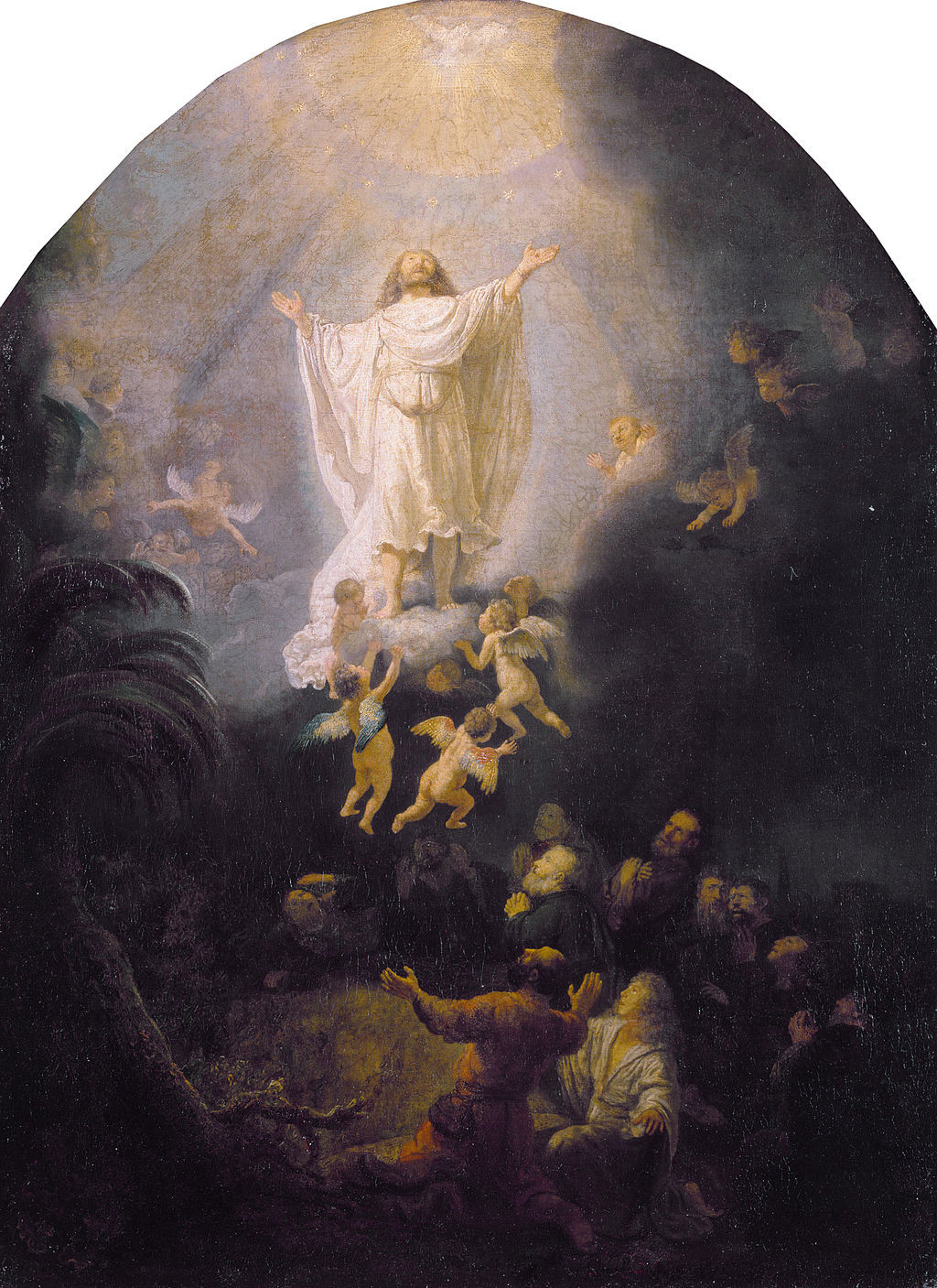
One of the most fascinating scenes in the New Testament—to my mind, at least—is the ascension of Jesus Christ. As Luke records the event in the book of Acts, he notes that after his resurrection, Jesus appeared to his disciples over a period of forty days and on one occasion:

They gathered around him and asked him, “Lord, are you at this time going to restore the kingdom to Israel?”

He said to them: “It is not for you to know the times or dates the Father has set by his own authority. But you will receive power when the Holy Spirit comes on you; and you will be my witnesses in Jerusalem, and in all Judea and Samaria, and to the ends of the earth.”

After he said this, he was taken up before their very eyes, and a cloud hid him from their sight.

They were looking intently up into the sky as he was going, when suddenly two men dressed in white stood beside them. “Men of Galilee,” they said, “why do you stand here looking into the sky? This same Jesus, who has been taken from you into heaven, will come back in the same way you have seen him go into heaven.” (Acts 1:6-11).

And that was the last they saw of Jesus. It was their final, unceremonious goodbye. And yet, apparently, there was no weeping or wailing. No one cried. No one mourned. In fact, the disciples simply got to work building the church and joyfully proclaiming the Good News.

What a contrast between this and when Jesus died six weeks earlier. And yet, from the standpoint of saying goodbye, at least as far as anyone could tell at the time, the situation was no different. A beloved friend was leaving for good. Why such a different response?

Was it the manner of death? This can’t be the explanation, since it is the loss of our loved ones that we mourn, not their manner of death. This is reflected in the (very reasonable) common expression, “I’m sorry for your loss.” We never say, “I’m sorry your loved one died the way they did.” Yes, an especially painful or violent death may exacerbate the pain of loss. But the essence of sorrow regards the loss of the person, not how they died. And yet, when Jesus ascended, the disciples lost their friend. So why no mourning?

Was it the presence of Jesus’ dead body that made his death so much more painful than his ascension? No, this can’t be it. If your loved one were to die in such a way that their body is out of sight or irretrievable (e.g., sunken in the ocean depths, lost in space, etc.) you would mourn every bit as much as if their lifeless body was present. The presence of a corpse may make some psychological difference (for better or worse), but that’s not the source of our sorrow. Again, it is the loss of the person we mourn.

Or maybe the difference lies in the fact that by the time Jesus ascended, he had proven he was the Messiah, that the disciples’ personal investment in him was not in vain, and that their trust in him was vindicated. Perhaps this is why
the disciples didn’t mourn his ascension. Again, this doesn’t account for the fact that, just as in the case of a physical death, by ascending Jesus was leaving them for good.

Or was he? It seems to me that the key to understanding the different responses is that Jesus’ ascension proved his departure was only temporary. That by his resurrection he proved that he had conquered death and that he could be trusted in his promise that he was going to return and bring about his everlasting kingdom. This meant, again, that the goodbye was not permanent but only temporary.

So the difference has to do with Gospel hope, something that the disciples definitely did not have immediately after Jesus was crucified and buried. In fact, they had lost all hope. But with the fact that the ascension occurred after his resurrection made all the difference. Moreover, his resurrection proved that all death is conquered and that, as Christians, all of our goodbyes are only temporary. And this is why the Apostle Paul would later dare to mock death, saying, “Where, O death, where is your victory? Where, O death, where is your sting?” (1 Cor. 15:55).

Of course, I am not saying that our mourning the death of friends and loved ones is not rational or that we lack faith in doing so. Rather, we mourn with hope. And, as Christians, we understand that our goodbyes really are temporary—that we, too, ascend after death and, like our Lord, we go to await our final reunion with the people of God. That is Gospel hope, and it makes all the difference in the world.

Christian Joy

In Galatians 5 we are told that joy is a fruit of the spirit, a virtue that is an important mark of the Christian life. We also know from such passages as 1 Cor 9:24-27 and 1 Tim 4:7-8 that we must train for godliness. The development of such virtues as patience, kindness, faithfulness, self-control and joy is largely intentional, a product of spiritual discipline. So how does one train to be joyful?

Surely, one important part of our training for joy, as for all of the virtues, is imitating Jesus. So what was the nature of his joy? One thing we know for sure is that Jesus’ joy was not based in this world. In fact, Isaiah 53, a prophetic messianic passage, tells us that Jesus was “a man of sorrows.“ Why was he a man of sorrows? Ecclesiastes 1:18 provides a clue: “with much wisdom comes much sorrow; the more knowledge, the more grief.” This disturbing truth follows from the fact that ours is a tragic world where virtue is hated and vice is pervasive. The most righteous people are often the most hated. This is one reason why righteousness is very rare (as Jesus says, the path is narrow and few find it). Being most righteous, Jesus was therefore destined to be hated. And being omniscient and maximally wise, he was also destined to be maximally grieved and sorrowful.

What, then, could be the nature of the joy of Christ given his perpetual condition grief and sorrow? It would have to come down to his hope for the future—an anticipatory grasp of what lay ahead for him. Christian joy, it turns out, is future oriented, a fact that was perfectly personified in Christ. As the writer of Hebrews notes, “for the joy set before himself he endured the cross” (Heb. 12:2).

As fallen human beings we are constantly tempted to seek joy in this world in the form of all sorts of things—job satisfaction, marital happiness, friendships, professional accomplishments, peer recognition, family harmony, physical pleasures, and creature comforts of all kinds. But those are all idols, false gods, since joy is borne of another world. In fact, joy comes only through the denial of the foolish pleasures of this world and embracing (not trying to avoid) its sorrows. This is why C. S. Lewis says joy is actually a kind of longing. Perhaps it is itself a species of sorrow—the sorrow that comes of longing for our eternal home with God. In any case, Christian joy is deeply connected to our Gospel hope.

This suggests another important way of cultivating the virtue of Christian joy and that is by studying biblical eschatology—the Scriptural teaching about the “last things.” It has been said that there is more teaching about eschatology in the Bible than about any other branch of theology. Whether or not that is accurate, it is clear from the abundance of eschatological biblical content that God wants us to dwell on our future hope, to reinforce our faith and to increase our joy. As with Christ, he sets this joy before us that we might be better motivated to endure the crosses we carry in our own lives.

Specifically, it appears that God wants us to know that: 1) the future is written, set in stone as much as are past events (he transcends time and knows the end from the beginning) and 2) the future is good, perfectly good for the people of God. We do know, from such passages as Matthew 24; 2 Thess. 2:1-12; 2 Tim. 3:1-9, and the book of Revelation that the end times will be painful, even excruciating for many Christians. But like childbirth this will all be for a good purpose, as God will be purging sin—punishing the wicked and purifying his people, preparing us for union with our Savior at the great wedding that will take place at the inauguration of his perfect Kingdom. The more we focus on this, the more we will find contentment in this troubled world and truly take hold of Christian joy.

The Old Grey Mare

Recently, our church held their annual Thanksgiving service and Jim and others in our congregation took a few minutes to share something for which they were thankful. They each did a great job, and as I listened to them I pondered the previous year and thought about gratitude-inspiring experiences, people, and situations I have encountered this year. Of course, there are the usual suspects: health, friends and family. While I certainly don’t mean to discount these blessings, I wanted to find something more specific to this season of life. What I settled on might surprise you.

I discovered that I am truly grateful for getting older. Now, a few decades ago, when birthdays brought new privileges, the ability to drive, to vote, to enjoy adult beverages, advancing in years was much easier to give thanks for. I suppose I still have senior citizens discounts and social security to look forward to, but, in the world’s eyes, there aren’t too many largely recognized perks to being on this side of the hill. And that is why I am so thankful for having been given a different vision through which to see my accumulating grey hairs and wrinkles. While those without hope look at the signs of aging as something to be denied and conquered, I am learning to see them as the scars of battles waged and won, of medals awarded for bravery in the face of the enemy. For those who call this life home, growing older is one step further in a finite journey, while for me and my brothers and sisters in Christ, this life is merely the womb in which we are being shaped and developed, and we are on a journey homeward bound.

This perspective is one I am working to cultivate and grow within myself as I face the indignities of middle age, especially in a culture which worships at the altar of youth. I don’t want to see myself as a clock which is slowly winding down and wearing out. Rather, I want to be a tree that is sending down deep roots, providing shade and shelter for those around her. There is an eternal aspect to trees which grow and produce seeds and eventually die and provide nourishment to the next generation of trees growing around them. They don’t cease to exist but rather take on a new form. The same is true in the life of a believer. My body might be a little slower, my mind not as quick or sharp as it once was, but each day I leave behind a little more of this world and the true me within grows a little bigger, growing to better reflect my true self. “The old grey mare she ain’t what she used to be,” and I say, thank heavens!

This fall, I had the immense honor of sitting with my mother-in-law, holding her hand and reading her the Psalms as she passed from this life to the next. I am infinitely thankful that God arranged circumstances such that I was able to witness this lovely lady going home. As she took her final breath, I felt sorrow at being left behind, but great joy in imagining her arrival in Heaven. She wasn’t leaving but arriving, and one day I will join her. One day, I will die, or in truth one day I will truly be born. And rather than filling me with a sense of dread or fear, this idea is a thrilling one.

Now don’t get me wrong. I am not making plans to go skydiving without a parachute any time soon. Just like a baby in utero, I have some maturing to do before I go head first into the cosmic birth canal. I hope to live to pluck many a chin hair and continue for years doing my best to do my best. But one day this heart will stop beating, these lungs will stop breathing, this brain will stop functioning. And then I will know what it is to truly live. And for this hope and knowledge, I am and will be eternally grateful.

The Best and Worst of 2016

It’s been another exciting year, and we want to thank you all for reading and, if applicable, posting comments on our blog. Once again, we would like to close out the year with some summary remarks about good and bad stuff related to film, music, books, sports, food, and family.

Film Experiences:

Jim: It was such a busy year that I didn’t see as many films as I normally do. But I really liked Dr. Strange—an interesting interface between Western science and Eastern mystical concepts, though it would have been better with more character development and less explosive action and eye-dazzling CGI. I also enjoyed Rogue One: A Star Wars Story, which so deftly weaved in connections to the main plotline of the Star Wars films. And Zootopia was a lot of fun—I still go back and watch that scene with the sloths at the DMV. Hilarious. But by far my favorite of the year was Hacksaw Ridge, which manages to wrestle with a serious moral dilemma, powerfully portray self-sacrificial love, and provide a compelling romantic love story.

Amy: I hate to be Debbie Downer, but when I went to consider movies I loved this year, I first thought of movies that disappointed rather than delighted. Kung Fu Panda 3 was a disastrous but memorable night out with the kids, which started with a soggy drive to the theater and ended with a misleading Yelp review of the local Chinese restaurant. Another big disappointment was Star Trek Beyond. I went to see this one by myself in the theater while Maggie and a friend saw Secret Life of Pets. Though I have loved the previous installments of the recent Star Trek series, I am pretty sure I would have enjoyed Secret Life more . . . if the girls would have allowed me to sit in the same theater as them. I saw Magnificent Seven with Bailey and friend who did let me sit with them, maybe because I bought the popcorn, and was thoroughly entertained. Hacksaw Ridge was probably the most powerful movie I saw this year, despite a few flawed and uneven performances, however my favorite experience this year was watching various Jane Austin and Elizabeth Gaskill adaptations (Emma, Pride and Prejudice, Wives and Daughters to a name a few) with Maggie and Andrew. It was like watching them all for the first time and I can’t wait to rediscover more of these beloved period pieces with them.

Jim’s Best Musical Experiences of the Year: My love for Cage the Elephant continued to grow with their latest album Tell Me I’m Pretty, produced by Black Keys front man Dan Auerbach. The band’s sound is less densely textured now, whether due to the departure of guitarist Lincoln Parish or Auerbach’s production. In any case, its still great CTE music. Manchester Orchestra’s Hope was another highlight for me. The album is a more mellow reworking of the songs on their Cope album from the previous year. It is a fascinating demonstration of how much difference musical arrangements and production makes. I also finally picked up the Raconteurs’ Consolers of the Lonely. Another superb record from the ever-expanding Jack White catalogue. I believe he is the greatest rock music talent of our time. The man is a bona fide quadruple threat (singer, songwriter, guitarist, and producer). Other artists I discovered this year—in some cases thanks to my oldest sons, who have become quite the music connoisseurs—include Cloud Cult, Portugal the Man, the Gorillaz, and the incredible Stromae. But the very best musical experience of the year was seeing Bob Dylan in concert in Indianapolis with my daughter Maggie, who is the only real Dylan fan among our kids. As we sat there at the show, she must have said to me at least ten times, “Dad, I can’t believe that’s really him.”

Amy’s Best Food Experiences of the Year: It is sad to say that the more confident I get in my own cooking, the less I enjoy eating out. In fact, one of my highlights food-wise this year would be catering a wedding with one of my favorite people. I love the process from start to finish, coming up with the menu, calculating portions and getting to spend hours and hours with a friend. What could be sweeter? Watching others, whether it is just my family or hundreds of strangers, enjoy food I made is a thrill. The other culinary highlight for me this year was eating with Jim and Bailey at Fogo de Chao, a Brazilian steakhouse in Indianapolis. The food was amazing, but the company was the best.

Jim’s Favorite Sports Moments of the Year: The Chicago Cubs are World Series champions! After suffering with that team for 33 years (and after the franchise itself had suffered a championship drought for 108 years) it has finally happened. What an absolute thrill to see it happen, with my son Andrew—the only truly dedicated sports fan among our kids. After the game 7 victory, we visited Samuel Morris Hall—one of the male residence halls at Taylor—and went from floor to floor high-fiving and chest bumping fellow Cubs fans until about 2:00 a.m. Later, Andrew told one of his friends, “I’m pretty sure some of those students thought my dad was drunk.” And so I was—drunk on the ecstasy of a world championship. The Cubs are champs! Another championship I should mention was that won by my son Andrew’s little league team, which I coached. Not quite at the same level as the Cubs championship, but still thrilling.

Amy’s Favorite Sports Moments of the Year: The Cubs are champs. Nuff said. A close second? Drafting Andrew’s little league team with a dear friend. As Jim mentioned, the team won the championship and I think we all know who to thank for it.

Jim’s Most Disappointing Sports Moments of the Year: With the Cubs winning the World Series, no sports disappointment can spoil my joy for long. But I must admit that watching the Ohio State Buckeyes defeat my Michigan Wolverines in overtime last month was pretty hard to take. And I confess that as I watched there were moments when my feelings for Ohio State bordered on . . . intense dislike. So I confess that I relished Clemson’s trouncing of the Buckeyes last night. Ah, misery loves company.

Amy’s Most Painful Sports Moment of the Year: Both involved our kids. One was literally painful. Nothing prepares you for that text or phone call telling you that your kid has been seriously injured on the field. So thankful nothing was permanently damaged though I am pretty sure I lost a few hours off my life due to elevated blood pressure. The other was a strange mixture of heartbreak and pride as one of the kids sacrificed his pride for the sake of his team. This experience showed me again that sports can play a significant role in the moral development of my kids, however hard it is to watch.

Good and Bad Reads of the Year:

Jim: I did a lot of reading of early church fathers over the summer, and it was really rich. Clement of Alexandria’s Paedagogus and Stromata are moral-theological treatises that are amazingly relevant today. Likewise, John Cassian’s Institutes and Conferences. I also read Athanasius’ Life of Antony, which is one of the most influential books in Christian history, deservedly so. Among contemporary works, my favorite of the year was Mike Mason’s The Mystery of Marriage, which has become something of a contemporary classic. Chock-full of honest and bracing observations about marriage, the book is also a stylistic masterpiece. Mason calls himself a “purveyor of fine sentences.” And so he is. The only negative reads of the year were a few philosophical articles and one book—Brene Brown’s Daring Greatly, which was recommended to me by a colleague. I’m not into pop psychology, and Brown seems to epitomize that.

Amy: This year I didn’t read nearly as much as I wanted to but the upside was I loved just about every book I read. I couldn’t stop quoting The Meaning of Marriage by Tim Keller. I chuckled along as I read All Creatures Great and Small by James Herriot. Cried through Roots by Alex Haley, Incidents in the Life of a Slave Girl by Harriet Ann Jacobs, and All the Light We Cannot See by Anthony Doerr. I also read a few of the James Bond books, which are much better than the movies, as well as some Agatha Christie and Career of Evil by Robert Galbraith, aka J.K. Rowling.

Best 2016 Family Memories:

Amy: The first half of this year, my nephew Josh lived with us which was a treat, especially given the fact that he and my sister’s family have been living overseas for more than a decade. He helped fill the void left by Bailey who was in Bolivia from January to May. Bailey’s first extended time away from home was a bittersweet experience for me. Missed him terribly, but so wonderful to watch him growing up and to see the Lord working in his life. It was humbling to see others influencing and caring for him while I could not. I am tearing up now at the memory of seeing his smiling face as he walked towards us at the airport. This spring and summer we managed a few family hikes during which the majority of the children refrained from cursing the concept of the great outdoors. This was a major victory. Table Rock State Park is a new favorite destination. Moving was a huge undertaking and while I am glad it is behind us, I will treasure memories of working along side Jim and the kids.

Jim: The best and at times more challenging family experience of the year was moving into our new (or, rather, old—built in 1920) house in Upland, Indiana. September was a zany month, but we pulled it off. I especially enjoyed the excursions I had with each of our kids this past year. In March I visited La Paz, Bolivia where Bailey attended Highlands International Academy for the semester. In July I went on a church mission trip to El Salvador with Sam. In August, I took Maggie to the Dylan concert and I took my Andrew to see the Cubs at Wrigley Field in Chicago. Did I mention that the Chicago Cubs are World Series champions? Yeah!!!

Best Kids’ Quotes of the Year

As usual, the best quotes from our kids this year come from our poet-comedian-dreamer daughter, Maggie (12) and our observant moral theologian Andrew (10):

  • Maggie: “If I were God the world wouldn’t be nearly so complicated.”
  • Andrew: “Everything that has to do with tomatoes is bad.”
  • Maggie: “In the future this will be the past, and I will be glad.”
  • Andrew: “You can’t turn back time but you don’t need to if you make the right decisions.”
  • Maggie: “There are two things I dislike about life: There is no background music and there are no musical montages.”

New Year’s Resolutions:

Amy: To be more prompt and not use my kids as an excuse for being late more often than I should be. To be a good neighbor and friend and not overthink or analyze my interactions with others. To be more intentional in my thoughts, not allowing them to wander . . . sorry, what was I saying?

Jim:  My primary goals this year are moral-spiritual: to be more meditative and disciplined in controlling my own thoughts. And, with regard to this blog, to do more posts that feature biblical reflections and practical theology. I also resolve to do more praying for our political leaders than complaining about them.

Happy 2017 everyone!