The Best and Worst of 2020

It has been an eventful year. On top of the Covid pandemic, we’ve endured some personal losses but nothing that God will not redeem for great good. As usual we are closing out the year with summary remarks about good and bad stuff related to film, music, books, sports, food, and family.


Film Experiences

Jim:  With Covid restrictions preventing us from going to the theaters, we watched all of our films this year at home, in many cases catching up on films from previous years. For me, the biggest disappointment was The Lighthouse, which is well acted (by Willem Dafoe and Robert Pattinson) with tremendous cinematography but ultimately an aimless, oppressive narrative. A more successful attempt at twisted horror is As Above So Below (2014), which could be described as American Treasure meets Blair Witch Project in the catacombs of Paris. Dante would be proud . . . maybe.  I was mesmerized by the docudrama Wormwood (2017), which is another film that features a dark psychological trip of sorts, as the principle subject, Eric Olson, seeks to get to the bottom of the death of his father, Frank Olson, who supposedly committed suicide while working for the CIA in 1953. Whoa. Finally, I highly recommend the surprisingly profound My Octopus Teacher, which chronicles the relationship between filmmaker Craig Foster and an octopus off the coast of South Africa. Ever been moved to tears by a mollusk? I was.

Amy: This year has been predominantly about escape when it comes to my viewing habits. I find true crime and detective shows oddly comforting when stressed or sad, inspiring the idea of justice being achievable. Some of my faves this year were Criminal UK and Unbelievable. I also fell down the rabbit hole of The Crown: Season Four, going back and forth between watching and researching the true events. Social Dilemma was terrifying and nearly had me throwing all our phones and devices in the toilet. Emma and Rebecca were period piece highlight and disappointment, respectively. I fell in love with The Unicorn as one of the few shows set in the South I have ever enjoyed.


Food and Music

Amy’s Best Food Experiences of the Year: This year my favorite food experience was a two-parter. First, I loved watching the Great British Baking Show with Bailey and Andrew and then I enjoyed celebrating Andrew’s victory in our competition to predict the winner by going out with Andrew and Bailey at a local restaurant with a good friend as our server. Otherwise, our culinary experiences, like many others, were homebound. Sampling the variety of bakery creations the kids concocted was almost worth all of the clean-up. My traditional birthday meal at Chesapeake’s in Knoxville with Jim, my parents and sister and brother-in-law was especially meaningful this year’s challenges.

Jim’s Best Musical Experiences of the Year: I’ve continued to enjoy the recent spate of female singer-songwriters, including Mitski, Phoebe Bridgers, and Madison Cunningham. I appreciated the bold adventurousness of the new Morrissey album, I am Not a Dog on a Chain. The new Dylan album, Rough and Rowdy Ways, was a wonderful surprise. Even more surprising is the fact that the album’s 16-minute closer, “Murder Most Foul” became the first #1 song in the 80-year-old legend’s career. Like millions of others, I was thrilled with both of Taylor Swift’s studio albums released this year—Folklore and Evermore, which are really a time-released double album (a la Radiohead’s Kid A and Amnesiac). With these albums, Swift further cements her status as one of the best songwriters of our time, a fact that is sadly missed on many people, whether due to latent sexism or a simple failure to study the lyrics of her songs. But I digress . . .  My most exciting musical discovery this year was the band MeWithoutYou. I regret to confess that I’m late to the party with these guys. But, man, has it been fun doing the deep dive into their seven albums . . . just in time for the band to announce they are calling it quits.


Sports

Jim’s Favorite Sports Moments of the Year:  Watching two frustrated sports franchises finally break through to win championships in the NFL (Kansas City Chiefs) and Major League Baseball (Los Angeles Dodgers) was gratifying. Normally I wouldn’t pull for an L.A. team, but after knocking at the door for several years and being denied by the cheating Houston Astros a few years ago, it was good to see the Dodgers finally reach the mountain top, especially for Clayton Kershaw, who by all accounts is an admirable Christian guy.

Amy’s Favorite Sports Moments of the Year:  Like so many things this year my favorite sports moment was bittersweet. Because of my work schedule I don’t often get to see my kids play, but I enjoyed cheering on Sam in his final soccer game of the year. Though it was heartbreaking to see Eastbrook lose in overtime in the sectional playoffs, Jim and I couldn’t be prouder and look forward to watching him play next year for our favorite college coach, Gary Ross.

Jim’s Most Disappointing Sports Moments of the Year:  Seeing the Saints going down against the Vikings (again) in the post-season was tough to take last January. But far more painful than that was watching our son, Andrew, break his arm during a basketball game a few weeks ago. Happily, orthopedist Dr. Daniel Edwards at Marion General Hospital worked his magic on our young man, and Andrew is on the mend and will hit the courts again as soon as the cast is cut off.

Amy’s Most Painful Sports Moment of the Year:  Because of Covid restrictions on the number of people who can attend kids’ games, I was not able to be at Andrew’s game when he fractured his arm. But seeing Andrew’s courageous response and the excellent care he received was a definite positive.


Good Reads

Jim:  My most underwhelming read of the year was Frank Herbert’s classic sci-fi book Dune. Just couldn’t get into it, but I’m glad to have read it. I’ve benefitted from digging into Solzhenitsyn’s Gulag Archipelago, which is disturbingly apropos for our time. I also appreciated Rod Dreher’s Live Not by Lies, which was inspired by, and takes its title from, Solzhenitsyn’s Gulag. I’ve also enjoyed working through two classics—Thucydides’ Peloponnesian War and Dante’s Inferno.

Amy:  The highlights of the year were James Clear’s Atomic Habits, Leadership in Turbulent Times by Doris Kearns Goodwin and The Subtle Art of Not Giving a F*** by Mark Manson. The latter book was an especially refreshing read. Despite the crudeness of the title, the book spoke to me in a profound way, both as an individual and as a parent. I intend every one of my kids to read it and recommend that you do the same. And if you don’t care to take my recommendation, then frankly, my dear reader, I don’t give a #@%!


Best 2020 Family Memories

Jim:  Our family retreat with my in-laws’ extended family in July was awesome. As always, we divided into teams and had some thrilling competition. I also enjoyed building a barn in Knoxville with my father-in-law and getting to know his mischievous cows, Lulu and Dottie.

Amy: Generally, the time we’ve spent together as a family, with Bailey home more than usual, was special. My niece Rachel’s wedding was definitely a highlight. And my supervisor’s traditional African wedding was a wonderful experience with Jim, Bailey, and Sam.


Best Kids’ Quotes of the Year

  • Maggie: “I have a zit on my soul.”
  • Andrew: “I think of our time on earth as a terrible sleepover where you just want to go home.”
  • Maggie: “Unlike humans, dogs deserve to be loved.”
  • Bailey: Regarding his initiation into the world of alcoholic beverages: “It’s like I’ve discovered a new primary color.”
  • Maggie: “I want my own guitar so I can get one of those straps and walk around with it in the woods and be one with nature. Wait . . . I hate nature.”


New Year’s Resolutions

Amy:  This year has presented Jim and me with some of the most profound challenges of our lives. Next year my hope is that more of my challenges will come from within as I seek to grow in mind, body, and spirit.

Jim:  To pray every morning on my knees.


Happy 2021 everyone!
Michaels and Morrissey

There are studies in contrast, and then there are studies in contrast.  During the past six months I’ve read two autobiographies—of sorts—and the similarities and differences have been striking.  The two authors work in very different fields, both of which I follow assiduously.  Neither is professionally an author, and partly for this reason their written reflections on their careers are especially interesting.  The authors are long-time sports broadcaster Al Michaels and singer-songwriter Morrissey.

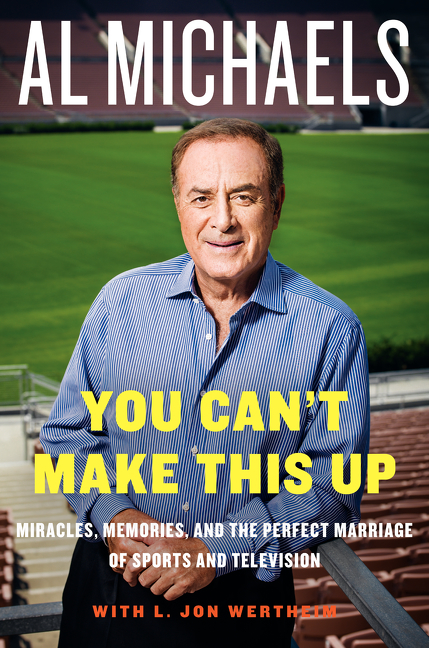
Michaels’ book, entitled You Can’t Make This Up (William Morrow, 2014), recounts his journey from the Flatbush section of Brooklyn, New York through a long career at ABC sports to his present position at NBC.  Michaels is perhaps most well-known for his iconic call at the conclusion of the dramatic U.S. hockey team upset of the Soviets at the 1980 Olympic games: “Do you 9780062314963believe in miracles?  Yes!”  He also recounts his experience at the earthquake-interrupted 1989 World Series and his relationship with O.J. Simpson, as well as many riveting on-the-field anecdotes.

One of the themes of his book is how Michaels’ has managed to abide by the advice that legendary NBC announcer Kurt Gowdy gave him back in the 1970s: “Don’t ever get jaded.”  Michaels is correct in his self-assessment that he’s followed this advice.  Although critical of some sports and network personalities with whom he’s worked, such as the self-possessed Boomer Esiason and the pompous but fascinating Howard Cosell, Michaels has maintained a boyish enthusiasm.  And his critical assessments of some of his peers are far outshone by his genuine appreciation of others with whom he’s worked, from John Madden to Cris Collinsworth—whom most would agree are two of the greats in NFL television broadcasting.

Michaels does note along the way that he is the most widely exposed person in the history of live television—no one has spent more hours on the air (because of his broadcasting all of the major team sports, the Olympics, etc.) than Michaels.  But somehow this doesn’t come across as anything but a truthful observation.  Perhaps because an attitude of gratefulness permeates the pages of You Can’t Make this Up.

Whereas Michaels’ book is calculated to entertain and endear the reader (as well as educate him or her about the history of sports broadcasting), Morrissey’s Autobiography (Penguin, 2014) seems more bent on venting and indulging grudges.  Former front man of the legendary 1980s band The Smiths, Morrissey set out on his own after a media-fueled rift between him and guitarist Johnny Marr.  Since going solo, Morrissey has made consistently high-quality records, featuring his trademark introspectively brooding lyrics, though his later albums have increasingly tackled social and political issues.

The Moz’s prose is, by turns, mesmerizing, tedious, obscure, and hysterical, but always interesting and too often indulgent.  It is, in the end, a book of complaints (especially about the music corporation rip-off machine) and self-justifications, only brightened occasionally by a tersely-put word of admiration about one of Morrissey’s musical heroes or (usually deceased) 519ZinY706L._AA160_friends who somehow managed to avoid severely offending him.  Tellingly, more than fifty pages of the book are devoted to the much publicized legal case involving Smiths drummer Mike Joyce who prevailed in his suit for a higher share of the band’s royalties.  While the Moz does seem to have been treated unjustly, his seething over it (even referring to his former band mate as “Joyce Iscariot”—really?) isn’t helping anyone.  Sadly, Morrissey only succeeds in typifying someone who willfully grants others the ability to steal his joy.

There are certain similarities between Michaels and Morrissey.  For one thing, both men are commentators and analysts who are regarded as compelling “voices” in their respective fields.  Furthermore, both are gifted at getting to the essence of aspects of the human drama.  Michaels is a master at his craft of describing compelling sports narratives, and the Moz, too, is a master in his realm of lyrical composition and vocal delivery.  And in their books they reflect on their careers in a way that sheds a certain light on their genius and also reveals their own sense of their significance.

But the contrasts are glaring.  Michaels’ sense of his significance is more measured and humble than that of the Morrissey, always reminding the reader of his own simple beginnings and the fortunate turns along his professional path.  Morrissey’s is an attitude of self-importance and exasperation that others have so often failed to properly appreciate his talent.  Both are witty, but Morrissey’s humor is famously sardonic, and this is relentlessly displayed in his Autobiography.  As mentioned, Michaels, too, takes time to critique his peers and make note of those who betrayed him, but these are brief and never with the tenacious vindictiveness of Morrissey.  Finally, and this is the key difference, Michaels seems to be a genuinely thankful man, repeatedly expressing his gratitude to those have helped him achieve all he has in his profession.  Not so the Moz.

Here are two famous, talented, and productive individuals who will go down as towering figures in their respective professions.  But just one of them seems genuinely happy.  That same man, not coincidentally, is the one who has managed to follow the old adage to “count your blessings.”  Hopefully, Morrissey will somehow learn to do this as well, and thus find that all-too-elusive joy in this life.  But once one becomes jaded, that’s a hard thing to do.

The Best and Worst of 2014

It’s been another exciting year, and we want to thank you all for reading and, if applicable, posting comments on our blog. Once again, we would like to close out the year with some summary remarks about good and bad stuff related to film, music, books, sports, and family.

Best and Worst Film Experiences:

  • Jim:  This was a down year for me in terms of watching films. I viewed a lot of “tweeners” that wouldn’t fall anywhere near the “best” or “worst” categories—e.g., Interstellar, The Grand Budapest Hotel, and The Hobbit: The Battle of the Five Armies.  Probably the best film I watched all year was the Israeli drama Fill the Void, a powerful story of a young Haredic Jewish woman who is pressured by her family to marry the widower of her older sister, who died in childbirth. On a lighter note, but just as memorable, is the endearing Jon Favreau comedy Chef. As for my worst film experience of the year, the choice is easy: Gone Girl, which Amy and I reviewed here and here.
  • Amy:  While Jim was in California, I pretty much anesthetized myself with any television series I could get my Netflixed hands on. While there was a great deal of loving or listing it, hunting for houses and cousins with kitchen, I did watch some quality shows, most of them dark and mysterious. I think the new paradigm of shows created directly for streaming and released in their entirety has real potential. Here are a few to which I became hopelessly addicted, with the usual disclaimer that since they are mostly British, they tend to be a wee smutty and anti-religious, but well-written and well-acted: Hinterlands, The Killing, Happy Valley, The Fall. My best experience, however, was watching Mockingjay: Part One with my older boys. I know it isn’t saying much to say it is the best in the series so far, but it was. There was popcorn and bonding, so take that and stuff it in your high culture hat.

Jim’s Best and Worst Musical Experiences of the Year:  The highlights for me were Morrissey’s World Peace is None of Your Business (despite the Moz’s increasingly sardonic perspective on life) the Black Keys’ Turn Blue (my review of which is here), and U2’s Songs of Innocence (despite the popular trend of hating this album just because it was simultaneously gifted to millions of people). The low point, as it probably could be most years, was catching “highlights” of the MTV awards. Blecch.

Amy’s Best and Worst Eating Experiences of the Year: Best: Finally got to experience (free range) pork belly and it did not disappoint. Like pork chops wrapped in bacon. Thank you, Barn Brassiere in Muncie, Indiana.  Worst: The hundredth Subway tuna sandwich on flat bread I ate with the kids while traveling back from California. Every woman has her fast food sub-sandwich limit and I reached mine somewhere in Kansas.

Jim’s Favorite Sports Moments of the Year:  It was a thrill to see both the Ole Miss and Mississippi State football teams in the top five, with the latter enjoying the #1 position for several consecutive weeks of the season.  I also enjoyed the Kansas City Royals’ exciting run to the World Series.  And as I write this I’m enjoying the Detroit Lions season culminating in a playoff appearance, though I expect the end of their run will make my “most disappointing sports moments” for 2015.

Amy’ Favorite Sports Moments of the Year:  Watching all my kids play soccer this fall. I had to step up my spectator skills in order to do play-by-play for Jim while he was in California. I saw Bailey score his first goal in a high school game, Sam play keeper (a position he and his high threshold of stimulation were born for), Maggie deceive many an opponent with her flighty demeanor, and Andrew take charge of his defense. So fun to watch them all, though the rides home were admittedly a little stinky (but only literally).

Jim’s Most Disappointing Sports Moments of the Year:  Although I’m not a Kansas City Royals fan, I got caught up enough in their improbable playoff run to be really deflated by their falling just short in game 7 of the World Series.  If Salvador Perez swings just half an inch higher on that final pitch, the Royals win the championship on a walk-off two-run homer rather than losing on a feeble pop-out. It’s a game of inches… And speaking of disappointments related to teams I don’t normally root for, it was also painful to watch Peyton Manning’s Broncos so thoroughly dismantled by the Seahawks in the Super Bowl.

Amy’s Most Painful Sports Moment of the Year: Having to tell Jim, who was suffering from amnesia at the time, that Peyton Manning didn’t play for the Colts anymore. He looked so devastatingly baffled. At least he forgot about it five minutes after I told him.

Satisfying Reads of the Year:

  • Jim:  I was delighted to have the time to finally read Melville’s Moby Dick, my reflections on which you can see here.  I also enjoyed Marilynne Robinson’s Pulitzer Prize-winning Gilead—an achievement that is as subtle as it is profound.  The best work in philosophy I read this year was Jason Baehr’s The Inquiring Mind, a rich and insightful work on virtue epistemology.  Also, I greatly enjoyed—and was happy to do a back-cover endorsement for—the book Rethinking Hell, a compendium of important articles and essays defending the doctrine of hell known as conditional immortalism (the view that the damned are eventually annihilated, as opposed to suffering eternally).
  • Amy:  I read so many good books this year. From contemporary fiction to 19th century memoirs, this was a great reading year for me. Here are just a few of my recommendations: The Warden by Anthony Trollope, People of the Book by Geraldine Brooks (though I hated Brooks’ March), Where’d you go, Bernadette? by Maria Semple, a couple by P. G. Wodehouse, 12 Years a Slave by Solomon Northup, Half-Broke Horses by Jeannette Walls, The Year 1000 by Robert Lacey, Crossing to Safety by Wallace Stegner, Extraordinary, Ordinary People by Condoleezza Rice and The Life of Charlotte Bronte by Elizabeth Gaskell.

Best 2014 Memories of Our Kids:

Amy:  Our trip out west was the big one. Sitting on the beach with Jim at Big Sur watching the kids playing in the water and looking for creatures was a near perfect moment. Looking at their happy and surprised faces when Jim told them we were getting a dog was priceless. Not being found first every time during Christmas bedtime hide and seek was pretty sweet too.

Jim:  Traveling through Arizona and California with my family in October, experiencing together such sites as the Grand Canyon, Sequoia National Park, Yosemite National Park, the Pacific coastal highway, and Alcatraz. Our kids have always been good travelers, but they blew us away with their endurance on this extended sojourn.

Best Maggie Quotes of the Year:

In the past we’ve reserved this spot for memorable quotes from all of our kids, but this was such a great year for quotes from our daughter Maggie (who is ten years old), we decided to simply list some of her more memorable ones:

  • “When I grow up, I’m gonna make an exact copy of the earth, then cut it in half with a big knife to see if the center of the earth is really so hot.”
  • “Sometimes being hungry can be satisfying. Unsatisfaction can be satisfying.”
  • “I never talk to myself when I’m alone in my room. I just talk to the Beatles and my stuffed animals.”

Most Satisfying Shared Experiences of the Year: 

  • Amy:  There were quite a few this year: Kayaking through the beautiful mangrove forest and onto the open ocean while in the Bahamas. Seeing so many beautiful places on our trip out west. The night Jim surprised me for my 40th birthday by driving me around to collect lovely, encouraging notes from my friends. However, number one has to be picking him up from the airport in December, knowing he was home to stay.
  • Jim:  Dittos on all of that.

New Year’s Resolutions:

  • Amy:  Somehow managing to maintain the new perspective Jim’s being gone gave me. Appreciate him more, worry about the little things less. Enjoy and encourage my kids more, criticize and hide from them less. Accomplish the fitness goals I set but didn’t quite reach for 2014. Watch more quality films with Jim. Put more time and energy into plans for my professional future and of course, read lots and lots of books.
  • Jim:  To read half as much as my wife did this year, which would mean reading twenty-six books next year. Good luck to me on that.

Happy 2015 everyone!

My Favorite Morrissey Songs

I’ve been reading Morrissey’s Autobiography (which I will review for Books and Culture soon), and of course this has sent me into quite a fit of listening to his music, both the Smiths and his solo stuff.  The Pope of Mope certainly has built an impressive catalogue.  And, being the lover of top ten lists that I am, I’ve been thinking about my favorite Moz solo tunes.  So here they are, lightly annotated for your reading pleasure.  To save myself the agony of trying to rank order them, I’ve decided to list them chronologically.

  1. “The Girl Least Likely To” (1989) – Morrissey is known for his lyrical daggers.  This one, directed at one of the singer’s many benighted critics, is as good as it gets.  “She lives for the written word, and people come second or possibly third,” the Moz sings over an addictive arpeggio guitar line.  Some call this Morrissey’s very best solo tune, and they might be right.
  2. “Interesting Drug” (1989) – More beautifully melodic jangly guitar lines, a tumbling drum part played by former Smiths band-mate (and eventual despised enemy) Mike Joyce, as well as a rare female harmony vocal (by Kirsty MacColl), all couch a truly depressing lyric: “A government scheme designed to kill your dream. Oh mom, oh dad.”  It works.  Man, does it work.

    From theguardian.com
    From theguardian.com
  3. “The Last of the Famous International Playboys” (1989) – Featuring some “Suffragette City”-esque keyboards played by producer Stephen Street, this song is an ironic musical ode to two notorious British gangsters from the 1960s.  “In our lifetime those who kill, the news world hands them stardom…”  So sadly true.
  4. “National Front Disco” (1992) – There are several great songs on Morrissey’s rockabilly-tinged Your Arsenal album.  This one might be the best, featuring some vintage guitar work by Boz Boorer and Alain Whyte.  Unfortunately, the song created controversy because of supposed racist lyrics (e.g. “England for the English”).  Never understood that fatuous charge.
  5. “Hold on to Your Friends” (1994) – Steve Lillywhite’s debut at the production helm for the Moz resulted in a classic with Vauxhall and I, including this beauty—a veritable feast of melodic guitar parts (Boorer and Whyte, again, at their best) as well as some genuine practical wisdom: “Give up your job, squander your cash, be rash…just hold on to your friends.”  Amen to that.
  6. “The More You Ignore Me the Closer I Get” (1994) – This is the very next song on Morrissey’s Vauxhall and I album, and its just as musically scrumptious.  It also has an unusually bold and confident lyric for the Moz:  “Beware, I hold more grudges than lonely high court judges.  When you sleep, I will creep into your thoughts like a bad debt that you can’t pay.  Take the easy way and give in.”  Wow.
  7. “First of the Gang to Die” (2004) – After a seven-year hiatus, Morrissey returned right in stride with You are the Quarry.  This dark anthem is one of the album highlights.  “Hector was the first of the gang with a gun in his hand and a bullet in his gullet and the first lost lad to go under the sod… And he stole all hearts away.”  More classic Moz dark humor.
  8. “The Youngest Was the Most Loved” (2006) – Under the direction of legendary producer Tony Visconti, Ringleader of the Tormentors featured some classic Morrissey tunes that took real chances, like this one with its powerful use of a children’s choir and a gritty mellotron.  “There is no such thing in life as normal.”  Indeed.
  9. “In the Future When All’s Well” (2006) – Human mortality is an abiding theme on Ringleader, and it is especially pronounced on this song, which hammers home the message with harmonizing Rickenbacker guitar lines.  “I will lie down and be counted in the future when all’s well.”  Won’t we all.
  10. “That’s How People Grow Up” (2009) – During his younger years, Morrissey’s perpetual lovelorn state was an invitation to pity.  Decades later (after many “years of refusal,” as the album title declares) it is a badge of maturity:  “I was wasting my time praying for love—for a love that never comes from someone who does not exist.  And that’s how people grow up.”

Got your own top ten (or top five or top three) Moz tunes?  I’d love to see it.

Top Ten Albums of the Decade

It’s the end of the ‘00s, which means it’s time for top ten lists.  Below are my picks for the best albums of the last ten years.  Honorable mentions: Bob Dylan’s Modern Times, The Killers’ Day and Age, Neko Case’s Fox Confessor Brings the Flood, The Strokes, Is This It?, Red Hot Chili Peppers’ By the Way, The Shins’ Chutes Too Narrow, Arcade Fire, Funeral, and Modest Mouse’s Good News for People Who Love Bad News.

AHA SHAKE10. Aha Shake Heartbreak (2004) – The Kings of Leon Just when it appeared that no one would make a great rootsy, blues-based rock again, the Followill boys arrived on the scene to prove it can still be done…and how.  Aha Shake Heartbreak was the sophomore effort from the Kings of Leon, a marked improvement on their debut which earned critical acclaim in its own right.  These guys are the full package, soulful at every instrument with the chemistry of kin to boot.  This album soars from the start and never lets up.  Highlights:  “King of the Rodeo” and “The Bucket”

RINGLEADER9. Ringleader of the Tormentors (2006) – Morrissey For his second album since his return from a seven-year hiatus, the Moz put legendary ‘70s producer Tony Visconti at the helm.  The results lived up to the hype, as Visconti built innovative orchestral elements into most of the song arrangements.  Combined with the fact that the songs were among Morrissey’s strongest compositions ever—both technically and emotionally—it’s no surprise that some critics hailed it as the best ever from the Pope of Mope.  Highlights:  “The Youngest Was the Most Loved” and “In the Future When All’s Well”

NO LINE8. No Line on the Horizon (2009) – U2 Following two strong but less than groundbreaking efforts, the legends from Dublin looked to find some fresh musical inspiration in the unlikely country of Morocco.  Setting up camp in a studio in Fez, some of the songs on the album bear the marks of Arabic musical influence.  During the long recording process the band invited producers Brian Eno and Daniel Lanois to make songwriting changes as well in hopes to make the material still stronger.  The results on No Line speak for themselves, as it is the most fresh and inspired U2 album since Achtung Baby.  It is also less commercial than anything they’ve done since Zooropa, which explains the cool reception of the album in some quarters.  But let’s hope this doesn’t discourage the band from further musical exploration.

THIEF7. Hail to the Thief (2003) – Radiohead On the heels of their landmark Kid A and Amnesiac albums, what could the Oxford quintet do next?  How about create another masterful album which is even more unified than its predecessors, if only because it’s creative explorations are not as multifarious.  The album also has a discernible theme, which is evident in its title.  And the interpretive Rosetta Stone for the 16-song cycle is “A  Punchup at a Wedding,” where the most sacred of events is marred by a drunken brawl.  For Radiohead the wedding is nature, and human beings are the intoxicated fighters.  A powerful image, even if it does seal Yorke & Co. as misanthropes.  Such a dark theme, however, does not diminish the sheer beauty of this album.  Highlights:  “Go to Sleep” and “Scatterbrain”

RETRIEVER6. Retriever (2004) – Ron Sexsmith This unsung Canadian songwriter’s songwriter has yet to make an album that isn’t at least very good.  Retriever features a dozen artful tunes which demonstrate why everyone from Elvis Costello to Paul McCartney count themselves among Sexsmith’s biggest fans.  Producer Martin Terefe effectively created an organic warmth which perfectly reinforces the wistful melancholy of most of the tracks.  Several songs are achingly beautiful.  Some still move me to tears.  Highlights:  “Imaginary Friends,” “For the Driver,” and “Wishing Wells”

YANKEE HOTEL FOXTROT5. Yankee Hotel Foxtrot (2002) – Wilco Recorded in 2001, Wilco’s record company, Reprise Records, refused to release the album because of its perceived lack of commercial viability.  Eventually the band was released from their Reprise contract and signed with Nonesuch Records, who released the album the next year.  Naturally, the album sold like hotcakes.  It’s a brooding, sometimes dark record with plenty of atmospherics and interesting turnarounds.  Probably the very things that turned off the Reprise execs are what turned on listeners.  So much for the convergence of market sense and aesthetic sensibility.  If you haven’t discovered the raw rock paradise of Jeff Tweedy and friends, this album is a good place to start.  Highlights:  “I Am Trying to Break Your Heart” and “Pot Kettle Black”

NEON BIBLE4. Neon Bible (2007) – Arcade Fire After the critical exultation over their first album, Funeral, most fans of the indie band Arcade Fire braced themselves for a let down with their follow-up.  But Neon Bible proved to be even stronger than their debut.  Both albums are melodically and emotionally rich, but Neon Bible is more mature in terms of lyrical vision.  The album’s abiding theme of spiritual angst is especially compelling, with several songs wrestling with the realities of sin, death, and redemption.  Highlights: “Intervention” and “The Well and the Lighthouse”

COOKIE3. Return to Cookie Mountain (2006) – TV on the Radio This unique outfit from Brooklyn, New York blends progressive rock, jazz, hip-hop, and electronica.  The song’s lush textures, thanks to the production wizardry of band guitarist Dave Sitek, reward repeated listening.  Layers of melodies, rhythms, and vocalisms create a unique and hypnotizing soundscape for stream of consciousness lyrical explorations.  One of the album’s standouts, “Wolf Like Me,” is quite possibly the song of the decade.  Other highlights: “Hours,” “A Method,” and “Dirthywhirl”

LOVE AND THEFT2. Love and Theft (2001) – Bob Dylan Just prior to the album’s release, the Bobster was quoted as saying Love and Theft felt like a greatest hits album.  This seemed like pre-release hype at the time, but he turned out to be correct.  Each song feels like a classic, whether the style is rockabilly, swing, bluegrass, parlor jazz, or blues.  Dylan and his band—featuring the incomparable tandem of Charlie Sexton and Larry Campbell—move effortlessly from genre to genre, humbly serving each tune.  Lyrically, Dylan is at the top of his game—which is no small boast—spinning captivating yarns, tossing off wise proverbs, telling jokes, and creating an abiding feeling of riverboat adventure and Old South nostalgia.  All in all, a flawless album.  And to think he did it as a man in his sixties.

KID A1. Kid A / Amnesiac (2000-01) – Radiohead Okay, so these are two albums rather than one, but I’m combining them because all of the music was recorded during the same sessions.  The band didn’t want to release it all on one double-length CD, so they divided the songs into two separate albums.  In actuality, it’s more like a time-released double album, with half of the songs appearing about six months after the others.  AMNESIACThe novelty of the release format only hints at the originality of the music itself, which felt at the time—and in many ways still does feel—as if it had been recorded in the year 2050 and sent back to our time to blow our minds.  Amazingly, the albums have “aged” well.  The truth is, as with all great music, it doesn’t seem to age at all.  Kid A highlights:  “Optimistic” and “Idioteque”; Amnesiac highlights:  “I Might Be Wrong” and “Knives Out”

New Albums by Morrissey and U2: A Study in Worldview Contrasts

When I heard last Fall that new albums were forthcoming from both Morrissey and U2, I was thrilled.  Not only are they two of my favorite musical artists of the last 20+ years, but they have established themselves as among the most important of their time.  Naturally, I was hopeful that their new records would be good, but being a realist about the fact that the quality of a band’s or songwriter’s work tends to wane over the years, I braced myself for disappointment.  If just one of these albums was strong, I’d be satisfied. 

Well, my most optimistic hopes were realized.  Both Morrissey’s Years of Refusal and U2’s No Line on the Horizon are excellent, once again proving the staying power of these artists.  In the latter case, however, it’s a more significant achievement.  I have noticed that most bands have approximately a ten year period of inspired creativity, after which the quality of their music begins to diminish.  This seems true of all the great bands which remained together for more than a decade, e.g. The Rolling Stones, The Who, Queen, Pink Floyd, REM, etc.  It also seemed true of U2, since after their 1991 classic Achtung Baby their work has been good but not great.  However, No Line on the Horizon breaks this trend, and the ten year hex just noted, in dramatic fashion.  From the mesmerizing and addictive opening title track to the eerie closer, “Cedars of Lebanon,” Bono and his mates seem inspired.  Lyrically, Bono has yet more to say and has found new ways to say the things he’s already said.  Musically, the Irish lads have managed—even in their 30th year as a band—to explore new territory, both in terms of chord structures and production approaches.

Meanwhile, the Moz has made his own strides on Years of Refusal, which is one of the strongest of his solo career now spanning more than two decades.  It is also one of his most energetic, as many of the songs were tracked live, and Jerry Finn’s deft production preserves an immediacy of feeling on the other tracks as well.  Morrissey’s voice is as strong and rich as ever, and his slowly revolving cast of supporting musicians serves the songs well, filling the album with memorable hooks and phrases.

So I’ve been enjoying both of these albums immensely.  But as I’ve listened, I’ve been struck by the stark contrast in worldviews.  Interestingly, both Years of Refusal and No Line on the Horizontypify the personalities and values of Morrissey and U2, respectively.  In fact, one might say that each album is a definitive statement of sorts for each artist, at least relative to their output thus far.  And I would sum up the prevailing themes as follows.  For Morrissey, it boils down to temporality, resentment, and despair, while for U2, the thematic core is eternity, grace, and hope.

Temporality vs. Eternity

Morrissey’s preoccupation with his mortality was especially keen on his previous album, Ringleader of the Tormentors, but the theme shows up on Years as well, with such lines as these: “time grips you slyly in its spell and before you know, goodbye will be farewell, and you will never see the one you love again” (“One Day Goodbye Will be Farewell”).  For the Pope of Mope, life is a bitter struggle where “Only stone and steel accept my love” (I’m Throwing My Arms Around Paris”) and “To the rescue nobody ever comes” (“When Last I Spoke to Carol”).  And the best he can do in the way of final comfort is to consider how death might end it all, and “we will be safe and sheltered in our graves” (“Momma Lay Softly on the Riverbed”).  But for U2, the expectation of afterlife is an abiding source of comfort.  In “Get On Your Boots” Bono assures us, “laughter is eternity, if joy is real.”  His joy is to “magnify” his Maker, as he sings, “I was born to be with you…  I was born to sing for you.  I give you back my voice.  From the womb, my first cry was a joyful noise” (“Magnificent”).  But perhaps nowhere is the theme of eternity more clear than in the title of the album and title track:  “No line on the horizon.”  For those who have eternal life, as is the hope of every Christian such as Bono, there is no such line because there is no end to what lies ahead for us.

Resentment vs. Grace

The Christian hope of eternal life is, of course, the result of divine grace and forgiveness, which comes to us through Christ.  Bono sings passionately about this grace, especially in “White as Snow,” the potency of which is underscored by the fact that the melody is a variation of that from the classic hymn “O Sacred Head Now Wounded”):  “Once I knew there was a love divine.  Then there came a time I thought it knew me not.  Who can forgive forgiveness where forgiveness is not?  Only the lamb as white as snow” (“White as Snow”).  In contrast to this, sadly, Morrissey’s world is one of self-loathing and resentment.  In one of his more sardonic songs on Years of Refusal, he sings, “It’s not your birthday anymore.  There’s no need to be kind to you.  And the will to see you smile and belong has now gone” (“Its Not Your Birthday Anymore”).  And his own refusal to forgive—perhaps offering the key to interpreting the album title—is plain in “Sorry Doesn’t Help”:  “Sorries pour out of you…like a QC full of fake humility. But sorry doesn’t help us, and sorry will not save us.  And sorry will not bring my teen years back to me….  Sorry won’t undo all the good gone wrong.”

Despair vs. Hope

So for the Moz, in the end there is only despair.  “There is no hope in modern life,” he tells us in “Something is Squeezing My Skull.”  And elsewhere he stoically declares “Disappointment came to me and booted me and bruised and hurt me but that’s how people grow up” (“That’s How People Grow Up”).  And in the closing track he sums up his own experience accordingly: “Could this be an arm around my waist?  Well, surely the hand contains a knife.  It’s been so all of my life.  Why change now?  It hasn’t!  Now this might surprise you, but I find I’m okay by myself” (“I’m OK By Myself”)  Or so Morrissey tries to convince us (and himself?).  These are the album’s lyrical book ends:  “I’m doing very well” and “I’m okay by myself.”  But in between its all angry despair.  Indeed, Morrissey’s world is a lonely one.  Things couldn’t be more different in U2’s world, where Bono proclaims, “I know I’m not alone” (“I’ll Go Crazy if I Don’t Go Crazy Tonight”).  There is plenty of pain and sorrow, but it is redeemed:  “This foolishness can leave a heart black and blue.  Only love can leave such a mark.  But only love can heal such a scar.  Only love unites our hearts” (“Magnificent”).  There is a profound and exhilarating sense of purpose:  “Every day I die again, and again I’m reborn.  Every day I have to find the courage to walk out into the street with arms out.  Got a love you can’t defeat, neither down nor out.  There’s nothing you have that I need.  I can breathe” (“Breathe”).  And there is that final hope:  “We’re gonna make it all the way to the light” (“I’ll go Crazy”).

Bono and Morrissey

Two of the stalwart acts in modern rock will release new records this February: U2 and Morrissey.  And, as usual in both cases, the pre-release hype machine is already in full-throttle months in advance.  The U2 record, to be titled No Line on the Horizon, was recorded in Morocco, France, and Dublin, Ireland.  And sources close to the band are effusive with praise about it.  Co-producer Daniel Lanois is quoted as saying “it’s one of the great, innovative records from U2.”  Well, we’ll see about that.  But one thing is for sure, the song titles of likely album tracks are intriguing.  They include: “Get Your Boots On,” “The Cedars of Lebanon,” “Moment of Surrender,” “Love is All We Have Left,” and “If I Could Live My Life Again.”

The new Morrissey album is called Years of Refusal, and was produced by Jerry Finn, who manned the board on the Moz’s 2004 comeback record You are the Quarry.  Tragically, Finn suffered a brain hemorrhage shortly after finishing the project and died August 21.  But it appears Finn’s final production effort will be a strong one, if comments from Morrissey’s band are any indication.  Like Bono, Morrissey has a knack for interesting song titles.  Probable album tracks include: “Action Man,” “I’m Throwing My Arms Around Paris,” “One Day Goodbye Will Be Farewell,” “Something is Squeezing My Skull,” “Because of My Poor Education,” “You Were Good in Your Time,” and “Mama Lay Softly on the Riverbed.”

The coincidence of these two releases is a double pleasure.  And as I anticipate them with glee, certain similarities between the two Irish-blooded songsmiths have jumped out at me.  For one thing, both Bono and Morrissey are musical connoisseurs, and not just within the rock tradition but across genres, ranging from Broadway show tunes to Indian trance music.  It is fascinating to see how two men in their late-forties have remained hungry and innovative, both lyrically and musically.  Far from being “written out,” each continues to explore interesting themes and styles with each release.

Bono and Morrissey are both well-read fellows, faithfully observing that guiding maxim for all literary artists: good writers must be good readers.  No artist creates in a vacuum, and as Bono himself has said, “every artist is a cannibal, every poet is a thief.”  These two have mastered the skill of artistic thievery, drawing their inspiration from great poets, novelists, and singers without lapsing into cheap, transparent imitation.

Another trait they share is strong convictions.  They have keen interests in political issues, and both are social activists regarding certain causes, such as AIDS relief in Africa in Bono’s case (cf. “Crumbs from Your Table”) and animal welfare for the Moz (cf. “Meat is Murder”).  You might say that they are very judgmental people, as perhaps all moral visionaries are, and each has been guilty of mouthing off or being too harshly critical at times.

Finally, both Bono and Morrissey have a strong sense of mortality.  Human frailty and desperation in a dangerous and confusing world are recurring themes in the work of both artists.  There is a certain sorrow which pervades their songs, though the Christian faith of Bono and the other members of U2 preserves a sense of hope in their music.  But Morrissey, no less than Bono, is on a spiritual quest—though I’m quite sure he would resist this characterization—which comes through in his music as well.  Both of them have shared their journeys with us in aesthetically pleasing ways.  And for this I am thankful.