Not All Conspiracy Theories Are Equal

One of the most common pejoratives used these days is “conspiracy theory.” Media pundits often apply it as a term of derision to conveniently dismiss a person or view they don’t like, and this almost always goes unchallenged. Even otherwise nuanced intellectuals often categorically impugn conspiracy theories as foolish. Novelist Oliver Markus Malloy has said that “conspiracy theories are popular among the ignorant, because they offer simplistic answers to difficult questions” (Inside the Mind of an Introvert). And neuroscientist Abhijit Naskar insists, “all conspiracy theories are the product of the subconscious attempt of an ignorant yet creative mind to counteract the fear of the unknown with tales of fantasy” (Mucize Insan: When The World is Family). While perhaps satisfying to the uncurious, superficial observer, such claims are remarkable for their dogmatic assumptions not only that all conspiracy theories are irrational but also that the root psychological cause of conspiracy theories is the same in every case. If for no other reason, such quick and haughty reproaches should give us serious pause to consider the possibility that they protest too much.

Like most cultural memes, the term “conspiracy theory” is rarely carefully defined. The Oxford Dictionary defines a conspiracy theory as “a belief that some secret but influential organization is responsible for an event or phenomenon.” Some examples of obviously absurd conspiracy theories include the claim that the U.S. moon landings were hoaxes, staged in a Hollywood backlot and that the 9-11 attacks were orchestrated by U.S. or Israeli operatives or didn’t happen at all, in which case it is claimed that bombs destroyed those buildings, not commercial jets. While it might be appropriate to say that such claims should not be dignified by a critical response, it should be with the understanding that a truly critical response can overwhelmingly demonstrate the ludicrousness of these theories.

But are conspiracy theories always without merit? And should we automatically condemn as irrational anyone who espouses a conspiracy theory? In fact, there are many significant historical events which are widely recognized to have involved conspiracies. The assassination of Julius Caesar was certainly conspiratorial in nature. The Watergate burglary involved a conspiracy of at least five people, probably many more than this, and the later cover-up expanded the circle of conspiracy even further. And numerous Mafia organizations have been exposed over the years, all of which constitute conspiracies of some kind, whether or not those infiltrated high echelons of government. It is an uncontestable historical fact, then, that some conspiracy theories have turned out to be correct. Moreover, many of these seemed absurd to most people at the time, until evidence eventually proved them to be true. The simple lesson, then, is that such theories should never be dismissed tout court. Each should be assessed on its own merits. And failure to do so, as is so typical these days, especially on the American left and in mainstream media, is manifestly a fallacy of faulty generalization.

So it seems that not all conspiracy theories are equal and that some are actually quite rational. Therefore, it is for good reason that certain conspiracy theories are accepted by those open-minded enough to carefully examine the evidence. Ironically, then, Oliver Markus Malloy’s condemnation of all conspiracy theories as problematic because “they offer simplistic answers to difficult questions” actually applies to his own categorical dismissal of conspiracy theories, as his is, indeed, a simplistic answer to a difficult question. Similarly, media pundits and cultural commentators who hastily apply the phrase as a convenient pejorative reveal their own failure to think critically even while accusing others of the same.

So why have such categorial dismissals of conspiracy theories become common parlance these days?  Perhaps, at least in part, it is because of the widespread irresponsible appeal to conspiracies, due in turn to the fact that they are entertaining and more likely to draw “clicks,” “likes,” and website traffic. Perhaps also because of cognitive laziness and an impatience with the process of critical inquiry and the sometimes painstaking evidential scrutiny this entails. More likely, it is because dismissing all such theories is an easy way to further one’s own narrative and hamstring competing views. After all, a sweeping demonizing of all conspiracy theories is a very efficient way to rule out any such theory that threatens one’s political perspective. The problem is that this approach also effectively poisons the well against the discovery of actual conspiracies, however rare these might be.

So, setting aside the more obviously absurd conspiracy claims about flat earth, hoaxed moon landings, and the like, are there any diabolical conspiracies associated with, say, the World Economic Forum, the 2020 presidential election, a Chinese takeover of U.S. businesses, Covid-19 vaccine mandates, or recent U.S. riots? With regard to any of these things, might there be powerful people and organizations working behind the scenes to expand their power or bring about their preferred political aims? We will only know one way or another through critical inquiry. Rejecting all such theories from the outset not only closed-mindedly rules out the discovery of possible truths but also places us in greater danger of being victimized if one of these theories turns out to be true.

History has shown that sometimes evil people band together in secretive ways to do sinister things. And in many cases those who had veridical suspicions about these plots were ignored, ridiculed, or denounced as loony for the accusations they made. Might some of today’s “conspiracy theorists” be correct as well? Time will tell. But dismissing all of them as equally ignorant or psychologically twisted will only slow our progress toward the discovery of truth in each case, and to do so is no more rational than uncritical acceptance of flat earth theory or a moon landing hoax.

Open-mindedness, Civility, and Our National Crisis

During the last month turmoil around the nation has been dizzying. From Officer Derek Chauvin’s hideous killing of George Floyd to the wave of protests and riots which followed to BLM’s calls for defunding the police to the CHAZ/CHOP protest occupation of downtown Seattle to a rash of firings and public shaming of college professors and other professionals who have critiqued some of BLM’s tactics. More recently, Atlanta police officer Garrett Rolfe has been charged in the murder of Rayshard Brooks, and protesters have begun to topple statues and monuments all around the country.

While these events seem to highlight a deepening rift in our nation, one thing about which nearly all Americans agree regarding all of this is that Officer Chauvin’s killing of Floyd was a horrific act which warrants severe punishment. And we should all agree that racism in this country has been and remains a serious problem. But there is disagreement over whether Chauvin’s act was racially motivated or a manifestation of systemic racism, whether Chauvin should be charged with manslaughter or second-degree murder, whether this heinous act is symptomatic of widespread police corruption in the U.S., whether such corruption warrants a fundamental restructuring of law enforcement, whether there is Edward Colston statue toppled in Bristolany merit to the Black Lives Matter call for defunding the police, whether the Black Lives Matter protest tactics are morally legitimate, whether local law enforcement responses to the protests and riots have been appropriate, whether Officer Rolfe’s killing of Brooks was justified, and whether Rolfe should be charged with murder. It is tragic that despite the gravity of these questions, cool-headed, rational discussions have been rare over the last several weeks. Many insist that high-pitched emotions are understandable and appropriate, given the issues at stake. While this may be true, none of us should allow our emotions to cloud our judgment or prevent us from a rational appraisal of evidence and coming to logical conclusions about these issues. Allowing feelings to reign over reason can only lead toward more division and turmoil as many of the residents of cities impacted by the rioters can attest.

Oxford University ethicist Neil Levy has observed that “part of the reason that controversial moral and political questions are controversial is that there is something to be said on each side.” Levy says that a belief is controversial when “conflicting beliefs are held by a significant number of relevantly well-informed, intelligent, and rational people over an extended period of time” (from Open-Mindedness and the Duty to Gather Evidence, Public Affairs Quarterly, p. 56). It is interesting to note that while everyone will readily admit that the above noted issues are controversial, many people will refuse to admit that there is, as Levy says, “something to be said on each side”—and by this I suppose Levy means that there is something reasonable to be said on each side which should be acknowledged and respected by those who disagree. There are, after all, intelligent and well-informed people on all sides of the current debates over racism and law enforcement in the U.S. So why are we seeing so much hysteria and so little respect between people who disagree on these issues?

In recent years I have published several articles and book chapters on open-mindedness and am currently working on a book on the subject. Most people believe, as I do, that open-mindedness is an intellectual virtue. It is a trait which, as virtue epistemologist Jason Baehr would say, involves a willingness to transcend one’s default cognitive standpoint on an issue. This means that the open-minded person is willing to consider that her view on an issue might be false and to seriously entertain evidence which contradicts her perspective. Open-mindedness seems especially appropriate when it comes to controversial issues, for the reasons that Levy notes: whatever view you hold—on say, the nature of racism in America and how it should be addressed—there are well-informed, intelligent people who disagree with you. So, as difficult as it is, you have an intellectual duty to listen carefully, respond patiently, and proceed respectfully as you engage the debate. To do otherwise is uncivil and does little to advance dialogue and productive work toward solutions. If we are going to remain (or return to being) a rational and civil culture, we absolutely must conduct ourselves with at least a modicum of intellectual virtue, especially open-mindedness.

I have despaired at the level of dogmatism and foreclosure when it comes to many of the above noted issues. This is especially dismaying when I consider how many important moral and epistemic questions are being ignored or particular answers to them are being taken for granted (despite the fact that intelligent, well-informed people would demur at those assumptions). Here are just some of those questions. As you read each one, ask yourself: How would I answer that question? And what are my evidence-based reasons for my answer?

  • What is the primary carrier of human sin? Is it systems and institutions or is it individual human hearts?
  • What exactly is “systemic racism”? What are the criteria for ascertaining when a system or institutional structure is racist? Are these criteria statistical? If so, then what are they? If not, then what is the nature of these criteria? In any case, how are they established?
  • Given one’s view on whether the sin of racism is fundamentally rooted in individual human hearts or institutional systems, how does this impact our approach to addressing this sin? In either case, what are the prospects for fully eradicating racist sin from society?

These are just some of the more foundational questions which are being widely overlooked, ignored, or only dogmatically addressed. There are many other questions that are not as foundational but still very important, such as these: Why is it no longer acceptable to question or critique some of the tactics and precepts of the Black Lives Matter organization, even if one emphatically affirms, as we all should, the understatement that black lives matter? Since many college professors and other professionals are being fired for critiquing BLM, how might this affect our national conversation about racial issues? Is the firing of people for raising critical points about BLM likely to make people more or less sympathetic with the BLM cause? Also, what criteria should be used to evaluate the continued display of historical statues and monuments? And how can we balance historical relevance with a desire to atone for past injustices?

Again, these are just some important questions. No doubt other questions come to your mind, perhaps even questions about why I list the questions that I do. That’s fine. The point is that we need to address these and other vital questions in a rational, evidence-based, and open-minded way. Such is essential to the maintenance of a civil society.

In closing, it is fitting to recall the standard set by Martin Luther King, Jr., who consistently demonstrated an evidence-based, rational, and civil approach. It is also noteworthy that he grounded his civil rights work methodology in the biblical themes of imago Dei, unconditional love, and non-violent resistance. (See my recent article on the subject here.) Why are these ideals not prevailing during our current unrest? What would it take for these values to take root (again) in our society? Without these values becoming preeminent today is there any real hope for pervasive racial justice and reconciliation in this country? These, too, are challenging and controversial questions, and they are more urgent than ever.

New Publication: “Open-mindedness and Disagreement”

Recently, an article of mine entitled “Open-mindedness and Disagreement” was published in the journal Metaphilosophy. You can access the article here. In the article I consider the relevance of open-mindedness to the problem of peer disagreement. Here is the article abstract:

The current debate about disagreement has as rivals those who take the steadfast view and those who affirm conciliationism. Those on the steadfast side maintain that resolute commitment to a belief is reasonable despite peer disagreement. Conciliationists say that peer disagreement necessarily undermines warrant for one’s belief. This article discusses the relevance of open‐mindedness to the matter of peer disagreement. It shows how both the steadfast and the conciliatory perspective are consistent with a robust and substantive display of open‐mindedness. However, it also turns out that there are more ways to display open‐mindedness on the steadfast view than on the conciliatory view.

In the article I distinguish between two basic accounts of open-mindedness. On the “indifference account,” defended by Peter Gardner, to be open-minded about an issue is to lack any firm commitment about it. Whereas, on the “contest” model, defended by William Hare, to be open-minded is to be willing to have one’s views challenged and thus be critically receptive to alternative perspectives. I see these accounts as constituting distinct but compatible forms of open-mindedness. So, then, when it comes to the two views on peer disagreement—the steadfast view and conciliationism—what role might either form of open-mindedness play in the epistemic lives of persons of each persuasion?

This is one of those articles where, in the course of writing it, I was surprised to see where my reasoning led me. Prior to deeply exploring this issue, I would have thought that the virtue of open-mindedness plays a more significant role in the epistemic life of the conciliationist, but in one sense the opposite turns out to be the case. Although we might naturally think of conciliationists as tending to be more open-minded than steadfastians, there are nonetheless more ways to display this trait on the steadfast view than on the conciliatory view. For in the face of peer disagreement, the conciliationist may only display indifference open-mindedness, but the steadfastian may display either indifference or contest open-mindedness.

Civil Public Discourse and the Virtue of Open-mindedness


This past weekend I gave a presentation at the Association for Practical and Professional Ethics in Chicago.  My presentation was entitled “Civil Public Discourse and the Virtue of Open-mindedness.”  Here I will summarize the content of my talk.

Today there is a lot of anger and division about political and moral issues.  How do we demonstrate civil discourse in the midst of this? Our natural responses to conflict are essentially fight or flight.  We either withdraw from those with whom we disagree or we challenge them to show them where they are wrong.  But neither approach is constructive because withdrawal kills dialogue and challenge makes people defensive.  In neither case is civil discourse achieved.

I argue that the proper alternative is open-minded engagement.  I affirm Jason Baehr’s definition of open-mindedness as a willingness to transcend one’s default cognitive standpoint on an issue (The Inquiring Mind, Oxford, 2011).  A person who is open-minded in this sense displays a readiness to take seriously alternative perspectives and a willingness to welcome new evidence that could overturn their current beliefs.  Although people generally admire those who display such open-mindedness, it is difficult to do so because our current belief set is comfortable, open-mindedness challenges our intellectual pride, and open-mindedness requires moral work, specifically development and application of the virtues of self-control and patience.

Obviously, we should not be open-minded about everything (e.g., being open to the idea that my spouse is actually an alien or that rape is morally acceptable).  We should be foreclosed about many things.  But regarding issues where reasonable people disagree, we should strive to keep an open mind.  I argue that in such cases open-mindedness is an intellectual duty.  This is because each of us has many false beliefs, as evident in the fact that we all disagree with many people who are at least as intelligent and responsible as we are.  Other factors also guarantee that I have false beliefs about various issues, including the fallibility of my reasoning skills and perceptual abilities, as well as the fact that I don’t have the time or ability to thoroughly vet all of my beliefs.

Some other reasons to be open-minded are that this trait is critical for learning, and open-mindedness follows from the Golden Rule: I want others to seriously consider my truth claims and welcome the evidence I present to them, so I should do the same regarding others’ truth claims and arguments.

So how does one become more open-minded?  Here are three practical tips for transcending one’s default perspectives: (1) intentionally build your moral imagination, (2) practice active listening—resolve to speak less than your conversation partner, and (3) be Socratic—develop the art of questioning (which can also expose problems in others’ views).

Finally, it is important to remember that open-mindedness is effective for changing others’ minds.  This is because open-mindedness is disarming; it prevents others from becoming defensive.  It can also be contagious.  If you display an open mind, then your neighbor is more likely to do so also.  But even where minds don’t change, open-mindedness improves civility because it makes us less defensive, makes us feel less threatened by those with whom we disagree, and enhances our capacity for calm and patient dialogue.

The 2015 Annual CCT Conference

Last week I attended the conference of the Biola Center for Christian Thought, which is the annual capstone event at the CCT.  This year’s research theme was “Intellectual Virtue and Civil Discourse,” and the conference featured a number of noteworthy scholars who have done significant work in areas related to the theme.  Among them were Robert Audi (University of Notre Dame),

Robert Audi and Storm Bailey

Jason Baehr (Loyola Marymount University), Elaine Howard Ecklund (Rice University), George Marsden (University of Notre Dame, retired), Robert Roberts (Baylor University), Richard Mouw (Fuller Theological Seminary, retired), and Martin Marty (University of Chicago, retired).  In addition to the presentations by these plenary speakers, there were many other excellent presentations at breakout sessions.

Thanks to the John Templeton Foundation, I was honored to be a CCT research fellow during the Fall semester this past academic year.  My research project regards the virtue of open-mindedness, and I was able to make significant progress on what I hope will culminate in a monograph on the subject.  My presentation at the CCT conference, entitled “Open-

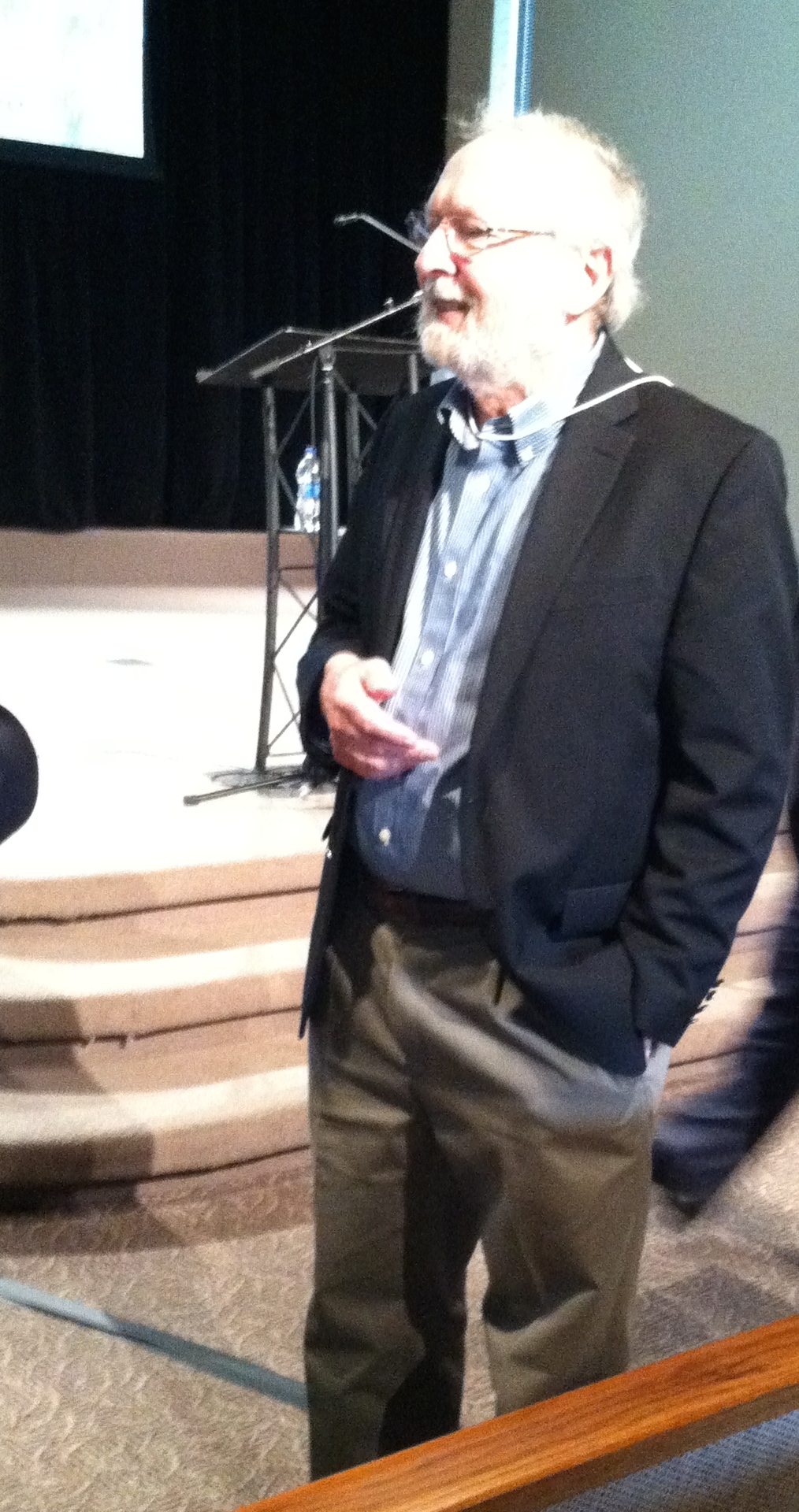
George Marsden
George Marsden

mindedness and Disagreement,” explored the connection between two topics that are germane to this year’s theme.  With regard to the issue of disagreement, the question is whether, or to what extent, confidence in your belief about an issue should be tempered by the fact that some epistemic peers disagree with you.  And, depending upon your view regarding the epistemic implications of peer disagreement, what does it mean to remain open-minded about the issue?  My session was well-attended, and I received helpful feedback, which I am looking forward to implementing in my paper as I revise it and eventually submit it for publication.

The most enjoyable thing about the conference was catching up with some of the scholars I’ve gotten to know through the CCT and other contexts, as well as becoming acquainted with a number of other scholars whom I’d never met before.  Some of these I had only admired from afar, such as the eminent

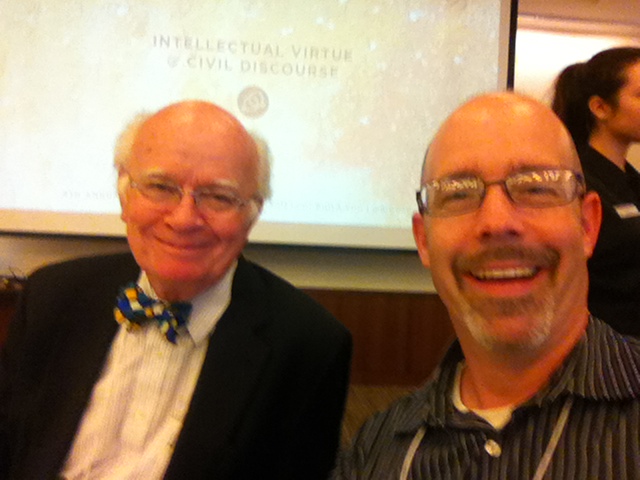
Martin Marty and me
Martin Marty and me

epistemologist Robert Audi and religious scholar Martin Marty, who might be the greatest living scholar in the English speaking world—author of more than 80 books, winner of numerous scholarly awards, member of two U.S. Presidential Commissions, and holder of 80 (yes, eighty) honorary doctorates.  Somehow I ended up sitting next to Marty at the evening banquet at the CCT conference, and I was struck by the warm humor and genuine humility of the man.  What an inspiration.

In fact, the word “inspiring” well captures my entire experience at the Biola Center for Christian Thought this year.  The CCT directors—Thomas Crisp, Steve Porter, and Gregg Ten Elshof—as well as staff members Evan Rosa and Laura Pelser, are all wonderful folks who know how to create a dynamic community atmosphere for rich scholarly research and dialogue.  The Center is currently accepting proposals for the 2016-17 research theme: “Humility: Moral, Religious, and Intellectual.”  If you do work related to this topic and would like an opportunity to dig a lot deeper, then consider submitting a proposal.  I guarantee that the experience would be a highlight of your academic career!

Three Great Books on Intellectual Virtue

This semester I have the honor of working as a Templeton Fellow at the Biola University Center for Christian Thought.  Each year the CCT focuses on a different topic, and the theme this year is intellectual virtue and civil discourse.  My research topic, which fits naturally within this theme, is one that I’ve been working on the last few years—open-mindedness.  What does it mean to be open-minded?  Why is it a virtue?  When is it not virtuous to be open-minded?  And is it possible to be simultaneously open-minded and religiously devout?  For some of my thoughts about these questions, look here.

In the course of my research, I’ve read some really good stuff on intellectual virtue.  So I thought I’d provide a brief introduction to, at least in my assessment, three of the best books on the topic.

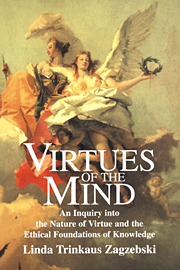
9780521578264Linda Zagzebski, Virtues of the Mind (Cambridge, 1996) — This book is considered by many to be a contemporary classic in the field of virtue epistemology, and for good reason.  Zagzebski not only develops a plausible theory of intellectual virtue, but also offers rich discussions of related and sub-issues along the way, including practical wisdom, understanding, and a critical assessment of Alvin Plantinga’s epistemology.  She conceives knowledge as “cognitive contact with reality arising out of acts of intellectual virtue.”  Although her account overreaches at times, it is nonetheless insightful at nearly every turn.  And, as is the case with all landmark works of philosophy, even her mistakes are instructive.


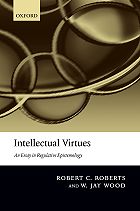
9780199283675_140Robert Roberts and Jay Wood, Intellectual Virtues (Oxford, 2007) — Rather than defending a particular theory of virtue epistemology, Roberts and Wood offer what they call a “regulative epistemology” which aims instead to “generate guidance for epistemic practice.”  For those who are more interested in the practical implications and applications of virtue epistemology, this is a book to check out, which is chock full of insights about the moral life.  After clarifying a number of key concepts, including just what a virtue is, they explore the meaning and practical dimensions of a number of particular intellectual virtues, including intellectual courage, intellectual humility, intellectual autonomy, intellectual generosity, and practical wisdom.


9780199604074_140Jason Baehr, The Inquiring Mind (Oxford, 2011) — In a work that is a bit more theoretical and advanced than the previous two works, Baehr (who is also a CCT fellow this semester) develops and defends what he calls a “personal worth” conception of intellectual virtue.  Along the way he argues for the relevance of considerations of intellectual virtue, whatever one’s view, whether one holds to a reliabilist or evidentialist epistemological theory.  After making his cases for these theoretical points, he explores in-depth two important intellectual virtues:  intellectual courage and open-mindedness.  Baehr’s discussion of the latter of these is especially interesting to me, of course.

These are rigorous, enriching texts which provide theoretical and practical insights—improving our understanding regarding both the nature of knowledge and how we ought to live.  In word, they make us wiser.  Philosophy doesn’t get any richer than this.

Recent Work on the Virtue of Open-mindedness

One of my current research projects concerns the virtue of open-mindedness, and recently two of my articles on the subject were published in scholarly journals.  One of these, which appears in the March issue of Theory and Research in Education, discusses several accounts of open-mindedness and defends William Hare’s account against some prominent alternatives, including those of Peter Gardner and Jonathan Adler.  In the essay I also compare and contrast open-mindedness with the related virtue of intellectual humility.

My other article, published in the April issue of Sophia, discusses what I call the paradox of open-mindedness and religious devotion.  To be religiously devout is presumably to be firmly committed to believing in and following God, and this includes behaving virtuously in all respects.  But such commitment seems to rule out openness to changing one’s mind about certain beliefs and values that are entailed in that religious devotion.  Now assuming (as nearly all virtue ethicists and epistemologists do) that open-mindedness is a virtue, this creates a paradox, where it appears to be virtuous to display an intellectual vice, namely closed-mindedness.  In my essay I explore a variety of potential ways of resolving this paradox.  The route that I think succeeds appeals to the possibility of personal knowledge of God via direct experience.

My work on open-mindedness is ongoing, and my long-term goal is to do a book on the subject.  More immediately, I am working on a paper entitled “Open-mindedness and Christian Flourishing” which I am slated to present at a Society for Christian Psychology conference this fall dealing with the theme “Towards a Christian Positive Psychology.”  I’ll say more about this conference in a later post.