
Death vs. Ascension

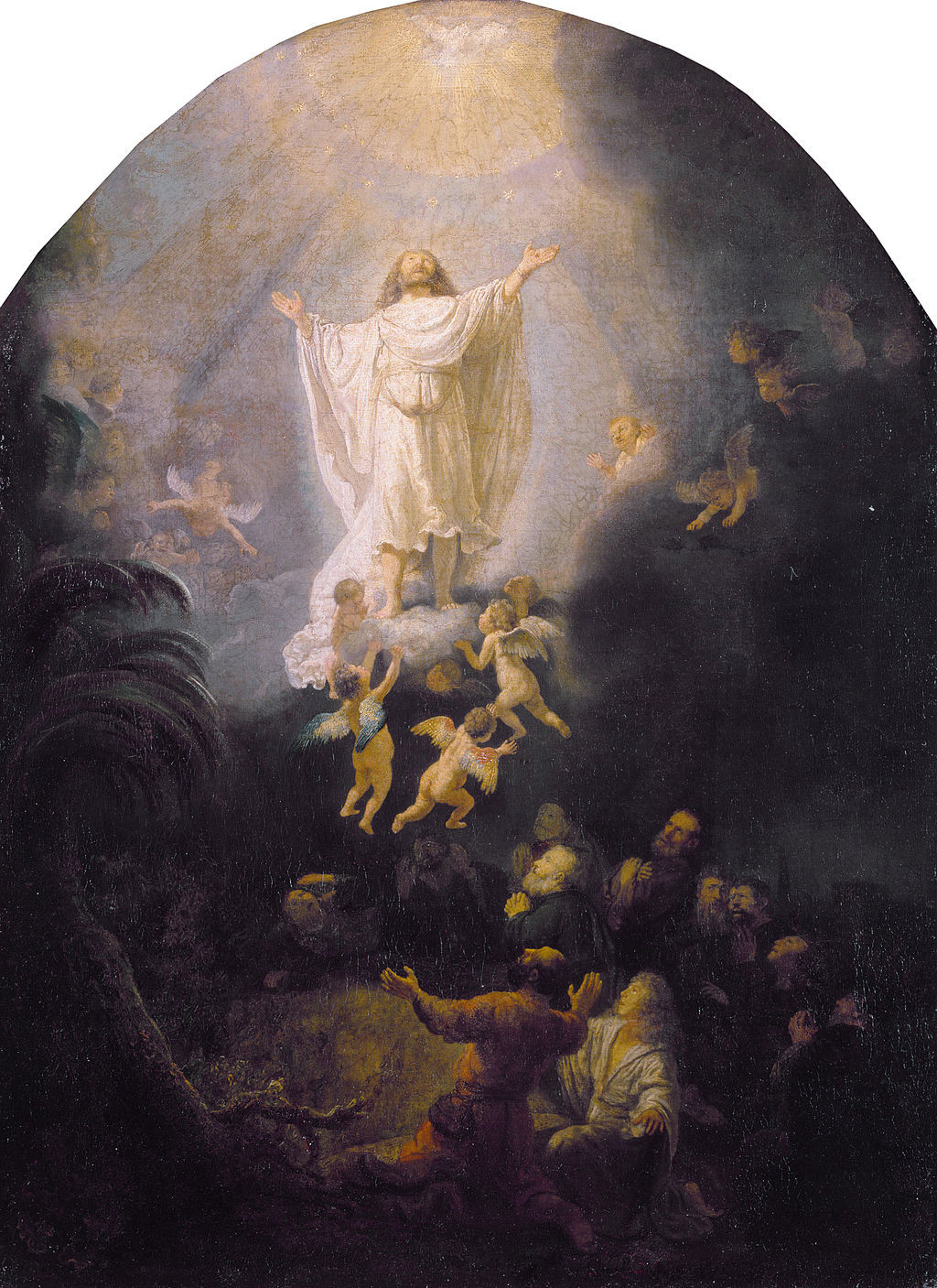
One of the most fascinating scenes in the New Testament—to my mind, at least—is the ascension of Jesus Christ. As Luke records the event in the book of Acts, he notes that after his resurrection, Jesus appeared to his disciples over a period of forty days and on one occasion:

They gathered around him and asked him, “Lord, are you at this time going to restore the kingdom to Israel?”

He said to them: “It is not for you to know the times or dates the Father has set by his own authority. But you will receive power when the Holy Spirit comes on you; and you will be my witnesses in Jerusalem, and in all Judea and Samaria, and to the ends of the earth.”

After he said this, he was taken up before their very eyes, and a cloud hid him from their sight.

They were looking intently up into the sky as he was going, when suddenly two men dressed in white stood beside them. “Men of Galilee,” they said, “why do you stand here looking into the sky? This same Jesus, who has been taken from you into heaven, will come back in the same way you have seen him go into heaven.” (Acts 1:6-11).

And that was the last they saw of Jesus. It was their final, unceremonious goodbye. And yet, apparently, there was no weeping or wailing. No one cried. No one mourned. In fact, the disciples simply got to work building the church and joyfully proclaiming the Good News.

What a contrast between this and when Jesus died six weeks earlier. And yet, from the standpoint of saying goodbye, at least as far as anyone could tell at the time, the situation was no different. A beloved friend was leaving for good. Why such a different response?

Was it the manner of death? This can’t be the explanation, since it is the loss of our loved ones that we mourn, not their manner of death. This is reflected in the (very reasonable) common expression, “I’m sorry for your loss.” We never say, “I’m sorry your loved one died the way they did.” Yes, an especially painful or violent death may exacerbate the pain of loss. But the essence of sorrow regards the loss of the person, not how they died. And yet, when Jesus ascended, the disciples lost their friend. So why no mourning?

Was it the presence of Jesus’ dead body that made his death so much more painful than his ascension? No, this can’t be it. If your loved one were to die in such a way that their body is out of sight or irretrievable (e.g., sunken in the ocean depths, lost in space, etc.) you would mourn every bit as much as if their lifeless body was present. The presence of a corpse may make some psychological difference (for better or worse), but that’s not the source of our sorrow. Again, it is the loss of the person we mourn.

Or maybe the difference lies in the fact that by the time Jesus ascended, he had proven he was the Messiah, that the disciples’ personal investment in him was not in vain, and that their trust in him was vindicated. Perhaps this is why
the disciples didn’t mourn his ascension. Again, this doesn’t account for the fact that, just as in the case of a physical death, by ascending Jesus was leaving them for good.

Or was he? It seems to me that the key to understanding the different responses is that Jesus’ ascension proved his departure was only temporary. That by his resurrection he proved that he had conquered death and that he could be trusted in his promise that he was going to return and bring about his everlasting kingdom. This meant, again, that the goodbye was not permanent but only temporary.

So the difference has to do with Gospel hope, something that the disciples definitely did not have immediately after Jesus was crucified and buried. In fact, they had lost all hope. But with the fact that the ascension occurred after his resurrection made all the difference. Moreover, his resurrection proved that all death is conquered and that, as Christians, all of our goodbyes are only temporary. And this is why the Apostle Paul would later dare to mock death, saying, “Where, O death, where is your victory? Where, O death, where is your sting?” (1 Cor. 15:55).

Of course, I am not saying that our mourning the death of friends and loved ones is not rational or that we lack faith in doing so. Rather, we mourn with hope. And, as Christians, we understand that our goodbyes really are temporary—that we, too, ascend after death and, like our Lord, we go to await our final reunion with the people of God. That is Gospel hope, and it makes all the difference in the world.
The Darkness Before the Dawn (Eschatologically Speaking)

In the Olivet Discourse in Matthew 24, Jesus describes the hardships of the church in the “last days”:

As Jesus was sitting on the Mount of Olives, the disciples came to him privately. “Tell us,” they said, “. . . what will be the sign of your coming and of the end of the age?”

Jesus answered: “Watch out that no one deceives you. For many will come in my name, claiming, ‘I am the Messiah,’ and will deceive many. You will hear of wars and rumors of wars, but see to it that you are not alarmed. Such things must happen, but the end is still to come. Nation will rise against nation, and kingdom against kingdom. There will be famines and earthquakes in various places. All these are the beginning of birth pains.

“Then you will be handed over to be persecuted and put to death, and you will be hated by all nations because of me. 10 At that time many will turn away from the faith and will betray and hate each other, 11 and many false prophets will appear and deceive many people. 12 Because of the increase of wickedness, the love of most will grow cold, 13 but the one who stands firm to the end will be saved. 14 And this gospel of the kingdom will be preached in the whole world as a testimony to all nations, and then the end will come.

15 “So when you see standing in the holy place ‘the abomination that causes desolation,’ spoken of through the prophet Daniel—let the reader understand—16 then let those who are in Judea flee to the mountains. 17 Let no one on the housetop go down to take anything out of the house. 18 Let no one in the field go back to get their cloak. 19 How dreadful it will be in those days for pregnant women and nursing mothers! 20 Pray that your flight will not take place in winter or on the Sabbath. 21 For then there will be great distress, unequaled from the beginning of the world until now—and never to be equaled again.

22 “If those days had not been cut short, no one would survive, but for the sake of the elect those days will be shortened. 23 At that time if anyone says to you, ‘Look, here is the Messiah!’ or, ‘There he is!’ do not believe it. 24 For false messiahs and false prophets will appear and perform great signs and wonders to deceive, if possible, even the elect. 25 See, I have told you ahead of time.

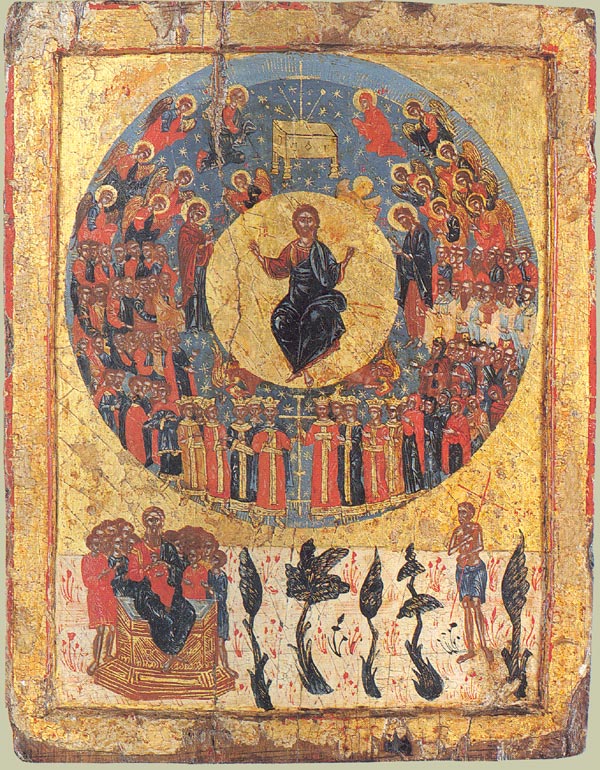
The timing of the events described in this passage is a matter of considerable scholarly debate.  Some interpret this passage as describing events that have (at least mostly) already occurred, and other commentators see the “great distress” described there as still (at least largely) in the future, just preceding his return to earth to usher in his Kingdom.  I’m inclined to a version of the latter view that life on Earth will be characterized by extreme suffering—worse than ever on this planet, in fact—just prior to Christ’s return.  That is, things

Greek icon of Second Coming, c.1700 (Wikipedia)

will get really bad just before they get really good.  Moreover, as I read this and other relevant biblical passages, Christians will not be exempt from the suffering (via some sort of “rapture’) but will experience awful tribulation and persecution in the final days.

If this is correct, then it raises an interesting question.  Why has God ordained human history to end this way?  Why write the narrative in such a way that the dawn of Christ’s eternal reign is preceded by extreme, perhaps unprecedented human—and especially Christian—suffering?  One answer, with which I’m sympathetic, appeals to theological aesthetics.  There is something beautiful in the passage from darkness to light.  Even when we’re not making such an aesthetic judgment about this pattern in human life, we nonetheless often make the observation that “its always darkest just before the dawn.”  The beauty of this pattern is evident in many contexts, from the triumph of an inventor after many failures to a sports team that rallies in the final minutes to prevail against adversity.  And, in the case of Jesus’ preferred metaphor, childbirth is one of the most vivid illustrations of this.  Perhaps no other human experience is marked by such excruciating pain followed by so much joy.  And here lies a major aspect of the beauty of the experience.  Similarly, one might say, the story of human history is more beautiful overall because the “birth pangs” of extreme human suffering will be swallowed up in the joy of Christ’s return and our “birth” into his blessed Kingdom.

All of this is right, I think, but there is another theological dimension here that I think is relevant, and this concerns the unity of Christ and his church.  A recurrent biblical theme is that the church—understood as the collection of Christ’s faithful followers—is in some mystical sense the “body of Christ.”  The Apostle Paul makes several references to this metaphor (e.g., 1 Cor. 12:27; Eph. 4:12-15; Col. 1:24).  Now to take seriously our deep metaphysical union with Christ is, therefore, to take seriously the notion that we must suffer with him.  As the Apostle Paul says, “if we share in his sufferings [then] we may also share in his glory” (Rom. 8:17).  Thus, for the church to be fully redeemed, we must be fully united with Christ, and this entails sharing in his experience of suffering and death as well as resurrection.  As Paul elsewhere says, “I want to know Christ and the power of his resurrection and the fellowship of sharing in his sufferings, becoming like him in his death, and so, somehow, to attain to the resurrection of the dead” (Phil. 3:10-11).  Peter echoes this theme as well when he says, “rejoice that you participate in the sufferings of Christ, so that you may be overjoyed when his glory is revealed” (1 Pet. 4:13).

This much is not particularly controversial biblically speaking, notwithstanding the contemporary American aversion to the biblical notion that Christians must suffer and that God actually ordains this for us (e.g., 1 Peter 1:5-7; James 1:2-4, etc.).  But what if the parallel goes even farther than the pattern of the church’s suffering on Earth followed by resurrection into eternal glory?  Perhaps even the narrative structure of the “life” of the Christian church parallels that of Jesus’ earthly life.  As we know, Jesus’ hardest days were toward the end of his time on earth.  No doubt, he faced all sorts of trials throughout his entire life, but his betrayal, unjust trial and condemnation, brutal pre-crucifixion torture and mockery, culminating in a hideous protracted crucifixion were surely the worst experiences of his life.  And all of this was followed by the triumphant joy of his resurrection.  So if we assume a parallel narrative structure between the life of Christ and the life of his “body” that is his church, then we should actually expect that worldwide Christian suffering will grow increasingly extreme in the last days prior to the second coming of Christ.

Thus, on this view, the tribulation of the church in the last days constitutes a sort of historical recapitulation of the life of Christ on earth—Jesus’s “passion week” writ large in the form of his suffering corporate body, the church.  Just as Christ was unjustly persecuted during his last days on earth, his bride—the worldwide Christian community—is persecuted during the last days of her 2000-year “lifetime.”  And like her Savior, the church suffers horribly only to be overjoyed upon her resurrection.  Hallelujah.