
Dealing with Anxiety about the Suffering of Others

Recently a student shared with me her struggle to concentrate on her school work due to the COVID-19 pandemic:

I know that suffering is always going on in the world, and if we let that get to us we’ll never live at all and we can’t help at all. However, for me to be expected to sit from the comfort of my own home and continue my education like normal when I know that there are people that do not share the same simple luxuries as I do seems almost blasphemous. I’ve always known that God has made me have my heart broken for the sake of others and right now it is shattered from all of the hurt in the world and I feel like we’re not addressing any of it. I feel completely helpless and like this is not how we should be responding. And I don’t know what to do. . . . How do I find motivation when all of this is going on?

Can you identify with this? This is a common struggle for people who are especially sensitive to suffering in this world. And it’s to be expected that the pandemic would heighten the difficulty for some folks. So what can one say in response?

If you share this struggle, the first thing I would do is affirm your sensitivity to the suffering of others. This sort of empathy is a gift, and God can use it mightily to motivate you to help and serve others. However, as with all gifts and special talents, it also presents certain challenges and temptations, and the temptation to anxiety and becoming overburdened by others’ sufferings is one of these. So you will need to address this head-on with some relevant biblical truths. One of these is Jesus’ command in John 14:1, “Do not let your heart be troubled.” The fact that he issues this directive as a command indicates that we bear some responsibility in keeping ourselves from indulging anxious thoughts. Because, as Kant says, “ought implies can,” this means we are capable of resisting the temptation to anxiety and a troubled heart.

So this raises the question, how does one do that? The answer is apparent in the following verses of John 14, where Jesus says, “You believe in God; believe also in me. My Father’s house has many rooms; if that were not so, would I have told you that I am going there to prepare a place for you? And if I go and prepare a place for you, I will come back and take you to be with me that you also may be where I am.” In short, we must exercise faith in Christ and specifically remember the eschatological promise that he will make all things well for his people in the next world. Jesus addresses anxiety also in Matthew 6:31-34 and Luke 12:22-31. In these passages, too, he reminds us that we should trust God, and know that he will take care of us. So worry and anxiety are basically a lack of faith. Now this applies to everyone, so when you are worrying about other people, some of whom perhaps you’ve never met, who are experiencing hardships that you have been spared, this is no less a lack of faith. You need to trust that God is taking care of them as well.

It might be helpful to consider how Jesus conducted himself during his time on earth. Note that he was not anxious about the millions of people around the world who were suffering in all sorts of ways, even though he could have brought all of that suffering to an end with just a snap of his fingers. Ponder that for a moment. In fact, he often enjoyed himself and lived in relative comfort. He even participated in a wedding banquet, and his first miracle was to create a luxurious item—wine out of water (John 2). So if we are to follow Jesus’ example, then we must recognize that it is appropriate to enjoy certain comforts and luxuries—in moderation of course. I would add that this, too, is one of our duties as God’s children—to thankfully enjoy the bounty that God may grant us at various times in our lives.

Furthermore, consider the Golden Rule in this context. When you are suffering in some way, is it your preference or desire that all sorts of other people whom you may or may not know become sorrowful and downtrodden because of your pain? Or would you rather just a few people close to you comfort you in your time of need? For me, it is definitely the latter. I certainly don’t want lots of people to be burdened by my pain. So the Golden Rule would seem to recommend that I be particularly concerned to help, assist, and comfort those whom I personally know to be in need and whom I am able to help or comfort in some way. To be extremely burdened by the suffering of countless people whom I have never met is a failure to abide by the Golden Rule. Moreover, it cannot help anyway and can be paralyzing, as my student seems to have experienced. So even though your anxiety might be prompted by a concern for other people, it actually makes you less helpful to others, so it is self-defeating.

So there are multiple biblical reasons (i.e., Jesus’ command, the example of Jesus, and the Golden Rule) not to be constantly troubled or anxious about the suffering of others out there whom you haven’t even met but to be productive and focus on blessing and serving others with whom you make contact in the course of your day. This is the best we can do as mortal, finite people. And we must trust God to take care of others all over the world. Remember that they are his children, and he loves them infinitely more than you do, and even if they suffer tragedies in this life (as the Kennedy family recently did, yet again) we must trust that God will comfort them, whether in this life or in the next world.

Again, the key is faith and trust in God. But now what can we do to build that faith and trust in God? The most effective step is prayer. See, for example, Ps. 34:4, Phil. 4:6-7, 1 Pet. 5:6-7, and Rom. 8:26-28. And if you struggle with this sort of anxiety, here is something you can do as a spiritual discipline. Whenever you feel that unease welling up within you, pray for one minute for the people about whom you are concerned. Or, if there is no one in particular who is the object of your anxiety, then pick some person, family, community, city, or nation and pray for them. And be sure to commit them into God’s good care and declare your trust in God regarding their welfare. If you make that a regular practice, I expect that will go a long way in resolving your struggles with anxiety. Give it a try. “The prayer of a righteous person is powerful and effective” (James 5:16). And that power and effectiveness pertains not just to the persons and situations about which one prays, but also one’s own soul.
Suffering with Christ—a Light Burden?

There are two teachings of Jesus which might seem irreconcilable or at least a source of rational tension.  On the one hand, Jesus tells us that following him comes at a significant personal cost.  He says, “Whoever wants to be my disciple must deny themselves and take up their cross and follow me.  For whoever wants to save their life will lose it, but whoever loses their life for me will find it” (Mt. 16: 24-25).  Elsewhere he tells his followers, “you will be hated by everyone because of me” (Mt. 10:22).  The Apostle Paul reiterates this same point when he asserts, “everyone who wants to live a godly life in Christ Jesus will be persecuted” (2 Tim. 3:12).  Paul also goes so far as to say that “we are heirs—heirs of God and coheirs with Christ, if indeed we share in his sufferings” (Rom. 8:17).  This theme of suffering with Christ is heavily emphasized by the biblical writers, as it recurs in such passages as Rom. 5:3-4; 2 Cor. 1:5; Phil. 3:10-11; 1 Pet. 4:13; James 1:2-4; and 1 Pet. 1:6-7.

Of course, these sobering declarations regarding the difficult road of submission to Christ are also accompanied by the promise that our loss and suffering on earth will be more than compensated for by heavenly reward, as Jesus assures us that those who faithfully serve him are storing up “treasures in heaven” (Mt. 6:20), that “the Son of Man is going to come in his Father’s glory with his angels, and then he will reward each person according to what they have done” (Mt. 16:27).  Therefore, promises the Apostle Paul, “our present sufferings are not worth comparing with the glory that will be revealed in us” (Rom. 8:18).

So there is a certain irony here—that one must lose in order to gain, suffer in order to know everlasting joy.  But the point of tension to which I refer emerges when we consider another teaching of Christ, remarkably one that aims to comfort us.  I am thinking of Jesus’ invitation in Matthew 11: “Come to me, all you who are weary and burdened, and I will give you rest.  Take my yoke upon you and learn from me, for I am gentle and humble in heart, and you will find rest for your souls.  For my yoke is easy and my burden is light” (Mt. 11:28-30).  This naturally begs the question, if life in Christ is marked by suffering and difficulty, how could such be an “easy yoke” or a “light burden”?  I certainly would not describe the travails of the Apostle Paul or his fellow apostles in that way.  Nor would I be inclined to use such terms to describe the lives of the many Christians who are currently being martyred around the world these days.

Of course, it is indeed helpful to place all such Christian suffering in eternal perspective.  Knowing that we will be forever comforted and relieved of all burdens in the afterlife does make our suffering more bearable.  But there is another consideration that must be borne in mind here, and that is the contrasting burden of the person who refuses Christ and lives for their own self.  A psalm says, “the Lord watches over the way of the righteous, but the way of the wicked leads to destruction” (Ps. 1:6).  A proverb declares, “the way of the transgressor is hard” (Pr. 13:15, KJV), and another proverb asserts, “the righteous person is rescued from trouble, and it falls on the wicked instead” (Pr. 11:8). In fact, the prevailing theme in the book of Proverbs is that the life of wisdom brings joy and great reward, while the life of folly brings frustration, sorrow, and destruction.  So here we have a clear contrast between the comparatively easy yoke and light burden of wise life as opposed to the hard yoke and heavy burden of the foolish life.  Add to this the weight of guilty conscience which plagues the fool, and the burden is compounded.  As John Calvin once said, “the torture of a bad conscience is the hell of a living soul.”  The true disciple of Christ is spared this torture, having been fully forgiven and also empowered by the Spirit to live a repentant, obedient life.

Considered in this light, Jesus’ observation that his yoke is easy and his burden is light makes much sense, even on this side of paradise.  We might experience significant suffering in this life, but we have the joy of knowing this will flower in eternal reward in the afterlife.  And during our earthly sojourn, we are spared the oppressive burden of a guilty conscience.  For all of the difficulties we may face as Christians, that is certainly a comparatively easy yoke. So Christ’s teachings that there is a high cost to following him and that his burden is light are reconcilable after all.

The Darkness Before the Dawn (Eschatologically Speaking)

In the Olivet Discourse in Matthew 24, Jesus describes the hardships of the church in the “last days”:

As Jesus was sitting on the Mount of Olives, the disciples came to him privately. “Tell us,” they said, “. . . what will be the sign of your coming and of the end of the age?”

Jesus answered: “Watch out that no one deceives you. For many will come in my name, claiming, ‘I am the Messiah,’ and will deceive many. You will hear of wars and rumors of wars, but see to it that you are not alarmed. Such things must happen, but the end is still to come. Nation will rise against nation, and kingdom against kingdom. There will be famines and earthquakes in various places. All these are the beginning of birth pains.

“Then you will be handed over to be persecuted and put to death, and you will be hated by all nations because of me. 10 At that time many will turn away from the faith and will betray and hate each other, 11 and many false prophets will appear and deceive many people. 12 Because of the increase of wickedness, the love of most will grow cold, 13 but the one who stands firm to the end will be saved. 14 And this gospel of the kingdom will be preached in the whole world as a testimony to all nations, and then the end will come.

15 “So when you see standing in the holy place ‘the abomination that causes desolation,’ spoken of through the prophet Daniel—let the reader understand—16 then let those who are in Judea flee to the mountains. 17 Let no one on the housetop go down to take anything out of the house. 18 Let no one in the field go back to get their cloak. 19 How dreadful it will be in those days for pregnant women and nursing mothers! 20 Pray that your flight will not take place in winter or on the Sabbath. 21 For then there will be great distress, unequaled from the beginning of the world until now—and never to be equaled again.

22 “If those days had not been cut short, no one would survive, but for the sake of the elect those days will be shortened. 23 At that time if anyone says to you, ‘Look, here is the Messiah!’ or, ‘There he is!’ do not believe it. 24 For false messiahs and false prophets will appear and perform great signs and wonders to deceive, if possible, even the elect. 25 See, I have told you ahead of time.

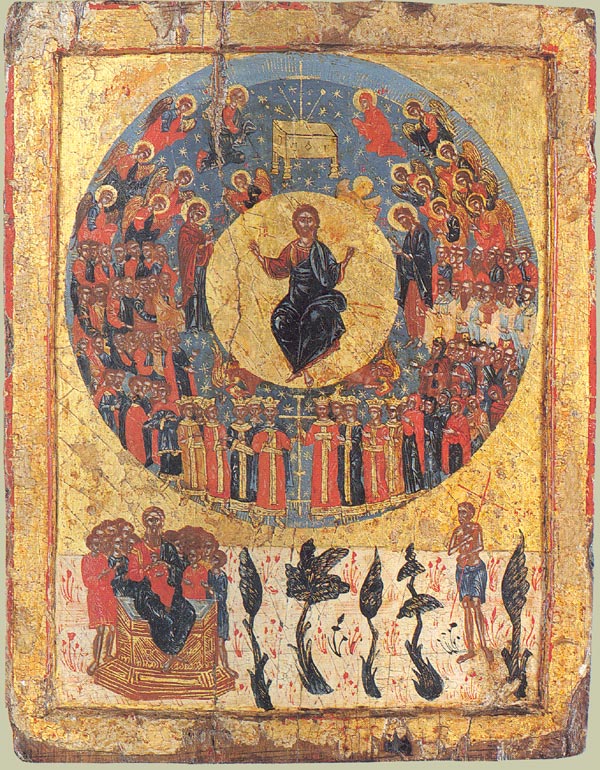
The timing of the events described in this passage is a matter of considerable scholarly debate.  Some interpret this passage as describing events that have (at least mostly) already occurred, and other commentators see the “great distress” described there as still (at least largely) in the future, just preceding his return to earth to usher in his Kingdom.  I’m inclined to a version of the latter view that life on Earth will be characterized by extreme suffering—worse than ever on this planet, in fact—just prior to Christ’s return.  That is, things

Greek icon of Second Coming, c.1700 (Wikipedia)

will get really bad just before they get really good.  Moreover, as I read this and other relevant biblical passages, Christians will not be exempt from the suffering (via some sort of “rapture’) but will experience awful tribulation and persecution in the final days.

If this is correct, then it raises an interesting question.  Why has God ordained human history to end this way?  Why write the narrative in such a way that the dawn of Christ’s eternal reign is preceded by extreme, perhaps unprecedented human—and especially Christian—suffering?  One answer, with which I’m sympathetic, appeals to theological aesthetics.  There is something beautiful in the passage from darkness to light.  Even when we’re not making such an aesthetic judgment about this pattern in human life, we nonetheless often make the observation that “its always darkest just before the dawn.”  The beauty of this pattern is evident in many contexts, from the triumph of an inventor after many failures to a sports team that rallies in the final minutes to prevail against adversity.  And, in the case of Jesus’ preferred metaphor, childbirth is one of the most vivid illustrations of this.  Perhaps no other human experience is marked by such excruciating pain followed by so much joy.  And here lies a major aspect of the beauty of the experience.  Similarly, one might say, the story of human history is more beautiful overall because the “birth pangs” of extreme human suffering will be swallowed up in the joy of Christ’s return and our “birth” into his blessed Kingdom.

All of this is right, I think, but there is another theological dimension here that I think is relevant, and this concerns the unity of Christ and his church.  A recurrent biblical theme is that the church—understood as the collection of Christ’s faithful followers—is in some mystical sense the “body of Christ.”  The Apostle Paul makes several references to this metaphor (e.g., 1 Cor. 12:27; Eph. 4:12-15; Col. 1:24).  Now to take seriously our deep metaphysical union with Christ is, therefore, to take seriously the notion that we must suffer with him.  As the Apostle Paul says, “if we share in his sufferings [then] we may also share in his glory” (Rom. 8:17).  Thus, for the church to be fully redeemed, we must be fully united with Christ, and this entails sharing in his experience of suffering and death as well as resurrection.  As Paul elsewhere says, “I want to know Christ and the power of his resurrection and the fellowship of sharing in his sufferings, becoming like him in his death, and so, somehow, to attain to the resurrection of the dead” (Phil. 3:10-11).  Peter echoes this theme as well when he says, “rejoice that you participate in the sufferings of Christ, so that you may be overjoyed when his glory is revealed” (1 Pet. 4:13).

This much is not particularly controversial biblically speaking, notwithstanding the contemporary American aversion to the biblical notion that Christians must suffer and that God actually ordains this for us (e.g., 1 Peter 1:5-7; James 1:2-4, etc.).  But what if the parallel goes even farther than the pattern of the church’s suffering on Earth followed by resurrection into eternal glory?  Perhaps even the narrative structure of the “life” of the Christian church parallels that of Jesus’ earthly life.  As we know, Jesus’ hardest days were toward the end of his time on earth.  No doubt, he faced all sorts of trials throughout his entire life, but his betrayal, unjust trial and condemnation, brutal pre-crucifixion torture and mockery, culminating in a hideous protracted crucifixion were surely the worst experiences of his life.  And all of this was followed by the triumphant joy of his resurrection.  So if we assume a parallel narrative structure between the life of Christ and the life of his “body” that is his church, then we should actually expect that worldwide Christian suffering will grow increasingly extreme in the last days prior to the second coming of Christ.

Thus, on this view, the tribulation of the church in the last days constitutes a sort of historical recapitulation of the life of Christ on earth—Jesus’s “passion week” writ large in the form of his suffering corporate body, the church.  Just as Christ was unjustly persecuted during his last days on earth, his bride—the worldwide Christian community—is persecuted during the last days of her 2000-year “lifetime.”  And like her Savior, the church suffers horribly only to be overjoyed upon her resurrection.  Hallelujah.

Why are Atheist Athletes Rare?

Last year, NFL punter Chris Kluwe made headlines because of his atheism.  The reason for his newsworthiness, as the writer of this Psychology Today report on Kluwe notes, is that “open secularity is rare in pro sports.”  This is something that has puzzled me since writing my atheism book several years ago.  Why are atheist athletes rare?

You can find all sorts of atheist lists on the Internet.  These include such categories as famous atheists, celebrity atheists, and top atheists in the world.  And it isn’t just atheist apologists that provide these lists.  There are also prodigious Wikipedia lists of atheists in various fields, including politics and law, science and technology, and arts and entertainment.

But try finding a similarly expansive list of atheist athletes.  Here’s the best I could do: 19 Famous Athletes Who are Atheist.  This is a classic case of exceptions proving the rule.  Pretty slim pickings.  I found it interesting, for starters, that they couldn’t even find one more to make it an even twenty.  (They should add Kluwe, since he’s not included.)  And it is supposedly a list of “famous” athletes.  Yet, as an avid sports buff, I only recognized five people on the list.  Moreover, some of these reach way back, such as to an Italian cyclist from 70 years ago.  And another is a WWE wrestler—isn’t that better categorized as acting?  After reading through this disappointing list, I discovered the Top 15 Athletes Who are Atheist.  But it largely overlaps with the list of 19 “famous” atheists above.

So why are atheists so rare in professional sports?  I have a theory, but to explain it I’ll need to start by discussing the primary rationale that atheists and religious skeptics give for not believing in God.  This is the problem of evil.  Lance Armstrong has been quoted as saying, “If there was a God, I’d still have both nuts.”  This statement encapsulates a common intuition about human suffering and religious belief, which essentially constitutes an atheistic argument:  God would not want humans to suffer significantly.  However, there is a lot of suffering in the world.  Therefore, God must not exist.  If you were to interview all of the atheists listed in the sites above and ask them why they reject theism, most if not all of them would cite suffering as a major reason.  But these men and women are not unique in their awareness of suffering.  All serious athletes are well acquainted with pain.  And here may lie the clue to understanding why atheist athletes are rare.

To do intense athletic training is to welcome a degree of suffering.  Athletes understand the usefulness of pain as a means to physical conditioning and mental toughness, which ultimately means success.  No pain no gain, as the saying goes.  Consequently, we should expect athletes to be less inclined to see suffering as antithetical to good ends.  And to become accustomed to linking these two things—pain and gain—is to gain a deeper existential awareness of how suffering is essential for growth in all of life, not just athletics.

This in turn will enable the athlete to recognize that God can work through painful experiences generally to bring about greater goods in people’s lives.  So he or she will be more ready to affirm with the prophet Isaiah that it is good how God gives us “the bread of adversity and the water of affliction” (Isa. 30:20).  And just as the difficulties and challenges one faces on the court, diamond or gridiron make one better, the athlete will be likely to affirm with the apostle James that our trials in life have a constructive end, namely to make us “mature and complete, not lacking anything” (Jas. 1:4).  Such an attitude might not create a perfect immunity to atheism or religious skepticism, but it certainly could prevent one’s faith from being undermined by the problem of evil.  And this might explain why atheist athletes are so rare.

Learning Obedience Through Suffering

This weekend I will am scheduled to speak at a church retreat near Knoxville, Tennessee.  My topic is “Growing the Church from the Inside Out,” and my focus will be on the role of spiritual formation in building the church, both in maturity and, secondarily, in numbers.  I give frequent talks on the spiritual disciplines and the concept of training for godliness (cf. 1 Cor. 9:24-27 and 1 Tim. 4:7-8).  This is a recurrent theme in Scripture, yet somehow it is a foreign concept to many evangelicals these days.  So I am always eager to speak on the subject, especially since I can count on a strongly positive response from audiences. Given the moral decay in the contemporary church, there is a deep need here, and judging by people’s responses, it is also a felt need.

One of the biblical themes I emphasize is the notion that we must be intentional about learning to obey, hence the critical role of such disciplines as fasting and sacrifice in order to build self-control.  I also highlight the role of suffering, unpleasant as it is, to discipline us and make us more obedient.  Regarding this latter theme, I have been revisiting one of the more fascinating (and cryptic) passages in the New Testament, Hebrews 5:8-9, which says regarding Jesus that “although he was a son, he learned obedience from what he suffered and, once made perfect, he became the source of eternal salvation for all who obey him…”  Now what does this mean?  Before venturing a positive answer, let’s first get clear on what it doesn’t mean.  It can’t mean that Jesus was ever disobedient or morally corrupt and that his suffering somehow brought him out of this condition.  Jesus neither had a sinful nature (because he was conceived by the Holy Spirit) nor did he ever perform sinful actions.

So what does this passage mean?  In what sense might a God-man “learn obedience”?  A few possibilities come to mind.  First, though morally impeccable, Jesus still might have had to develop the skill of obedience in diverse contexts.  One can only become proficient at resisting  certain kinds of temptation when one has actually been tempted in those ways.  And such virtues as self-control and humility become fully formed only when one has had to display them in a variety of circumstances.  Second, Jesus’ moral perfection would not rule out the need to practice obedience in the face of increasing degrees of difficulty.  Given his mission to be publicly humiliated and die an excruciating death, before ultimately conquering death through his resurrection, the suffering he experienced throughout his life no doubt prepared him to endure his torturous final hours.

Perhaps there are other ways to make sense of this passage, but one thing is clear:  suffering played a constructive role in helping even the God-man to grow in obedience.  And if suffering served Jesus’ moral development in this way, then how much more must we suffer in order to grow morally?

A Series of Deaths

I have a good friend who likes to say that “life is a series of deaths.”  In saying this, he is referring to the fact that our journey on this planet involves many farewells and demands of self-denial—and each of these represents some kind of permanent loss.  As you grow your childhood perishes.  With each graduation during your school years you say goodbye to friends, many of whom you will never seen again.  And the ones with whom you do stay in touch you will never know in that context again.  When you marry, much of your freedom dies, and with the birth of each child you must lay aside worthwhile projects and even some dreams.  And then come the real deaths.  You lose friends to accidents, cancers, and even suicide.  Your parents begin to fail and suddenly you find yourself having to parent them in return, perhaps nursing them into that good night—always half believing its not really happening.  It’s just one death after another.

Sounds pretty bleak, doesn’t it?  Well, it would be if that were the whole story.  And I suppose that if I thought it was, perhaps I’d have gone the way of some of my departed friends by now.  But it’s not the whole story.  Because with each of those deaths has come new life.  God has a way of replacing lost projects and dreams with even greater projects and dreams.  Far beyond the meager imaginings of my youth and even my young adulthood is the joy and satisfaction I’ve found in my wife and children as well as the broader community of which we are a part.  What calling is higher than investing your life in other souls?  Even the pains we feel in this context are, as C.S. Lewis would say, “more precious than all other gains.”

Of course, there are goodbyes ahead for all of these relationships as well.  More deaths to come in a seemingly endless train.  But it’s not really endless.  One day, we are told, all death will cease and God will wipe away every tear.  And, if Scripture is to be trusted, there are good things which emerge from our earthly trials—good things which are endless, such as the virtues we develop in persevering (cf. James 1:2-4; 1 Pet. 1:5-7).  God does not put us through this soul-grind without reason.  He does so to mold us into something wonderful, even the image of Christ.  And if that isn’t worth enduring a series of deaths, then nothing is.