The first time I heard a Weezer song was in the Fall of 1994 at the university where I taught at the time. The song was “Undone” and while it was playing I asked a student, “Who is that band?” He sneered and said “Weezer” dismissively. The next day I went out and bought the album and was immediately amazed by what I heard. Over 30 years and hundreds of songs later, the band is still going strong and I love them more than ever. But many people still sneer at Weezer or at least don’t take them seriously. Why is this?
Several reasons, I believe. For starters, there is the band name, which is goofy. It originated with Rivers Cuomo’s father who would call his son “weezer” when Rivers was a little kid. Rivers liked the sound of it, so the rest is history. Another likely reason is that Weezer’s music is fun. Many of their songs are witty, 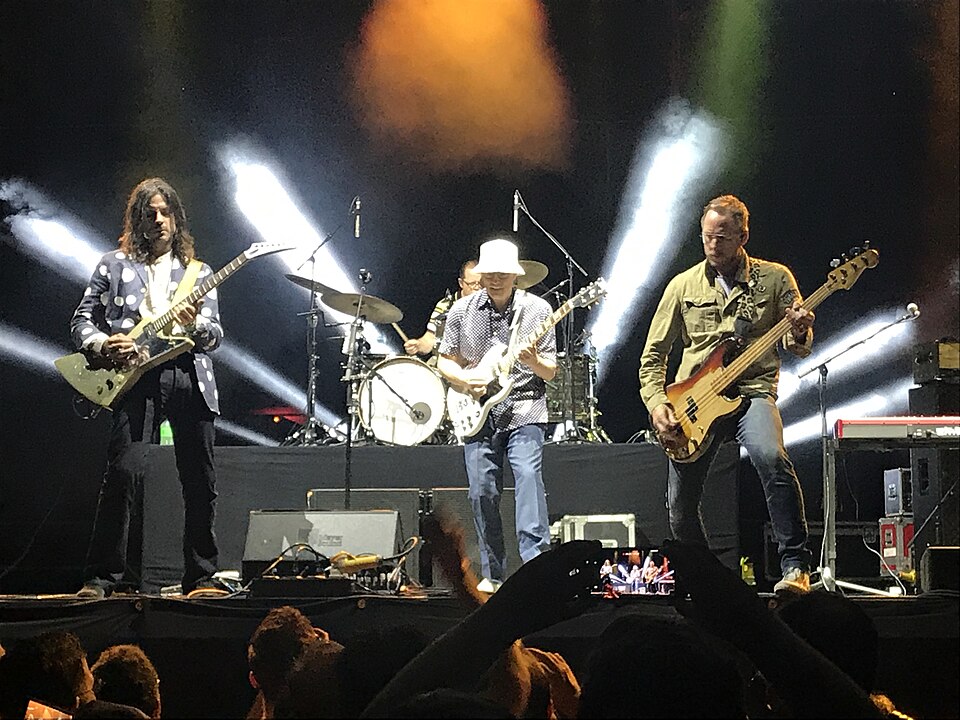 satirical, or silly, and even on many serious songs there are funny turns of phrases that make us smile, all of which adds up to a band that has a generally campy aesthetic. This has been consistently reinforced by many of Weezer’s album covers, album titles, and their practice of repeatedly releasing self-titled albums, leaving it to journalists and fans to nickname them by their predominant colors. But perhaps the biggest reason why Weezer isn’t taken seriously is their unlikely front man. Shy, reclusive, self-deprecating, and well-educated, Rivers Cuomo is the archetypal anti-rockstar. Or, at least, his persona directly contradicts what we have learned to expect from a rock band’s central figure.
In light of all of this, those who are bound by rock culture categories will naturally be inclined to dismiss Weezer, perhaps seeing them as something of a jester in the court of modern rock. Add to this the fact that Rivers Cuomo doesn’t look cool. He looks more like an accountant or IT guy than anything we usually associate with rock stardom. Which is why it is so easy to miss the fact that he is a bona fide triple threat: A strong vocalist, a superb songwriter, and an excellent guitarist. Sadly, he is underrated in all three of those categories. But so it goes. Such must be the fate of anyone who so readily embraces the image of a dork.
Be all of that as it may, Weezer is a band to be taken seriously. Serious enough to be regarded as one of the great bands of all-time. This is despite the fact that their discography is wildly uneven in terms of quality, including several gems and some absolute stinkers. But, alas, every band whose career spans 30+ years has some bad albums to their discredit. What is fascinating about Weezer, however, is that, unlike most (all other?) bands, they have made their best music in their later years. Yet another way in which these guys don’t fit the mold.
Well, enough of this preamble. Let’s get down to business with my ranking of Weezer albums from “worst to first.” Unlike others who have done such rankings, I will lay out my assessment criteria so you’ll know the basis of my evaluations. I am using these four criteria: 1) musical quality, 2) lyrical quality (an often overlooked but critical aspect of song quality), 3) production quality, and 4) overall originality or innovation.
Weezer [The Teal Album] (2019) – Not rated due to incommensurability. In 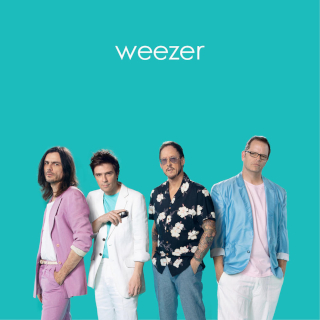 other words, as an album of covers it requires assessment by a somewhat different set of criteria than albums of original compositions. Among cover albums, I suppose I would arrive at a middling score of a C+ or B- (using a letter grade to help me resist any temptation to place it somewhere in the following ranking).
Now for the rest of the albums, I start from the worst and work upward. Brace yourself, Weezer fans; the first few may hurt. But hang in there. It gets better as you go!
Hurley (2010) – 1.6
In 2010 Weezer hit bottom with this misbegotten amalgam of bland melodies and trite lyrics. An album with literally no bright spots, it is as if they randomly  selected a 10th grade kid from Podunk, USA and said “Here, write lyrics for 14 songs; you have one hour,” and this was the result. I can only think the band was somehow in need of money, or perhaps they did it on a dare and intentionally made a bad album. Whatever the explanation, Hurley goes down about as well as a diarrhea smoothie.
Death to False Metal (2010) – 2.7
To round out a year best forgotten in the history of Weezer, the band released  this collection of re-recordings of leftover tracks from throughout their career. Biggest stinkers: “Everyone,” “Unbreak My Heart,” and the torturously wretched “Losing My Mind”—an excellent candidate not only for Weezer’s worst song but for the worst song of the decade by any artist. Even thinking about it puts me in a bad mood.
Make Believe (2005) – 3.5
Another poor effort overall, but with a few bright spots, including the opening track, “Beverly Hills,” which is Weezer’s satirical homage to Hollywood 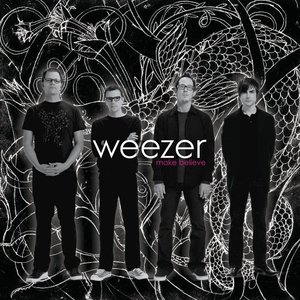 subculture. The next song, “Perfect Situation,” also works—a decent singalong. But from here it’s all downhill with non-stop lyrical drivel—clusters of cliches and lazy rhymes set forth in mostly somniferous packages with occasionally serviceable guitar lines. Make Believe is an album that makes you feel bad for the band—an aimless and uninspired recycling of mediocre ideas. The guys sound bored, though pretending otherwise. Make believe, indeed.
Weezer [The Red Album] (2008) – 5.5
A brief semi-recovery from the dreary aesthetic lowlands of Make Believe, the “Red album” has no cohesive identity but should be commended for its bold experimentation. It is Scott Shriner’s breakout album as a bassist and has some truly great moments. The album is replete with power chords, which is 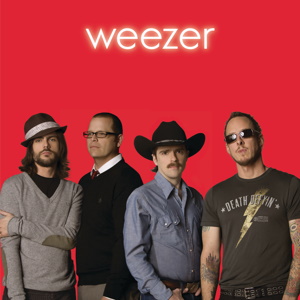 fine, but low on Rivers’ melodic lead work. The high points are clever power pop tunes like “Troublemaker” and “The Greatest Man that Ever Lived” (an epic tune, despite the talk-over, which is usually poison to a pop song but here adds to the comic effect). “Pork and Beans” is inane but it works somehow. The corny tribute “Heart Songs” kills the mood, and the three non-Cuomo songs in the middle of the album, though all earnest efforts, feel more like novelties and don’t strengthen the record.
Raditude (2009) – 6.1
Perhaps Weezer’s most critically panned album, I believe Ratitude is usually unfairly assessed. For all its quirks and strange turns, the album knows what it is: a party album. And an almost decent one at that. Weezer is goofing off here,  and we love it. The production team, led by Jacknife Lee, temporarily rescues the band from its creative coma with crunchy textures, strong dynamics, and varied arrangements. Probably Weezer’s most danceable album. Definitely their best workout album. (Try it. I burn calories just listening while sitting still.) Most importantly, on this record Cuomo rediscovers some of his lyrical wit. The songwriting is generally helped by contributions from folks outside the band.
Weezer [The Green Album] (2001) – 6.4
Complicated by psychological wounds sustained from confused critical responses to Pinkerton, the “Green Album” was destined to be a safe, catchy retreat that takes no musical chances. It strives to be a high energy college rock album but is unwittingly marked by Cuomo’s melancholic disillusionment 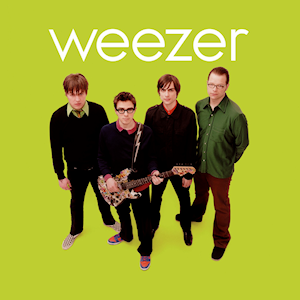 from unjust treatment of Pinkerton and, consequently, feels disingenuous. Despite good melodies and sweet harmonies throughout, there are too many vapid rhymes and lyrical cliches (including the most overused chorus lines on pop radio—e.g., “can’t you see,” “I’m lost without your love,” etc.) to be anything more than a mediocre album.
Van Weezer (2021) – 7.0
After a five year (and four album) hiatus from guitar-centric music, Weezer returned to their stylistic home base with this pure rocking collection. Sans the acoustic closer, the songs are uniformly metal-inspired, many of which  showcase Cuomo’s superb lead guitar work. If the album title signals the fact that the album is a sort of tribute to the metal genre, the opening track, “Hero,” belies this: “. . . I tried to be a hero, but I was lying to myself. I walk alone.” It’s a powerful, and well-articulated confession in song. Something of which the young Rivers Cuomo seemed incapable. Besides “Hero,” however, there are just a few real highlights, including the Van Halen knock-off “The End of the Game” and the Ozzy-inspired “Blue Dream,” but, thanks to the guitar work and mostly decent lyrics, no real losers.
Pacific Daydream (2017) – 7.8
Though the opening song is named for an electric guitar, this album is decidedly not a guitar album. It’s more about dance grooves and synth pop. But it works. It has a consistent dreamy pop atmosphere. In that sense it is aptly titled. Lots of clever lines: “Everyone wants to be cooler than everyone 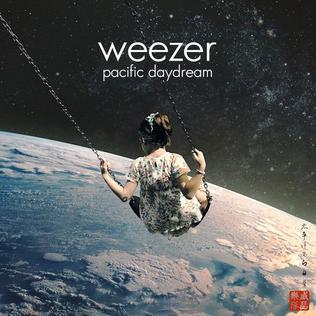 else. It’s a hip-hop world, and we’re the furniture” (“Beach Boys”), “You’ve gotta choose between the Internet and me” (“QB Blitz”), and “You don’t have to die to go to heaven” (“Weekend Woman”). The album highlights are “Weekend Woman” and the closer, “Any Friend of Diane’s,” a danceable ditty featuring a classical guitar solo that, strangely, fits the song perfectly. An appropriate ending to an album that is surprising at many levels. Many critics complain that it’s a stylistic reach for the band. A reach, perhaps. But not out of their reach.
Pinkerton (1996) – 8.1
As a huge fan of the Blue Album, when Pinkerton was released, I was as surprised as anyone at the lo-fi turn the band took. But I was heartened by the clear indication the band refused to sell out. I also liked the raunchy keyboard 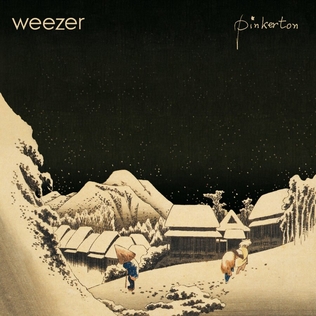 sound that pervades the album and, of course, the lyrical vulnerability conveyed with raw vocals and minimal instrumental effects. It all showed these guys were for real and not just a pop rock outfit, daring to seriously address exasperation with the promiscuous rock star lifestyle (“Tired of Sex”) and sexual attraction to a minor (“Across the Sea”), among other difficult topics. So as negative reviews emerged, I was perplexed. But history has been kinder to the album, as its real quality has become evident to most music critics.
Maladroit (2002) – 8.3
Ironically titled given the depth and range of the album, Maladroit was a refreshing sign of musical growth, including the band’s first forays into heavy metal. It is also Pat Wilson’s breakout album on drums. His work on “Dope Nose,” “Keep Fishin’,” and “Burndt Jam” is especially strong. And the rhythmic 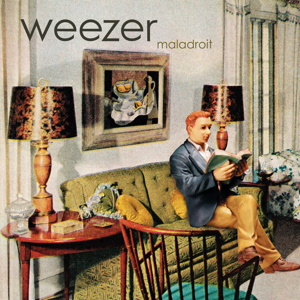 turnarounds on “Fall Together” are super cool. Add to this some excellent lead guitar work and a lot of fun, nonsensical wordplay, and you have another distinct artistic advance for the band. The only significant low point is “December,” an unfortunately corny, if admittedly catchy, album closer. Cuomo sings, “Only trust can inspire soggy lungs to breathe fire.” Soggy lungs? Ohh-kay. An earnest but failed attempt at an inspiring rock anthem. In time, however, Weezer would succeed at this, and in big ways. Persistence pays!
Weezer [The Black Album] (2019) – 8.7
Horribly underestimated by most critics, in part no doubt due to a lack of interest or appreciation for lyrical quality, the “Black Album” was another step of maturation for Rivers Cuomo as a lyricist and the band as a whole for  musical innovation. The album features more imaginative and creative humor, on a level with their “White Album” from three years earlier. Like that one, the “Black Album” is melodically and instrumentally rich and varied. There are lots of strong dance grooves to go with some excellent musical hooks. Also, some great lines, like: “the future’s so bright I gotta poke my eyes out” (“Can’t Knock the Hustle”), “life will make a beggar of rich men, bring the sovereign to his knees; and all the gold and all of the platinum melt like a chocolate sea” (The Prince Who Wanted Everything”), and “I don’t believe in mysticism, only in what science proves—like the sex appeal of your sick dance moves” (“Byzantine”).
Everything Will be Alright in the End (2014) – 9.3
Weezer’s “comeback album” after more than a decade of artistic doldrums. Was it Ocasek’s production? Cuomo’s brush with death? Creativity enhancing meditation? Who knows. Well-crafted songs, creative dynamics and arrangements, smart and sometimes introspective lyrics, inspired guitar solos, and ambitious vocals. The second half of the album might be the band’s strongest 6-song sequence, with two of the songs enhanced by female vocals.  “The British are Coming” is one of Weezer’s very best—featuring a gorgeous melody, perfectly sung, and one of Cuomo’s most brilliant guitar solos, finished off with a killer outro. This is immediately followed by “Da Vinci”: Cuomo has written many songs about the unreachable, ineffably sublime girl, but this is his finest, complete with references to Stephen Hawking, the Rosetta Stone, the eponymous painter, and even the Gospel. All wrapped in an addictive cluster of melodies. Following this are the plaintive “Go Away,” featuring guest vocalist Bethany Cosentino, the genre-defying “Cleopatra,” and the touching “Foolish Father.” It all culminates in a soaring three-song suite to close the album. Wow.
Weezer [The Blue Album] (1994) – 9.5
What can be said that hasn’t already been said about this legendary Weezer premier? One of the all-time great album debuts, full of raw, youthful, catch-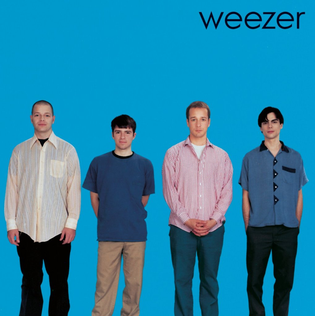 us-if-you-can energy. Uncommonly clever, if sometimes nonsensical, compositions packaged in walls of fuzzy power chords, pierced with hooky guitar solos, street-level vocals, all sprinkled with occasional dissonant guitar lines. Masterful production by the late, great Ric Ocasek, the ideal musical mentor for these determined grunge and 80s rock-inspired rookies who had no idea what lay ahead of them as a major rock band.
Weezer [The White Album] (2016) – 9.7
The ultimate “beach album” (as inspired by the band’s manager, Jonathan Daniel), complete with fully realized lyrical concepts, fresh melodic innovations, and, yes, some beachy themes. Modern rock just doesn’t get any better than this. The album completes Cuomo’s decade-long trek from lyrical sloth to a genuinely smart, insightful, and even quotable songsmith. “We’ve 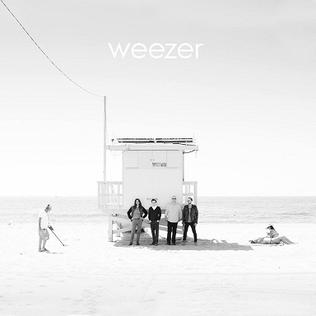 got the wind in our sail like Darwin on the Beagle and Mendel experimenting with the pea” (“Wind in Our Sail”), “We’re as happy as a couple Hare Krishnas” (“Good Thing”), “She swam away and flexed her mermaid tail” (“Summer Elaine and Drunk Dori”), “You’re the sun that I’m orbiting. I burn in your heat. Supernova and cosmic dust, you spawn galaxies” (“Jacked Up”). And then there’s Weezer’s single greatest song: “Thank God for Girls”—a lyrical journey that warrants an essay’s worth of analysis by itself. The White Album is not just a batch of hook-laden, super-singable, beach-inspired tunes. It is, at last, a lyrical effort worthy of the Harvard University English major graduate that is Rivers Cuomo.
OK Human – 9.8
Who would have thought Weezer was capable of something this smart and sophisticated? A baroque-style, fully orchestrated set of strikingly thoughtful compositions. And no electric guitars! The rich musicality throughout creates the ideal pallet for Cuomo’s substantive and moving lyrical ventures that 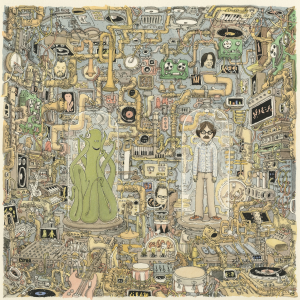 include immersions in literature (“Grapes of Wrath”) and music (“Playing My Piano”) to insightful social commentaries on digital devices (“Screens”) and the psychological effects of statistics (“Numbers”) to a touching personal reflection about feeling past one’s prime (“Bird with a Broken Wing”). All of these songs are sandwiched between the plaintive opener “All My Favorite Songs” and the hopeful roundelay “Here Comes the Rain,” which, like several other tracks on the album, subtly packs a profound lyrical message. The string and horn orchestration and dynamics are exquisite, featuring seemingly endless layers of melodies and instrumental textures that perfectly serve the songs. Producer Jake Sinclair deserves as much credit as anyone here. The very idea of Weezer doing an album like this might have once seemed comical. (Yes, there are plenty of funny moments, but only because of Cuomo’s clever wit.) The truth is it all feels very natural and, well, authentically human.
SZNZ (2022) – 9.9
Technically, the SZNZ EPs are four separate releases. But because of their unifying theme and the fact that all of the songs came out of the same recording sessions, I regard SZNS as a single, albeit time-released, work.  Indeed, Weezer’s greatest work. A consistently innovative blend of progressive rock, orchestral rock, baroque, and chamber music, with dashes of heavy metal, all with consistently strong lyrics. This is Rivers Cuomo at his most literate, smart, witty, personal, and compelling. SZNZ is loaded with seemingly endless pockets of melodies. Nearly every song has some interesting dynamic, whether a surprising arrangement, a challenging
  syncopation, an unexpected modulation, or creative musical sidebar, and usually a unique intro and/or outro. But nothing forced or pretentious. Just persistent, often stunning musical innovation. Lyrically, nearly every song is thought-provoking, many profoundly so, as in the case of “Lawn Chair” (on the origin of human suffering) “What’s the Good of Being Good,” (why be moral?), and “Should She Stay or Should She Go” (on Adam’s dilemma if Eve had succumbed to temptation in the Garden of Eden but Adam did not: “I could
  kick her ass out, move on with my life. Or I could follow her into the night”). Some more lyrical doozies: “I wish I could say it all to you in iambic pentameter. I’d improvise high notes like Thelonious when he’s jammin’ it” (“Iambic Pentameter”), “Why was I ever born and why did God make me? He must’ve been high when he dropped me down here” (“Dark Enough to See the Stars”), and “Lollygag in the lee of a highland ’til my ghost takes flight. In the sky I’m as high as a titan feeding on the fire, shattering those iron bars through
  the sky like shooting stars” (“Wild at Heart”). In addition to all of this, Cuomo’s voice is in top form. Underrated as he is as a guitarist, he’s probably just as underrated as a vocalist—like many great rock singers, not because of technical excellence but because of the personal connection he achieves and his ability to consistently match his vocal dynamics and emotion to each song’s meaning and mood. Simply put, SZNZ is an extraordinary achievement. If Weezer never records again, they will have gone out at their artistic peak. Brilliantly done, guys.