This is very late notice, but I will be interviewed tonight (or, rather, tomorrow morning) from 12:00-2:00 a.m. (Pacific Time) on KKLA (99.5 FM), which broadcasts from San Diego to Santa Barbara in California. The interview is for the Apologetics.com program which airs every week at this time. You can listen to the podcast here at the Apologetics.com website. The hosts will drill me with a lot of tough questions, many of which are discussed in my book, Gum, Geckos, and God, and many others which are not. Should be fun.
The Owl, the Ass, and the Blog Tour
Today’s stop on the Gum, Geckos, and God blog tour is At a Hen’s Pace. A review of the book is posted there as well. My thanks to Jeanne and the other bloggers participating in the tour! Its been a blast so far, especially since I can actually be on tour while doing projects around the house, which lately have included painting, building bunk beds, and pouring some concrete steps. Good times.
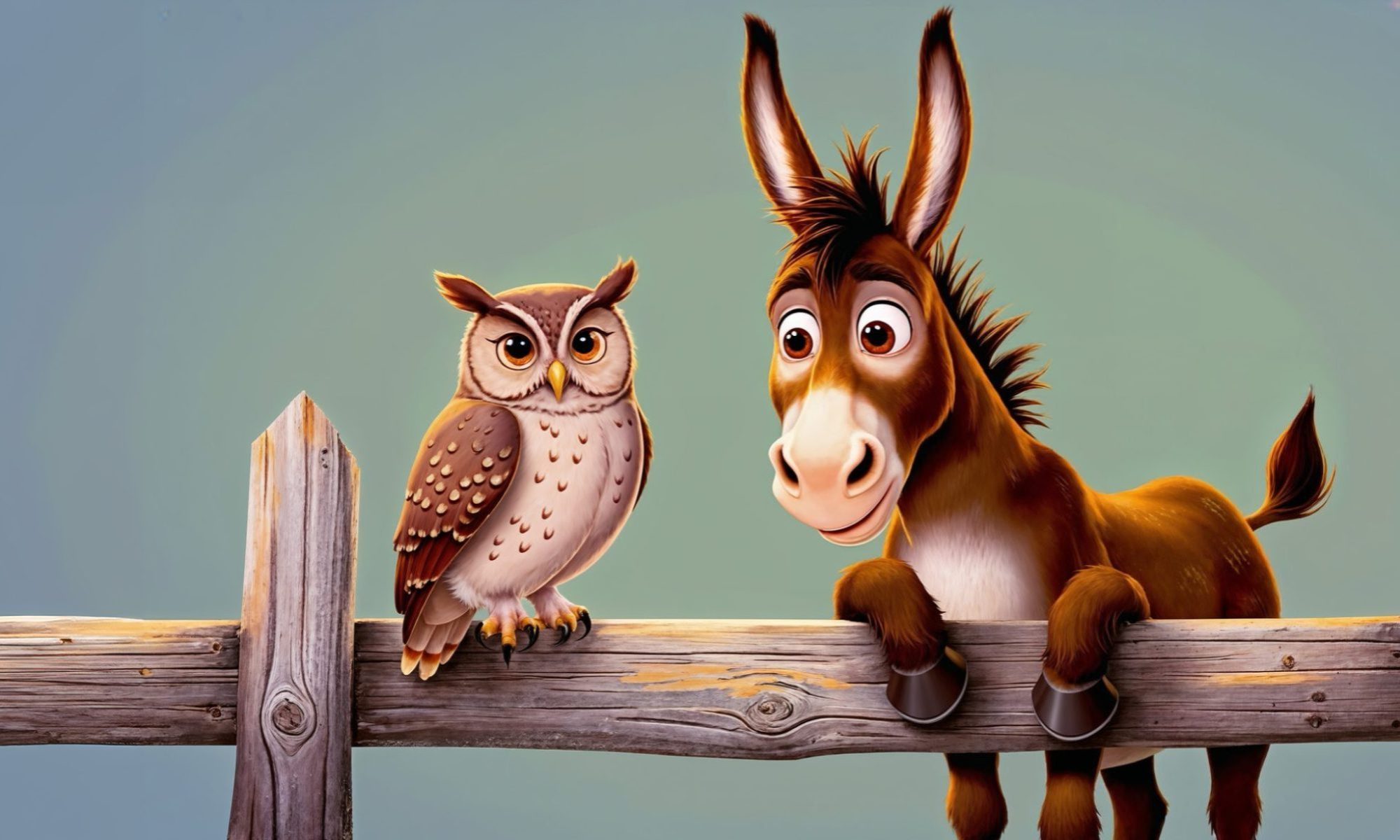
Also, below is the first response to our invitation to submit owl and ass drawings. It comes from an actual artist, Danny Wilson. You can see his work at Satellite Studio. Danny tells me it was a quick “30 second” sketch. Cool. I like how the two beasts look mutually suspicious—an accurate reflection of the relationship between wise and foolish people.

Blog Tour for Gum, Geckos, and God
I am doing a blog tour for my book, Gum, Geckos, and God, and it begins TODAY. For the next two weeks, a dozen different bloggers will post my answers to their questions about my book, and they will share their own thoughts about it as well. The subjects and themes of the participating blogs range from theology and culture to homeschooling and family issues. But what all of the bloggers have in common is a Christian perspective and a thoughtful approach to faith and culture.
The blog tour schedule is below. I hope you’ll drop by and perhaps even join the conversation. For more information about Gum, Geckos, and God. See the “related website” link to the right.
The Owl and the Ass
Welcome to our blog. No doubt you have noticed the images of the owl and the ass above. These are not random, of course. We chose them because (at least in popular consciousness) they represent “wisdom” and “folly,” respectively. If we had gone with random, then we’d have chosen images that are more easily drawn, like an egg and a pyramid, or a square and a tree, or maybe just a smiley face. But no…. We had to go with purposeful and symbolic, thus leaving us in the quandary of deciding how to find some good original renderings of an owl and an ass. The images you see were drawn by me (Jim). Obviously, I’m no artist, as the drawings are primitive and lack pizzazz. We briefly considered commissioning a professional artist to produce the images for us but decided against this because, for one thing, we don’t have a lot of extra cash lying around to fund this endeavor. Frankly, we’d rather spend what we do have on chai, CDs, and diapers. Also, we figure that since this is a homespun operation, my unwieldy drawings will do, at least for now.
However, in keeping with the interactive nature of this blog, we would like to invite you to send us your own original drawing(s)-whether a quick sketch or laboriously crafted painting-of an owl and/or an ass. Make it comical or serious, minimalist or ornate. Any style or mood will do. Why? Because this blog will be a thing of many moods-sometimes serious and (hopefully) sometimes funny. You may submit your drawing(s) as an attachment to Jim at jmspiegel@taylor.edu. There is no deadline. We may or may not incorporate your drawing(s) into our blog nameplate, but if it’s interesting enough we’ll post it. And we will give you credit for your work if we decide to use it. But sorry-no cash remuneration.
Okay, enough of that. A few words of explanation are in order regarding just why owls and asses commonly represent the wise and the foolish. As for owls, they are nocturnal and can function very well in the dark. Also, they are far-sighted, able to spot prey from hundreds of feet away, while having poor vision for things up-close. These traits are good metaphors for wisdom, as wise people can maintain their integrity even in the midst of moral “darkness.” A wise person also demonstrates a keen eye for what lies beyond, while not being distracted by immediate concerns. The linkage between owls and wisdom probably also has to do with the solemn or studious look of the bird. At any rate, in the West owls are commonly associated with wisdom, even dating back to ancient Greece, where Athena, the goddess of wisdom, was frequently depicted as holding an owl.
As for the ass or donkey, its scientific name is Equus asinus, from which we get the word “asinine.” In ancient times, the ass was used to symbolize Dionysus, the Greek God of indulgence and excess. And as we all know, fools are overindulgent and excessive. Donkeys also have a reputation for being stubborn and unteachable. This is not really accurate, but we’ll follow that folklore because, well, we need a good image for foolishness. As with humans, in the animal kingdom it is sometimes difficult to distinguish stubbornness and stupidity from independence and single-mindedness. But in most cases it is easy to tell the difference between the two, as the ways of the fool eventually come to ruin.
Who is wise and who is foolish? To summarize the biblical contrast between them, the wise person is prudent, teachable, self-controlled, and morally insightful, while the fool is reckless, stubborn, self-indulgent, and morally thick-headed. For more details, see the book of Proverbs.
The content of this blog will display the ways of the wise and foolish. While we will seldom apply these tags to the ideas and people we discuss, we trust you’re wise enough to know which applies in each case.
Popular Music and Survival of the Fittest
Long before I ever became an academician I loved rock n’ roll-from the crunch and sizzle of Jimmy Page guitar riff to the soul-soothing wail of Aretha Franklin. But most of all, I loved the songs themselves, from love ballads to R&B grooves to punk rock political anthems. And I’ve spent decades building my music catalogue, both to enjoy the music and to get a better grasp on the evolution of this art form.
It wasn’t long ago that to call rock music an “art form” was a howler. And it has only been very recently that study of the popular arts generally has become a legitimate field of scholarly inquiry. Happily, today there are several academic journals devoted entirely to the subject, and even the most prestigious aesthetics journals routinely feature treatments of rock music. Finally scholars have realized what should have been obvious all along. The study of popular culture is important because it provides us with insights in a wide range of subjects: art, anthropology, psychology, sociology, cultural studies, and philosophy, to name a few. And study of the history of popular culture is significant for the same reason that any historical inquiry is significant. It provides us with a better understanding of human nature and society.
Perhaps the reason some have doubted the significance of rock music as an art form is that, frankly, much of it is bad. And, indeed, radio stations play mostly tripe all day long. They always have, even in rock’s “golden age.” But something like this has been true of all art in every age. Much of the music made in the 17th, 18th or 19th centuries was no doubt very bad, but that music has been deservedly lost to time while the best has survived-as it always has, standing the test of time precisely because it is the best. What we call “classical” music is simply the best music of bygone eras. And, yes, some music from our era will survive for centuries as well. They are not royal courtiers anymore, but include film soundtrack composers (e.g. John Williams and Danny Elfman), singer-songwriters (e.g. Bob Dylan and Morrissey), and rock bands (e.g., the Beatles and Radiohead).
Students of popular music face a challenge that students of classical music do not. History has yet to weed out the weak specimens among the songs of our time, so we must do the extra work to discern which songs will likely stand the test of time because of their merits. As in the biological world, it comes down to survival of the fittest. And contemporary music critics are sometimes no more able to predict which songs will last than a biologist is able to predict the future evolutionary path of organisms. As Bob Dylan has said, “You have to stand on your tiptoes to see the future.”
But the sheer difficulty of the task should not discourage us. There are, after all, some basic aesthetic standards when it comes to assessing rock music, just as there are for any art genre. And we have already seen some “natural selection” of rock songs already, if we go back to the 1950s, 60s, and even the 70s. There are songs that we already call “classics,” from Chuck Berry’s “Roll Over Beethoven” to Led Zeppelin’s “Stairway to Heaven.”
In future posts, I will discuss a variety of popular musical artists and songs, some of which have risen to the level of “classic” and some which I suspect will do so in time. I will also offer some of my own “best of” lists. The first of these will be the twenty best albums of the rock era, which I will post in just a few days. So stay tuned, rock fans.