Covid-19, Churches, and Hardware Stores

Here is another point about the issue of government bans on Church worship services that in my two previous posts I have taken for granted but which I evidently need to make explicit. Do these bans really accomplish much given how little time each week is devoted to corporate worship? And does the small reduction of risk achieved by such bans compensate for the loss of religious freedom they entail?

Consider the fact that during the pandemic hardware stores like Lowe’s, Home Depot, and Menards are open every day of the week for 11-14 hours each day with thousands of customers coming and going throughout the week, while church services, which average just 75 people, are not permitted to meet for even one hour each week. When it comes to presenting a real danger to a community in terms of spreading the Covid-19 virus, the risks at a small church service are negligible compared to those at such large hardware stores. Yet the former are closed while the latter are bustling with activity all over the country.

One might argue that our society needs hardware stores to stay open far more than we need weekly worship services. First, such a response presupposes that corporate worship is not necessary for human flourishing, which begs the question of my original argument in my April 25 post. Secondly, even if one grants that corporate worship services are not as essential to human flourishing as home improvement supplies, then can we not at least grant that worship services are 1/60th as valuable as hardware stores? If so, then this would warrant permitting a 90-minute worship service once per week (to maintain the proper value ratio vis-à-vis a Lowe’s, Home Depot, or Menards, which are open 80+ hours per week).

So, fellow Christians, if you support the ban on church worship services while you’re supporting keeping open such hardware stores (and your shopping at one of these stores during the week is a tacit admission that you do), then this would seem to imply that you have a rather low view of the importance of corporate worship. For some of my critics, perhaps that is the real crux of our divergence on this issue, and that is fine. But for those who say they place a high value on corporate worship, something has to give here.

If you are really that concerned about human contact hours and the risk this presents regarding spreading the virus, then it would be far more efficient to create a stricter limit on the operating hours of retail stores. Therefore, I would suggest this modest compromise: Reduce the operating hours of large retail outlets by just one hour per day and lift the ban on corporate worship services. This would create a net reduction in the number of contact hours during which the virus can be spread while preserving the public good of corporate worship. Everybody okay with that?

More Thoughts on Government Bans of Worship Services

In his powerful plea to keep churches open during the Coronavirus pandemic, First Things editor R. R. Reno declared that “the massive shutdown of just about everything reflects the spirit of our age, which regards the prospect of death as the supreme evil to be avoided at all costs.” It is interesting to note, however, that in this country we don’t take this approach with any consistency.

Let’s suppose we could be confident that Covid-19 is, say, three or even five times as deadly as seasonal flu and thus likely to kill tens of thousands more Americans if the bans on corporate worship are lifted. Would this justify these mandates? Well, consider some other legal behaviors in this country which result in the deaths of large numbers of people. Every year approximately 40,000 Americans die in traffic accidents. This figure could be greatly reduced by simply lowering the speed limit 10 or 15 mph. But no one is clamoring for this in the interest of saving innocent lives. Why? Because we cherish our freedom to drive fast and arrive at our destinations quickly, even though doing so endangers ourselves as well as others.

Or consider the fact that there are approximately 480,000 deaths in the U.S. each year due to tobacco use. We have chosen to keep tobacco use legal despite this high mortality rate. Why? Again, because we cherish our freedom to use these products. Similar points can be made regarding the legality of alcohol and fatty foods in this country.

The point is that there are many activities which cost hundreds of thousands of American lives every year, but we keep them legal despite this because of the pleasure we get out them and simply because we cherish freedom. So why not permit religious worship services even if this costs more lives? Is not the freedom to engage in the corporate worship of God at least as valuable as the freedom to drive fast, smoke a cigarette, drink a beer, or eat a cheeseburger?

Here many Christians appeal to the alternative of on-line worship as a reasonable alternative to traditional corporate worship. Aside from the fact that on-line worship is an inherently poor substitute for worshiping in the physical presence of fellow believers, there is the further problem that two church sacraments—baptism and communion—cannot be administered via on-line services. For those church traditions where communion is done on a weekly basis and necessarily administered by an ordained minister, this is a serious loss. Even in those traditions where communion is administered monthly, as the corporate shutdowns continue, the loss is felt there as well. Perhaps your particular church tradition is not highly sacramental, but for tens of millions of Americans communion is a means of grace. This is vital spiritual nourishment, and government mandates are depriving them of this. That is a big deal, a serious blow to their relationship with God. This is another reason why I am surprised that more Christians aren’t challenging the shutdowns of corporate worship services.

Are Government Bans on Religious Worship Services Morally Appropriate?

During the Covid-19 pandemic many state governments across the country have banned church worship services. Some states have prohibited religious services altogether, while others have placed severe restrictions on the number of people who may gather to worship. While the constitutionality of this unprecedented move is certainly open to debate, one may question whether such bans are morally appropriate. Thus, we may ask, do religious practitioners have a moral obligation to abide by these mandates even if they are constitutional?

Here is an argument which challenges the moral appropriateness of the bans on religious services:

  1. Civil government has a moral duty to permit what is essential to human flourishing.
  2. The corporate worship of God is essential to human flourishing.
  3. Therefore, civil government mandates which forbid corporate worship are immoral.
  4. Christians do not have a duty to abide by immoral government mandates, particularly those which proscribe fundamental aspects of their religious practice.
  5. Therefore, Christians do not have a moral duty to abide by a government mandate to abstain from corporate worship.

What follows from the conclusion here is that congregants at local Christian churches don’t have an obligation to abide by the government mandate to avoid meeting for corporate worship.

This is a logically valid and, I believe, sound argument. That is, the conclusion follows from the premises and, it seems to me, each of the premises is true. I assume most Christians will grant the first and fourth premises, as would all Christian ethicists and theologians I know of. So that leaves the critic with the burden of demonstrating that the second premise is false. Presumably, many atheists and religious skeptics will reject this premise, in some cases because they believe that religious practice of any kind is actually harmful. That’s fine. My main audience with this argument is fellow religious practitioners.

But is the Covid-19 pandemic somehow serious enough to justify a qualification to the second premise and thus warrant certain bans on worship services? In other words, might this pandemic provide a special exception to the general truth that corporate worship services enhance human flourishing? This question naturally leads us into a discussion of a whole nest of issues that are epidemiological, immunological, microbiological, economic, and statistical in nature. This is why we must pay close attention to recent reports and scientific studies showing the mortality rate of the Coronavirus is much lower than previously thought. Several recent studies suggest that the mortality rate of this virus is comparable to that of common strains of flu. Other reports suggest a higher mortality rate than seasonal flu, though still no more than .08%. But is this difference significant enough to warrant a general ban on religious services? It’s difficult to see how it could be when other options are available. For example, why not rather encourage high risk people (i.e., the elderly and those with pre-existing medical problems) to stay at home while allowing others to resume practice of corporate worship?

If Covid-19 mortality rate data is inconclusive in terms of justifying general bans on corporate worship services, then the social harms caused by the shutdowns should give us further pause as regards warranting an exception to the general good of corporate worship. There is also the economic dimension of shutdowns, which some economists believe could trigger a depression. Furthermore, the shutdowns are taking a serious public mental health toll in our country.

All things considered, there is evidence to suggest that the shutdowns, not just of worship services but other sectors of society, are more harmful than helpful, potentially more devastating to American society than any flu virus could be. This creates strong supplemental support for my argument’s second premise, which given any reasonable Christian view of government already enjoys a strong presumption in its favor. Therefore, only very strong empirical evidence could nullify it’s applicability to our current situation. And that, I submit, no one has provided, despite what our political leaders and the American mainstream media have been telling us.

A Christmas Day Reflection

On this Christmas day I have been reflecting on our unity in Christ, which seems increasingly threatened by divisions within the American Church, especially due to disagreements over political issues. This prompted me to think about the following possibility. Suppose, upon our arrival in the Next World, we ask Jesus, “Who was right regarding those early 21st century American political issues which divided us so much, even those of us who followed you, Lord? Was it the conservatives or the progressives?” What if Jesus replies, “Both sides were right and wrong about many things” and then he proceeds to itemize the insights and errors on both sides, to which we respond by saying, “Wow, it’s all so clear now. Why didn’t we see this during those days when we were so caught up in all of those political squabbles?” Then what if He says, “because it was not my will that you would see these things clearly but rather to test you and mature you through such disagreements. Those issues, vital and important as they were, served primarily as means of interpersonal engagement, to catalyze the forging of your souls, to build virtues of patience, generosity, perseverance, humility, and grace. In short, your political debates functioned as props on the stage of human life, the main focus of which was always about making you all more like me, though even you, my precious children, at times lost sight of this. But don’t worry about it, guys. For all is well now. And all manner of things is well.”

What if that is how it will go down in the Next World? And suppose we somehow could know now that this was God’s main purpose regarding all of the political strife which currently grips our nation. How might this change the way we approached all of these divisive issues?

Is Evangelism Biblical?

Among evangelical Christians there is a widespread, even dogmatic belief that every Christian has a duty to evangelize unbelievers, that is, to explicitly share the Gospel with them in order to persuade them to come to belief. If you’re an evangelical Christian reading this, you’re probably thinking, “Well, yes, of course Christians have a duty to do that.” But is this really true? Are there any biblical grounds for thinking that every Christian has a moral obligation to evangelize? I don’t think so. In fact, I don’t think there is a shred of biblical evidence for this.

Now let me explain my claim a bit by clarifying what I am not saying. First, I am not saying that Christians do not have a biblical duty to be prepared to intelligently explain the Gospel when asked.   This much is clear in the apostle Peter’s directive to “Always be prepared to give an answer to everyone who asks you to give the reason for the hope that you have. But do this with gentleness and respect” (1 Peter 3:15). Clearly, Peter is saying that all Christians have a duty to be ready to explain the Gospel and even provide some apologetic grounding for their beliefs. But notice that this is an injunction to respond to those who inquire, not a command to actively initiate such conversations in order to persuade others.

Secondly, I am not suggesting that it is unbiblical or morally wrong for individual Christians to do evangelism. In fact, it is overwhelmingly clear in Scripture that well-planned initiatives to persuade people of the Gospel are appropriate and wise in various circumstances. This is obvious from Jesus’ sending out his disciples two-by-two to spread the good news (Luke 9:1-6 and Luke 10:1-11) and numerous instances in the book of Acts where Christian leaders evangelized (Acts 5:42; Acts 8:4-13, etc.). However, note that these are specific initiatives that do not imply a universal duty to evangelize, though they might support the notion that Christian church leaders have a duty to 4242566_origevangelize. In fact, the apostle Paul confesses that “when I preach the gospel, I cannot boast, since I am compelled to preach. Woe to me if I do not preach the gospel!” (1 Cor. 9:16). But in that passage, Paul is speaking for himself and perhaps, by extension, other apostles, as the context of that passage is Paul’s defense of his rights as an apostle.

Thirdly, I am not suggesting that the Church, as a body of believers, does not have a duty to evangelize unbelievers. Clearly, evangelism is an obligation of the Church. For as Paul says elsewhere, “How . . . can they call on the one they have not believed in? And how can they believe in the one of whom they have not heard? And how can they hear without someone preaching to them? And how can anyone preach unless they are sent?” (Romans 10:14-15). Moreover, there is the Great Commission which is given by Jesus himself: “Go and make disciples of all nations, baptizing them in the name of the Father and of the Son and of the Holy Spirit, and teaching them to obey everything I have commanded you. And surely I am with you always, to the very end of the age” (Matt. 28:19-20). But while these passages imply that the Church should spread the Gospel, neither of these passages imply that each individual Christian has a duty to bear this burden. And to suggest that the former implies the latter is to commit the logical fallacy of division (illicitly reasoning from an attribute of a whole to that of its parts).

So by rejecting the notion of a universal Christian duty to evangelize I am not suggesting that evangelism is wrong, that Christians need not be prepared to defend the Gospel, nor even that the Christian church has no duty to evangelize. I am suggesting that evangelism is a crucial function of the Church that should be intentionally carried out by those who are especially well-prepared—and I would say specially gifted—to perform. I would compare the gift of evangelism to such spiritual gifts as prophecy, teaching, and church leadership (1 Cor. 12:8-10 and Rom. 12:6-8). Such are crucial functions within the church, but it would be absurd to suggest that every Christian has a duty to prophesy, teach, and be a church leader. No, as Paul says, not all members of the body of Christ have the same function (Rom. 12:4). Similarly, although evangelism is an important task of the church, not everyone is called or properly gifted to perform that task. (For more on this idea, check out Bryan Stone’s book Evangelism After Christendom.)

Yet the myth of a universal Christian duty to evangelize is extremely popular among evangelicals these days. Given the way that some Christian leaders emphasize and even guilt trip congregations about it, it is tempting to classify this as a modern pharisaism, a way in which Christian leaders have bound the consciences of Christians, effectively adding to the law. I am not exaggerating when I say that I’ve heard more sermons proclaiming a supposed universal Christian duty of evangelism than I have heard proclaim any of the Ten Commandments as moral duties. What is wrong with this picture?

So where did this idea come from? If there are no biblical grounds for an individual mandate to evangelize, then why is this misconception so popular among evangelicals? In short, I believe it is a consequence of Western, particularly American capitalistic thinking as applied to Christian public life. In other words, I think the idea resulted more from market and sales thinking than from Scripture. This is my best guess anyway. (For more on the connection between evangelism and marketing, see the Kenneson and Street book Selling out the Church.)

Speaking of history, consider a final point that should prompt doubt in the minds of even the most stalwart defenders of a universal duty to evangelize. So far as I can tell, none of the greatest Christian theologians and spiritual leaders ever taught this doctrine. I challenge you to locate it in any of the early church fathers (St. Ignatius, Clement of Alexandria, Athanasius, John Chrysostom, Basil of Caesarea, Gregory of Nyssa, John Cassian, Augustine), the great medieval theologians (Anselm, Bernard of Clairvaux, St. Francis of Assisi, St. Dominic, Thomas Aquinas), the Reformation era theologians (Martin Luther, John Calvin, John Knox, Ulrich Zwingli, Teresa of Avila), Revivalist theologians (John Wesley, Charles Wesley, Jonathan Edwards, and George Whitefield) and the greatest 20th century theological minds (Karl Barth, Dietrich Bonhoeffer, and C.S. Lewis). That’s 25 of the greatest Christian minds—and certainly inclusive of the greatest Christian theological minds—in world history. Yet apparently none of them believed that there is a universal Christian duty to do evangelism. Now if that teaching was a biblical one, I think its safe to say that most, if not all, of these folks would have picked up on that. Right? So what gives?

If you’re a conservative evangelical, you’re probably bothered by what you’ve just read. But my plea to you is to honestly reflect on whether your view is actually biblical. I would also urge you to consider the force of the fact that there is no evidence that any of the greatest theological minds in history agree with you. That fact alone should give any Christian serious pause.

Now, finally, why does this matter? Even if we did get this one wrong, you may ask, isn’t it better to err in the direction of zeal than complacency when it comes to evangelizing others? I don’t think so, and here are three reasons why. First, it is wrong and harmful to bind people’s consciences. Legalism is deadly for Christian faith and spiritual formation. Secondly, the myth of a universal duty to evangelize has undoubtedly compromised the power of the Church’s witness, since this myth has had the effect of prompting incompetent evangelizing which poorly represents the Gospel. Thirdly, this myth has created a tragic association of Christianity with cheap marketing, thus making conservative Christianity synonymous with insincere, means-to-an-end salesmanship and kitschy sales techniques. (I’m sure we can all think of many cringe-worthy examples we have personally witnessed.) This, of course, is the most ironic distortion of Christianity, representing the Gospel as something precisely opposite what it is.

So, in summation, the answer to the question “Is evangelism biblical?” is, of course, yes. It is clearly biblical that the church has a duty to spread the Gospel message. But what is not biblical is the notion that there is an individual mandate for Christians to evangelize other people. For those who feel so led or, better, have the gift of evangelism, it is perfectly appropriate for them to do so, given the right circumstances. But the duty for all Christians is to be prepared to answer those who ask them about the Gospel and, most importantly, to live virtuous lives, displaying the fruit of the Spirit (“love, joy, peace, patience, kindness, gentleness, goodness, faithfulness, and self-control”—Gal. 5:22-23). Now these are universal mandates that are biblical. And if we Christians were all more serious in pursuing them, I bet the Church would be far more effective in fulfilling the Great Commission.

The Darkness Before the Dawn (Eschatologically Speaking)

In the Olivet Discourse in Matthew 24, Jesus describes the hardships of the church in the “last days”:

As Jesus was sitting on the Mount of Olives, the disciples came to him privately. “Tell us,” they said, “. . . what will be the sign of your coming and of the end of the age?”

Jesus answered: “Watch out that no one deceives you. For many will come in my name, claiming, ‘I am the Messiah,’ and will deceive many. You will hear of wars and rumors of wars, but see to it that you are not alarmed. Such things must happen, but the end is still to come. Nation will rise against nation, and kingdom against kingdom. There will be famines and earthquakes in various places. All these are the beginning of birth pains.

“Then you will be handed over to be persecuted and put to death, and you will be hated by all nations because of me. 10 At that time many will turn away from the faith and will betray and hate each other, 11 and many false prophets will appear and deceive many people. 12 Because of the increase of wickedness, the love of most will grow cold, 13 but the one who stands firm to the end will be saved. 14 And this gospel of the kingdom will be preached in the whole world as a testimony to all nations, and then the end will come.

15 “So when you see standing in the holy place ‘the abomination that causes desolation,’ spoken of through the prophet Daniel—let the reader understand—16 then let those who are in Judea flee to the mountains. 17 Let no one on the housetop go down to take anything out of the house. 18 Let no one in the field go back to get their cloak. 19 How dreadful it will be in those days for pregnant women and nursing mothers! 20 Pray that your flight will not take place in winter or on the Sabbath. 21 For then there will be great distress, unequaled from the beginning of the world until now—and never to be equaled again.

22 “If those days had not been cut short, no one would survive, but for the sake of the elect those days will be shortened. 23 At that time if anyone says to you, ‘Look, here is the Messiah!’ or, ‘There he is!’ do not believe it. 24 For false messiahs and false prophets will appear and perform great signs and wonders to deceive, if possible, even the elect. 25 See, I have told you ahead of time.

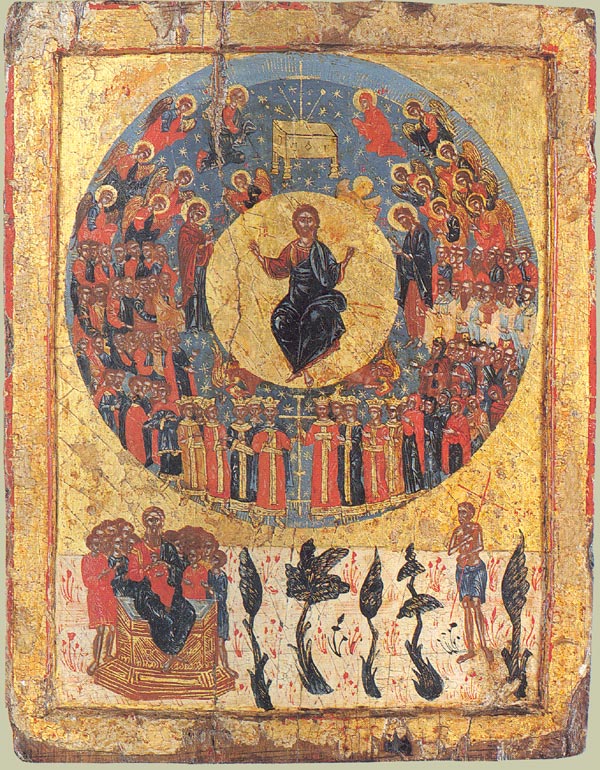
The timing of the events described in this passage is a matter of considerable scholarly debate.  Some interpret this passage as describing events that have (at least mostly) already occurred, and other commentators see the “great distress” described there as still (at least largely) in the future, just preceding his return to earth to usher in his Kingdom.  I’m inclined to a version of the latter view that life on Earth will be characterized by extreme suffering—worse than ever on this planet, in fact—just prior to Christ’s return.  That is, things

Greek icon of Second Coming, c.1700 (Wikipedia)

will get really bad just before they get really good.  Moreover, as I read this and other relevant biblical passages, Christians will not be exempt from the suffering (via some sort of “rapture’) but will experience awful tribulation and persecution in the final days.

If this is correct, then it raises an interesting question.  Why has God ordained human history to end this way?  Why write the narrative in such a way that the dawn of Christ’s eternal reign is preceded by extreme, perhaps unprecedented human—and especially Christian—suffering?  One answer, with which I’m sympathetic, appeals to theological aesthetics.  There is something beautiful in the passage from darkness to light.  Even when we’re not making such an aesthetic judgment about this pattern in human life, we nonetheless often make the observation that “its always darkest just before the dawn.”  The beauty of this pattern is evident in many contexts, from the triumph of an inventor after many failures to a sports team that rallies in the final minutes to prevail against adversity.  And, in the case of Jesus’ preferred metaphor, childbirth is one of the most vivid illustrations of this.  Perhaps no other human experience is marked by such excruciating pain followed by so much joy.  And here lies a major aspect of the beauty of the experience.  Similarly, one might say, the story of human history is more beautiful overall because the “birth pangs” of extreme human suffering will be swallowed up in the joy of Christ’s return and our “birth” into his blessed Kingdom.

All of this is right, I think, but there is another theological dimension here that I think is relevant, and this concerns the unity of Christ and his church.  A recurrent biblical theme is that the church—understood as the collection of Christ’s faithful followers—is in some mystical sense the “body of Christ.”  The Apostle Paul makes several references to this metaphor (e.g., 1 Cor. 12:27; Eph. 4:12-15; Col. 1:24).  Now to take seriously our deep metaphysical union with Christ is, therefore, to take seriously the notion that we must suffer with him.  As the Apostle Paul says, “if we share in his sufferings [then] we may also share in his glory” (Rom. 8:17).  Thus, for the church to be fully redeemed, we must be fully united with Christ, and this entails sharing in his experience of suffering and death as well as resurrection.  As Paul elsewhere says, “I want to know Christ and the power of his resurrection and the fellowship of sharing in his sufferings, becoming like him in his death, and so, somehow, to attain to the resurrection of the dead” (Phil. 3:10-11).  Peter echoes this theme as well when he says, “rejoice that you participate in the sufferings of Christ, so that you may be overjoyed when his glory is revealed” (1 Pet. 4:13).

This much is not particularly controversial biblically speaking, notwithstanding the contemporary American aversion to the biblical notion that Christians must suffer and that God actually ordains this for us (e.g., 1 Peter 1:5-7; James 1:2-4, etc.).  But what if the parallel goes even farther than the pattern of the church’s suffering on Earth followed by resurrection into eternal glory?  Perhaps even the narrative structure of the “life” of the Christian church parallels that of Jesus’ earthly life.  As we know, Jesus’ hardest days were toward the end of his time on earth.  No doubt, he faced all sorts of trials throughout his entire life, but his betrayal, unjust trial and condemnation, brutal pre-crucifixion torture and mockery, culminating in a hideous protracted crucifixion were surely the worst experiences of his life.  And all of this was followed by the triumphant joy of his resurrection.  So if we assume a parallel narrative structure between the life of Christ and the life of his “body” that is his church, then we should actually expect that worldwide Christian suffering will grow increasingly extreme in the last days prior to the second coming of Christ.

Thus, on this view, the tribulation of the church in the last days constitutes a sort of historical recapitulation of the life of Christ on earth—Jesus’s “passion week” writ large in the form of his suffering corporate body, the church.  Just as Christ was unjustly persecuted during his last days on earth, his bride—the worldwide Christian community—is persecuted during the last days of her 2000-year “lifetime.”  And like her Savior, the church suffers horribly only to be overjoyed upon her resurrection.  Hallelujah.

A Caution to Church Haters

In Amy’s last post she highlighted the hypocrisy implicit in the way some Christians preach grace towards certain people outside the church but withhold grace to their fellow Christians within the church.  I see this attitude as part of a larger, disturbing trend, as it has become rather fashionable of late for Christians to be critical of the church.  This is evident in such recent books as David Kinnaman’s You Lost Me, Wayne Jacobsen and Dave Coleman’s So You Don’t Want to Go to Church Anymore, and Kelly Bean’s just released How to be a Christian Without Going to Church.  I would like to offer a word of caution to those who so freely criticize the church and even, as in Bean’s case, recommend that Christians spurn church attendance and formal membership altogether.

First, we need to keep in mind that “the Church” is not an abstract entity but is composed of real people, fellow followers of Christ who aim, albeit imperfectly and sometimes very awkwardly, to worship and serve God together in local communities.  So to reject “the church” is to reject particular people.  And to hold a grudge against “the church” is to refuse to forgive or withhold grace from particular people.  When reading the accounts of some who have followed this path, its hard not to interpret their attitude toward the church as genuine hatred.  And that’s what’s scary, because from hatred of “the church” it is just a short step to hatred of Christians.  And hatred of Christians is tantamount to hatred of Christ.

Consider the experience of the Pharisee Saul on the road to Damascus, leading to his conversion and eventual apostleship.  Here is the account as recorded by Luke in Acts 9:

Meanwhile, Saul was still breathing out murderous threats against the Lord’s disciples.  He went to the high priest and asked him for letters to the synagogues in Damascus, so that if he found any there who belonged to the Way, whether men or women, he might take them as prisoners to Jerusalem.  As he neared Damascus on his journey, suddenly a light from heaven flashed around him.  He fell to the ground and heard a voice say to him, “Saul, Saul, why do you persecute me?”

“Who are you, Lord?” Saul asked.

“I am Jesus, whom you are persecuting,” he replied. “Now get up and go into the city, and you will be told what you must do.”

Notice Jesus’ choice of words here.  Twice he clarifies to Saul whom he really is persecuting with all of his “murderous threats,” namely Jesus himself.  Those who follow Christ—“the Lord’s disciples”—constitute the church, which is the “body of Christ” as the Apostle Paul would later declare (1 Cor. 12:27; Eph. 3:6; Col. 1:24).  For all of our foibles, failures, and petty preoccupations, the followers of Christ—yes, even in formally organized ecclesial structures—are somehow, mysteriously united to, and the most tangible expression of, our Lord.  So any condemnation of the church is impudent, to say the least.

Am I saying that no critical commentary or assessment of the global church, a local church or particular Christians is ever appropriate?  Not at all.  In fact, this is crucial for the life of the church when done properly.  Genuinely constructive critical engagement is often powerfully redemptive, as it has been at so many junctures of church history.  But wholesale rejection, condemnation, or abandonment of the church, as is increasingly being encouraged these days, is neither constructive nor redemptive.  In fact, its more like, well, persecution.

So we should take this as a caution against vitriolic pronouncements about, let alone endorsements to divorce oneself from, “the church.”  Instead, let’s go for ethical, theological, and socio-cultural critique, whether of particular churches, denominations or individual Christians.  This can be done pointedly but with love.  (Successfully or not, that’s what I’m going for in this very post.)  Like Amy, I would hope we can show at least as much grace to our own as we show to those outside the Christian community.

Shame on You

There will be no clever intro. No easing into the subject with a gentle and mildly amusing anecdote. I will get straight to the point: If I have to read one more “Down with the Church” Facebook post by someone calling him/herself a Christian, I am going to beat myself to death with a hymnal. I refuse to read another hypercritical expose on how discussions of modesty are wrong or how those who hold a traditional view of homosexuality are evil. I don’t want to read another story about the “angry modesty police who escort the scantily clad from church buildings waving pitch forks and New King James Bibles.” No more “If you believe you should love the sinner but hate the sin, you are a homophobic bigot who should be burned at the stake.” Perhaps I exaggerate but seriously, people, enough already.

Now before you spit out your no-fat, fair trade latte in disgust, screaming about the need for reform and open-mindedness, I am not talking about genuine critique, based on love and concern for the future of the Body. To use a bit of the language I often hear thrown about in these Facebook firebombs against Christians, the Church is made up of broken individuals; flawed sinners. There is always going to be a need for correctives and those criticisms should be heard and if necessary, adhered to. What I am talking about is Christians throwing fellow Christians under the bus. Which seems a bit ironic, given that those doing the throwing are supposedly all about tolerance and hope for the lost.

So here’s my criticism: if the Church is for the lost, why don’t you love the lost after they are found? Say I come to church fleeing a life of drugs and prostitution. And you welcome me with open arms. Yay for you. That’s what Jesus would do, right? Sure. But let’s say it’s ten years down the road. Drugs and prostitution have been kicked and my tramp stamp tattoo is now concealed by modest capris and a kid on each hip. I volunteer in the nursery and sing in the praise band. Am I suddenly the enemy? Isn’t the Church about being engrafted into the body of believers? I am still a sinner. Still in need of grace and acceptance. What if I never left the fold in the first place? What if I have been a good girl all my life? That doesn’t make me better than anyone else but I am pretty sure it doesn’t make me worse either.

The church is supposed to be a place of love and acceptance. But in some cases, to love is not to accept. To love is to challenge and rebuke, with respect and kindness but nonetheless, love doesn’t sit on it’s behind while people destroy their lives, poison their minds and neglect the life of obedience we are called to. What kind of sins should we be rebuking within the church? All kinds. Greed, self-righteousness, and unkindness. But also lust, immodesty and vulgarity.

I am sure there are many Christians and non-believers who have experienced harsh and demeaning treatment at the hands of people in the church. But don’t those harsh and demeaning people deserve forgiveness and grace as well? It’s as if the only ones deserving of God’s mercy are those outside of the church. How did we come to the place in the American evangelical church where the only time it is “appropriate” to shame people is when they are part of the church? And where are all the stories celebrating the experiences of healing and comfort brought about by the church?

We as a church have been judgmental and self-righteous in the past, but what do you expect from a bunch of sinners? The failures of the church to live up to Christ’s standard don’t condemn her as hypocritical but rather confirm some of her core doctrines and beliefs. The errors of our past (and present) should bring us shame, but that shame should bring repentance and that repentance should bring us to the Cross. If Jesus will accept the church as His bride then I guess she ought to be good enough for the rest of us—warts, failures, tramp stamps and all. If you can’t accept her with her flaws, when then that’s a real shame.

The Sexual Pluralist Revolution: Reasons to be Skeptical

In the United States the last generation has seen a decisive move away from the Judeo-Christian sexual norms that have reigned in the West for centuries.  This shift has involved a move toward sexual pluralism, the view that any sexual behavior is morally permissible so long as it takes place between mutually committed adults.  This is nothing short of revolutionary, as it constitutes a radical and abrupt change of practice and moral perspective.  This should be troubling to anyone who prizes the values of the Judeo-Christian tradition, because it flouts both natural law and biblical teaching on sexuality.  But it is also troubling for non-theological reasons.  Here I will consider several reasons why we should be especially skeptical of the rise of sexual pluralism.  I will give special attention to homosexual conduct both because this issue is so heavily emphasized by sexual pluralists and because it is now a point of controversy within some Christian communities.

One reason to be skeptical of sexual pluralism is that this movement has not been driven by rational argument, unlike other revolutionary developments such as the Protestant Reformation, the scientific revolution, and the abolitionist movement.  Rather, the sexual pluralist revolution has been powered by postmodern relativism, pop culture influences, and a confused view of tolerance that is really a disguised form of dogmatism.

Many say the sexual pluralists do have an argument, specifically the argument from nature—science has proven that our sexual orientation is innate, not under one’s control.  Yet here is another reason to be skeptical of sexual pluralism.  The so-called argument from science is spurious.  No credible studies have proven a biological basis for homosexual orientation.  Some cite the LeVay or Bailey-Pillard studies of the early 1990s, but these are seriously flawed.  Moreover, even if there were a genetic or congenital disposition toward homosexual attraction, this proves nothing regarding whether homosexual practice is ever morally appropriate.  For even if homosexual orientation is biologically determined, this does not imply that such people must choose to behave accordingly or that they are not morally culpable for their sexual choices.  To insist so is to embrace hard determinism, the view that since human choices are caused we are neither free nor morally responsible for our behavior.  The fact that sexual pluralists must appeal to such deterministic thinking shows how thin their rational grounds are.

A third reason that Christians should be skeptical of sexual pluralism is the fact that significant disagreement about the issue within the Church is historically unprecedented.  Never before the last generation was there ever serious debate among Christian theologians or ethicists regarding the moral legitimacy of homosexual behavior.  In fact, there has been considerably more debate about such fundamental doctrines as the Trinity and the divinity of Christ than there has been about this.  Other sexual issues (e.g., polygamy) have been debated, of course.  But not until the late twentieth century have Christians seriously debated the moral permissibility of homosexual practice.

This leads to a final reason to be skeptical about sexual pluralism: debate in the Church has occurred almost exclusively in North America and parts of Europe.  Christians in Africa, Asia, and South America almost uniformly affirm the traditional view.  Because of this, it is extremely misleading, even ethnocentric, to glibly declare that “Christians are very divided on the homosexuality issue” as some are wont to do.  Consult a typical Christian in Kenya or China or Brazil, and they will shake their heads in disbelief, perhaps even asking “What is wrong with American Christians that they could actually disagree about this issue?”  Good question.

For these reasons Christians are well-advised to hold fast to the historic Judeo-Christian sexual ethic.  In the coming years, doing so will be increasingly difficult, since this will demand a firm resolve to resist cultural currents.  Those on the side of biblical orthopraxy will be dismissed or, worse, persecuted.  And although sexual pluralism has no rational grounds—theologically, historically, or scientifically—it might be useless to resist with rational argument.  For a view which rises to prominence by abandoning reason can hardly be defeated through the use of reason.

Why Do Churchgoers Live Longer?

Did you know that going to church is linked to living longer?  Check out this Washington Times piece on a study several years ago which found that there is a significant correlation between regular church attendance and good health and, therefore, a longer life.  Director of the study, University of Iowa psychology professor Susan Lutgendorf, commented, “There’s something involved in the act of religious attendance, whether it’s the group interaction, the worldview or just the exercise to get out of the house.  There’s something that seems to be beneficial.”

Another possible explanation is the fact that faithful worshippers are more likely to live temperate lives, particularly as regards eating, drinking, drugs, smoking, and promiscuous sex.  But the researchers said they corrected for such variations in their study.

So how else might one account for this correlation between church attendance and greater longevity?  Here are some factors that come to (my) mind as potentially relevant factors.

1. Regular church-goers are less likely to suffer what I might be called moral stress, that is, the psychological pressures created by shame, grudges, and resentment.   A burdened conscience can cause a lot of psychological havoc and, in turn, one would suspect, health problems.  As for forgiveness, those who experience divine forgiveness are presumably more likely to extend grace to others.  Those who forgive others often report a sense of relief and other emotional benefits.  And it is well documented that forgiveness contributes to the reduction of anxiety and generally better mental and physical health.

2. Perhaps the greater longevity is partly attributable in the fact (if it is a fact) that those who attend church regularly are more likely to be disciplined people overall.  It does, after all, take some discipline to attend church at least once weekly.  And such discipline is a transferable life skill, or virtue, that can increase one’s chances at a longer life.

3. We can’t forget the supernatural dimension here, recalling that God often rewards the obedient with a long life (e.g. 1 Kings 3:14; Eph. 6:2-4).  Obviously, sometimes righteous people die young, and sometimes the wicked live long lives.  However, as this divine blessing works out across a population, perhaps it accounts for the statistical differences found in this study.

I don’t mean to suggest that these explanations are mutually exclusive.  Perhaps, as I suspect, the latter factor pertaining to divine blessing actually supervenes over the various other “natural” factors.  After all, divine providence works through secondary causes.  In any case, these findings provide much food for thought  . . . and yet another reason to make it to church this Sunday.