On Lying to Children about Santa Claus

Have you seen this story about a ten-year-old girl, Belle Adams, whose belief in Santa Claus was dashed by her mother?  My wife texted me little Belle’s letter with the comment that the story “confirms one of our parenting decisions.”  That decision, which we made early on (when our oldest son, Bailey, was a toddler), was that we would not lie to our kids about Santa Claus but rather tell them the story while also informing them that it is a popular Western myth.  And to reinforce the fictional nature of it all, I would sometimes throw in extra narrative flourishes, such as that: 1) Santa is a chain-smoker and 2) Santa cheats at golf.  (These additions were not themselves lies, of course, since we were admittedly dealing in the realm of fiction.  When trafficking in cockamamie myths, why not augment along the way?)

Seriously, though, our reservations about participating in the Santa deception (despite the fact that some good friends of ours have done this) boiled down to a few fundamental concerns.  First, it constitutes a lie to one’s kids.  From the start, Amy and I have been committed to being truthful and as trustworthy as possible with our kids, whether regarding ole St. Nicholas or the weightier issues of life.  Being a systematic lie, the Santa deception certainly defies commitment to truthfulness and, when that lie is exposed, parents’ trustworthiness is necessarily undermined.  Little Belle Adams’ furious letter to her parents demonstrates just how serious the impact of this can be.  We might be tempted to think, “Oh, that’s just an immediate reaction; she’ll get over it.”  But, as the testimony of several adults I know confirms, in some cases the recovery is not so swift, and anyway a child’s “getting over it” emotionally is no guarantee that her trust in her parents is not damaged to some degree.  And that is a serious thing, no matter how much fun and silliness might be involved in perpetuating the deception.

Secondly, the Santa deception could set a child up for religious skepticism.  Consider the mythical attributes of the portly fictional elf.  He is omnipotent (as implied by the notion that he can travel at the speed of light and flawlessly deliver billions of presents to children worldwide in just a few hours); he is omniscient (“he knows when you are sleeping; he knows when you’re awake”); and he is omnibenevolent (he’s a moral judge, distinguishing the “naughty” and “nice” —“he knows when you’ve been bad or good, so be good for goodness sake!”).  Notice that these are all essentially divine attributes.  So when a child is eventually shown that her “faith” in Santa was misplaced, an unfortunate precedent is set: when it comes to testimonies about a wondrously wise, powerful, and loving being, don’t believe it, even if the reports come from the authorities in your life that you trust most—your own parents.  Such stories are just too good to be true, a set-up for disappointment.  As they say, fool me once, shame on you.  Fool me twice, shame on me.

I’m not saying that participating in the Santa deception will necessarily turn your kids into agnostics or even incline them at all in the direction of religious skepticism.  But, again, I’ve had adults tell me that their enlightenment about the Santa story did prompt them to consciously entertain doubts about God for just this reason.  And this, too, is a serious thing, however much fun parents and their children might have along the way.

But perhaps, after all, I am the one who is taking Santa Claus too seriously!  I mean, come on—it’s just a fun story that adds to the magic of the Christmas holiday, right?  To that I say:  Is the real Christmas story not magical enough?  Who needs a goofy cultural myth to add to the joy and wonder of the Lord of the universe taking on human flesh?  What good is a remote bearded elf in a funny suit visiting us once yearly when we have an omnipresent Lord who attends to our every prayer?  Who needs an imperfect judge to dole out toys or lumps of coal, depending on one’s degree of goodness, when the real Judge of the world is also the way of atonement, the one who suffered, died, and rose again on our behalf?  In short, why pollute the greatest story ever told with the most kitschy tale ever told?  So, in the final analysis, perhaps the best reason to scuttle the whole Santa story (at least as anything more than a cultural myth) is an aesthetic one:  to emphasize St. Nick over the baby Jesus is to exchange a profoundly beautiful narrative for an insipid one.  Santa Claus might not be a chain-smoker or cheater at golf, but he’s an incomparably less interesting character than the Christ child.

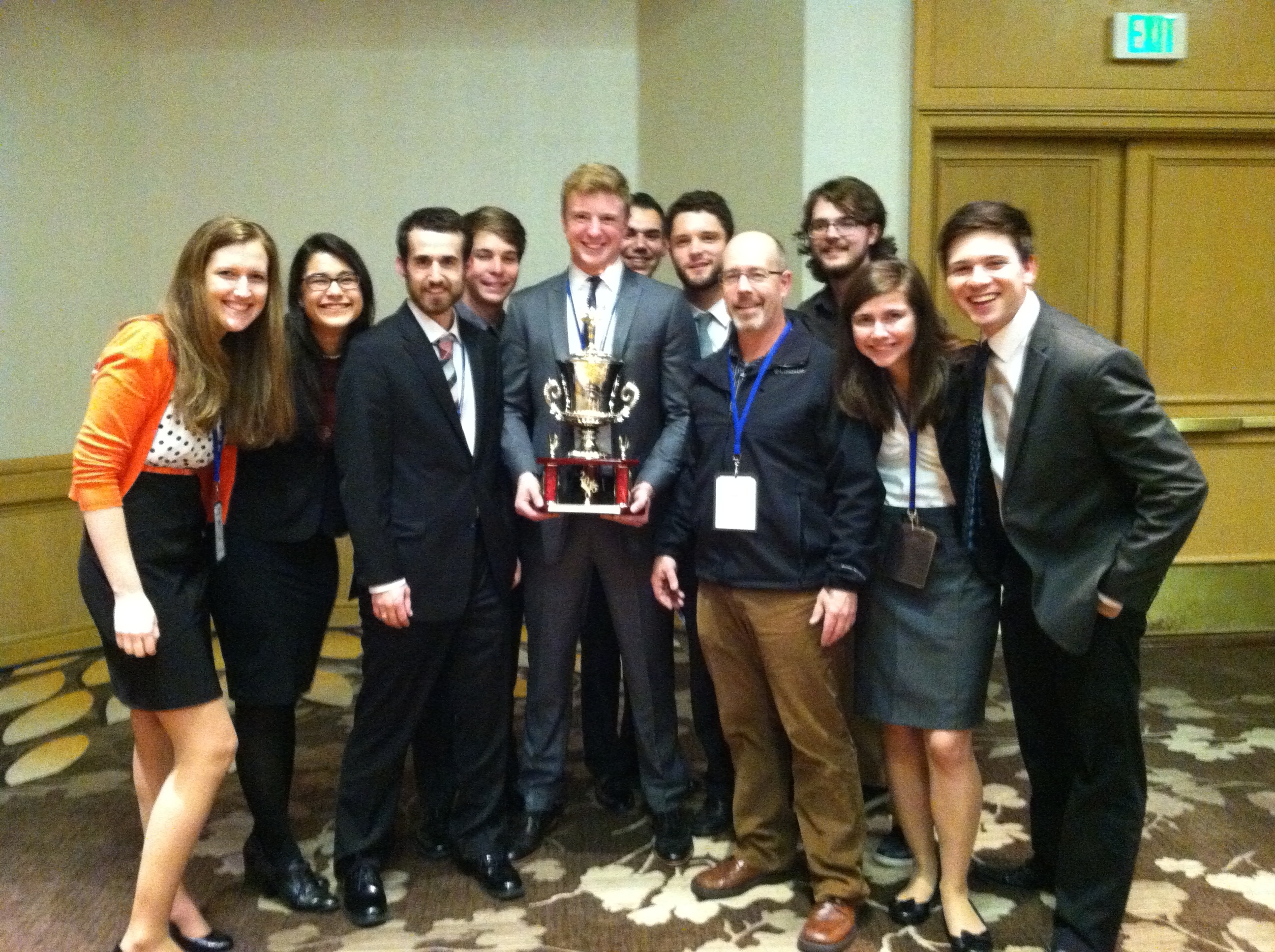
2015 Ethics Bowl Regional Champs

This past Saturday, November 21, the Taylor University Ethics Bowl team won the Central States regional championship for the 5th time in the history of the program.

Photo by Jim Garringer

Twenty-six teams from fifteen colleges and universities participated in this year’s Central States regional competition, which once again was held at Marian University in Indianapolis. The other schools involved were Belmont University, DePauw University, Illinois Wesleyan University (two teams), Indiana University (two teams), IUPUI-Fort Wayne, Marian University, Millikin University (three teams), Mount St. Joseph University (two teams), Northern Kentucky University, Ohio Northern University, Slippery Rock University, St. Mary of the Woods College, University of Arkansas (two teams), University of Southern Indiana, Xavier University, and Youngstown State University.

As usual Taylor entered two teams, and the rosters were as follows:

Team I:

  • Veronica Toth (Senior, English Writing)
  • Blair Hedges (Junior, Political Science)
  • Jackson Wilcox (Sophomore, Accounting)
  • Sarah Manko (Freshman, Exercise Science)
  • Caleb Holleman (Freshman, Math and Philosophy)
  • Loyal Juraschek (Sophomore, Philosophy)

Team II:

  • Kasey Leander (Senior, History and Political Science, Philosophy, & Economics)
  • Sam Moore (Junior, Philosophy and Biblical Studies)
  • Gabriel Harder (Freshman, Philosophy)
  • Chin Ai Oh (Sophomore, Political Science, Philosophy, & Economics)
  • Bo Thomas (Freshman, History and Philosophy)
  • Gloria Talbot (Sophomore, International Business Systems)

The top finishing teams qualify for the national tournament. At the competition each team competes against three other teams, and our teams had a combined record of six wins and no losses:

  • TU team #1 defeated Marian University (149-131), DePauw University (158-149), and Indiana University II (163-141)
  • TU team #2 defeated Univ. of Arkansas II (160-136), Ohio Northern Univ. (158-136), and Mt. St. Joseph Univ. I (149-139)

Taylor now has a combined 18-match winning streak, dating back to nationals earlier this year and regionals last year.

As is typical of Ethics Bowl competitions, very timely issues were debated in the various matches. These included the following:

  • Do religious freedom laws (protecting, say, a baker’s right not to make a cake for a same-sex wedding) properly balance constitutional rights?
  • Is the “Law Enforcement Officers Bill of Rights” (providing that law officers can’t be forced to make a statement within ten days of an incident) morally justifiable?
  • Does the American Freedom Defense Initiative (which ran the “Muhammad cartoon contest”) practice appropriate free speech or unacceptable intolerance?
  • Is the composting of human corpses, as advocated by the Urban Death Project (for environmental reasons) an acceptable way of disposing of the dead?
  • Is the Indian Child Welfare Act (mandating that social services place displaced Native American children with tribal relatives) morally appropriate?

These were just five of fifteen cases that all of the teams had to prepare to address. Other cases pertained to issues as wide ranging as the ethics of physicians’ prescribing hard narcotics to their patients, sexism in video games, a New Zealand species conservation case, special taxes on parents who refuse to vaccinate their children, the ethics of human egg freezing to delay motherhood, and the ethics of forcing parents to have their young teenager undergo chemotherapy. You can find a complete list of cases as well the competition rules and guidelines here.

In the regional competitions (unlike nationals) wins and losses do not impact teams’ overall scores. Rankings are determined entirely by scores awarded by judges. The top five at the conclusion of the day were as follows:

  1. Taylor University I
  2. St. Mary of the Woods College
  3. Illinois Wesleyan University I
  4. Indiana University I
  5. Taylor University II

The national Ethics Bowl competition is scheduled for February 21, 2016 and will be held at the Hyatt Regency Hotel in Reston, Virginia (near Washington, DC).  A total of 36 teams will participate, and Taylor will be striving to defend its national title.

The ELT Statement and Responsible Animal Care–Part 2

Most Christians who would push back on the position expressed in the Every Living Thing statement would resist the idea that animals have real moral standing and that, therefore, we have no real duties toward them. The ELT statement provides good biblical grounds for affirming such duties. I would echo this reasoning and expand upon it in light of two further considerations:

  1. Divine Ownership – We have a duty to respect God in all that we do. God owns everything, so disrespect towards any aspect of nature is disrespect towards God.  Cruel treatment of animals is disrespectful towards them, so we have a duty to treat them humanely. See Psalm 24:1 and Psalm 50:10-11.
  2. The Hierarchy of Being Beings differ in terms of their various perfections and may be hierarchically arranged accordingly. The propriety of our treatment of any being may be assessed according to its place in the hierarchy. Given the sentience and consciousness of animals (and their relatively high place on the hierarchy of being), they should not be treated cruelly.

The upshot is that humans have a two-fold moral duty toward animals, specifically to care for them in a way that is respectful of their divine owner and to do so in a way that is appropriate to their nature as conscious beings with needs and the capacity to suffer.

This has some important practical implications. Generally speaking, we ought to treat animals humanely. Accordingly, we should reconsider our support, directly or indirectly, of:

  1. Factory farms — Animals in huge factory farms are commonly slaughtered carelessly and cruelly.
  2. Circuses – Animals are frequently trained through torturous mistreatment (e.g., Ringling Bros. elephant training).
  3. Trapping Traps used to catch animals for their furs are often very cruel.
  4. Animal research — Animals are often tortured for the sake of questionable research (such as for cosmetics products).

The videos to which I’ve provided links above are hard to watch, but such is necessary to raise awareness about how animals are treated in our society. Hopefully, these will provide further motivation to take seriously our responsibilities regarding animals, even to the point of making significant lifestyle changes.

The “Every Living Thing” Statement on Responsible Animal Care

What duties, if any, do we have toward animals? A new statement on responsible animal care addresses this question in a balanced and biblically informed way. It is being called an “evangelical statement” and appears to be the first such formal document of its kind.  You can read and, if you wish, sign the statement here. (Note that clicking on the “sign the statement” button does not commit you to signing it but merely takes you to the page where you can read the statement and have the option to sign it.)

I signed and strongly endorse the statement because I think it achieves a proper moral-theological balance when it comes to animal welfare. There are two extreme positions regarding this issue. There is the No Moral Status view, which says that animals deserve no moral consideration, and humans have no duties regarding them, except as impacts other humans. Modern philosophers such as Descartes and Kant took such a view, still popular today, which encourages us to see animals as natural resources like any other aspect of nature. On the other hand, there is the Strong Animal Rights position, which affirms that animals and humans have the same inherent value and deserve equal moral consideration. Contemporary moral philosophers such as Peter Singer and Tom Regan take such a view, which is championed by activist animal rights groups like PETA (People for the Ethical Treatment of Animals). Advocates of this approach maintain that all use of animal products for food, clothing, experimentation, or entertainment is immoral.

Somewhere between these extremes is a moderate position which affirms that animals have significant moral status, but not the same status as human beings. Accordingly, we have a duty to treat animals humanely. We ought not to treat them cruelly.  And by “cruel treatment” I mean the causing of severe and unnecessary suffering. On this view, it is morally appropriate to use animals for food, clothing, experimentation, and entertainment, but only if the animals are not treated cruelly in such contexts. The Every Living Thing statement on responsible animal care effectively achieves such a balance.

Refusing to Serve: Moral Dimensions of the Masterpiece Cakeshop Case

Recently, a Colorado appeals court ruled that baker Jack Phillips—owner of Masterpiece Cakeshop in Denver—does not have a right to refuse service for a gay wedding.  The legal reasoning in this case, which affirmed previous rulings, is now the topic of much debate, and many more cases like it are sure to follow, with some perhaps being appealed all the way to the Supreme Court.

Setting the legal issues aside, what are we to say about the moral stance of the baker in this case?  Was Mr. Phillips morally justified in refusing to serve this same-sex couple?  A Christian pastor recently posed this question to me:  Assuming that same-sex marriage is inappropriate for moral-theological reasons, does a Christian baker such as Phillips have a duty to refuse to serve for a same-sex wedding?  The pastor went on to explain that he strongly affirms the traditional view of marriage as the union between one man and one woman and that, therefore, same-sex unions are immoral.  Yet, he was not convinced that Phillips would necessarily be doing anything wrong by serving the couple.  After all, the pastor said, he’s just doing his job.  Why not simply take the approach that he will serve whoever asks.  After all, Jesus says, “give to the one who asks you” (Mt. 5:42; Lk. 6:30).

In response, one might note that Jesus’ maxim here is not intended to be unqualified.  Thus, for example, presumably Jesus would not want you to strictly abide by this instruction when an inebriated friend asks you for the keys to his car so he can drive himself home.  Similarly, one might say that a business owner should not refuse anyone service unless doing so would constitute support for an immoral act.

The problem with this general qualification, the pastor pointed out, is that, as American consumers, it is virtually unavoidable to indirectly support immoral systems and policies, such as manufacturing sweat shops or environmentally hazardous practices, via our clothing and food purchases.  So how is this any different?

This is a common response to the situation, but I think it confuses the issue by comparing a clear case of problematic moral complicity with less clear “gray area” cases.  To make my point, I countered with a hypothetical case of my own:  Suppose a Christian baker is approached by members of NAMBLA (the North American Man/Boy Love Association) with a request to bake cakes for one of their meetings.  Since the baker believes, for theological reasons, that pedophilia is immoral, he refuses to serve them.  The pastor thought this would be reasonable.  And he said the same regarding another scenario I presented where a similar request is made by a Skinhead group.

So the question is this:  Is the Denver baker case more like these scenarios or is it more like cases of inadvertent support of sweatshops and other injustices through one’s purchases?

In response, I would note, first, that in many of the latter cases, we should likewise refuse to lend our support through our purchases, because it constitutes moral complicity with an immoral act.  However, it can be difficult to know when such support is significant enough to warrant our refusal to make certain purchases on those grounds.  Thus, we may want to consider two relevant moral criteria:  1) how significant is the immoral conduct in question?  And (2) how direct would be one’s support of the immoral conduct, if one acted on the request?  The reason most of us would grant that a baker is morally justified in refusing service to NAMBLA and the Skinheads is that such service would directly support these organizations, and the immoral aims of these groups are highly significant–pedophilia and ethnic hatred are serious moral crimes.

So let’s apply these questions to the Denver baker case.  Does Phillips have grounds for thinking that same-sex unions are significantly immoral?  As a Christian who takes seriously both Scripture and the unified voice of nearly two millennia of theological history, he certainly seems to.  And would the requested service directly support this conduct?  Again, the answer is yes—at least as directly as the same service would support NAMBLA and the Skinheads in the parallel cases.

So whatever legal fate might befall Mr. Phillips for refusing to serve a gay wedding, his choice is morally appropriate, given the traditional Christian sexual ethic.  However one might want to quibble with that traditional doctrine or shift focus to the political-legal dimensions of the case, Phillips’ actions are morally coherent and warranted.  Active complicity with an immoral act is wrong, and the refusal to be so complicit is morally justified.

Planned Parenthood and the Banality of Evil

Another video exposing Planned Parenthood’s practice of selling fetal tissue was released today.  You can view it here.  The video features a taped conversation with Mary Gatter, President of the Planned Parenthood Medical Director’s Council, recorded incognito by people with the Center for Medical Progress.  (In case you missed last week’s video, featuring Deborah Nucatola, Planned Parenthood’s Senior Director of Medical Services, you can check it out here).

I was as floored by this new video as I was by the one last week.  Both are excellent examples of what Hannah Arendt (in her study of Adolf Eichmann and the Nazi death camps) called the “banality of evil.”  This is the idea that many horribly wicked acts are performed not with malicious or sadistic intent so much as a blithe adherence to routine procedure within an institutional structure or political system which enables or perhaps even arranges for such evil.  Edward Herman sums it up this way:  “Arendt’s thesis was that people who carry out unspeakable crimes, like Eichmann, a top administrator in the machinery of the Nazi death camps, may not be crazy fanatics at all, but rather ordinary individuals who simply accept the premises of their state and participate in any ongoing enterprise with the energy of good bureaucrats.”

That seems like an apt description of Nucatola, Gatter, and presumably other operatives for Planned Parenthood—an organization that we all help to fund with our tax dollars.

Post-Obergefell: What Might be Next for LGBT Activists and Marriage Traditionalists

Now that LGBT dreams of “marriage equality” have been fulfilled with last week’s Supreme Court ruling in Obergefell v. Hodges, what comes next for LGBT activists?  In this New York Times piece, Jodi Kantor reports a “twinge of loss” that comes with this historic victory for their cause.  After all, theirs is a community that has defined itself in terms of its oppression and thus as an “outsider culture.”  While Kantor’s article merely contemplates this question, I think it is worth considering the likely next step for the LGBT activists: counter-oppression.  As we have seen over the last several decades, with each victory in the legislatures and courts, LGBT activists have only more aggressively sought further legal changes in their favor.  Should we expect them to proceed any differently now?  On the contrary, I think it is more realistic to expect that with the backing of federal law, they will be emboldened to ensure that their “oppressors” (i.e., proponents of traditional marriage) be made the new “outsider culture,” even if this must be done by force.

Hints of this direction appeared in another New York Times article a couple months back, this one authored by Frank Bruni.  In this op-ed, Bruni quotes gay philanthropist Mitchell Gold as proposing that church leaders should be made to “take homosexuality off the sin list.”  Bizarre as this suggestion is, Bruni declares that “his commandment is worthy — and warranted.  All of us, no matter our religious traditions, should know better than to tell gay people that they’re an offense.”

From www.cathnewsusa.com

Perhaps this will be the next rallying point for LGBT activists—to fight for censorship of those who would question the moral legitimacy of same-sex relationships.  If achieved, this would entail severe proscribing of religious freedom.  Perhaps this is why four of the Supreme Court justices issued such dire warnings in their dissenting opinions in the Obergefell case, announcing the dangers this decision represents for religious traditionalists, with Judge Scalia even calling the decision “a threat to democracy.”  Strong, chilling words.

In a Time Magazine piece in response to the Supreme Court ruling, Rod Dreher has suggested that Christians “must now learn to live as exiles in our own country.”  What this amounts to, says Dreher, is taking the “Benedict Option,” as described by Alasdair MacIntyre in his prescient 1982 book After Virtue.  In other words, we must essentially go underground in order to preserve the values of our community.  The trouble is, of course, that things are very different for 21st century U.S. Christians than they were for 6th century Benedictines.  Socially, economically, and technologically, we are too entangled to achieve anything like a true Benedict Option.  To paraphrase the great boxer Joe Louis, we can run but we can’t hide.

What this means is that if LGBT counter-oppression is coming, we’ll simply have to face it—with as much courage and integrity as we can manage.  For many, such courageous resolve will be too demanding.  And this will undoubtedly mean a sudden realization that, well, the sexual pluralists were right after all.  For 4000 years of Judeo-Christian history all of the greatest ethicists and theologians in our tradition were mistaken about same-sex relationships, as are the overwhelming majority of orthodox Christians, Jews, and Muslims today.  With this admission, the forbidden conviction will be “off the sin list,” just as ordered, and gone will be any worries about persecution from legal authorities.

For others who stand firm, this may mean loss of jobs, the death of businesses, the end of educational institutions, jail time or even worse.  There is, after all, a price to be paid for certain convictions in a culture where the “oppressed” become the oppressors.  And where decades, even centuries of suffering under the tyrannical rule of a majority opinion can justify imposing even greater suffering on those who persist as proponents of that same opinion when it has become, at last, a vulnerable minority view.  Or so some may reason.  All for the sake of “justice,” of course.

The 2015 Annual CCT Conference

Last week I attended the conference of the Biola Center for Christian Thought, which is the annual capstone event at the CCT.  This year’s research theme was “Intellectual Virtue and Civil Discourse,” and the conference featured a number of noteworthy scholars who have done significant work in areas related to the theme.  Among them were Robert Audi (University of Notre Dame),

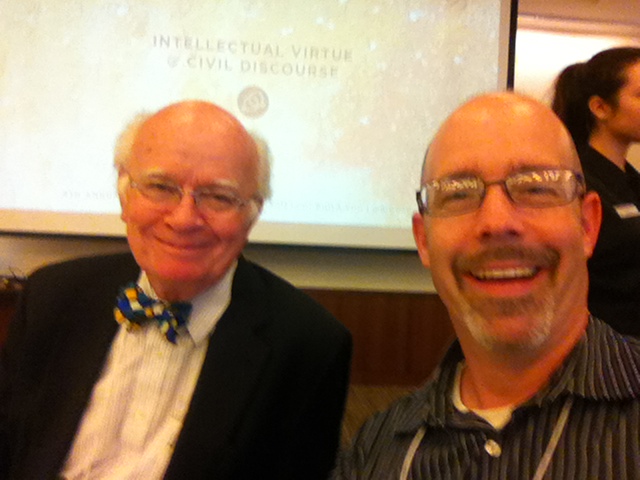
Robert Audi and Storm Bailey

Jason Baehr (Loyola Marymount University), Elaine Howard Ecklund (Rice University), George Marsden (University of Notre Dame, retired), Robert Roberts (Baylor University), Richard Mouw (Fuller Theological Seminary, retired), and Martin Marty (University of Chicago, retired).  In addition to the presentations by these plenary speakers, there were many other excellent presentations at breakout sessions.

Thanks to the John Templeton Foundation, I was honored to be a CCT research fellow during the Fall semester this past academic year.  My research project regards the virtue of open-mindedness, and I was able to make significant progress on what I hope will culminate in a monograph on the subject.  My presentation at the CCT conference, entitled “Open-

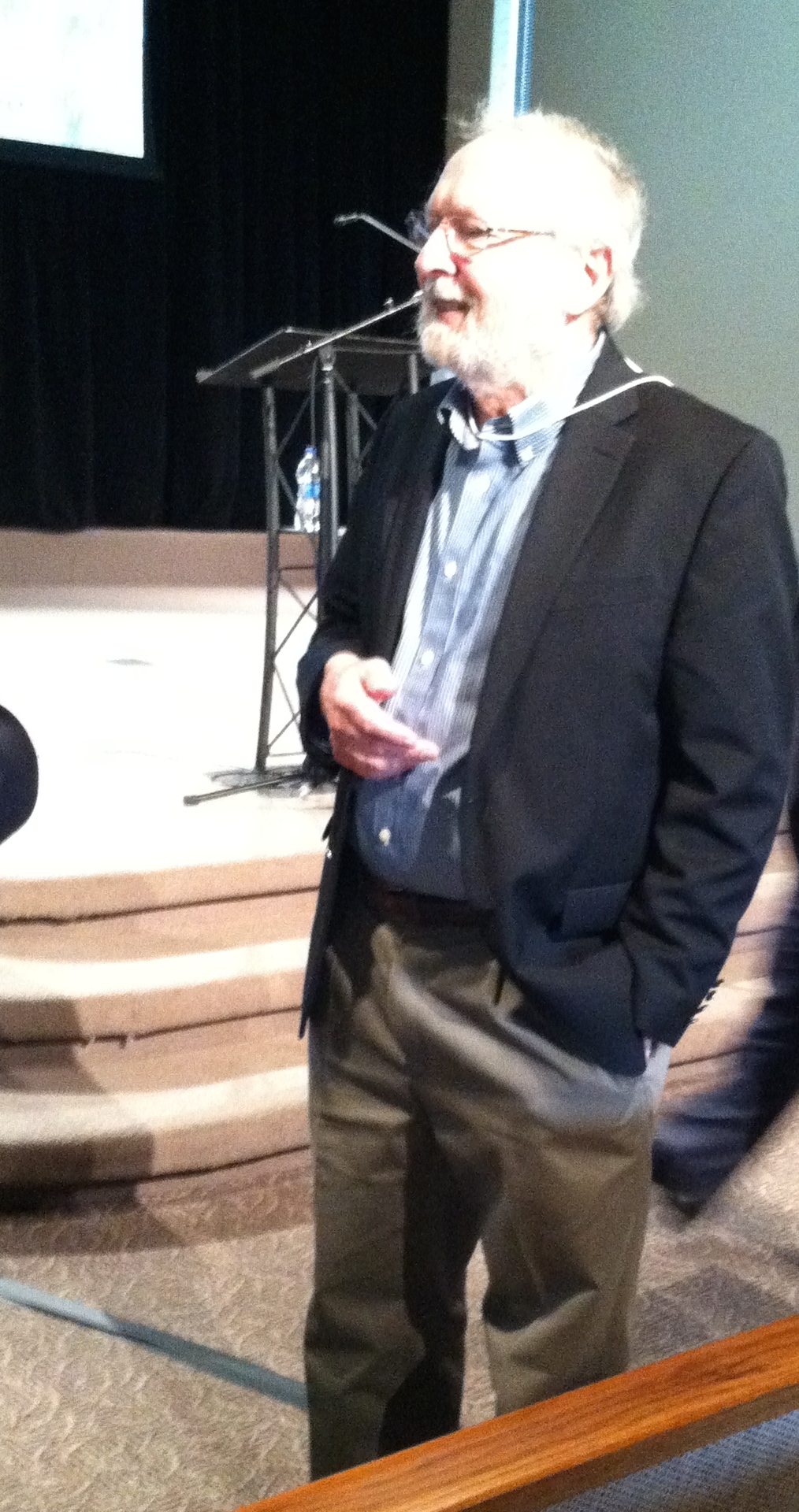
George Marsden
George Marsden

mindedness and Disagreement,” explored the connection between two topics that are germane to this year’s theme.  With regard to the issue of disagreement, the question is whether, or to what extent, confidence in your belief about an issue should be tempered by the fact that some epistemic peers disagree with you.  And, depending upon your view regarding the epistemic implications of peer disagreement, what does it mean to remain open-minded about the issue?  My session was well-attended, and I received helpful feedback, which I am looking forward to implementing in my paper as I revise it and eventually submit it for publication.

The most enjoyable thing about the conference was catching up with some of the scholars I’ve gotten to know through the CCT and other contexts, as well as becoming acquainted with a number of other scholars whom I’d never met before.  Some of these I had only admired from afar, such as the eminent

Martin Marty and me
Martin Marty and me

epistemologist Robert Audi and religious scholar Martin Marty, who might be the greatest living scholar in the English speaking world—author of more than 80 books, winner of numerous scholarly awards, member of two U.S. Presidential Commissions, and holder of 80 (yes, eighty) honorary doctorates.  Somehow I ended up sitting next to Marty at the evening banquet at the CCT conference, and I was struck by the warm humor and genuine humility of the man.  What an inspiration.

In fact, the word “inspiring” well captures my entire experience at the Biola Center for Christian Thought this year.  The CCT directors—Thomas Crisp, Steve Porter, and Gregg Ten Elshof—as well as staff members Evan Rosa and Laura Pelser, are all wonderful folks who know how to create a dynamic community atmosphere for rich scholarly research and dialogue.  The Center is currently accepting proposals for the 2016-17 research theme: “Humility: Moral, Religious, and Intellectual.”  If you do work related to this topic and would like an opportunity to dig a lot deeper, then consider submitting a proposal.  I guarantee that the experience would be a highlight of your academic career!

Thoughts on the Indiana Religious Freedom Restoration Act

Recently there has been a lot of controversy surrounding the Indiana Religious Freedom Restoration Act (RFRA).  This act declares, “a governmental entity may not substantially burden a person’s exercise of religion…[unless it] (1) is in furtherance of a compelling governmental interest; and (2) is the least restrictive means of furthering that compelling governmental interest.”  The law is very similar to more than twenty other such RFRA laws in other states, as well as a 1993 federal law, which states, “Government shall not substantially burden a person’s exercise of religion even if the burden results from a rule of general applicability.”

A few days ago I participated in a panel discussion of the issue at Taylor University.  In addition to some substantive Q&A with the audience, those of us on the panel addressed several prepared questions.  Below are my responses.

What is the nature of ‘religious freedom’?  

Legally speaking, religious freedom is the right to practice one’s faith without interference or censure by the government or fellow citizens.  The First Amendment says Congress cannot “prohibit the free exercise” of religion.  Morally speaking, we may agree that such freedom should be granted by governing authorities just to the extent that practicing one’s religion does not violate the basic rights of other people.  (This is also essentially affirmed in the French Declaration of the Rights of Man in 1789.)  And it is here that things get messy.  For some religious practices could be construed as violating someone’s rights.

What do laws like the Indiana RFRA aim to affect as far as religious freedom is concerned?

Although the principal context of the 1993 Federal RFRA concerned government encroachment onto Native American sacred land, this law and similar state laws have more generally been taken to aim at protecting a religious person’s freedom to abide by their religion’s core moral convictions.  In more recent years, as regards the whole issue of same-sex marriage and religious folks affirming the traditional Judeo-Christian view of marriage, this has been taken to include not being forced to commit the sin of complicity with immoral acts.

What does this legislation actually allow? 

This legislation allows a person the freedom to practice their faith without “substantial burden” being placed on them by the government.  And, in the legal context, a business or corporation may be construed as a “person”.  In last year’s landmark “Burwell v. Hobby Lobby Stores” Supreme Court decision, it was decided that for-profit corporations may hold religious beliefs.

What is it about the Indiana RFRA as opposed to the federal 1993 version that has provoked such ire?

This question commits the fallacy of complex question.  Did this law in particular provoke “such ire” or were there other factors that initiated and fanned the flames of controversy?  Since there is the 1993 federal law and more than thirty states have similar laws and legal provisions, many believe it is the latter.  Some speculate that the Indiana law was simply chosen by LGBT activists for practical reasons to generate national public attention to this issue—perhaps to prime the pump of public opinion as the Supreme Court is currently deliberating a case pertaining to the same-sex marriage issue.  And much of the controversy also seems to have been media driven.

Does the language of this particular version legally permit the service discrimination of certain minorities beyond the circumstances of participation in religious ritual and ceremony?

I don’t see how it could, since there is nothing about being a minority per se that presents a challenge to any reasonable religious practice.  Perhaps this is one of the reasons why the RFRA has not, until now, been controversial or faced any fundamental court challenges in the 22 years of its existence at the federal or state levels.

Do individuals have the moral right to treat individuals differently due to their sexual orientation or gender identity if such treatment is based on religious reasons?

I don’t think there is any theological basis for moral discrimination against people.  But I do think there are strong moral-theological reasons for discriminating against certain behaviors.  For example, a refusal to participate in some activities may be necessary to avoid moral complicity with behaviors essentially proscribed by one’s religion—for instance, if I am asked to support a same-sex wedding by providing a service such as a photography or baking.  But notice that even this doesn’t amount to discriminating on the basis of a person’s sexual orientation so much as it discriminates against the action of performing a same-sex wedding or, more specifically, the lifestyle choices that such a ceremony celebrates and even religiously enshrines.  Keep in mind that when performed by a minister in a church context such weddings are religious ceremonies.  So to insist that any person, such as a baker or photographer, lend their professional support to this sort of religious ceremony is essentially to insist that they embrace or approve of a particular religious practice.  So, ironically, in such contexts the RFRA actually protects people from religion or certain religious practices.

Should we be concerned about the manner in which the Indiana government responded to social pressure, ultimately amending the bill in the wake of serious backlash from national business? Isn’t this undemocratic?

Some say it amounts to public blackmail.  I would say that, generally speaking, the freedom to exert such pressures is part of the democratic process.  But that doesn’t mean they are always reasonable or coherent.  In this case, there are reasons to think it is arbitrary, because so many states and the federal government have similar laws, and hypocritical, because so many business leaders who have protested already do business in states that have such laws.

Is the ability of large businesses to effect such change a dangerous precedent regarding freedom of expression in general?

I think the more dangerous precedent is how such hysteria and duplicitous public criticism of the RFRA has gone unchecked and critiqued by major media and journalistic groups.

The ACLU has remarked that this legislation is a “solution in search of a problem” – Is there good reason for this legislation to exist in Indiana at this time?

I think so.  The GLBT movement and its rhetoric has advanced to the point that those who even voice dissent on the morality of same-sex relations are demonized or ostracized without any discussion or debate.  We’re approaching a state of dogma (again, about the moral issue) in the American cultural centers of power (federal government, state and local government, major media, public education, and entertainment industries) that would terrify and astound (the great proponent of liberty) John Stuart Mill, not to mention the U.S. founding fathers.  Where there is public suppression of views, political oppression of people is never far away.

Today we seem to be moving toward a situation where public expression of the traditional Judeo-Christian view of marriage and sexuality are essentially censored (suppressed via public pressure), and this is creating by contrast a new form of heresy.  If you don’t tow the line regarding the new progressive sexuality, then you are a moral heretic (never mind that your view has been affirmed by the overwhelming majority of scholars and ordinary folks in the East and West, both down through history and in most of the world today).

National Champions!

Last weekend the Taylor University Ethics Bowl team, which I coach, won the national championship in Costa Mesa, California.  Ethics Bowl is an intercollegiate moral issues debate competition, in which hundreds of schools participate nationwide. Taylor has been participating since the late 1990s, and our team has won numerous regional championships, and in recent years we’ve been doing increasingly well at nationals. Two years ago we advanced to the finals, only to be edged by one point in the IMG_1313championship match. But last weekend we took that final step, winning our first national championship in a very close match against Whitworth University (a superb team and one of the most consistently strong teams in the country).

Our team won all three qualifying matches (against Duke University, Santa Clara University and Texas Pan American). Then we defeated Villanova University in the quarterfinals and Indiana University in the semi-finals, culminating in the showdown against Whitworth University.

The competition took place at the Hilton Hotel in Costa Mesa, California. As usual, 32 teams participated, all having qualified by finishing among the top teams in their region. There are ten regions nationwide, and ours is the Central States region, which features some of the best teams in the nation, including former national champions Indiana University (2004 and 2009), Wright State University (2002), and DePauw University (2013).

The topics debated at nationals were the following (two cases covered per match):

  • Unpaid internships
  • The use of ancient artifacts (Roman lead ingots) for scientific purposes
  • “Prescriptive planting” farming technology
  • The killing of civilians in war
  • Parental rights of rapists
  • Fracking
  • Artificial intelligence
  • Minimum wage
  • Horse slaughterhouses
  • Stealth (undercover) journalism
  • Media use of “crowdsourcing”
  • Transgendered people and public bathrooms

The Taylor team roster:

  • Jess Biermann (Senior, Philosophy)
  • Nathaniel Cullen (Senior, Philosophy and Environmental Studies)
  • Kasey Leander (Junior, Political Science, Philosophy, and Economics)
  • Davis Meadors (Senior, Philosophy)
  • Caleb Nagle (Senior, Political Science)
  • Mark Taylor (Senior, Philosophy)
  • Veronica Toth (Junior, English)

And non-roster Ethics Bowlers who were on the Fall regionals team and made the trip to nationals, supporting the team in various ways:

  • Kyle Carruthers (Senior, Professional Writing)
  • Lydia Grace Espiritu (Senior, Philosophy)

Katie Duncan is my assistant coach, and she led the team while I was on sabbatical in the Fall when the team qualified for nationals by finishing second at regionals.

We couldn’t be happier for the students, as they worked like crazy for the last two months and performed brilliantly all day during the competition.  It’s an amazing bunch.  For the seniors, they’ve made it to two finals in three years, and now they’ve won a national championship.

Soli Deo Gloria!