
Passing Into History

Recently, I had the sad honor of attending a memorial service for a dear friend’s father who passed away quite unexpectedly. I listened as several people shared their memories of Fred, some funny, some touching, but all laced with the sorrow of his absence. It is a tragic irony of such events that the more beloved and accomplished the person is, the deeper the sense of loss and grief. It struck me that most of us are striving to live life in such a way as to make many people, whom we love, miserable when we are gone. The only thing worse than a funeral for someone for whom everyone is grieving is a funeral for someone for whom no one is mourning.

My friend’s dad was, fortunately, not such a person. There were many tears from the large crowd who gathered to comfort his family and celebrate his life. There was beautiful singing and a truth-filled homily declaring faith in life after death and the hope of resurrection. And then . . .  it was over. We wiped away our tears and hugged one last time. Some of us gathered for a meal and caught up on life. Then we drove home and did chores, walked our dogs and spent time with our families. Of course, the grieving process is not over and for his family and close friends. It never will be, at least this side of heaven. He will be missed at each family event, talked about among those who didn’t have the privilege of knowing him. But as those who had that privilege slip away, so will their memories. So it will be for each of us. One day in the future our lives, however long, will be reduced to an obituary and an afternoon service.

There are, of course, a select few whose lives take on historic relevance, but they are few and far between. Most of us will not be a world leader, a great inventor or the writer of a timeless classic. Even these figures aren’t really remembered as people but more by their accomplishments. Their deeds and works live on in our memories rather than in their personal impact on individual lives.

As I reflected on this truth, I realized that this is actually true for all of us. In the case of my friend’s dad, Fred, his skills will carry on every time his grandson tees up for a round of golf. His smile and kindness will echo through history in the smiles and kindness of each person whom he influenced for good. Each time his daughter stands in front of her class, his love of teaching will continue.

We each have the opportunity to live a historic life, one that ripples through time far after we are gone. Each day presents us with countless opportunities to reach beyond our eventual grave and live on through small acts of kindness or faithful service. There is no telling how you might echo through history, how loudly your life might resonate through time.

Of course, this requires one to think beyond oneself. After all, if I live a life that is primarily focused on myself, then that leaves very little behind after I am gone. While writing this post, the lyrics of the Beatles’ famous Eleanor Rigby kept playing through my mind. The namesake of this famous song which asks “all the lonely people, where do they all come from?” is buried in Liverpool’s St. Peter’s church cemetery. In the song, Eleanor is alone, touching the lives of no one, she is not mourned or missed at the end of her life. According to the gravestone of the real Eleanor, however, she was a beloved granddaughter and wife. One version of Eleanor has been enshrined as a monument to human isolation and loneliness. But the impact of the real Eleanor is quietly rippling through history in who knows how many ways. Let us strive to do the same.

Not All Conspiracy Theories Are Equal

One of the most common pejoratives used these days is “conspiracy theory.” Media pundits often apply it as a term of derision to conveniently dismiss a person or view they don’t like, and this almost always goes unchallenged. Even otherwise nuanced intellectuals often categorically impugn conspiracy theories as foolish. Novelist Oliver Markus Malloy has said that “conspiracy theories are popular among the ignorant, because they offer simplistic answers to difficult questions” (Inside the Mind of an Introvert). And neuroscientist Abhijit Naskar insists, “all conspiracy theories are the product of the subconscious attempt of an ignorant yet creative mind to counteract the fear of the unknown with tales of fantasy” (Mucize Insan: When The World is Family). While perhaps satisfying to the uncurious, superficial observer, such claims are remarkable for their dogmatic assumptions not only that all conspiracy theories are irrational but also that the root psychological cause of conspiracy theories is the same in every case. If for no other reason, such quick and haughty reproaches should give us serious pause to consider the possibility that they protest too much.

Like most cultural memes, the term “conspiracy theory” is rarely carefully defined. The Oxford Dictionary defines a conspiracy theory as “a belief that some secret but influential organization is responsible for an event or phenomenon.” Some examples of obviously absurd conspiracy theories include the claim that the U.S. moon landings were hoaxes, staged in a Hollywood backlot and that the 9-11 attacks were orchestrated by U.S. or Israeli operatives or didn’t happen at all, in which case it is claimed that bombs destroyed those buildings, not commercial jets. While it might be appropriate to say that such claims should not be dignified by a critical response, it should be with the understanding that a truly critical response can overwhelmingly demonstrate the ludicrousness of these theories.

But are conspiracy theories always without merit? And should we automatically condemn as irrational anyone who espouses a conspiracy theory? In fact, there are many significant historical events which are widely recognized to have involved conspiracies. The assassination of Julius Caesar was certainly conspiratorial in nature. The Watergate burglary involved a conspiracy of at least five people, probably many more than this, and the later cover-up expanded the circle of conspiracy even further. And numerous Mafia organizations have been exposed over the years, all of which constitute conspiracies of some kind, whether or not those infiltrated high echelons of government. It is an uncontestable historical fact, then, that some conspiracy theories have turned out to be correct. Moreover, many of these seemed absurd to most people at the time, until evidence eventually proved them to be true. The simple lesson, then, is that such theories should never be dismissed tout court. Each should be assessed on its own merits. And failure to do so, as is so typical these days, especially on the American left and in mainstream media, is manifestly a fallacy of faulty generalization.

So it seems that not all conspiracy theories are equal and that some are actually quite rational. Therefore, it is for good reason that certain conspiracy theories are accepted by those open-minded enough to carefully examine the evidence. Ironically, then, Oliver Markus Malloy’s condemnation of all conspiracy theories as problematic because “they offer simplistic answers to difficult questions” actually applies to his own categorical dismissal of conspiracy theories, as his is, indeed, a simplistic answer to a difficult question. Similarly, media pundits and cultural commentators who hastily apply the phrase as a convenient pejorative reveal their own failure to think critically even while accusing others of the same.

So why have such categorial dismissals of conspiracy theories become common parlance these days?  Perhaps, at least in part, it is because of the widespread irresponsible appeal to conspiracies, due in turn to the fact that they are entertaining and more likely to draw “clicks,” “likes,” and website traffic. Perhaps also because of cognitive laziness and an impatience with the process of critical inquiry and the sometimes painstaking evidential scrutiny this entails. More likely, it is because dismissing all such theories is an easy way to further one’s own narrative and hamstring competing views. After all, a sweeping demonizing of all conspiracy theories is a very efficient way to rule out any such theory that threatens one’s political perspective. The problem is that this approach also effectively poisons the well against the discovery of actual conspiracies, however rare these might be.

So, setting aside the more obviously absurd conspiracy claims about flat earth, hoaxed moon landings, and the like, are there any diabolical conspiracies associated with, say, the World Economic Forum, the 2020 presidential election, a Chinese takeover of U.S. businesses, Covid-19 vaccine mandates, or recent U.S. riots? With regard to any of these things, might there be powerful people and organizations working behind the scenes to expand their power or bring about their preferred political aims? We will only know one way or another through critical inquiry. Rejecting all such theories from the outset not only closed-mindedly rules out the discovery of possible truths but also places us in greater danger of being victimized if one of these theories turns out to be true.

History has shown that sometimes evil people band together in secretive ways to do sinister things. And in many cases those who had veridical suspicions about these plots were ignored, ridiculed, or denounced as loony for the accusations they made. Might some of today’s “conspiracy theorists” be correct as well? Time will tell. But dismissing all of them as equally ignorant or psychologically twisted will only slow our progress toward the discovery of truth in each case, and to do so is no more rational than uncritical acceptance of flat earth theory or a moon landing hoax.

The End of a Matter

There is a passage in the book of Ecclesiastes that has always fascinated me. It is Ecclesiastes 7:8, which says, “The end of a matter is better than its beginning, and patience is better than pride.” Specifically, the first clause has always struck me. Why is the end of a matter better than its beginning? Why is finishing better than starting? My quest for a better understanding of this idea naturally prompted me to consult biblical commentaries on the passage, but I found that in most cases the commentators skirt past this clause to focus on the second clause which is far easier to understand and explain, however strange it might be to contrast patience with pride (as opposed to impatience).

So I’ve essentially been left to my own devices to understand why the end of a matter is better than its beginning. Fortunately, personal experience has proven to be an effective interpretive tool in this case. As the years have passed, I have been struck by the vivid truth of this passage as it applies to various events in my life and in human experience generally. It hit me again two weeks ago as we celebrated the graduating class of Lighthouse Christian Academy where I serve as head of school. And it hit me a week before that when our oldest son, Bailey, graduated from Taylor University. In both cases, there was a celebration of completion, the attainment of long sought goals, the realization of the telos for which the students strived for so many years. And that is most definitely a very good thing, even better than the beginning of the journey for each of the graduates, however fun or exciting that might have been for them.

Graduations are positive outcomes, of course. But many human experiences are quite negative, even horrifically so. Here again Ecclesiastes 7:8a is clearly applicable. Whether we are talking about a painful trip to the dentist, an unhealthy dating relationship, or any number of other negative experiences, it is certainly good when such things come to an end. After some such event, it is not uncommon to hear people say, “Man, I’m glad that’s over with!” This seems to be a tacit affirmation of the negative pole of the Ecclesiastes 7:8a principle.

So I would sum up my analysis like this. The end of a matter is better than its beginning because any particular “matter” (experience/event/project) is either good or bad. If the matter is bad, then it is good to have it over with. And if the matter is good, then you still benefit from and even enjoy and celebrate the achievement. Either way, then, the end is better than the beginning.

One might object, however, that it is sad when good things end, such as when a virtuous person dies or when a good friend moves away. How could the end of wonderful things like this be better than their beginning? One of Aristotle’s observations about happiness is useful here. He notes that you cannot know you have had a happy life until it is over. This is because until a life is actually completed it is always possible that it can go awry in some way. Only when a person is dead can it be truly said with confidence that that person had an overall good life. And what is true of an entire lifetime is true of particular events (e.g., a good game or a good evening with friends). So for all of the sadness of saying goodbye to a loved one or to a sweet phase in one’s life, it is nonetheless a blessed thing to be able to say with confidence, “Old Joe was a tremendous guy” or “Didn’t we have wonderful times together!”

All of this thinking about “ends” naturally prompts me to think about the ultimate end of things—the culmination of human history as promised in Scripture. Numerous times in the Bible we are reminded that the end of the matter when it comes to the course of history will be marked by the return of Jesus Christ in power and glory. And that will be goodness on a colossal scale. The writer of Genesis says that when God created the heavens and the earth and everything in them, he repeatedly declared them “good.” But as great as that was, it doesn’t compare to what will be achieved in the end—a glory that we are told, often cryptically, is beyond our ability to fathom (cf. Rom. 8:18, 1 Cor. 2:9), a time when “He will wipe every tear from their eyes. There will be no more death or mourning or crying or pain, for the old order of things has passed away.” A time when Christ will rule with perfect justice and righteousness, and perfect joy and fellowship among his people will be established forevermore (Isa. 9:6-7). Now that is an end that is truly better than its beginning!

My Trip to Greece and Italy

Recently, I returned from a 17-day sojourn through Greece and Italy.  The trip was led by Footsteps Ministries and traced the “footsteps” of the Apostle Paul on his missionary journeys as recorded in the book of Acts.  More than 50 Taylor students were on the trip, which functioned as a Biblical Studies course.  The leaders of the trip—David and Elizabeth Sparks, as well as Dave Sparks, Jr. and Kleanthis Iliadou, were tremendous guides, extremely knowledgeable in Greek and Roman history as well as biblical literature.  They also demonstrated a wonderfully pastoral touch.

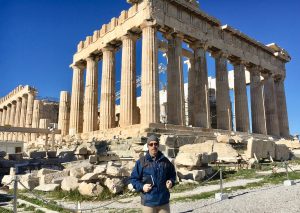
At the Parthenon

Our journey began in Thessaloniki, where we visited the Arch of Galerius, the Basilica of St. Demetrios, and the Roman forum.  From there we went on to Philippi, where we visited the site of Lydia’s baptism and had a tour of the archaeological site: tour of the archaeological site: the agora, basilicas, theater, city walls, and the traditional location of Paul’s imprisonment.  Next we traveled to Berea to see the Rostrum of Paul and the Jewish Quarter with its synagogue.  Then we continued on to Vergina, site of the royal tombs of Philip II of Macedon, father of Alexander the Great.

Next, we traveled to Delphi, but on our way we stopped to visit the monasteries of Meteora, which are perched high atop gigantic rock formations.  In Delphi we visited the sanctuary of Apollo, the Delphic agora, theater, and stadium.  This is where the oracle at Delphi, reputedly speaking for the god Apollo, declared that Socrates was the wisest man in Athens, which is was our next destination.  We stayed in Athens four days, visiting the theater of Dionysios, Hadrian’s Arch, the Temple of Zeus, the Acropolis, where the Parthenon, Erectheion, Temple of Athena, and other sites are located.  We

Ruins of Aristotle’s Lyceum

also visited Areopagus (Mars Hill), where the Apostle Paul gave his discourse recorded in Acts 17.

While in Athens I used a free day to hike up to the northern part of the city, wending my way through the tangled, cramped city streets to visit the remnants of Plato’s Academy.  I also made my way over to the ruins of Aristotle’s Lyceum.  Although these sites are not as visually dazzling as many of the other destinations on this trip, they were highlights for me—just to walk amongst the remnants of the schools founded by these two great Greek thinkers, whose writings have so deeply impacted Western history.

At the Roman Colosseum

We also visited Corinth, visiting the extensive ruins of the ancient city and climbing up to the Corinth acropolis, where the views are spectacular.  Then it was on to Italy, where we spent the final four days of the trip, visiting numerous sites in Rome, including Piazza del Popolo, Trevi Fountain, the Pantheon, the Colosseum, St. John Lateran Church, St. Paul’s Basilica, the Church of St. Sebastian, and the Roman catacombs.  We also spent a day in Vatican City, visiting the Bridge of Angels, St. Peter’s Square (which isn’t really square), the Vatican Museum, and the Sistine Chapel.

What an extraordinary experience!  If you decide to visit Greece and/or Italy, then by all means do it with Footsteps Ministries.  The Sparks family are the best!

WANTED: Gay Affirming Christian Scholar from Before 1950

I am currently researching and writing a chapter for an upcoming book on sexual ethics, to be entitled Venus and Virtue (edited by Jerry Walls, Jeremy Neill, and David Baggett and published by Wipf and Stock). The aim of the book is, in the editors’ words, to “recover Christian wisdom about sexuality by exploring again the biblical and theological foundations that teach us how to celebrate sex while seeking sanctification.”

My own chapter, entitled “The Sexual Pluralist Revolution: Reasons to be Skeptical,” will discuss the dramatic shift of perspective that has occurred in the West within the last generation regarding sexual morality—a shift away from the traditional Judeo-Christian ethic of sex as appropriate only within heterosexual marriage and in the direction of affirming any sexual relationship so long as it takes place between consenting adults. I dub this view “sexual pluralism.” I think there are several reasons to be skeptical of sexual pluralism, not the least of which is the fact that there appear to be no gay-affirming Christian scholars (theologians, philosophers, ethicists, etc.) in history until the latter part of the twentieth century. So with this post I am beckoning our readers to help me out here. Can anyone give me a plausible example of such a scholar?

This matter of historical precedent is quite germane to the question of a Christian’s skepticism about sexual pluralism, and here’s why. As Christians we should take seriously the wealth of moral and theological wisdom that has preceded us historically, and where there is strong consensus among our best thinkers about an issue, as there is on the sexual conduct question, then that forms a strong presumption in favor of the prevailing view. Now since sexual pluralism constitutes a rejection of the Christian consensus about sexual ethics, then, to say the least, we ought to be rather skeptical of this view. In fact, it seems to me, to dismiss the strong consensus of all of the greatest Christian minds who have written on the subject down through history is actually quite arrogant or else historically myopic (or perhaps, to a degree, both).

Now it is very clear that there is, as I have said, a strong historical consensus among Christian scholars on sexual ethics until the last few decades. (This point is strongly confirmed in Fortson and Grams’ new book Unchanging Witness.) But what I want to know is whether there is actual unanimity—agreement without exception—among Christian scholars regarding the traditional sexual ethic until the mid-twentieth century. Not that my argument depends on such, of course. One would expect at least a few historical exceptions, given the many thousands of Christian scholars who have weighed in on the issue over nearly twenty millennia. Identifying a few outliers would not undermine the argument. But I am intrigued by the possibility that there are no such outliers and that there really was complete unanimity on the issue among Christian scholars until recently. So again, I beseech your help in identifying an example for me. This would then confirm that I should avoid use of the term “unanimous” in my chapter in describing the Christian scholarly consensus on the issue prior to the mid-twentieth century.

Now, a couple of caveats. First, it will not do to point to a given scholar in history who might appear to have engaged in same-sex practices or to cite historical innuendo in that direction. Not only is this potentially slanderous regarding the scholar in question but it misses the point of my argument, which regards the studied views of Christian scholars down through history, for it is this which carries some epistemic authority for Christians today.

Also, it won’t do to appeal to the dangers of being a sexual pluralist or gay affirming in past times, thus ostensibly explaining the silence of dissenting Christian scholars on the subject. This is because down through history thousands of Christians—scholars and lay people alike—have suffered severely for rejecting other doctrines, even those as relatively minor as particular views on communion and baptism, as well as the doctrine of salvation and creedal matters. (Here is one partial list.) So if some Christian scholars were gay affirming in such dangerous contexts, surely at least a few would have been willing to make this known despite the damaging consequences. Also, the threat of execution or even severe prosecution would not apply to all Christian contexts in all countries down through history. In some places and times, the ramifications for affirming sexual pluralism would be less severe, thus making the supposed “silence” of all sexual pluralist Christian scholars less plausible.

The Greatest Man Who Ever Lived

Today we celebrate the birthday of Jesus of Nazareth, widely considered the greatest man who ever lived. His teachings are arguably the most profound, insightful and challenging the world has ever seen. He has inspired countless universities, hospitals, and ministries to the sick, poor, and oppressed. He has inspired the world’s greatest literature, art, and music, not to mention the greatest theological treatises and much of the greatest philosophy in history. He has also inspired countless followers to make extreme sacrifices, many even literally giving up their lives, in his service. So great is his influence on human history, in fact, that this itinerant teacher became the reference point for the world’s dating system. That’s remarkable stuff for a man who never held a political office, never led an army, never authored any books or even a single essay, nor did he even travel more than a few hundred miles from his hometown.

So how did he manage to so profoundly impact human history? For Christians, of course, the answer is that Jesus wasn’t just the greatest man who ever lived. He was something far more than this.

“Now unto him that is able to keep you from falling, and to present you faultless before the presence of his glory with exceeding joy. To the only wise God our Savior, be glory and majesty, dominion and power, both now and ever. Amen.” (Jude 1:24-25)

The Fates of Jesus Killers

It is interesting to note the fates of those who would destroy Jesus Christ. These included Herod the Great, Judas Iscariot, and Pontius Pilate.

Herod the Great was the Roman king of Judea who reigned from 37 B.C. to 4 or 1 B.C.  He was so brutally ambitious that he even killed his own wife and children.  But his most notorious act was the so-called “Massacre of the Innocents” in Bethlehem and its vicinity, ordered by Herod in an attempt to destroy Jesus in his infancy.  By the time the order was carried out, however, Joseph had been warned

from Wikipedia
from Wikipedia

in a dream to leave the area, which, along with Mary and Jesus, he did, foiling Herod’s plan.

It was not long after this that Herod experienced what the ancient historian Eusebius calls a “terrible end”:

He had an overpowering desire for food, which it was impossible to satisfy, ulceration of the intestines with agonizing pains in the lower bowel, and a clammy transparent humour covering the feet.  The abdomen was in the same miserable state, and in the genitals mortification set in, breeding worms.  Breathing was constricted and only possible when sitting upright, and it was most offensive because of the heavy stench and feverish respiration.  He suffered in every part convulsions that were unbearably severe.  (Ecclesiastical History, 1.8)

A maggot infestation of the scrotum?  Ugh.  No wonder Herod went on to attempt suicide.  But as the Jewish historian Josephus tells us, Herod was prevented from doing so by his cousin.  In any case, Herod’s demise soon followed his torturous illness.

Fast-forward about 33 years, and we find Judas Iscariot attempting to waylay Jesus.  Unlike Herod, Judas succeeds.  For thirty silver coins, Judas betrays Jesus into the hands of the Romans, who would subsequently crucify him.  The Gospel of Matthew tells us that Judas felt extreme remorse for this, saying “I have sinned for I have betrayed innocent blood.”  Matthew then notes that “Judas threw the money into the temple and left.  Then he went away and hanged himself” (Mt. 27:4-5).  According to the book of Acts, Judas first

from Wikipedia
from Wikipedia

purchased a field with some of that money.  Presumably, that’s where he hung himself, and where eventually “he fell headlong and all his intestines spilled out” (Acts 1:18).

It was Pontius Pilate, prefect of Judea, who presided over the trial of Jesus.  Seemingly reluctant to condemn Jesus, Pilate declared, “I find no basis for a charge against this man” (Lk. 23:4).  Nevertheless, he eventually succumbed to the pressure of the crowd and Jewish leaders, sentencing Jesus to be crucified.  Still, he insisted, I am innocent of this man’s blood” (Mt. 27:24) while washing his hands in front of the crowd.

So what became of the duplicitous Pilate?  Apparently he met the same fate as Judas—suicide.  Eusebius explains that, Pilate “was involved in such calamities that he was forced to become his own executioner and to punish himself with his own hand.” (Ecclesiastical History, 2.7)

Herod the Great, Judas Iscariot, and Pontius Pilate—three (would-be or actual) Jesus killers.  It is a macabre coincidence—whether or not mere coincidence—that each died the way he did.  Herod attempted to kill Jesus but failed, though his attempt brought much misery.  Likewise, he attempted to kill himself but failed, and his failure extended his own extreme misery.  Iscariot and Pilate, on the other hand, both succeeded in putting Jesus to death.  Likewise, they both also succeeded in putting themselves to death.

Talk about poetic justice.  To condemn the Source of Life is to condemn one’s own life.  To attack God is to attack oneself at the most foundational level.

Foundational Documents of Israel and Hamas

The recent violence in the Middle East has prompted me to take a close look at the founding documents of Israel and Hamas—the governing authority of Gaza.  Reading through the Hamas Charter it is clear that the principal aim of Hamas is the extermination of Jews.  As article seven Small_hamas_logostates, “Hamas has been looking forward to implement Allah’s promise whatever time it might take. The prophet, prayer and peace be upon him, said: The time will not come until Muslims will fight the Jews (and kill them); until the Jews hide behind rocks and trees, which will cry: O Muslim! there is a Jew hiding behind me, come on and kill him!” Hamas is fundamentally committed to jihad and opposed to peaceful negotiation with Israel (see article 13).

As for Israel’s founding documents, it is interesting to note that they have no formal constitution.  Rather, the legal foundation of the country is a document called the Basic Laws of Israel.  See especially the basic laws on Human Dignity and Liberty.  These fundamental laws concern the protection of human rights to life, property, dignity and privacy, regardless of a person’s race, religion, or ethnicity.  It is striking to note the vast difference of content and tone between this document and the Hamas Charter.  In short, we see in these two documents Emblem_of_Israel.svgthe essential differences between founding principles that respect human rights and those which do not.  Or, to be more blunt: the difference between a rational political system and a terrorist state.

I would encourage anyone interested in Middle East relations—which should include all of us—to take a close look at these documents.  They go a long way in explaining the on-going events in that region.  As it is with individual people, so it is with nations and political systems:  Our basic values drive our conduct.

Thoughts on Hitler’s Demise

I’m a big fan of Quentin Tarantino films, as is probably apparent to regular readers of this blog.  I am especially fond of his most recent effort, Inglourious Basterds (see my October 29, 2009 post for a full review), which excels in nearly all cinematic categories.  Some have been critical of the film because of its deliberate (and extreme) distortion of history.  In case you haven’t seen the film—spoiler alert!—the story concerns two fictional plots to assassinate Hitler and his fellow Third Reich imps.  Unlike the actual Stauffenberg assassination attempt that merely injured the Fuhrer, Tarantino’s film brings Hitler to an extremely violent end.  Part of the incentive to concoct such a story, presumably, would be to give viewers the satisfaction of watching Hitler get what he deserved—indeed, the fate that many of us would like to see all genocidal maniacs meet.  I think Tarantino has indicated as much in some interviews about the film.

While reading excerpts from Ian Kershaw’s recent Hitler biography, I’ve been reflecting a bit on the historical facts and have concluded that Tarantino’s invented story of Hitler’s demise is really less satisfying (in the sense of being pleased by the wicked getting their just deserts) than what actually took place.   On the afternoon of April 30, 1945, Hitler, Eva Braun, and assorted Nazi officers were holed up in a bunker at the Reich Chancellery in Berlin, as the Red Army closed in.  The Fuhrer had heard that Mussolini had been captured and killed (though he probably was not aware of the gory details), and he wished to avoid such a fate, as well as the ignominious prospect of his body being permanently displayed by the Soviets as a trophy of their triumph.  So Hitler’s plan was to commit suicide and have his body cremated.  Specifically, he would take a pill of prussic acid.  However, being doubtful about the effectiveness of the poison, he instructed one of his officers to test it on his dog, an Alsatian named Blondi.  The dog died almost immediately upon ingesting the poison—which apparently prompted no emotional response from Hitler, despite the fact that he showed more love to the animal than any human in his life, including his long-time lover Eva Braun.

So when it was clear the Soviet army was only a few hundred meters away and could storm the Chancellery at any minute.  Hitler and Eva Braun executed their plan…and themselves.

Why is this true story more fitting than that envisioned by Tarantino, or, for that matter, any of our own dreams of, say, a live Hitler capture, trial, and execution?  For one thing, there is the powerful symbolism of the self-destructiveness of evil.  The pursuit of absolute power is self-defeating, and those who live by the murderous sword often fall upon it.  Hitler, of course, is only one of the more recent examples of this fundamental truth about the human condition.  History has seen myriad despots destroy themselves, whether directly by their own hand or as an indirect consequence of their wicked actions.

One must also consider the emotional dimension of the story.  What despair must Hitler have experienced in those final days and, especially, his last hours.  Perhaps during that time he came to some sober reflections on the true moral horror of what he had done.  Perhaps not.  But the despair he felt surely gave him at least a taste of what so many millions of innocent Jews and other victims of the Nazi scourge felt as they awaited their fate in concentration camps—a sense of hopelessness and the most sickening sorrow.

Of course, in the end, there really is no completely just recompense for the wicked on this earth.  As Scripture tells us, we must wait for Judgment Day for that (cf. Eccl. 12:14; 2 Cor. 5:10).  But human history, and particular narratives, may nonetheless be more or less pleasing from the standpoint of justice.  Some point better than others to deep moral, spiritual, and human truths.  And it seems to me that, in these respects, however much we may want to indulge our own fantasies about Hitler’s fate, we can’t improve on the tale as told by God.