The Best and Worst of 2018

It’s been another exciting year, and we want to thank you all for reading and, if applicable, posting comments on our blog. Once again, we would like to close out the year with some summary remarks about good and bad stuff related to film, music, books, sports, food, and family.

Film Experiences:

Jim:  This year I saw numerous films and few of them were disappointments. My expectations were low going into several of these, which contributed to my delight at their quality. One of these was Solo: A Star Wars Story, which wonderfully matched the Star Wars campy humor aesthetic at its best. Another was Incredibles 2, which blew me away in terms of how naturally it followed and even improved upon the seemingly unmatchable first film. What took them so long?! And my expectations were especially low with regard to A Star is Born, but under Bradley Cooper’s superb direction, combined with some strong acting and singing performances by Cooper and Lady Gaga, what seemed from the start to be a really bad idea (why remake such a bad film?) became a stunning triumph—an authentically portrayed tragic tale at a time in Hollywood history when tragedy seems to be a dead genre. Bravo! Two other highlights for the year for me were Phantom Thread (Daniel Day-Lewis is truly a master of his craft) and The Ballad of Buster Scruggs (the Coen brothers—directors of the film—are masters of theirs).

Amy:  Jim stole a few of my choices for great film experiences, but here are a few others he didn’t mention. I spent a lot more time watching the small screen than the big screen this year. However, two highlights among blockbusters were Avengers: Infinity War and Mission: Impossible-Fallout. Neither was the best movie ever, but once you have committed to a series, you have to see it through, right? The Searchers and My Life as a Zucchini were two small screen gems we enjoyed as a family. I discovered Sneaky Pete which is a brilliantly produced con series and Patrick Melrose. The kids and I devoured The Great British Baking Show and all I can say is it was scrummy! We also made sport with several Hallmark movies this Christmas (one point if you can predict upcoming dialogue, two points for predicting plot developments) which are a bit like your Aunt Betty’s cheese ball: unoriginal and bland but for some reason you can’t stop yourself from consuming it.

Jim’s Best Musical Experiences of the Year:  One of the highlights of the year was taking my daughter, Maggie, to see Taylor Swift in concert at Lucas Oil stadium in September. Maggie cried through much of it, while I simply enjoyed the show. Seeing Bailey, Sam, and Andrew develop as musicians (guitar, drums, and piano, respectively) has been wonderful. As for new music that I’ve especially enjoyed, by far my biggest discovery of the year was the Avett Brothers. I have been vaguely aware of them for years but I never really dug into their stuff. Then I discovered their song “No Hard Feelings” at a time in my life when I really needed it. This prompted a deep dive into their catalogue and I’ve been astounded by the musical beauty and lyrical wisdom of their work ever since.

Amy’s Best Food Experiences of the Year:  This summer, a friend and I catered two weddings, with our husbands and kids playing supporting roles.  So much work, so much time, so much fun. Kind of like marriage, actually. Being trusted to play a significant role in one of the biggest days of a couple’s life is a true honor . . . not to mention the joy of discovering homemade pickled beets and chicken shawarma. Yum yum.

Jim’s Favorite Sports Moments of the Year:  The Chicago Cubs had a strong regular season, but I’ll leave it at that (see disappointing sports moments below), and the New Orleans Saints have been dominant in the regular season as well, and I’m hopeful that their season this year won’t end in a crushing last second defeat like last year (see below as well). Sam’s Eastbrook high school soccer team won sectionals again, which was fun.  And his first year on a travel team was great for him as well.

Amy’s Favorite Sports Moments of the Year:  Ironically, my favorite sports moment involved watching my team lose. We had a challenging spring semester and making a run for the border (to Canada) with Jim for our anniversary was a much-needed break. Attending my first NHL game (Detroit vs. Montreal) was icing on the cake. Go Red Wings!

Jim’s Most Disappointing Sports Moments of the Year:  The Chicago Cubs early dismissal from the playoffs via a loss in the wild card game against the Colorado Rockies was disappointing. But it wasn’t terribly surprising, as all season long they seemed to lack the timely hitting that great teams consistently come up with. And the New Orleans Saints’ sudden ousting from the playoffs in January due to the “Minneapolis Miracle” TD pass reception by Stefon Diggs was one of the most difficult moments in my life as a sports fan. Oh well, there’s always next year, and I’m hoping this year will be it for my Saints.

Amy’s Most Painful Sports Moment of the Year:  I really thought (and hoped) the Cubs would make a deep run in the playoffs, but I enjoyed watching the Red Sox win it all. On a more personal note, Andrew’s travel basketball team lost in double overtime despite the other team going down two players and he ended up with a concussion, a first for the both us.

Good and Bad Reads of the Year:

Jim:  One of my favorite reads this year was Christian Faith and Social Justice: Five Views, edited by Vic McCracken. The book displays just how widely varied are the perspectives on social justice, even within the Christian community. And it doesn’t even include a chapter on the natural law perspective, which is probably the book’s main weakness. Here is my full review of the volume. Another superb scholarly text I read this year was Linda Zagzebski’s Epistemic Authority, which explores the role of authority in belief formation. Next to Alvin Plantinga, Zagzebski is probably my biggest contemporary hero in Christian philosophy and, more specifically, virtue epistemology. Everything she does is lucid and profoundly insightful. The worst book I read this year (and probably for many years) was Willie James Jennings’ The Christian Imagination. It is a work which is unfortunately highly touted in many circles, but which lacks anything like a coherent argument for its thesis. I also read many superb (and a few not so good) scholarly articles pertaining to hell and open-mindedness, my primary scholarly projects these days.

Amy:  I read so many great books this year, some for pleasure, some I had to muscle through, and some that were a little bit of both. Mindset by Carol Dweck and A Failure of Nerve by Edwin Friedman were two that challenged my narrative-oriented brain but were well worth the effort as was Reflection on the Psalms by C.S. Lewis, though in a more spiritually edifying way. Black Like Me by John Howard Griffin and Up from Slavery by Booker T. Washington were sobering reminders of the history of prejudice in our country which both, ironically, left me hopeful about the potential of our future. The Choice by Dr. Edith Eger is one of the best books I read this year and one I couldn’t stop recommending to people. Our family entered the world of the Enneagram with The Road Back to You and I have loved all things P. G. Wodehouse this fall and winter. Lethal White, the next in the series by Robert Galbraith, aka J. K. Rowling, did not disappoint.

Best 2018 Family Memories:

Amy:  Our 20th wedding anniversary trip in March was wonderful especially our trip to the Toronto Museum of Art and hiking around Montreal. This year was full of transitions for us as a family. Bailey graduated from high school started at Taylor this fall. His absence is felt by us all and yet we are excited to see him moving on to bigger and better things. I wrapped up homeschooling with Maggie and Andrew and with their entrance into our local public school, I have taken on the role of cheerleader rather than teacher, a role I quite enjoy unless it means explaining linear equations, to myself and Maggie, at 11:30 at night. The kids and I took a trip over fall break with my folks and enjoyed beautiful scenery and one another’s company. We have all also loved having my niece, Rachel, living with us this year.

Jim:  Our trip to Canada in March was a rewarding and timely excursion. On the way home, we visited Ausable Chasm, the “Grand Canyon of the Adirondacks,” which we both enjoyed immensely. Also, seeing our sons Sam and Andrew develop as athletes (soccer for Sam and baseball, basketball, and soccer for Andrew) has been a lot of fun. And having Bailey as a student in my History of Philosophy class at Taylor was also a memorable, if sometimes strange, experience. Also, building a chicken coop and acquiring some chicks (which are now full-grown, ready-to-lay, hens) has been quite the adventure. Lastly, taking part in a two-day retreat of silence at the Abbey of Gethsemani monastery in Kentucky two weeks ago with my father-in-law, brother-in-law, and our six sons was a highlight as well. The extended time of prayer, Bible study, and silent meditation was spiritually enriching and cleansing. And the bourbon chocolate fudge made by the monks was a nice bonus!

Best Kids’ Quotes of the Year

Here are some of the best quotes of the year from our kids, which come from Maggie (14) and Sam (16):

  • Maggie: “I wish cancer would get cancer and die.”
  • Sam: “The worst things happen to people when they forget how small they really are.”
  • Maggie: “Moms know. Dads understand.”
  • Sam: “No one is anonymous under the divine eyes.”
  • Maggie: (in a conversation about sexual ethics) “Truth does not have an expiration date. It’s not frickin’ milk.”
  • Maggie: “If someone kidnapped me and held me against my will but gave me ice cream regularly, I would stay.”

New Year’s Resolutions:

Amy:  I want to strive to be more disciplined in scripture reading. I am working on turning worries into prayers and with my career as a homeschooling mom coming to an end, I am figuring out what I want to be when I grow up.

Jim:  Once again, my primary goal this year is to be more regular with posts on Wisdom and Folly. But I really mean it this time!


Happy 2019 everyone!
My Debates with John Loftus

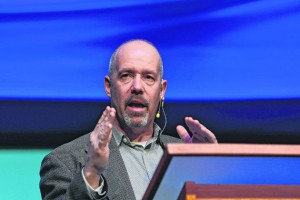
Last week I twice debated atheist author John Loftus.  The first debate was hosted by Brookville Road Community Church in Indianapolis.  Approximately 600 people attended the event, and you can view it here.  The second debate, which was held the very next night, was hosted by the Free Thought Fort Wayne group at the Allen County Public Library auditorium.  The audience at this event was smaller—about 150—and consisted of a higher concentration of religious skeptics.

At both events Loftus and I debated the question “Is Religious Faith Rational?”  I took the affirmative position while Loftus defended the negative thesis.  John is a veteran debater, having gone toe-to-toe with the likes of Dinesh D’Souza, Randal Rauser, David Wood, and others.  Spiegel at Indy DebateThis was my first experience at formal debate, so I was curious to see how it would go.  I certainly enjoyed Loftusit, and I found the time constraints to be the most challenging aspect of the experience.

There was an interesting wrinkle regarding the first event.  John’s van broke down in Muncie on his way to the Indy debate.  So the organizers contacted me to ask if I would pick him up on the way to the church, which I was happy to do.  Consequently, John and I were able to spend about an hour together getting to know one another before the first event.  We actually hit it off, and I think that helped set the tone for a cordial debate both nights.

Here is a piece about the Indy debate that appeared in the Daily Reporter.

I am interested in doing more debates with other atheists and religious skeptics.  In addition to the topic of the reasonableness of religious faith, I am happy to debate such issues as the problem of evil, the existence of God, the prospects of ethics without God, and other issues related to philosophy of religion.  So if you or someone you know would like to partner with me to do that, let me know!


Review of McLeod-Harrison’s The Resurrection of Immortality

Mark McLeod-Harrison’s new book, The Resurrection of Immortality (Cascade, 2017) is a welcome contribution to the growing literature related to personal eschatology. His concern in the book is to explore the question of human immortality. Historically, parties to the debate have generally affirmed either that human beings are essentially immortal or conditionally immortal. Those taking the first view maintain that by nature human beings will live forever. As human beings we naturally possess the property of immortality. Conditionalists deny this, maintaining that humans may or may not live forever. God grants immortality to some, depending on certain conditions (e.g., redemption in Christ).

McLeod-Harrison defends a third alternative, which denies that immortality is intrinsic to human nature but says immortality is an enduring property possessed by human beings. On this view, immortality is an extrinsic property, one which God confers on human beings based on other properties that God gives us. And much of the book is devoted to constructing an argument for this claim—an argument that is philosophical, rather than theological, in nature. Though purely philosophical in methodology, McLeod-Harrison’s argument is nevertheless “in-house,” aimed specifically at Christian scholars in that it assumes certain basic claims of Christian theology—the existence of God, the reality of an afterlife, and the biblical doctrine of salvation.

The author admirably devotes the first couple of chapters to laying conceptual groundwork for his argument, especially defining key terms. Since “immortality” is a privative concept (like “infinite” or “unbiased”), he begins with a careful review of the concept of “mortality” and the modal varieties of meanings potentially associated with the term. Thus, he notes, we may understand mortality as referring to the possibility, actuality, or necessity of the death of the body. Alternatively, we may understand mortality vis-à-vis the soul and its possible, actual, or necessary destruction. In the second chapter, McLeod-Harrison lays out, in somewhat parallel fashion, the varieties of immortality. This conceptual backdrop is very helpful preparation for the ensuing discussion and is one of the strengths of the book.

The author’s main target of refutation is conditional immortality, which he defines as the view that humans may possibly suffer soul-death. In chapter three he addresses this claim head-on, considering whether God can cause humans to cease to exist. He addresses the question primarily in terms of God’s “moral purview to cause humans to cease to exist” (29). Though understanding that the moral and metaphysical conditions for God’s destruction of human persons are distinct, he rightly notes that “if it is morally permissible for God to bring about soul-death for humans, then it seems that it also is metaphysically possible for God to bring about soul-death” (29). Here the author appeals to Kantian notions regarding the relationship between “ought” and “can.” So although his argument in this chapter appeals primarily to what is in God’s moral power, the author regards his findings as having significant implications regarding what is metaphysically possible for God.

For the rest of my review, including my criticisms of McLeod-Harrison’s arguments, go here.

Seneca on Anger

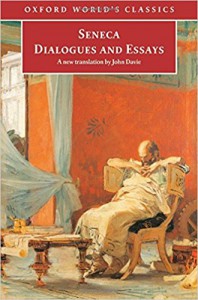
This semester in my Principles of Ethics class I’ve been incorporating some new readings, including several works by the ancient Stoic philosopher Seneca.  A lot of his stuff is not only insightful but also practically beneficial, not to mention beautifully written.  His essay “On Anger” is an excellent case in point.  Personally, I think he goes too far in suggesting that all anger should be avoided, but I think we all can agree that much, if not most, human anger is counter-productive.  And we all would benefit from improving in the area of anger management, especially in these days of division and rancor.  Below I have highlighted some of Seneca’s thoughts on the subject which you may find helpful.  (All quotes below are from the Oxford edition of Seneca’s Dialogues and Essays, translated by John Davie.)

Why Anger Should be Avoided

  1. Anger inflicts harm on oneself: anger makes one a prisoner of one’s own passion. It is more painful to 516fhtlbDsL._SX328_BO1,204,203,200_surrender to anger than to resist it: “every sense of grievance grows to self-torture” (32). “The anger I feel is more likely to do me harm than any wrong you may do me” (40).
  2. It is a sign of greatness to be resistant to all disturbances: “a lofty mind, always composed and established in a peaceful location, suppresses all that produces anger, and so is moderate, well-ordered, and earns respect; none of these things will you find in an angry man” (23).
  3. Anger turns men into savages: Gaius Caesar and many other leaders have allowed their anger to the most extreme cruelties, which extends even to fury on entire nations. Anger begets “every sort of evil, fire and sword. Trampling shame underfoot, it defiles men’s hands with murder . . . and leaves no place free from crime” (50).

Anger is Susceptible to our Control

  1. Many others have pardoned worse sins than you’ve suffered: People have forgiven criminal offenses, so “should I not pardon laziness, carelessness, or chattering?” (39). Even Harpagus controlled his anger when he was forced to eat his own sons, which the Persian king had killed, cooked, and served to him.
  2. You are able to tolerate other forms of irresponsibility, such as “a sick man’s lunatic behavior, a madman’s crazed words, or children’s petulant blows. . . . What difference does it make what fault it is that makes a person behave irresponsibly?” (40).

Guidelines for Avoiding Anger

  1. Take note of the things that provoke you: “It is an advantage to know one’s illness and to destroy its strength before it has scope to grow” (27).
  2. Use humor as a defense: “Let most affronts be turned into amusement and jest.”
  3. Resist the tendency to suspicion and exaggeration: “Very many men manufacture complaints, either by suspecting what is untrue or by exaggerating the unimportant. Anger often comes to us, but more often we come to it” (28).
  4. Put yourself in others’ shoes: Usually anger results from an “unjustified estimate of our own worth” and “an unwillingness to put up with treatment we would happily inflict on others” (28).
  5. Remember that everyone does foolish things: “Even the wisest men do wrong.” “No one is so ripe in judgment that his self-possession is not driven by misfortune into some heated action” (39). “All of us are inconsiderate and imprudent, all unreliable, dissatisfied, ambitious—why disguise with euphemism this sore that infects us all? All of us are corrupt.” (40).
  6. Remember your mortality: Resisting anger will make you more lovable. Better to “spend the brief span we have left in rest and peace” (50). Anyway, the one who offended you will die one day, whether or not you burn with anger toward him.  “Soon we will spit out this little spirit. In the meantime, while we have breath, while we are among our fellow men, let us behave as men should; let us not be a cause of fear or danger to anyone; . . . and let us tolerate with a great mind our short-lived misfortunes” (52).

New Publication on Open-mindedness

Recently, another article of mine on the virtue of open-mindedness was published, this one in Philosophia: Philosophical Quarterly of Israel. It is entitled “Contest and Indifference: Two Models of Open-Minded Inquiry.” The link takes you to (a read-only version of) the entire article. Here is the abstract:

While open-mindedness as an intellectual trait has been recognized for centuries, Western philosophers have not explicitly endorsed it as a virtue until recently. This acknowledgment has been roughly coincident with the rise of virtue epistemology. As with any virtue, it is important to inform contemporary discussion of open-mindedness with reflection on sources from the history of philosophy. Here I do just this. After reviewing two major accounts of open-mindedness, which I dub “Contest” and “Indifference,” I explore some ideas pertinent to the subject in four philosophers spanning eighteen centuries: Sextus Empiricus, John Locke, John Stuart Mill, and Paul Feyerabend. Despite their varying concerns and terminology, their contributions may valuably inform current reflection on the virtue of open-mindedness, whether construed in terms of the Contest or Indifference account.

This article is the product of research I did while a fellow at the Biola University Center for Christian Thought a couple of years ago. It is my third scholarly publication on open-mindedness (along with articles in Sophia and Theory and Research in Education). My long-term aim is to publish a monograph on the topic. It is certainly an area where such work is needed, both because there are very few book-length treatments of open-mindedness and because in the West, especially the United States, genuine open-mindedness is an endangered intellectual virtue. High-pitched, dogmatic and even abusive rhetoric seem to be carrying the day in our culture. We could benefit from a large dose of this intellectual virtue, in the form of either version of open-mindedness that I discuss in my piece—contest or indifference. I would prefer the former, but let’s take what we can get!

Berkeleyan Idealism and Christian Philosophy: My Overview in Philosophy Compass

Last year saw the publication of the two-volume Bloomsbury series on Idealism and Christianity, for which I was chief editor. My co-editors (Steve Cowan, Joshua Farris and Mark Hamilton) on the two volumes happily discovered that there is no shortage of Christian scholars today who espouse the idealist perspective, whichcoveraffirms that the physical world is entirely dependent on a conscious Mind (also known as “God”) or, otherwise put, consciousness is most real and the physical world is essentially divine ideas made public (i.e., perceivable by finite minds).

So far, our volumes have created just the sorts of conversations we intended to stimulate. In fact, one of our colleagues—Chad Meister, Philosophy professor at Bethel University—recently informed us that he has “converted” to Berkeleyan idealism. And many others are intrigued and attracted to idealism for a variety of reasons.

So these are exciting days for idealism (also known as “immaterialism”). So much so that I was commissioned to write an article for Philosophy Compass on idealism and Christian philosophy. Last week the article was published, and you can access it here. As I note in the abstract, my essay “provides an overview of some of the ways Christian philosophers have deployed immaterialism to solve problems and generate insights in metaphysics, philosophy of mind, philosophy of science, philosophy of religion, and philosophical theology.” Indeed, the explanatory power of idealism is formidable and is its most convincing feature. That is, at least in my judgment. Perhaps my article will be of some help to you as you look into it yourself.

Hoffman’s Conscious Realism

Recently I learned of this excellent article in a recent issue of the Atlantic. It is an interview with cognitive scientist Donald Hoffman, who endorses an idealist view of reality—the notion that all that exist are conscious minds and their thoughts. He dubs the view “conscious realism,” but that is just his own terminology for what any philosopher will immediately recognize as something akin to Berkeleyan idealism, the thesis that esse est percipi aut percipere (to be is to be perceived or to be a perceiver).

The author of piece, Amanda Gefter, prefaces the interview with a nice summation of how two different scientific fields are converging on the idealist conclusion:

Getting at questions about the nature of reality, and disentangling the observer from the observed, is an endeavor that straddles the boundaries of neuroscience and fundamental physics. On one side you’ll find researchers scratching their chins raw trying to understand how a three-pound lump of gray matter obeying nothing more than the ordinary laws of physics can give rise to first-person conscious experience . . ..

On the other side are quantum physicists, marveling at the strange fact that quantum systems don’t seem to be definite objects localized in space until we come along to observe them. Experiment after experiment has shown—defying common sense—that if we assume that the particles that make up ordinary objects have an objective, observer-independent existence, we get the wrong answers. The central lesson of quantum physics is clear: There are no public objects sitting out there in some preexisting space. As the physicist John Wheeler put it, “Useful as it is under ordinary circumstances to say that the world exists ‘out there’ independent of us, that view can no longer be upheld.”

So Gefter concludes, “while neuroscientists struggle to understand how there can be such a thing as a first-person reality, quantum physicists have to grapple with the mystery of how there can be anything but a first-person reality. In short, all roads lead back to the observer.”

Indeed, this is precisely Hoffman’s view, as he explains in the interview. “As a conscious realist,” he says, “I am postulating conscious experiences as ontological primitives, the most basic ingredients of the world.” But, of

from Psychology Today

course, he cannot stop there. For consciousness—first-person subjectivity, awareness, perception, etc.—is not so much a thing as an event or phenomenon that must be had by a thing. Awareness and other forms of thought cannot exist on their own (as Descartes rightly observed). There must be someone who is aware, a mental substrate that is the ontological ground of the conscious events. So it won’t do to stop at conscious experience as an “ontological primitive.” A personal who must lie behind the consciousness what.

Hoffman recognizes this, granting that “objective reality is just conscious agents.” Gefter worries that this emphasis on first-person subjectivity might be a threat to science. Hoffman rightly dismisses this worry, mainly because the best science points in this direction. Others might worry that as a scientist it is not Hoffman’s place to make inferences to such a metaphysical notion as personal agency. But it would be disingenuous to suggest that scientists can avoid making metaphysical claims and assumptions. The real question is when certain scientific discoveries warrant our making particular metaphysical inferences. In this case, it seems to me that such inferences are clearly warranted.

Swinburne, Homosexuality, and the Society of Christian Philosophers

This weekend I attended the Midwest meeting of the Society of Christian Philosophers at Evangel University. The theme of the conference was “Christian Philosophy and Public Engagement.” The keynote speakers included Alexander Pruss (Baylor University), Leigh Vicens (Augustana University) and the eminent Richard Swinburne (Oxford University). Each of the keynoters gave thoughtful and stimulating presentations.

Unfortunately Swinburne’s talk sparked controversy, though it really shouldn’t have. In his presentation, entitled “Christian Moral Teaching on Sex, Family and Life” he addressed, among many other moral issues, homosexuality. img_2160  He noted that the inability of homosexual couples to procreate constitutes a “disability” and referred to those gays and lesbians who are unable to develop heterosexual desires as “incurable.” During the Q&A that followed, an attendee named J. Edward Hackett badgered Swinburne with a Foucauldian rebuke, insisting that Swinburne’s constituted “metaphysical violence.” Hackett never addressed his actual arguments but simply made this indignant accusation, to which Swinburne responded with admirable patience and grace.

The next day Hackett posted about it on the Philosophical Percolations blog. Hackett’s piece is a semi-coherent rant that misconstrues Swinburne’s actual remarks, though he is correct in noting that Swinburne believes—in agreement with Christian scholars throughout church history—that homosexual behavior is morally wrong. This was followed just hours later with disclaimers by both the SCP president Michael Rea and img_2162executive director Christina Van Dyke, distancing the SCP from Swinburne’s remarks. Rea’s statement, posted on his Facebook page, is as follows:

I want to express my regret regarding the hurt caused by the recent Midwest meeting of the Society for Christian Philosophers. The views expressed in Professor Swinburne’s keynote are not those of the SCP itself. Though our membership is broadly united by way of religious faith, the views of our members are otherwise diverse. As President of the SCP, I am committed to promoting the intellectual life of our philosophical community. Consequently (among other reasons), I am committed to the values of diversity and inclusion. As an organization, we have fallen short of those ideals before, and surely we will again.

Not surprisingly, this prompted a lengthy discussion with opinions expressing both support and criticism of Rea’s disclaimer. Personally, I side with those who are critical of Rea’s approach, and for several reasons.

First, while Rea would likely insist (as some supporting him do) that such a disclaimer does not necessarily constitute a rejection of Swinburne’s view, such seems to be implied. Disclaimers like this are only issued when an organization regards someone’s views as embarrassing or problematic and thus effectively amounts to a censure. For an academic society to do this to an invited speaker is really bad form, but it is especially inappropriate when the speaker is someone of the stature of Richard Swinburne, who is one of the top philosophers of religion in the world and whose work for the Society of Christian Philosophers for more than three decades has been immense. If I were Swinburne, I would feel humiliated by this. Talk about “hurt” that is worthy of “regret.”

Second, this disclaimer sets a dangerous precedent and chills the academic air for anyone in the SCP who holds the traditional view on the ethics of homosexuality. Will I be the next one to be called out by an SCP officer if I express the same view at a future conference? While surely not intended to censor the advocacy of the traditional view of Christian sexuality at SCP meetings, from a psychological standpoint Rea’s remarks could be tantamount to this. Some Christian scholars active in the SCP, especially those who are early in their careers, may be intimidated into silence about their traditional views on sexual ethics. This is hardly an atmosphere that is desirable for an academic community where the free and open sharing of ideas is crucial.

Third, it is disturbingly ironic that Rea’s disclaimer distances the SCP from what is an historic Christian conviction regarding the morality of homosexual behavior. Would he have posted a similar disclaimer if a keynote speaker had defended a permissivist view on homosexuality? I doubt it. But now that the traditional view is under fire in our culture, he deems it necessary to disclaim a speaker’s assertion of the view—a stance which, by the way, was not as strong as some assertions in biblical passages such as Romans 1:26-27, 1 Corinthians 6:9-10, and 1 Timothy 1:9-10 (not to mention the language used in Leviticus 18:22 and 20:13). One wonders if Rea would have posted a similar disclaimer if St. Paul himself delivered a keynote address at the SCP. After all, if the apostle simply read the relevant passages from his epistles, his remarks would be no less “hurtful” than Swinburne’s.

I don’t know where this controversy will lead or how this will impact the SCP. But one thing is certain: it is indicative of a dramatic and alarming shift regarding discussions of sexual ethics within the Christian academic community.

You Gotta Believe

Many atheists and agnostics like to declare that only religious people have faith.  However, if by “faith” one means a belief that ventures beyond the evidence or what can be strictly proven, then every (sane) person has significant faith.  In fact, all of us exercise lots of faith in many ways every day.  It is not only the “religious” folk who do so.

from Salvo Magazine

I explain why this is so in my article “You Gotta Believe” in the latest issue of Salvo.  I show how even some of our most basic and common sense beliefs are as unprovable as they are irresistible and that even the most rigorous scientist makes a number of assumptions that are essentially faith ventures.  Faith, it turns out, is unavoidable, despite what popular clichés might suggest to the contrary.

By the way, Salvo is a really cool magazine about society, sex and science.  So after you read my piece, be sure to subscribe.  And encourage all your friends (and enemies) to do so as well.

Four Arguments for Purgatory

The doctrine of purgatory is naturally associated with Roman Catholic theology, but some Protestant philosophers and theologians affirm the doctrine (albeit a version of the view which sees purgatory as serving the function of completing sanctification rather than providing final satisfaction for sin). One of the most prominent of these is Jerry Walls, who has published a trilogy of Oxford monographs on personal eschatology, as well as Heaven, Hell, and Purgatory, a single volume treatment of the subject.

Walls, who is a Wesleyan, defends the doctrine of purgatory beginning with the basic idea that salvation is not just about forgiveness of sins but is mainly about spiritual transformation. So if salvation essentially involves transformation, “what becomes of those who plead the atonement of Christ for salvation but die before they have

From http://www.catholiceducation.org/en/

been thoroughly transformed?” Such people, he says, “do not seem ready for a heaven of perfect love and fellowship with God, but neither should they be consigned to hell.” The standard Protestant view is that for such people full sanctification is accomplished immediately and painlessly “by a unilateral act of God at death.” This view, which some scholars call “provisionism” is deeply problematic, according to Walls. One of his arguments appeals to human temporality. Since all human moral growth and maturation on earth is a process that takes time, then it makes sense to assume that our moral progress in the next world will be a temporal process. This suggests something like a purgatorial completion of our sanctification. Walls also uses an argument from human freedom. The idea here is that all human sanctification on earth involves free human choices as we cooperate in the process of moral growth. A unilateral act of God that instantaneously perfects us would be a radical departure from this basic aspect of our experience.

Another Protestant advocate of purgatory is philosopher Justin Barnard. In his Faith and Philosophy article “Purgatory and the Dilemma of Sanctification,” Barnard emphasizes two further considerations. One of these is the problem of personal identity that provisionists face. With such a radical sudden transformation of one’s moral nature, as provisionists propose, how can one be properly considered the same person afterwards? Preservation of personal identity through time requires more gradual change, Barnard would say, and this suggests a slow purgatorial transformation.

But Barnard’s primary concern regards the problem of evil. If God can perfect us morally suddenly after death, then why doesn’t he do it now? The fact that God waits suggests that there is a lot of evil that God cannot remove “without thereby sacrificing any significant good.” Here some appeal to the idea that God refrains from perfecting us on earth in order to respect our free will. But then this implies that God takes away our freedom when he perfects us in heaven. But if that’s not problematic in heaven, then why would it be problematic here? Barnard proposes that the doctrine of purgatory—or his “sanctification” version of the doctrine anyway—avoids this problem, as it says that the process of moral perfection that we begin on earth is simply completed in the afterlife—gradually and eventually completely.

Personally, I am not a proponent of the doctrine of purgatory, but I must admit that such arguments give me pause. While they might never ultimately persuade me to accept the doctrine, I certainly respect the view and see why it has been affirmed by so many great Christian thinkers down through history.