William James on Human Immortality

William James was one of the leading American pragmatists of the late 19th and early 20th centuries. Although highly empiricistic in his bent, his openness and increasing sympathy with belief in a transcendent reality is remarkable. Especially through his research for his Gifford Lectures on religious experience, which culminated in the classic text The Varieties of Religious Experience, James’s views seemed to shift from openness to bona fide belief.

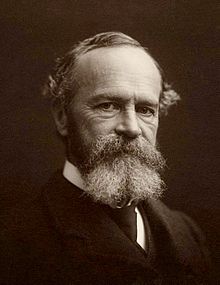
In his 1898 essay “Human Immortality” James argues that even if we assume the brain-dependence of the mind, this does not rule out the possibility of life after death. James begins with the assumption that “thought is a function of the brain” and so asks, “Does this doctrine logically compel us to disbelieve in immortality?” 220px-William_James_b1842cHe answers negatively, and all he needs to do to support his thesis is offer a reasonable way in which such survival is possible even given this assumption. This would show that the functional dependence of the mind on the body “has in strict logic no deterrent power” when it comes to belief in immortality.
“The fatal conclusion of the physiologist,” says James “flows from his assuming off-hand another kind of functional dependence, and treating it as the only imaginable kind.” The truth is that there are several kinds of functional dependence, only one of which is the productive function that materialists assume about the brain-mind.

James asks us to consider two other kinds of functional dependence: (1) a releasing function, as when an obstacle is removed from the bow, allowing the bow to bounce back and, thus, the arrow to be shot away or when a plug is removed from a drain, allowing water to flow into the pipe and (2) a transmissive function, as when a prism or refracting lens allows light to pass through while determining the color, path, and shape of that light as it proceeds. In both of these cases there is functional dependence, but in neither case is the dependence productive.

So the question is whether the functional dependence of the mind on the brain must be productive. James says no, “we are entitled also to consider permissive or transmissive function. And this is what the ordinary psycho-physiologist leaves out of his account.” So James is proposing the possibility that the brain does not produce but rather transmits or releases mental activity, in the sense that there is a realm of consciousness beyond this physical realm—whether a single, monolithic consciousness, as conceived by pantheists or innumerable individual consciousnesses as conceived in orthodox Christian and Jewish traditions—which breaks into the physical realm via our brains.

James writes, “Consciousness in this process does not have to be generated de novo in a vast number of places. It exists already, behind the scenes, coeval with the world. The transmission theory not only avoids in this way multiplying miracles, but it put itself in touch with general idealistic philosophy better than the production-theory does. It should always be reckoned a good thing when science and philosophy thus meet.” As a Berkeleyan idealist myself, I am especially pleased to see James make this important observation. He continues: “On the production-theory one does not see from what sensation such odd bits of knowledge are produced. On the transmission-theory, they don’t have to be ‘produced,’—they exist ready-made in the transcendental world, and all that is needed is an abnormal lowering of the brain-threshold to let them through.” So, on this view, death doesn’t bring destruction of the person. Rather, “all that can remain after the brain expires is the larger consciousness itself as such” whether conceived in a pantheistic or traditionally theistic way.

I find James’ perspective here to be refreshing for a couple of reasons. In the first place, the theory he proposes here is quite plausible—it has significant explanatory power, and it avoids many philosophical problems related to the two major theories of mind—physicalism and substance dualism. Secondly, James’ approach is refreshing because of his open-mindedness and theoretical adventurousness. James’s views evolved throughout his philosophical career, and as he explored issues in the area of religious experience, he showed an admirable willingness to allow his findings to open his mind to the pervasive reality of the supernatural. The proposal he makes in “Human Immortality” is just one instance of this.

Mill on Immortality

In a posthumously published essay entitled “Theism,” the great 19th century British philosopher John Stuart Mill takes an agnostic stance on life after death. Here I will review some of Mill’s arguments in this essay.

Mill rehearses the standard “correlation argument” against survival (formerly deployed by Lucretius, Hume and others). He observes that “the different degrees of complication of the nervous and cerebral organization, correspond to differences in the development of the mental faculties; and . . . diseases of the brain disturb the mental functions and . . . decay or weakness of the brain enfeebles them. We have therefore sufficient evidence that cerebral action is, if not the cause, at least . . . a condition sine qua non of mental operations.” Mill rightly concedes, John_Stuart_Mill_by_London_Stereoscopic_Company,_c1870however, “these considerations only amount to defect of evidence; they afford no positive argument against immortality.”

Mill further notes that belief in immortality isn’t grounded in philosophical or scientific arguments anyway but rather is inspired by “our own wishes and the general assent of other people.” There is also the fact that immortality is naturally desired, which some (such as Aquinas) have parleyed into an argument in favor of the belief. Mill writes, “We are told that the desire of immortality is one of our instincts, and that there is no instinct which has not corresponding to it a real object fitted to satisfy it.” Mill critiques this argument by comparing it to an inference from the desire for food to the conclusion that we will always have plenty to eat. This is clearly a misunderstanding of the argument, however. Since the inference is not just from the presence of desire to the conclusion that the desire will be fulfilled. Rather, the argument reasons from the fact that there is a natural human desire to the conclusion that that desire can be fulfilled (not that it necessarily will be). So Mill’s criticism doubly misconstrues the argument from desire.

Mill notes another line of argument, which is based in the goodness of God and “the improbability that God would ordain the annihilation of his noblest and richest work . . . and the special improbability that he would have implanted in us an instinctive desire of eternal life and doomed that desire to complete disappointment.” He says the problem with this argument is that it assumes we know more than we do about God’s broader purposes, some element of which might have made it best to give us this desire without its being fulfilled. Mill is certainly correct on this point.

Mill concludes that we have “no assurance whatever of a life after death on grounds of natural religion. But . . . there is no hindrance to his indulging that hope.” This tempered conclusion makes sense given the arguments he discusses, even despite his misconstrual of the argument from desire. Philosophical arguments (or those based on “natural religion,” as he puts it) for life after death, much less human immortality, are probably fall short of providing anything like assurance, at least those arguments available in Mill’s day. (Contemporary arguments based on recent near-death experience research, however, might be a different story. I will explore such in some upcoming posts.) But Mill is also wise to allow for the reasonableness of indulging in the “hope” of life after death. I would certainly say so, given (1) the nearly universal desire for survival, (2) the Kantian point that ethics depends upon immortality, and (3) the theological grounds for immortality, which are considerable.

Idealism and Christianity Book Series

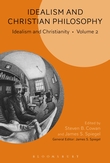
I am happy to announce the release of a two-volume book series entitled Idealism and Christianity, which I edited with the help of my colleagues Steve Cowan, Joshua Farris, and Mark Hamilton. The books are published by Bloomsbury Press and constitute what we hope will be the start of a renaissance of scholarly interest in metaphysical idealism. This is the thesis that mind is most real, and that the 9781628924022entire physical world essentially constitutes the thoughts of that wise and almighty mind—God.

The first volume in the series, entitled Idealism and Christian Theology, explores a variety of issues in theology, including Christology, the resurrection of Jesus, the doctrine of creation, and the knowledge of God. Contributors include Oliver Crisp, William Wainwright, and Keith Yandell. The second volume, Idealism and Christian Philosophy, features essays treating such issues as time, truth, perception, science, miracles, and the mind-body problem. Contributors include Doug Blount, Howard Robinson, Charles Taliaferro, and Keith Ward.

The heroes of the volumes are two 18th century thinkers: George Berkeley and Jonathan Edwards. Both of these 9781628924060great scholars regarded Idealism as amenable to a Christian perspective because it constitutes the most biblical and philosophically plausible way of conceptualizing the world. Idealism effectively addresses skeptical challenges to theism and it provides helpful resources for dealing with all sorts of knotty problems that have plagued philosophers and theologians for centuries.

In addition to the scholarly benefits of Idealism, this perspective also has tremendous personal benefits and is a powerful boon to faith. This was the constant refrain of Bishop Berkeley who concluded his classic defense of Idealism by confessing that his purpose in writing was to “inspire my readers with a pious sense of the presence of God and . . . the better dispose them to reverence and embrace the salutary truths of the Gospel, which to know and to practice is the highest perfection of human nature.” Amen to that, good Bishop!

On Butler’s Argument for Immortality

This semester I am teaching a course entitled “Philosophy of the Afterlife,” which covers a range of issues, including the concept of human immortality, near-death experiences, reincarnation, the doctrines of heaven, hell, and purgatory, and the prospect of achieving immortality via computer technology.  Since this is my first time to teach such a course, I thought it would be fun to post some of my thoughts along the way.  I begin with a critical reflection on one of Joseph Butler’s arguments for human immortality.

*****

In his 1736 book The Analogy of Religion, the English bishop and apologist Joseph Butler offers some arguments in defense of life after death.  His overarching aim with these arguments is not to prove that human beings are immortal but rather to show that we have no good reason to believe that our lives end with the death of our earthly bodies.  Here I will explain and critically assess one of his arguments.

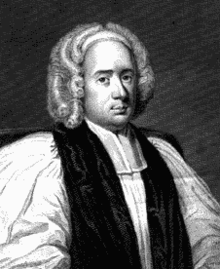
from Wikipedia
from Wikipedia

Butler asks us to “consider what the analogy of nature” might suggest to us regarding what death truly entails.  And he observes that throughout nature we find immense variety, constant change and “degrees of life and perception” among living things.  And in each individual human life we find a vast transformation from our lives in the womb to adulthood.  Thus, Butler concludes, “that we are to exist hereafter in a state as different (suppose) from our present as this is from our former is but according to the analogy of nature.”

Furthermore, Butler argues, there is no evidence that death brings complete extinction of the self.  What we do observe is merely “the dissolution of the flesh, skin, and bones,” but “these effects do in no wise appear to imply the destruction of the living agent.”  Such physical decay indeed “destroys the perceptible proof which we had before their death of their being possessed of living powers, but does not appear to afford the least reason to believe they are then, or by that event, deprived of them.”  In other words, when person dies, the destruction of her body only eliminates positive evidence that she is still alive.  But it does not prove she is no longer alive.  This is an important distinction.  Lack of evidence for X does not necessarily constitute evidence for not-X.

In this way, Butler defends what I will call the “survival thesis”—the notion that human beings survive death in the sense that their conscious lives continue somehow despite the destruction of their physical bodies.  So what are we to make of his claims?  While Butler’s argument is carefully nuanced, aiming just to show that we have no good reason to reject the survival thesis, as opposed to positively arguing for that thesis, some counter-arguments might rebut his defense.

First, one might argue that Butler’s analogy from nature has been rendered irrelevant by the advance of science.  As many naturalists have pointed out, neurophysiology reveals a much more specified analogy that points in the direction of extinction of the self.  As a person develops from infancy to adulthood and then to old age, her cognitive capacities correspond entirely to her brain functionality.  As brain function deteriorates, so does one’s mental function.  And where there is serious damage to the cerebral cortex, there is likewise damage or even complete elimination of the cognitive operations for which that part of the brain is responsible.  What this suggests is that with the complete destruction of the brain there will likewise result complete cessation of cognitive function, and this is tantamount to extinction of the person.

Second, one might challenge—as again many naturalists have—Butler’s assumption that the burden of proof is on the naturalist to show that the survival thesis is false.  Why make this assumption when arguably there is no independent philosophical or scientific evidence to suggest that the survival thesis is true?  Presumably, Butler helped himself to this assumption because at the time and place of his writing—early 18th century Europe—belief in life after death was far more widely affirmed among scholars than it is today in the West.  So this presupposition regarding evidential burden was not controversial for his readers.  Things have changed dramatically during the intervening 280 years, however.  These days most Western scholars are religious skeptics, and a large number are bona fide naturalists.  Accordingly, among scholars today the burden of proof regarding the survival thesis seems to rest squarely on the shoulders of those who affirm it.  One wonders how Butler’s approach to the issue would be different were he writing on the subject today.

The Rethinking Hell Conference

Last weekend’s Rethinking Hell conference at Fuller Seminary in Pasadena went extremely well.  Greg Stump, Christopher Date, et al. did a superb job organizing and directing it.  Those in attendance represented the spectrum of Christian views on the issue: traditionalists, universalists, and conditional immortalists.  I was one of six plenary speakers, three of whom (including me) affirm conditional immortalism.

For those not aware, the three views are as follows.  Traditionalists maintain that the damned suffer eternal conscious torment in hell.  Universalists believe that, though some may suffer in hell for some indeterminate length of time, everyone is ultimately restored to fellowship

Greg Stump, David Instone-Brewer, Jim Spiegel, Oliver Crisp, Jerry Walls, and Robin Parry

with God.  And conditional immortalists maintain that the damned suffer for a finite period in hell and are ultimately annihilated (hence the term “annihilationism” that is sometimes applied to conditionalists).

For more information resources on conditionalism, check out the Rethinking Hell website.

The plenary speakers featured traditionalists Oliver Crisp and Jerry Walls, universalist Robin Parry, and conditionalists David Instone-Brewer, Christopher Date, and myself.  All of their presentations were very good and generated substantive discussion with the audience.  And I greatly enjoyed the discussion with them in between the sessions.

Jerry Walls is especially enjoyable to engage with, as he is a zealous Arminian and strong critic of Calvinists (like me) and anyone who shows sympathy with Roman Catholicism (like me).  But we do agree on much more than we disagree about, especially when it comes to moral and social issues.

Future Rethinking Hell conferences are tentatively planned for the United Kingdom and Australia.  And there is also talk of regional Rethinking Hell conferences.  Stay tuned!

In the meantime, check out the Rethinking Hell podcasts and consider joining the Rethinking Hell Facebook Group.

The 2015 Annual CCT Conference

Last week I attended the conference of the Biola Center for Christian Thought, which is the annual capstone event at the CCT.  This year’s research theme was “Intellectual Virtue and Civil Discourse,” and the conference featured a number of noteworthy scholars who have done significant work in areas related to the theme.  Among them were Robert Audi (University of Notre Dame),

Robert Audi and Storm Bailey

Jason Baehr (Loyola Marymount University), Elaine Howard Ecklund (Rice University), George Marsden (University of Notre Dame, retired), Robert Roberts (Baylor University), Richard Mouw (Fuller Theological Seminary, retired), and Martin Marty (University of Chicago, retired).  In addition to the presentations by these plenary speakers, there were many other excellent presentations at breakout sessions.

Thanks to the John Templeton Foundation, I was honored to be a CCT research fellow during the Fall semester this past academic year.  My research project regards the virtue of open-mindedness, and I was able to make significant progress on what I hope will culminate in a monograph on the subject.  My presentation at the CCT conference, entitled “Open-

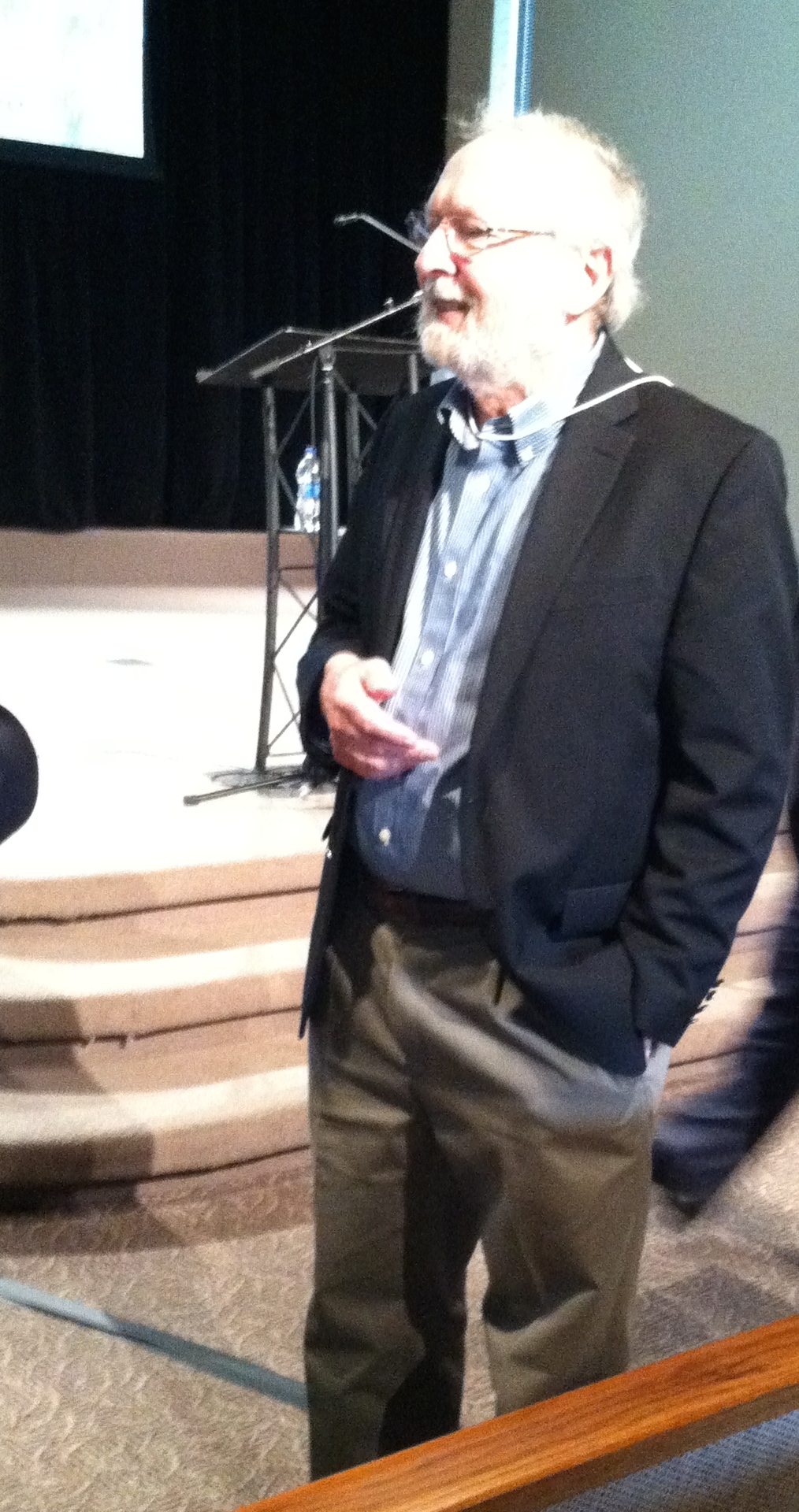
George Marsden
George Marsden

mindedness and Disagreement,” explored the connection between two topics that are germane to this year’s theme.  With regard to the issue of disagreement, the question is whether, or to what extent, confidence in your belief about an issue should be tempered by the fact that some epistemic peers disagree with you.  And, depending upon your view regarding the epistemic implications of peer disagreement, what does it mean to remain open-minded about the issue?  My session was well-attended, and I received helpful feedback, which I am looking forward to implementing in my paper as I revise it and eventually submit it for publication.

The most enjoyable thing about the conference was catching up with some of the scholars I’ve gotten to know through the CCT and other contexts, as well as becoming acquainted with a number of other scholars whom I’d never met before.  Some of these I had only admired from afar, such as the eminent

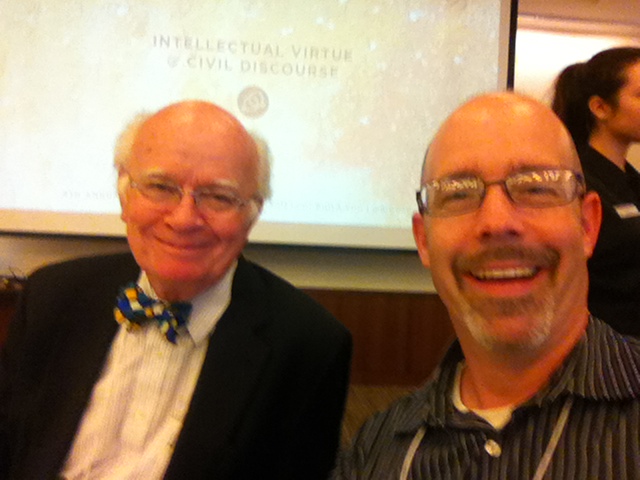
Martin Marty and me
Martin Marty and me

epistemologist Robert Audi and religious scholar Martin Marty, who might be the greatest living scholar in the English speaking world—author of more than 80 books, winner of numerous scholarly awards, member of two U.S. Presidential Commissions, and holder of 80 (yes, eighty) honorary doctorates.  Somehow I ended up sitting next to Marty at the evening banquet at the CCT conference, and I was struck by the warm humor and genuine humility of the man.  What an inspiration.

In fact, the word “inspiring” well captures my entire experience at the Biola Center for Christian Thought this year.  The CCT directors—Thomas Crisp, Steve Porter, and Gregg Ten Elshof—as well as staff members Evan Rosa and Laura Pelser, are all wonderful folks who know how to create a dynamic community atmosphere for rich scholarly research and dialogue.  The Center is currently accepting proposals for the 2016-17 research theme: “Humility: Moral, Religious, and Intellectual.”  If you do work related to this topic and would like an opportunity to dig a lot deeper, then consider submitting a proposal.  I guarantee that the experience would be a highlight of your academic career!

John Hick and Human Progress

An interesting philosophical question concerns whether human beings are making progress.  Great thinkers have fallen on either side of the issue, as you can see here.

Some who take the negative view on this issue use lack of human moral progress as an objection to theism.  After all, wouldn’t God want human beings to improve?  And, being omnipotent, wouldn’t he find a way to ensure that happened?  Thus, the notion that God exists seems to be undermined by the fact that human beings are not making any moral progress.

I happen to agree with the no-moral-progress thesis.  I believe that human beings in the early 21st century are no better, and no worse, than we were a century ago, just prior to the first of two hideous world wars.  And we are no better or worse than we were during the Renaissance, the Dark Ages, or the Iron Age.   From a moral standpoint, human nature has remained constant—since the Fall, anyway—notwithstanding salient eruptions of evil (e.g., the Mongol conquests, the Nazis, etc.) and bursts of goodness (e.g., the birth of the university, the abolition of Western slavery, etc.).

But granting the no-progress thesis regarding the human race generally, it doesn’t follow that there is no significant human moral progress at all.  Just because the human race doesn’t improve as a whole, this doesn’t mean there is no individual progress.  On the contrary, I think such progress is the norm throughout the world.  And it is here that we see the moral work of God on a global scale.

In his classic book Evil and the God of Love, philosopher of religion John Hick insightfully addressed this issue:

Because this is a pilgrimage with in the life of each individual, rather than a racial evolution, the progressive fulfillment of God’s purpose does not entail any corresponding progressive improvement in the moral state of the world. . . .  It is probable that human life was lived on much the same moral plane two thousand years ago or four thousand years ago as it is today.  But nevertheless during this period uncounted millions of souls have been through the experience of earthly life, and God’s purpose has gradually moved towards its fulfillment within each one of them, rather than within a human aggregate composed of different units in different generations. (Evil and the God of Love [Harper & Row, 1966], p. 292)

Hick was a religious pluralist and a universalist, but one need not affirm either pluralism or universalism to see the sense in his proposal here—that God works redemptively in the individual lives of people—perhaps the overarching majority of people worldwide—and this is consistent with the disappointing fact that the human race shows no signs of moral progress.  In fact, Hick even suggests that the lack of aggregate human improvement makes for a better environment for individual moral growth.  After all, as free agents, we all must choose to pursue the good and live faithfully before God, all the while resisting temptation, dealing with strife and disappointment, recuperating from failure, and persevering through suffering in order to do so.  In short, the struggle against evil is precisely how we grow in this world.  This is Hick’s so-called “soul-making” theodicy—an approach to the problem of evil that I find particularly compelling philosophically.  Moreover, it enjoys some biblical support as well, as is evident in such passages as James 1:2-4, Rom. 5:3-4, and 1 Pet. 1:6-7.  While I don’t regard this theodicy as a final and complete solution to the problem of evil, I do think it is an essential part of a Christian response to the problem.

There is also a moral-psychological (or, one might say, existential) benefit in this way of thinking about the human condition.  For if God is ever at work in people, accomplishing his work of redemption in the lives of individuals, then I need not despair over the “current state of the world” or lose hope when considering what appears to be a general moral decline of our society.  Nor should those of us who work to improve human institutions and social structures despair if we see no net improvements.  For God is still at work in the lives of those we meet.  He always has been and he always will be.

From Christianity to Atheism?

When reading or hearing the stories of atheists, certain patterns tend to emerge.  One standard account goes like this:  I was a devout Christian but along the way became dissatisfied with certain aspects of my faith.  As I learned more about the Bible I realized that it is loaded with problems.  After examining it more closely, I concluded that it is horribly unreliable and really just a bunch of made up stories, essentially religious fairy-tales.  This realization, combined with all of the hypocrisy I witnessed among Christians, essentially spelled the end of my faith.  So now I’m a completely fulfilled atheist.  Examples of this basic story abound on the Internet, such as here and here.

Now there are a few things about this journey to un-faith paradigm that bother me and that from a rational standpoint don’t add up.  For one thing, it strikes me as odd that so many atheists moved directly from giving up Christianity to giving up theism.  The Christian faith is just one of three major brands of theism (along with Judaism and Islam).  To falsify one form of this general religious perspective is not to falsify it in all of its forms.  After rejecting Christianity, why not look into one of the other major versions of theism?  Perhaps such atheists will insist that in discovering the Bible is a book of fairy tales they have basically discovered that all religions “of the book” (in this case, all three including the Old Testament) are baseless.  But, then, we may ask, why limit one’s theistic alternatives to these three traditions?  Why not consider generic theism or a non-religious philosophical theism such as that espoused by the likes of Socrates, Plato, or Aristotle?—at least until one has thoroughly reviewed the evidences for God.  Some thinkers, such as Antony Flew late in his career, have done just this, all the while keeping an open mind about the possibility that the world creator had revealed himself in some special way.

The Light of the World by William Holman Hunt

Another unsettling fact about many atheists is their rejection of Jesus Christ, not just as a religious figure or, more specifically, the God-incarnate savior of humankind, but in toto.  That is, in rejecting Jesus Christ as Christians believe in him, one need not also reject his teachings.  One can deny that Jesus is “Lord” but still recognize his wisdom, even philosophical genius, as evident in his many brilliant discourses and parables.  One might even reasonably say that Jesus is a great philosopher.  As Doug Groothuis shows in his fascinating little book On Jesus, the itinerant Nazarene is undeniably a profound and innovative philosophical mind, whatever else he might be.

Suppose a religious tradition emerged which had as a core teaching the notion that Immanuel Kant was divine and somehow God’s envoy to save humanity from our moral faults, such as by assiduously following the Categorical Imperative, praying in Kant’s name, and so on.  Now if I decided, as I think we all should, that Kant is not the savior, would it make sense to also completely disregard him as a philosopher or otherwise ignore his many valuable insights about ultimate questions?  The same might be said of many other great thinkers, from Plato and Aristotle to Augustine, Aquinas, Locke, Hume, and Plantinga.  The fact that none of these thinkers is divine is no excuse to completely ignore them as philosophers and sources of great wisdom.  In fact, we should study their teachings closely regardless of how they might be misconstrued from a religious standpoint.  Other people’s overestimation of their ultimate identity or moral goodness is no reason to ignore their philosophical genius.  Yet, this is what most atheists and other non-Christians do when it comes to Jesus.  They seem to assume that rejection of him as God-incarnate and/or savior of humanity is tantamount to rejecting him as wise or even as a significant ethicist or philosopher of religion.  But these two things are far from equivalent.

For this reason I often implore Christians-turned-atheists to return to Jesus, if only as a student of the man’s philosophical acumen.  Jesus’ logical skill, ethical teachings, anthropological insights, and cultural criticism (usually aimed at religious leaders, which should please any atheist)—not to mention his rhetorical genius and unparalleled influence on world history—all merit close study.  For these reasons we can all benefit from a better understanding of Jesus, whether we call him Lord or merely a great human thinker.

Why is Flatulence Funny?

It has been one of my career goals to publish a scholarly piece with a Cambridge journal.  Now that dream has been realized, as the journal Think has recently published my article “Why Flatulence is Funny.”

Actually, in this article I do explore a serious philosophical issue, though it regards the nature of humor (and that most silly of bodily functions).  Traditionally, philosophy of humor has fallen into the category of aesthetics.  This makes sense, since comedy is a form of artistry.

So why is flatulence funny, in fact funnier than most things in life and funny in every culture?  In the article I get to the bottom of this (so to speak), showing how farts satisfy the conditions for humor on each of the three major theories of humor: superiority theory (e.g., Hobbes), incongruity theory (e.g., Kant and Schopenhauer), and relief theory (e.g., Spencer and Freud).

So the next time you guffaw at someone passing gas, you need not feel foolish or childish.  You can feel secure in the knowledge that your laughter is warranted by the fact that farts really are funny, according to any serious philosophical account of humor.

Planned Parenthood and Infanticide

In February I presented a paper at an ethics conference in which I critiqued a Journal of Medical Ethics article that defended infanticide.  The thesis of the article is that so-called “’after-birth abortion’” (killing a newborn) should be permissible in all the cases where abortion is, including cases where the newborn is not disabled.”  Upon its on-line publication a year ago, the article generated so much controversy that it was temporarily taken off-line.  The authors and editors had apparently underestimated the severity of outrage that a serious defense of infanticide would generate.

However, the authors of the article, Alberto Giubilini and Francesca Minerva, are far from the first moral philosophers to defend infanticide.  In recent decades the practice has been advocated by such prominent scholars as Mary Ann Warren and Peter Singer.  And in ancient Greece Plato notoriously defended the practice in his classic work The Republic.

However, it is one thing for a practice to be embraced by a small minority of scholars.  It is quite another for it to be accepted by the most prominent reproductive health organization in the country.  In a recent hearing in the Florida state legislature, a Planned Parenthood official, Alisa LaPolt Snow, essentially defended the right of abortion providers to kill newborn babies—in particular, those which are born alive after a failed abortion.  Snow was pummeled with questions from several legislators, inviting her to acknowledge that such newborn babies have a right to life.  But Snow coolly demurred, insisting that “any decision that’s made should be left up to the woman, her family, and the physician.”  Of course, “any decision” would include the decision to kill the baby.  You can see an excerpt of the discussion here.  As you watch, bear in mind that Planned Parenthood is an organization that our tax dollars support.

This is a vivid and disturbing example of how yesterday’s most implausible academic theories become today’s horrific practices.  But given the demise in our culture of a Judeo-Christian ethic and its core notion of the sanctity of human life (as opposed to a quality of life ethic), we shouldn’t be surprised.  Ideas have consequences.  And when a society reject an idea that is crucial to the preservation of basic morality, extreme evil will follow.  Infanticide is such an evil.