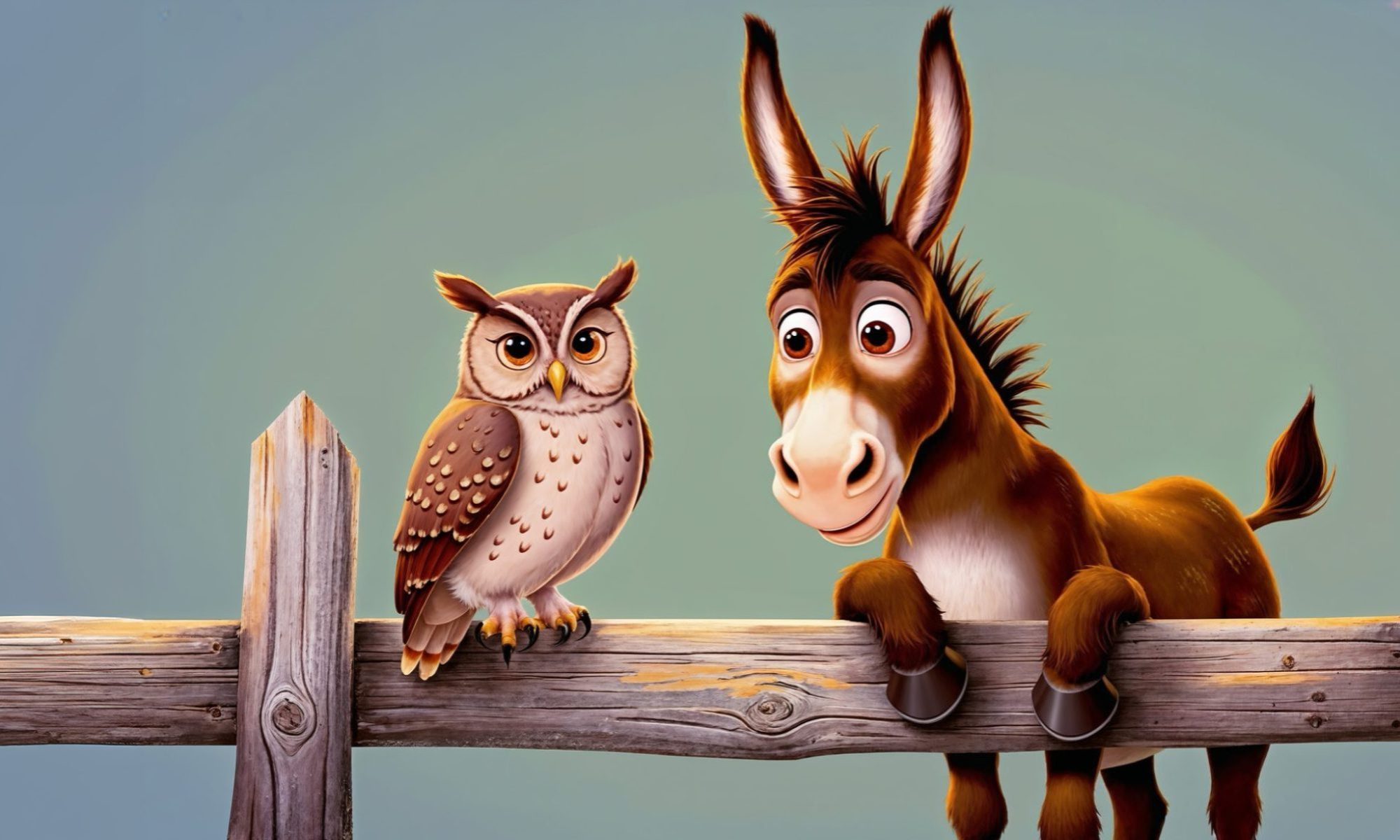
Welcome to our blog. No doubt you have noticed the images of the owl and the ass above. These are not random, of course. We chose them because (at least in popular consciousness) they represent “wisdom” and “folly,” respectively. If we had gone with random, then we’d have chosen images that are more easily drawn, like an egg and a pyramid, or a square and a tree, or maybe just a smiley face. But no…. We had to go with purposeful and symbolic, thus leaving us in the quandary of deciding how to find some good original renderings of an owl and an ass. The images you see were drawn by me (Jim). Obviously, I’m no artist, as the drawings are primitive and lack pizzazz. We briefly considered commissioning a professional artist to produce the images for us but decided against this because, for one thing, we don’t have a lot of extra cash lying around to fund this endeavor. Frankly, we’d rather spend what we do have on chai, CDs, and diapers. Also, we figure that since this is a homespun operation, my unwieldy drawings will do, at least for now.
However, in keeping with the interactive nature of this blog, we would like to invite you to send us your own original drawing(s)-whether a quick sketch or laboriously crafted painting-of an owl and/or an ass. Make it comical or serious, minimalist or ornate. Any style or mood will do. Why? Because this blog will be a thing of many moods-sometimes serious and (hopefully) sometimes funny. You may submit your drawing(s) as an attachment to Jim at jmspiegel@taylor.edu. There is no deadline. We may or may not incorporate your drawing(s) into our blog nameplate, but if it’s interesting enough we’ll post it. And we will give you credit for your work if we decide to use it. But sorry-no cash remuneration.
Okay, enough of that. A few words of explanation are in order regarding just why owls and asses commonly represent the wise and the foolish. As for owls, they are nocturnal and can function very well in the dark. Also, they are far-sighted, able to spot prey from hundreds of feet away, while having poor vision for things up-close. These traits are good metaphors for wisdom, as wise people can maintain their integrity even in the midst of moral “darkness.” A wise person also demonstrates a keen eye for what lies beyond, while not being distracted by immediate concerns. The linkage between owls and wisdom probably also has to do with the solemn or studious look of the bird. At any rate, in the West owls are commonly associated with wisdom, even dating back to ancient Greece, where Athena, the goddess of wisdom, was frequently depicted as holding an owl.
As for the ass or donkey, its scientific name is Equus asinus, from which we get the word “asinine.” In ancient times, the ass was used to symbolize Dionysus, the Greek God of indulgence and excess. And as we all know, fools are overindulgent and excessive. Donkeys also have a reputation for being stubborn and unteachable. This is not really accurate, but we’ll follow that folklore because, well, we need a good image for foolishness. As with humans, in the animal kingdom it is sometimes difficult to distinguish stubbornness and stupidity from independence and single-mindedness. But in most cases it is easy to tell the difference between the two, as the ways of the fool eventually come to ruin.
Who is wise and who is foolish? To summarize the biblical contrast between them, the wise person is prudent, teachable, self-controlled, and morally insightful, while the fool is reckless, stubborn, self-indulgent, and morally thick-headed. For more details, see the book of Proverbs.
The content of this blog will display the ways of the wise and foolish. While we will seldom apply these tags to the ideas and people we discuss, we trust you’re wise enough to know which applies in each case.