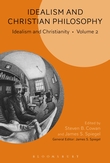
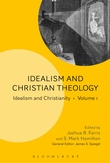
Idealism and Christianity Book Series

I am happy to announce the release of a two-volume book series entitled Idealism and Christianity, which I edited with the help of my colleagues Steve Cowan, Joshua Farris, and Mark Hamilton. The books are published by Bloomsbury Press and constitute what we hope will be the start of a renaissance of scholarly interest in metaphysical idealism. This is the thesis that mind is most real, and that the 9781628924022entire physical world essentially constitutes the thoughts of that wise and almighty mind—God.

The first volume in the series, entitled Idealism and Christian Theology, explores a variety of issues in theology, including Christology, the resurrection of Jesus, the doctrine of creation, and the knowledge of God. Contributors include Oliver Crisp, William Wainwright, and Keith Yandell. The second volume, Idealism and Christian Philosophy, features essays treating such issues as time, truth, perception, science, miracles, and the mind-body problem. Contributors include Doug Blount, Howard Robinson, Charles Taliaferro, and Keith Ward.

The heroes of the volumes are two 18th century thinkers: George Berkeley and Jonathan Edwards. Both of these 9781628924060great scholars regarded Idealism as amenable to a Christian perspective because it constitutes the most biblical and philosophically plausible way of conceptualizing the world. Idealism effectively addresses skeptical challenges to theism and it provides helpful resources for dealing with all sorts of knotty problems that have plagued philosophers and theologians for centuries.

In addition to the scholarly benefits of Idealism, this perspective also has tremendous personal benefits and is a powerful boon to faith. This was the constant refrain of Bishop Berkeley who concluded his classic defense of Idealism by confessing that his purpose in writing was to “inspire my readers with a pious sense of the presence of God and . . . the better dispose them to reverence and embrace the salutary truths of the Gospel, which to know and to practice is the highest perfection of human nature.” Amen to that, good Bishop!

From Christianity to Atheism?

When reading or hearing the stories of atheists, certain patterns tend to emerge.  One standard account goes like this:  I was a devout Christian but along the way became dissatisfied with certain aspects of my faith.  As I learned more about the Bible I realized that it is loaded with problems.  After examining it more closely, I concluded that it is horribly unreliable and really just a bunch of made up stories, essentially religious fairy-tales.  This realization, combined with all of the hypocrisy I witnessed among Christians, essentially spelled the end of my faith.  So now I’m a completely fulfilled atheist.  Examples of this basic story abound on the Internet, such as here and here.

Now there are a few things about this journey to un-faith paradigm that bother me and that from a rational standpoint don’t add up.  For one thing, it strikes me as odd that so many atheists moved directly from giving up Christianity to giving up theism.  The Christian faith is just one of three major brands of theism (along with Judaism and Islam).  To falsify one form of this general religious perspective is not to falsify it in all of its forms.  After rejecting Christianity, why not look into one of the other major versions of theism?  Perhaps such atheists will insist that in discovering the Bible is a book of fairy tales they have basically discovered that all religions “of the book” (in this case, all three including the Old Testament) are baseless.  But, then, we may ask, why limit one’s theistic alternatives to these three traditions?  Why not consider generic theism or a non-religious philosophical theism such as that espoused by the likes of Socrates, Plato, or Aristotle?—at least until one has thoroughly reviewed the evidences for God.  Some thinkers, such as Antony Flew late in his career, have done just this, all the while keeping an open mind about the possibility that the world creator had revealed himself in some special way.

The Light of the World by William Holman Hunt

Another unsettling fact about many atheists is their rejection of Jesus Christ, not just as a religious figure or, more specifically, the God-incarnate savior of humankind, but in toto.  That is, in rejecting Jesus Christ as Christians believe in him, one need not also reject his teachings.  One can deny that Jesus is “Lord” but still recognize his wisdom, even philosophical genius, as evident in his many brilliant discourses and parables.  One might even reasonably say that Jesus is a great philosopher.  As Doug Groothuis shows in his fascinating little book On Jesus, the itinerant Nazarene is undeniably a profound and innovative philosophical mind, whatever else he might be.

Suppose a religious tradition emerged which had as a core teaching the notion that Immanuel Kant was divine and somehow God’s envoy to save humanity from our moral faults, such as by assiduously following the Categorical Imperative, praying in Kant’s name, and so on.  Now if I decided, as I think we all should, that Kant is not the savior, would it make sense to also completely disregard him as a philosopher or otherwise ignore his many valuable insights about ultimate questions?  The same might be said of many other great thinkers, from Plato and Aristotle to Augustine, Aquinas, Locke, Hume, and Plantinga.  The fact that none of these thinkers is divine is no excuse to completely ignore them as philosophers and sources of great wisdom.  In fact, we should study their teachings closely regardless of how they might be misconstrued from a religious standpoint.  Other people’s overestimation of their ultimate identity or moral goodness is no reason to ignore their philosophical genius.  Yet, this is what most atheists and other non-Christians do when it comes to Jesus.  They seem to assume that rejection of him as God-incarnate and/or savior of humanity is tantamount to rejecting him as wise or even as a significant ethicist or philosopher of religion.  But these two things are far from equivalent.

For this reason I often implore Christians-turned-atheists to return to Jesus, if only as a student of the man’s philosophical acumen.  Jesus’ logical skill, ethical teachings, anthropological insights, and cultural criticism (usually aimed at religious leaders, which should please any atheist)—not to mention his rhetorical genius and unparalleled influence on world history—all merit close study.  For these reasons we can all benefit from a better understanding of Jesus, whether we call him Lord or merely a great human thinker.

Thislethwaite, Theology, and the Norway Massacre

This Washington Post piece by Susan Brooks Thislethwaite has created quite stir.  Take a look, and you’ll see why.  For starters, she follows the NY Times and others in referring to the Norway mass assassin, Anders Behring Breivik, as a Christian.  Then she goes on to challenge readers to consider how Christianity may inspire violence.  Interestingly, in her article she vacillates between asserting that the supposed violence-inspiring elements in Christianity are mere theological “interpretations” of our religion, on the one hand, and actual “elements of Christianity” on the other.  If she intends to claim the latter, she gives us no evidence whatsoever to support her claim.  If she intends only to suggest the former, then her remarks are horribly misleading.  In any case, Thislethwaite’s article is inflammatory and only manages to create confusion.

Thislethwaite apparently rejects the distinction between genuine Christians and those who merely claim to be Christians.  We recognize this distinction in every other context, so why not here?  Being a Christian is not simply a matter of affirming certain propositions, as is clear from many biblical passages (e.g., Mt. 25:31-46; 1 Cor. 6:9-10; and Gal. 5:19-21).  Even if Anders Breivik did affirm the deity and resurrection of Jesus (which, by the way, he denies), this does not by itself make him any more Christian than the devil himself (who presumably would affirm these truths).

It is telling that Thislethwaite doesn’t bother to identify any biblical passages that might reasonably be construed to inspire violence, much less mass murder.  Perhaps she has in mind certain Old Testament passages where God commanded the killing of the Canaanites.  But these are not uniquely Christian texts.  Jews and Muslims also regard these as scripture.  It is the New Testament that is uniquely Christian, so it is here that we must look for “Christian elements” that might inspire violence.  And what do we find in the New Testament?  A consistent ethic of non-violence.  The ethic of “turn the other cheek” non-resistance.  The ethic of submitting to political authorities.  And, when one must disobey the governing authorities, an ethic of peaceful disobedience.  In short, we find an ethic of non-violence that has inspired numerous pacifist theological traditions.  Yet Thislethwaite insinuates that there is something about Christianity that could justify violence?  Breathtaking.

Okay, so perhaps what Thislethwaite really wants to suggest is that some madmen, most recently Anders Breivik, have warped or twisted Christian ideas to their own use in attempting to justify their violence.  Well, of course this is true—and it is so obvious it is hardly worth stating.  But if this is all she wants to say, then why does she say that it is Christianity that becomes lethal, that Christianity may be complicit in mass violence?  Perhaps Thislethwaite just wants to have it both ways—to implicate Christian theology itself in violence without having to do the biblical or theological analysis necessary to demonstrate this (which, of course, is an impossible task, as I just noted—the New Testament nowhere endorses violence but only peaceful responses, whether in resistance or non-resistance).

Or, more cynically, perhaps Thislethwaite’s only real aim in this piece is political.  Maybe she just wants to create a negative association with conservative Christianity by suggesting that Breivik is a “right wing” Christian extremist.  This would certainly help to demonize the political views of conservative Christians—views that, as a “left wing” political thinker, Thislethwaite personally despises.

In the end, I’m not sure what Thislethwaite’s aims or real claims are in this piece.  What I am sure of is that her article is confused, inflammatory, and irresponsible.

Homosexuality, State Dogma, and the Censoring of Christians

A lot of attention is being given to two recent legal cases regarding Christian counseling students who are being censored because of their views on homosexuality.  Last week a federal court upheld Eastern Michigan University’s expulsion of Julea Ward, a graduate student, due to her belief that homosexuality is immoral.

And down in Georgia, school officials at Augusta State University have informed counseling graduate student Jennifer Keeton that she must complete a remediation program to change her views about homosexuality or else she will be dismissed.  Keeton has decided to sue ASU.

Now a few observations.  Notice that the issue in both cases is the students’ beliefs about homosexuality, not their conduct.  This is, as one of the attorneys in the Ward case said, “scary stuff,” and I would add that it is just the sort of thing that John Stuart Mill warned us about in his classic On Liberty.  The State has no business controlling or attempting to control people’s consciences.  And to shut down freedom of opinion on such a crucial issue as sexual immorality is especially frightening.

The district court judge, George Steeh, declared that the university was justified in “requiring students to counsel clients without imposing their personal values.”  And EMU is not imposing its values on Ward by insisting that she change her views?  Clearly there are values at stake in this case, but it is not just Ward’s personal, or Christian, values.  EMU’s values, specifically that homosexuality is morally appropriate, are involved too.  To insinuate that EMU is value neutral here is ethically naïve or, worse, disingenuous.  The truth is that EMU, Augusta State, and no doubt most other state universities, have an ethically dogmatic position on the homosexuality issue, no less dogmatic than that of Ward, Keeton, and other conservative Christians.

Also, consider the irony that the EMU and ASU officials aim to change these students’ beliefs when it is also presumably the view of these university officials that homosexuals cannot change.  The notion that homosexual orientation is somehow fixed and immutable is, after all, the most popular argument in defense of its moral legitimacy.  The irony here is that between the two, beliefs and conduct, the latter is far more susceptible to voluntary change.  In fact, many philosophers would argue that one’s beliefs are not at all under one’s control.  (Try changing your belief about even a trivial matter, and you’ll see this is so.  And even the prospect of long-term intentional change of one’s beliefs is a controversial matter.)  But one’s sexual conduct is under one’s control.  The decision to have sex is a choice (except in cases of rape, of course, but that’s beside the point).  Human beings have free will, and that applies in the sexual sphere as well as anywhere else.  To deny this and insist that those with homosexual attraction (even if it is innate, though there is little evidence to suggest it is) “cannot help themselves” is to affirm hard determinism, a radical and morally deadly view in itself.

Yet, despite these problems, moral permissivism about homosexuality is becoming a dogma in our culture, including the academy and the legal sphere.  This is bad news—not just for religious freedom in America but for the state of our public discourse.

Drawers, Labels, and People Categories

Over the years, I have talked with many moms whose daughters are preoccupied with one thing or another. For some it’s Barbie; for others it’s Dora; for my daughter, however, it’s the seasons. You might call Maggie our seasonal alert system. It only makes sense, really. We teach kids the months of the year, assigning three to each season and say “Now these months belong here and during this time the weather is like this.” Of course, as adults we know that there are more subtle distinctions and that spring eases May into summer and fall into winter; that there will be a few chilly days in July and a few sunny days in February. But this is not the case for five-year-olds, at least not ours anyway. With great frequency, usually in connection with picking her clothes for the day, Maggie will ask “Mommy, is it [insert much anticipated next season]?” Now this is tricky because if I respond with, let’s say, “Yes, it’s summer, sweetie,” then whatever the temperature outside, Maggie immediately runs for her suit and heads for the sprinkler, ready for a day of fun in the sun. If I try to qualify my answer, she is quick to rebut my qualification by pointing to the calendar and saying “But it’s June! That means summer, which also means swimming!”

I suppose in some ways, we are all like Maggie. We like to put everything (and everyone) in tidy categories. We like to label people so we can know what to expect, sorting people like kitchen utensils, by purpose and appearance. “Forks and knives to the left of the sink in the silverware drawer.” And Crazy Cousin Eddy in the “Relatives to be Avoided at Thanksgiving Dinner” drawer.” In certain respects, this type of categorization is helpful. You certainly don’t go looking for a friend amongst the “People I Always Argue about Politics With” drawer or potential spouses in the “Wouldn’t Trust With my Pet Hermit Crab” drawer. Still, it can also act as a barrier in relating to people whom you might otherwise enjoy getting to know.

Sometimes rather than putting other people in such categories, you find that you have placed yourself in one or two mislabeled drawers. This fact struck me, recently, while reading for my upcoming book club meeting. The book is an interesting work of historical fiction, set at the end of WWII on the island of Guernsey in the English Channel. The characters were all charming and entertaining until the shrewish Christian lady entered upon the scene to ruin all their fun and give faith a bad name. I meet this character often in various works of contemporary fiction and cinema. Yet, having lived my entire life associated with church or another, I can honestly say I have never encountered her or the type of pharisaical maliciousness she displays. That is not to say I have not encountered fallen and flawed individuals and heard many accounts of rudeness and insensitivity, but the majority of committed Christian folk I know are pilgrims like me, doing the best they can and quite aware of their own failings. Of course, there are the all too public exceptions, but isn’t that true of any group?

The novel I mentioned earlier deals with a great many Germans but doesn’t equate all of them with Hitler. So why not extend the same benefit of the doubt to those who profess their sinfulness and are seeking to be transformed? Whenever I encounter such characters in books or films, my first instinct is one of shame and apologetic embarrassment. But why should this be when although I have sometimes behaved badly toward people, it has rarely been a conscious, much less malicious, act. I often fail to live up to the standards of Christ but when I (like many of those I know) am confronted with my wrong deeds, I seek forgiveness and repent. The church is supposed to be full of sinners, for where else can we go?  And why is it that those outside of the church seem unwilling to accept the fact that we freely acknowledge our own limitations? Sadly, I think it is because to do so would mean taking us out of the drawers labeled “Hypocrites and Bigots” and thinking long and hard about what drawer we actually belong in. Or if we aren’t all ignorant at best and prejudiced at worst, what does that mean about the drawer you are living in?

To me, one of the greatest tragic scenes in literature occurs in Victor Hugo’s Les Miserables when Javert has triumphed in his capture of the “criminal” Jean Valjean, but in doing so he is confronted with something that he has no category for. He is able to recognize the transformation of Valjean from thief to upright citizen but is unwilling to accept that transformation and would rather die than define Valjean as his equal or, worse, his superior. I am no Jean Valjean, but we do have a few things in common. We are both recipients of undeserved grace; both humbled and transformed by the sacrifice of another. It is interesting to me to compare the portraits of Christians coming from contemporary literature and those long past. In many of the classics (e.g., Dickens, Austen, Gaskell, Bronte), there are examples of the type of religious folk represented in more contemporary works. But they are shown for what they are—wolves in sheep’s clothing. And other examples of true sheep are given to balance the scales. Perhaps contemporary writers need to take a break from organizing their drawers and get to know the contents a bit better before making too hasty an assignment. Perhaps, too, we need to make our own purpose more clear and apparent. Let us not go quietly into the “Crazy, Mean Religious People” drawer. Let us refuse to be discouraged by those who wish to believe that there are no Christians worth knowing. But all the while let us love our neighbor as ourselves is such a way that there is nowhere to put us but in the “People Who Love and Care for Those Around Them” drawer.

The Real Offense in Christianity

In my previous post—January 8—I discussed some aspects of Christianity which might explain why people might find it so offensive—it’s supposed dangerousness, blatant irrationality, and the exasperating nature of some Christian people.  None of these factors really explain the anger and hostility so often directed at Christianity.  So what is the explanation?  Since Christianity provokes people much more than Judaism or Islam (or generic theistic belief), there must be something about Jesus himself or the gospel message that bugs people so much.  What could that be? 

I suspect (as some readers intimated in their comments) that the resentment really has to do with the implications of Jesus’ crucifixion—the idea that he had to die (and resurrect) for our sins.  This implies, of course, that there is something wrong—terribly wrong—with humans which needs fixing.  Specifically, we need to be forgiven, and our offenses are so egregious that they called for a blood sacrifice.  And not just any blood-sacrifice.  Killing a toad or even an AKC-registered poodle wouldn’t do the atoning work.  In fact, not even a human child sacrifice would do.  No, it had to be the execution of a morally perfect person—God incarnate.  Now if that isn’t insulting to our pride as a species, I don’t know what is. 

Of course, this moral insult is well-deserved, if we are as naturally depraved as Scripture teaches.  But for those who think there is nothing wrong with human nature (despite the constant wars, human trafficking, ethnic cleansing, child molestation, and countless other evils all over the globe), I can see how this would seem ridiculous and even be a rather annoying claim.  Indeed, as the Apostle Paul said, “the message of the cross is foolishness to those who are perishing” (1 Cor. 1:18). 

Lest we forget, the Christian story is also a profound compliment—that God loves us so much as to provide that sacrifice himself.  Again, to quote Paul: “God made him who had no sin to be sin for us, so that in him we might become the righteousness of God” (2 Cor. 5:21).  And, as it turns out, this is the only way to reconciliation with God, as Jesus declares, “No one comes to the Father except through me” (John 14:6).  Yet this, too, is a blow to human pride, as it implies that we cannot save ourselves; even the most perfect repentance, apart from Christ, would be ineffectual in avoiding God’s judgment. 

So whatever else might bug people regarding Christianity, the ultimate source of offense is human pride.  People are offended by Jesus because his crucifixion represents both a divine condemnation of our sin and a statement that we cannot escape that condemnation on our own.  Again, I do see why this would bother people who think the Christian message is false.  If the Christmas and Easter stories are fictions, then our worldview is merely a profound insult; and as Paul says, “we are to be pitied more than all men” (1 Cor. 15:19).  But if Jesus really was the God-man and really did die and rise from the dead for us, then, well, that is wondrous—mind-boggling, in fact, and should make us very, very glad.  Far from being offensive, it is the best possible news.

What’s So Offensive About Christianity?

This past holiday season saw more stories of communities using “holiday trees” instead of Christmas trees and retailers insisting that their employees not say “Merry Christmas” to customers, out of a concern not to offend people.  Some folks are disturbed by Christianity—much more so, it seems, than by the other major theistic traditions of Judaism and Islam.  So far I haven’t heard anyone complain about public use of the phrase “Happy Hanukkah” or “Happy Ramadan.” 

The last few years have also seen a marked upsurge in Christian-bashing, as bloggers and pop culture figures have become more brazen in their criticisms and lampooning of Christianity.  You don’t have to listen or read very long to see that this is not just a matter of intellectual dissent but visceral disgust.  The fact is—increasingly it appears—many people find Christianity offensive.  Why is this so? 

Let’s consider some possibilities.  Perhaps it is because Christian ideas and values are dangerous.  Sam Harris, Christopher Hitchens, and other new atheists think so, based on their observations that many terrible things have been done by religious people, including Christians.  They seem to overlook the myriad social goods that Christians have contributed throughout history and that Judeo-Christian values are foundational to the very concept of human rights (Nicholas Wolterstorff’s book Justice is the latest scholarly demonstration of this fact). The argument of Hitchens, et al. pivots on abuses of Christian teachings, not the doctrines themselves.  A crucial but common mistake.  Of course, notwithstanding all of this, the perception that Christian ideas are dangerous might still explain, in part, some people’s offense.

Another possibility is that people are offended by how pushy and aggressive some Christians are when it comes to their beliefs  This can be very annoying, as people are made to feel more like marketing target than persons.  This is actually one of my own pet peeves about the evangelical world.  But lots of non-Christians in our society are pushy with their beliefs as well.  Plenty of professors and entertainers are aggressive worldview proselytizers.  Every marketer pushes her products.  Every lobbyist presses her agenda.  Even scientists and auto mechanics proselytize others to win converts.  Evangelistic Christians might be more of a nuisance to some people than these other zealots, but, again, this doesn’t seem to explain the degree of offense that so many people feel in regards to Christianity and its adherents.  (In fact, renowned illusionist and atheist Penn Gillette regards such evangelistic fervor as admirable.  Check out a remarkable anecdote here.)

Thirdly, people might be offended by Christianity because they perceive it as obviously false, a blatant flouting of reason.  This seems to be what bugs Bill Maher in his controversial documentary Religulous  as well as the creators of The God Who Wasn’t There.  But, again, this doesn’t quite explain the level of disdain and even hatred that some people display towards Christianity and Christians.  When someone is as badly deluded as Christians are, according to these critics, the proper emotional response is not hatred but pity.  I don’t see a lot of pity on the part of the new atheists and anti-Christian critics.

My pastor recently suggested that the primary offending element is the suggestion, implicit in Christian theology, that there is a moral authority to which one is accountable.  There’s probably some truth to this.  In our culture the idea that one must live according to someone else’s standard, even if that Someone is God himself, is offensive to some people.  The problem with this answer is that it can’t explain why Christianity appears to offend people more than other theistic traditions, most notably Judaism and Islam.  Mention Moses or Mohammed with approval in a public context—or even quote either of them as an authority on some issue—and no one raises an eyebrow.  People may disagree with you, but they won’t try to censure you or get you fired.  But if you bring Jesus Christ into the conversation or—if you have the temerity—affirm his moral authority on an issue, then, well, look out. 

So what is it about Jesus Christ that is so offensive (if, indeed, it is not just his followers but Jesus himself who bugs folks so much)?  I will address this question in my next post but, in the meantime, I’d be happy to hear your own thoughts—in response to this question or anything else I’ve said.

Happy New Year (Whatever that Means)

When I exchanged “Happy New Year” greetings with someone yesterday, I found myself thinking “What a relief that I can use a holiday salutation which is not potentially offensive because it implicitly endorses my religion—Christianity.  Unlike “Merry Christmas,” a phrase containing the messianic title of the One whose birth we celebrate, “Happy New Year” is free from any such reference.  But then, as I reflected, it occurred to me that even this phrase potentially endorses Christianity—at least if we refer to the new year as 2009.  For what does that number signify but the (approximate) number of years that have passed since Jesus Christ was born.  It is, after all, A.D. (Anno Domini—“Year of our Lord”) 2009.  So now I’m wondering when someone will begin a serious public campaign to change the current dating system because it tacitly honors Jesus as the chronological reference point of world history.

Of course, this has already been addressed in scholarly circles by the “Common Era” system, in which the abbreviations “B.C.” and “A.D.” are supplanted, respectively, by “B.C.E.” (“Before the Common Era”) and “C.E.” (“Common Era”).  However, this change is merely nominal, as the dates used are the same as ever, the pivotal reference point still being the birth of one Jesus of Nazareth.  So is there a different historical event which would be a more broadly acceptable alternative?  In the 1790s, supposedly, there was a movement in France to make the French Revolution the key chronological marker.  Obviously, that never caught on.  Perhaps something like Aldous Huxley’s fictional suggestion of “A.F.” (“After Ford”) would be more appropriate.  In Brave New World the “Ford” dating system made pivotal the year (A.D.) 1908, when the first Model-T was made.  Huxley rightly saw how modern technology would change the world (and how we think about the world).  But, with the benefit of hindsight (and some reasonable foresight), we might settle on the computer as a more impactful technology.  Perhaps we could dub 1936 as the pivotal year (marking the introduction of the Z1 Computer, a primitive machine useful for basic calculations).  This would have the natural appeal of allowing for continued use of “B.C.” (“Before Computers”) and implementation of “C.E.” (“Computer Era”), which would represent a sort of compromise between the Christian and Common Era dating systems, at least ostensibly.  That would make this year 73 C.E., and it would also mean that Jesus himself was born in the year 1936 B.C. (or, adjusted for historical precision, perhaps something like 1939 B.C.).

Somehow I don’t think this proposal holds much promise for catching on either.  On the whole, human civilization is just too thoroughly committed to the Christian dating system.  As a Christian, of course, this is okay by me, since I think it makes sense to regard God’s incarnational entrance into human history as the central event.  But should non-Christians be bothered by this?  Should they take offense by expressions such as “Happy 2009” as some are by expressions like “Merry Christmas” or “Happy Easter”?  If so, then perhaps we should qualify our “Happy New Year” salutation somehow.  How about this:  “Happy New Year, Whatever the Word ‘Year’ Might Mean to You.”  Ah, now doesn’t that have a pleasant, inclusive ring to it?  Hmm…  Lets see if it catches on.

Is Christianity the One True Religion?

My son, Bailey, has a friend named Conner who has been asking his parents some very challenging theological questions of late.  He is only eight years old, but Conner has been stumping his mom and dad just like my kids stump me from time to time.  Recently he asked, “How do we know that our religion (Christianity) is the true one and the others are wrong?”  Whoa.  That’s a toughy.  This is one of those cases where the kid’s question itself is as encouraging as it is challenging.  It’s encouraging because it shows that he is already thinking critically about worldviews.  And it’s challenging, of course, because, well, the question raises a whole nest of difficult issues.  It’s also worth noting that Conner’s question presupposes two important truths.  First, it assumes that there is such a thing as truth in religion and, secondly, it assumes that not all religions can be true.  So the question as to why we should believe Christianity is the one true religion is itself insightful.

So, then, how do we know that Christianity is true?  The short answer is that we know this through special revelation—the Bible.  Scripture tells us that Jesus Christ is the unique of Son of God, that he lived a sinless life, and that he died and rose from the dead to save humanity from their sins.  This is the essence of the gospel and the heart of Christianity.  It is also the essential doctrine of our faith which distinguishes it from all other religious faiths.  The great theistic traditions of Judaism and Islam, for all their many insights and true doctrines (e.g., that there is a personal God who created the world and communicates with us through special revelation, etc.), deny the divinity of Christ.  And pantheistic religions, such as Hinduism and New Age thought, deny that Jesus Christ is uniquely divine (since they affirm that all human beings are essentially divine). 

Christianity stands alone in affirming that Jesus is the unique God-man and savior of the world.  And this core Christian belief is based on the teachings of the New Testament.  So, then, the next question is whether the New Testament is trustworthy.  Without delving into technicalities, the evidence for the historicity (historical reliability) of the N.T. documents is overwhelming.  In fact, the manuscript attestation for the New Testament documents is incomparably greater than that for any other ancient documents.  For an informative—a surprisingly stimulating—book on this subject, I highly recommend F. F. Bruce’s classic The New Testament Documents: Are They Reliable?  And there are many other excellent resources, such as Craig Blomberg’s The Historical Reliability of the Gospels and Richard Bauckham’s Jesus and the Eyewitnesses, which confirm our confidence in the New Testament and, in turn, its central claim that Jesus Christ is uniquely divine.

So it all comes down to the identity of Jesus Christ.  Is he the God-man or a mere mortal?  This is not only the central question in the study of comparative religions but also the central question of human history.  Either Jesus is divine and Christianity is the one true religion, or he was a fraud and Christianity is a scandalous lie.  Neither of those alternatives is benign.  Both have profound implications for the meaning of life.  So kudos to Conner for posing such a foundational question.  He has gotten to the heart of the matter.  And all of us, not just his parents, need to be ready with an answer.

By the way, in my book Gum, Geckos, and God I tackle many questions like these posed by my own kids.  I’m interested in hearing other insightful and challenging theological questions posed by children (or adults, for that matter), so let me know if you have a good one to share.