The Best and Worst of 2023

It has been a very exciting year, full of transitions and making new friends. In January Jim commenced his work as a Templeton Fellow at Hillsdale College. Amy continued her role as an agent with State Farm Insurance until she changed roles in November, beginning her work in the office of Gifts and Estate Planning at Hillsdale College. So now we are officially a double-barreled Hillsdale couple! The kids continue to develop into interesting young adults, and our family conversations about art, culture, philosophy, theology, and politics are more stimulating and enriching than ever. As usual, we are closing out the year with summary remarks about good and bad stuff related to film, music, books, sports, food, and family.

Film Experiences

Jim: Continuing the trend of recent years, we have seen very few films at the theater and have focused mostly on watching films at home via Netflix and Amazon Prime. My favorite of the year was JFK: One Day in America, which has rekindled my life-long interest in the Kennedy assassination. The documentary focuses on JFK’s fateful trip to Dallas in November 1963 and features interviews with the last surviving eyewitnesses, including secret service agents Clint Hill and Paul Landis. (In his interview for the documentary, Landis’ revelation regarding the so-called “magic bullet” has enlivened the perpetual debate over whether Oswald acted alone in the assassination.) One film we did see at a theater, Napoleon, was a disappointment. Despite Ridley Scott’s spectacular cinematography and a typically strong performance by Joaquin Phoenix in the titular role, the film ultimately falls flat for lack of a compelling theme. The film recounts major events in the life of Napoleon, but a straight documentary can do this much. Probably our family favorite series of the year was Only Murders in the Building, starring Martin Short, Steve Martin, and Selena Gomez. The third season was every bit as clever, thrilling, and waggish as the first two. Kudos to the creators of this smartly crafted series.

Amy: I agree with Jim’s assessment of OMITB and Napoleon whole-heartedly. Please don’t expect any artsy, groundbreaking recommendations from me this year. Perhaps it was moving again and looking for some reassuring old friends via my viewing activity but whatever the reason, I delved deep into my anglophile ways, re-watching some familiar favorites and discovering some new ones. To The Manor Born and Keeping Up Appearances were recommended by a friend as witty, delightful escapism and lived up entirely to that recommendation. As Time Goes By was a favorite of Jim’s mom which I shamelessly binged watched and felt as if she was sitting beside me laughing along at the incomparable Madame Judi Dench. This helped to rinse the bad taste left in my mouth by the sixth, and blessed, final season of The Crown. Maggie and I love a good Hallmark genre holiday flicks and were pleasantly surprised by EXMas which departed from the hyper-stereotypical, shallow character development we have come to enjoy so much while still embracing all the characteristics of the genre (e.g., estranged boy and girl who are obviously meant for one another, quirky parents, tensions at work, an odd devotion to Christmas which is taken for granted by all, etc.). On the doc side of things, Convicting a Murderer and Who Killed Jill Dando? were shocking and well-executed. We ended the year by going to the movies with my dad to see The Boys in the Boat. As a lover of the book, I came in with low expectations which were quickly forgotten. Well-cast and well-written, this movie took me back to the good old days when movies just told a great story and left agendas to the politicians.

Food and Music

Amy’s Best Food Experiences of the Year: Without a doubt it was a meal experienced this week with all the kids. While vacationing in Florida, we went to Peg Leg Pete’s in Pensacola and were initially shocked at the 1½-2 hour wait time. Thanks to some cheerleading from Bailey and Andrew, we decided to stick it out and had a night to be remembered. We killed time playing games in the bar, ate some of the best seafood we have had in a while, and soaked up the joy of being together. We also had some truly wonderful meals with new friends in Michigan as well as spending time with “old” friends from Indiana.

Jim’s Best Musical Experiences of the Year: After doing a deep dive into the music of the Talking Heads, my respect for the musical genius of David Byrne has risen to new levels. Now in his 70s, Byrne’s innovative musical explorations continue unabated and have even taken him onto the Broadway stage with his award-winning American Utopia. Also, my son Bailey recently turned me on to the sparse, atmospheric music of the Icelander artist Soley, specifically her 2011 debut album We Sink. From there I dug into her other work, which is mesmerizing and, by turns, haunted and sweetly endearing. Oh, and my love for the music of Sia has grown even stronger. What I described as a “guilty pleasure” two years ago is now unashamed. So good! Check out her albums We are Born and 1000 Forms of Fear, and prepare to be addicted.

Sports 

Jim’s Favorite Sports Moments of the Year: Watching Andrew emerge as a star soccer and basketball player on the Hillsdale Academy teams has been a lot of fun. He’s still deciding whether to play soccer or basketball at the college level, though he’s leaning toward soccer. And watching Sam play on the Lansing semi-pro soccer team last summer was a blast, as was watching his rise as captain and goalkeeper on the Taylor University soccer team. He had another season of spectacular moments in goal this year, culminating in his being selected as national NAIA defensive player of the week near the end of the season. He’s a human highlight reel! But it does make for tense viewing. It is hard to be the parent of a goalkeeper. You want to see your kid involved in significant game action, but for the keeper to get such action there must be a defensive breakdown or an otherwise serious scoring threat. Agonizing!

Amy’s Favorite Sports Moments of the Year: Watching Andrew, newly arrived in Michigan via Bolivia, bonding with teammates on the basketball court was definitely a highlight as was cheering on Sam’s Lansing Robins this summer. I was quite proud of perfecting my “tailgate charcuterie” which I am sure contributed to much of their success.

Jim’s Most Disappointing Sports Moments of the Year: My Detroit Lions just missing the NFL playoffs last January was disappointing, but this year they are heading back to the postseason, hosting a playoff game for the first time in 30 years. The Atlanta Braves being bounced in the second round of the National League playoffs, again, by the Philadelphia Phillies who, again, were a decidedly inferior team throughout the six-month regular season, only to benefit from a playoff system that handicaps the top seeds by forcing a four-day layoff which serves to undermine the rhythm of hitters and pitchers. When will the MLB wake up and correct this? Given that it makes more money for the league, perhaps never.

Amy’s Most Painful Sports Moment of the Year: Taylor’s defeat in PK’s (following a couple of controversial calls by the refs, I might add) after tying through triple overtime against Spring Arbor in the Crossroads Conference tournament was almost more than I could bear. So proud of the team’s effort and love seeing Sam continue to grow and mature as a player. A close second would be suggesting to Jim that a great pre-Thanksgiving Lions game activity would be to “clean up” the “unneeded” cable lines cluttering up the outside of our house only to realize I forgot to mention that one was in fact our much needed WiFi line. Several agonizing hours and a panicked drive to first Wal-Mart and then Meijer later, WiFi was restored, only to have the Lions lose to the Packers.

Good Reads

Jim: Because of the transition into my new role at Hillsdale College, I have been consumed with philosophical research, especially work on the problem of evil and the metaphysical idealism of George Berkeley. My article “The Premortalist Free Will Defense” was recently published in the International Journal for Philosophy of Religion. Also, I have completed two pieces on the problem of evil which I expect to appear in peer-reviewed scholarly journals in the next year or so. I am nearing completion of an article on Berkeley, public objects, and common sense, which I’ll be submitting somewhere soon. So as far as my “good reads” for the year, I would count most of the scholarly literature I consumed when working on these articles as “good reads,” including those featuring fallacious arguments and misbegotten philosophical claims that I have been more than happy to refute! ☺

Amy: Several books I read this year fall into the strange category of books I can’t say I enjoyed but also couldn’t stop thinking about after: I Will Die in a Foreign Land by Kalani Pickhart, The Parasites by Daphne du Maurier, A Room of One’s Own by Virginia Woolf and The Road to Wigan Pier by George Orwell. I devoured The Running Grave by Robert Galbraith aka J.K. Rowling and was given plenty to chew on by The Rise of the New Puritans by Noah Rothman and Michael Shellenberger’s Apocalypse Never and San Fransicko. Honorable mentions are Settle for More by Megyn Kelly and The Twist of a Knife by Anthony Horowitz. I was also terribly proud of Jim for his piece on “Self-Governance and Self-Worship” in the American Reformer and this piece at the Federalist.

Best 2023 Family Memories

Jim: A highlight for me was doing house renovations with Bailey last summer. Our “new” house in Jonesville, Michigan was built in 1846—when Nietzsche was in diapers! It has great character and “bones,” as they say, but it needed a lot of work. Doing the renovations has been a family adventure, and the joy these improvements bring Amy and the kids is thrilling for me.

Amy: Jim’s seemingly magical transformation of our house has been a sight to behold. So proud of the herculean effort he and Bailey have put in. We’ve had several special times with all four kids: Christmas in July (to make up for Andrew’s and Bailey’s absence last Christmas), walks in the woods, kayaking with Sam and Bailey on Baw Beese Lake, so much laughing over rounds Jim’s ingenious new game Make ‘Em Laugh and our time in Florida.

New Year’s Resolutions

Amy: Taking my health more seriously, cultivating my Hillsdale College fun facts database and reawakening my love of reading (over watching).

Jim:  Completing renovations on our “new” (178-year-old) house in Jonesville.

Happy 2024 everyone!

The Best and Worst of 2022

It has been another eventful year. Jim continued his work as Head of School at Lighthouse Christian Academy in Bloomington, and Amy continued her role as an agent with State Farm Insurance. Now we are looking forward to the next chapter of our lives, as we will be moving to Hillsdale, Michigan where Jim starts work at Hillsdale College next week. As usual, we are closing out the year with summary remarks about good and bad stuff related to film, music, books, sports, food, and family.

Film Experiences

Jim: 2022 was not a particularly good year for me, as regards film. I didn’t have the time to take in as many movies as I normally do. And most of the films I watched were oldies, from the Silver Chalice (Paul Newman’s film debut) to several classic Dirty Harry and James Bond films. Among the new releases I did see, Amsterdam was noteworthy. Well-acted with a strong script and an interesting, if somewhat predictable, plotline. This year we watched the conclusion to Better Call Saul, the Breaking Bad prequel. While never matching the quality of Breaking Bad (what TV series possibly could?), Better Call Saul is nonetheless compelling, if only for the tremendous performances by Bob Odenkirk and Rhea Seehorn. I also enjoyed The Thief, His Wife, and the Canoe, a fascinating four-episode drama about a man who faked his own death in order for insurance money to avoid bankruptcy. Based on a true story, it is a powerful cautionary tale about the tragic outcome that may follow if you refuse to face the just consequences of your actions. If the series had a subtitle, it could be “How to Make a Bad Situation Far Worse.”

Amy: Like Jim, this wasn’t the year of the film for me, not because I didn’t have time but because I have lost patience with Hollywood’s agenda pushing. Most of my watching hours were spent with crime series, true and otherwise. You may call it dark voyeurism, but nothing thrills me more than watching the good guys and gals track down the bad ones. The Puppet Master, Untold: The Girlfriend Who Never Existed, Girl in the Picture, Bad Vegan, Heist and The Tinder Swindler were some of my favorites. The Unbearable Weight of Massive Talent with Nicholas Cage was a surprising gem, though somewhat profane. A few disappointments were An Enemy of the People (starring Steve McQueen, just in case we are tempted to think Hollywood went woke in this century), The Glass Onion: A Knives Out Mystery (a victim of poor casting despite the treasure trove of talented actors and lack of plot creativity, though the visuals were superb) and Persuasion (I have been anticipating this film version of my favorite Jane Austen novel in “half agony, half hope.” It wasn’t the anachronistic casting that bothered me but the complete reinvention of the characters, especially my beloved Anne Elliot, which lowered it’s worth in my eyes. If you want to make a film about a cynical, alcoholic spinster, fine; just refrain from hijacking the heroine of someone else’s creation and go make your own.)

Food and Music

Amy’s Best Food Experiences of the Year: This year I, along with my senses of taste and smell, fell victim to Covid . . . twice. Therefore, food became a lot more about the company I was sharing it with than the meal itself, which wasn’t such a bad thing. Meals shared with new friends in Bloomington and old friends passing through. A meal graciously brought to my dad’s hospital room and eaten with my sister and mom while we rejoiced in my dad’s recovery from life-threatening blood clots. And, of course, any meal we got to eat as a whole family since those are rare these days. I did conquer the art of croissant making this year, which I am quite proud of. There is nothing more heavenly than layer upon layer of flaky butteriness.

Jim’s Best Musical Experiences of the Year: In terms of listening experiences, my 2022 highlights were Weezer and Sinatra. Since the early 2000s I had not followed Weezer’s releases very closely. But last Spring their 2021 OK Human album caught my eye—a fully orchestrated collection of songs that is now my favorite Weezer album. The band immediately followed this with Van Weezer, which hails their metal heroes, and in 2022 a series of four 7-song EPs entitled SZNZ, each named for, and released on the first day of, one of the four seasons. That’s nearly 50 songs over the past two years from these guys. And it’s all wonderful stuff. In a completely different stylistic vein, I have greatly enjoyed Frank Sinatra’s Watertown, a concept album released in 1970. The only album in which Sinatra sang over pre-recorded instrumental tracks, it has a very different feel than all of his other material, and in a good way. There is a certain intimacy in the songs that you don’t hear in his other work. Upon its release, the album was met with tepid reviews. But a half century later, Watertown is now widely regarded as one of Sinatra’s best. If nothing else, I recommend you check out my favorite cut from the album, “I Would Be In Love Anyway.” Beautiful.

Sports

Jim’s Favorite Sports Moments of the Year: Watching Sam emerge as starting goal keeper on the Taylor University soccer team. He had some spectacular moments in goal this year, and he was recently named as a captain on next year’s team. That’s my boy.

Amy’s Favorite Sports Moments of the Year:  Watching Sam play is almost equal parts thrill and terror for me, so I don’t know that I can say I enjoy it until it’s over. With Andrew away during most of the NFL season, I became Jim’s companion for Sunday football watching and thoroughly enjoyed it. We predicted winners and losers each week and I even managed to come out on top a few times. I also loved watching my Tennessee Volunteers return to their former glory. Go Vols!

Jim’s Most Disappointing Sports Moments of the Year: The Atlanta Braves getting bounced by the Phillies in the National League Division Series playoffs. I really don’t like how this new playoff system effectively punishes the best teams with long layoffs before their first playoff games. Unlike many other sports, in baseball such layoffs disrupt players’ rhythms, especially hitters, and therefore hurt rather than help teams. Oh well. Hopefully, MLB officials will recognize this and revise the playoff format.

Amy’s Most Painful Sports Moment of the Year:  Falling victim repeatedly to renewed hopes that the Colts really did deserve my allegiance as well as witnessing the demise of Tom Brady. I have never liked the guy, on or off the field, but it’s just sad. As one of the greats, you’ve gotta know when to walk away. 

Good Reads

Jim: I highly recommend Carl Trueman’s The Rise and Triumph of the Modern Self, an astute study of the historico-philosophical developments which led to the sexual revolution and ultimately our current confused cultural condition regarding sexuality. Rod Dreher was right in calling this one of the most important books of the decade. I also appreciated Pete Hegseth’s Battle for the American Mind, which I used for an LCA faculty book study this Fall. Hegseth traces the history of the progressivist takeover of American public education and issues a compelling call to the growing classical Christian education movement. But the best read of the year for me was a work of fiction: Alexander Dumas’ Count of Monte Cristo. At 1250 pages, reading this book takes commitment, but it is well-worth the journey in terms of the moral and even theological insights that Dumas’s rich, multi-layered narrative provides.

Amy:  My reading slowed down quite a bit this year but I managed to read some great ones: Man’s Search for Meaning by Viktor Frankl, Lonesome Dove by Larry McMurtry, The Midnight Library by Matt Haig, A Kim Jong-II Production by Paul Fischer, Intellectuals by Paul Johnson, Ordinary Men by Christopher Browning, and Soundtracks by Jon Acuff. Some were heavier than others but all insightful and well worth the time.

Best 2022 Family Memories 

Jim: Although it wasn’t a family memory as such, the highlight of the year for me was when we sent Sam and Maggie down to Bolivia to spend six days with Bailey and Andrew the week before Christmas. A cross-cultural experience for all of our kids to remember, for sure. And they sent us some spectacular photos.

Amy: The birth of Austen’s puppies was definitely the highlight for me. Life truly is a miracle and our dogs are a focal point of love we all share. Car rides with the kids and walks with Jim and the dogs. Watching Bailey launch himself into the world after graduating from college.

New Year’s Resolutions

Amy: Getting off the couch and getting more active. Spend more time reading and less streaming.

Jim:  To post more consistently on Wisdom & Folly!

Happy 2023 everyone!

Homeland Security

So the past few weeks have been . . . interesting. I feel like the end of August was like a micro-2020 for the Spiegels. We were just going along like any other fall and “Wham!” out of nowhere came a life-altering event.

If you haven’t heard, on August 24, Jim was unexpectedly fired from his tenured position at Taylor University, after 27 years, countless awards and accolades, not to mention decades of relationships and investment. If you want to know more, you can read any number of articles on what happened. Several news outlets have covered the story, including the New York Post, The College Fix, Religion News Service, Ministry Watch, the Todd Starnes Radio Show, and Taylor’s student newspaper The Echo. All I will say here is that Jim is not guilty of any moral failing and has been given the support of an enormous number of Taylor faculty, staff, students and alum.

While I doubt that many of you have experienced the exact same scenario, I am sure you can relate to the feeling of the rug suddenly being pulled out from underneath you. The one-moment-everything-is-fine-the-next-you-are-falling-teacup-over-kettle feeling that comes with a late night phone call, an unexpected diagnosis, or a disappointing fall from grace.

It seems appropriate that I am writing this on the eve of one of our nation’s collective rug-pullings. Anyone old enough to remember can tell you where they were on September 11, 2001 just like generations before us could tell you where they were on December 7, 1941 (the Pearl Harbor attack) or November 22, 1963 (the JFK assassination). I was making pancakes and my sister called. She thought it was just a small plane, and then news started coming in on the radio (we didn’t have a TV at the time). To this day, when I am listening to the radio and I hear confusion in the background, a jolt of fear runs through my veins.

So I am only a few weeks into processing this major life event, which, as major life events go, I have to say is not my favorite. However, it has already taught me something that perhaps I should have learned years ago: “On Christ the solid rock I stand. All other ground is sinking sand.” Think you have a solid career ahead of you? Maybe. Maybe not. Maybe the company goes under. Maybe you underperform and they let you go. Maybe you post a song on YouTube and they fire you. Think you have a secure retirement? Maybe. Maybe not. Maybe a pandemic breaks out and you get trapped in your assisted living facility for months on end.  Maybe you get swindled out of your life savings. Maybe the stock market crashes, taking your dreams of days spent on the golf course with it. Think you have years of health and happiness ahead of you? Maybe. Maybe not. Maybe the test comes back malignant. Maybe the other driver doesn’t see the light turn red. Maybe she decides she doesn’t love you anymore. Our achievements, our possessions, our future plans, hopes and dreams. They are all sinking sand. Nineteen years ago, buildings full of people and all of their hopes and dreams crashed to the ground in a heap of rubble and ash.

But there is a solid rock on which to stand. This rock is sure and unmovable. It will not give way and is the cornerstone on which our faith is built. That doesn’t mean it is comfortable. Or even predictable. It is, however, a rock to which we can cling. It is Christ. He is perfect when I am not. He is sure when I am uncertain. He is steadfast when I am weak. This side of heaven, I can hold fast to Him in times of trouble and use Him as a landmark in times of plenty. On the other side of heaven, He will be the foundation on which my eternity is built. Christ is my ground zero. He is my homeland security. Here I stand. I can do no other.

2015 Ethics Bowl Regional Champs

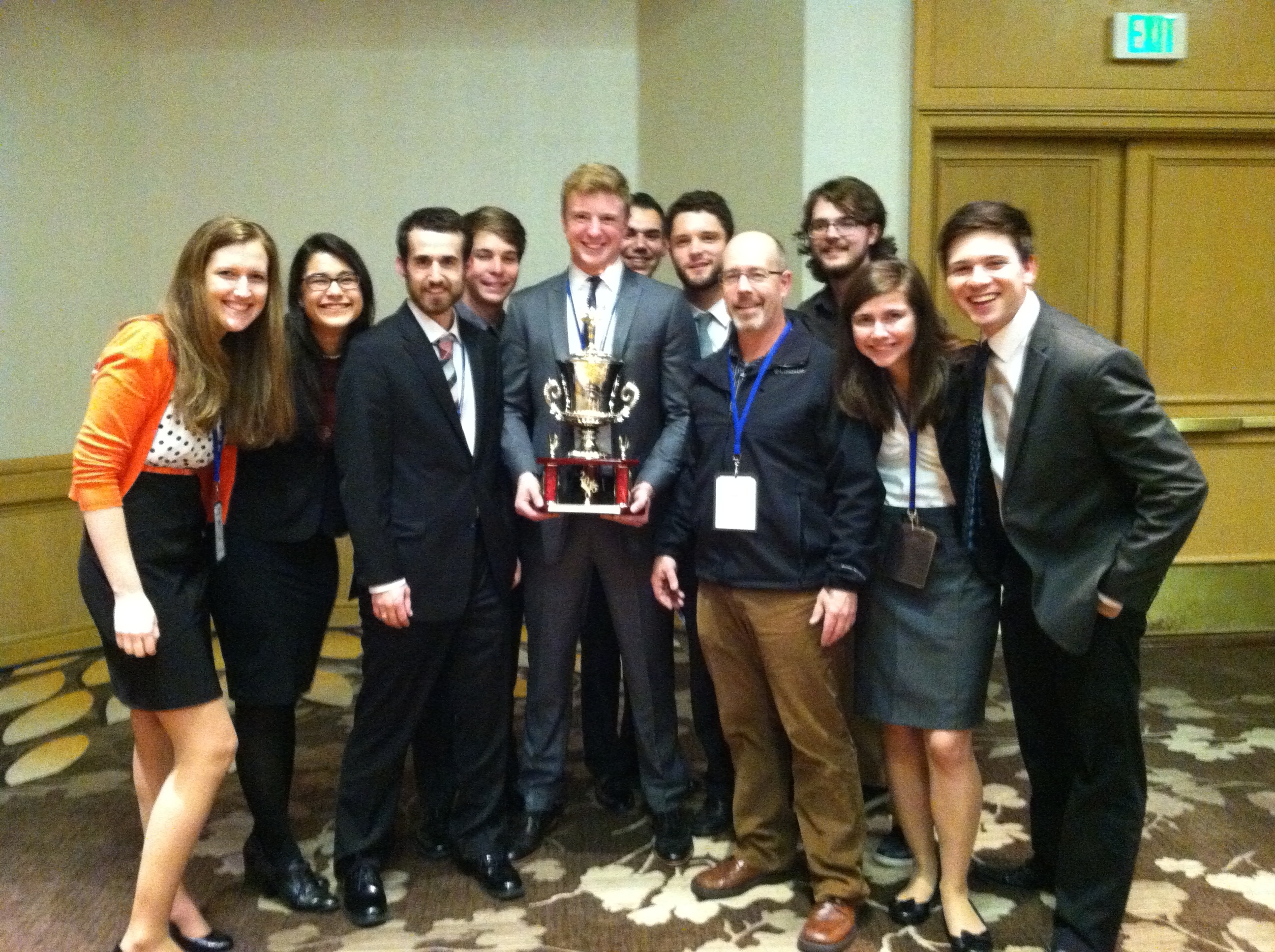
This past Saturday, November 21, the Taylor University Ethics Bowl team won the Central States regional championship for the 5th time in the history of the program.

Photo by Jim Garringer

Twenty-six teams from fifteen colleges and universities participated in this year’s Central States regional competition, which once again was held at Marian University in Indianapolis. The other schools involved were Belmont University, DePauw University, Illinois Wesleyan University (two teams), Indiana University (two teams), IUPUI-Fort Wayne, Marian University, Millikin University (three teams), Mount St. Joseph University (two teams), Northern Kentucky University, Ohio Northern University, Slippery Rock University, St. Mary of the Woods College, University of Arkansas (two teams), University of Southern Indiana, Xavier University, and Youngstown State University.

As usual Taylor entered two teams, and the rosters were as follows:

Team I:

  • Veronica Toth (Senior, English Writing)
  • Blair Hedges (Junior, Political Science)
  • Jackson Wilcox (Sophomore, Accounting)
  • Sarah Manko (Freshman, Exercise Science)
  • Caleb Holleman (Freshman, Math and Philosophy)
  • Loyal Juraschek (Sophomore, Philosophy)

Team II:

  • Kasey Leander (Senior, History and Political Science, Philosophy, & Economics)
  • Sam Moore (Junior, Philosophy and Biblical Studies)
  • Gabriel Harder (Freshman, Philosophy)
  • Chin Ai Oh (Sophomore, Political Science, Philosophy, & Economics)
  • Bo Thomas (Freshman, History and Philosophy)
  • Gloria Talbot (Sophomore, International Business Systems)

The top finishing teams qualify for the national tournament. At the competition each team competes against three other teams, and our teams had a combined record of six wins and no losses:

  • TU team #1 defeated Marian University (149-131), DePauw University (158-149), and Indiana University II (163-141)
  • TU team #2 defeated Univ. of Arkansas II (160-136), Ohio Northern Univ. (158-136), and Mt. St. Joseph Univ. I (149-139)

Taylor now has a combined 18-match winning streak, dating back to nationals earlier this year and regionals last year.

As is typical of Ethics Bowl competitions, very timely issues were debated in the various matches. These included the following:

  • Do religious freedom laws (protecting, say, a baker’s right not to make a cake for a same-sex wedding) properly balance constitutional rights?
  • Is the “Law Enforcement Officers Bill of Rights” (providing that law officers can’t be forced to make a statement within ten days of an incident) morally justifiable?
  • Does the American Freedom Defense Initiative (which ran the “Muhammad cartoon contest”) practice appropriate free speech or unacceptable intolerance?
  • Is the composting of human corpses, as advocated by the Urban Death Project (for environmental reasons) an acceptable way of disposing of the dead?
  • Is the Indian Child Welfare Act (mandating that social services place displaced Native American children with tribal relatives) morally appropriate?

These were just five of fifteen cases that all of the teams had to prepare to address. Other cases pertained to issues as wide ranging as the ethics of physicians’ prescribing hard narcotics to their patients, sexism in video games, a New Zealand species conservation case, special taxes on parents who refuse to vaccinate their children, the ethics of human egg freezing to delay motherhood, and the ethics of forcing parents to have their young teenager undergo chemotherapy. You can find a complete list of cases as well the competition rules and guidelines here.

In the regional competitions (unlike nationals) wins and losses do not impact teams’ overall scores. Rankings are determined entirely by scores awarded by judges. The top five at the conclusion of the day were as follows:

  1. Taylor University I
  2. St. Mary of the Woods College
  3. Illinois Wesleyan University I
  4. Indiana University I
  5. Taylor University II

The national Ethics Bowl competition is scheduled for February 21, 2016 and will be held at the Hyatt Regency Hotel in Reston, Virginia (near Washington, DC).  A total of 36 teams will participate, and Taylor will be striving to defend its national title.

National Champions!

Last weekend the Taylor University Ethics Bowl team, which I coach, won the national championship in Costa Mesa, California.  Ethics Bowl is an intercollegiate moral issues debate competition, in which hundreds of schools participate nationwide. Taylor has been participating since the late 1990s, and our team has won numerous regional championships, and in recent years we’ve been doing increasingly well at nationals. Two years ago we advanced to the finals, only to be edged by one point in the IMG_1313championship match. But last weekend we took that final step, winning our first national championship in a very close match against Whitworth University (a superb team and one of the most consistently strong teams in the country).

Our team won all three qualifying matches (against Duke University, Santa Clara University and Texas Pan American). Then we defeated Villanova University in the quarterfinals and Indiana University in the semi-finals, culminating in the showdown against Whitworth University.

The competition took place at the Hilton Hotel in Costa Mesa, California. As usual, 32 teams participated, all having qualified by finishing among the top teams in their region. There are ten regions nationwide, and ours is the Central States region, which features some of the best teams in the nation, including former national champions Indiana University (2004 and 2009), Wright State University (2002), and DePauw University (2013).

The topics debated at nationals were the following (two cases covered per match):

  • Unpaid internships
  • The use of ancient artifacts (Roman lead ingots) for scientific purposes
  • “Prescriptive planting” farming technology
  • The killing of civilians in war
  • Parental rights of rapists
  • Fracking
  • Artificial intelligence
  • Minimum wage
  • Horse slaughterhouses
  • Stealth (undercover) journalism
  • Media use of “crowdsourcing”
  • Transgendered people and public bathrooms

The Taylor team roster:

  • Jess Biermann (Senior, Philosophy)
  • Nathaniel Cullen (Senior, Philosophy and Environmental Studies)
  • Kasey Leander (Junior, Political Science, Philosophy, and Economics)
  • Davis Meadors (Senior, Philosophy)
  • Caleb Nagle (Senior, Political Science)
  • Mark Taylor (Senior, Philosophy)
  • Veronica Toth (Junior, English)

And non-roster Ethics Bowlers who were on the Fall regionals team and made the trip to nationals, supporting the team in various ways:

  • Kyle Carruthers (Senior, Professional Writing)
  • Lydia Grace Espiritu (Senior, Philosophy)

Katie Duncan is my assistant coach, and she led the team while I was on sabbatical in the Fall when the team qualified for nationals by finishing second at regionals.

We couldn’t be happier for the students, as they worked like crazy for the last two months and performed brilliantly all day during the competition.  It’s an amazing bunch.  For the seniors, they’ve made it to two finals in three years, and now they’ve won a national championship.

Soli Deo Gloria!

Taylor University Ethics Bowl Team Finishes #2 in the Nation!

Last Thursday the Taylor University Ethics Bowl team, which I coach, finished in second place at the national Intercollegiate Ethics Bowl Competition in San Antonio, Texas.  This is our best finish ever and our second consecutive year to make it to the “elite eight.”

Our road to the final was not easy, as we had to defeat last year’s champion, Whitworth University, in the semi-final match.  In the championship match we faced DePauw University, a team with whom we are very familiar, having faced them many times before in our Central States Regional competitions.  Like Taylor, DePauw is a liberal arts college from Indiana.  It was an exciting match, as the Wyndham Hotel ballroom was packed, and the cases debated were highly controversial—illegal immigration and active euthanasia.  Both teams did brilliant work articulating

Semi-final match against Whitworth University

and defending their views, and the judges were divided as to who the winner should be.  In the end, DePauw prevailed by the narrowest of margins: 154-153.  Congratulations to the DePauw University team!

The issues debated during the course of the day’s competition concerned such topics as pre-natal genetic testing, protest tactics used by animal rights groups, art museums’ use of stolen art, and a novel technological approach to combating global warming.  Each year the fifteen national tournament cases are posted in mid-January, so teams have about six weeks to prepare.  However, the questions posed are not known until match time, so teams must know their cases thoroughly and be prepared to address the many ethical dimensions of each case.

Other schools that competed included Colgate University, Villanova University, Loyola University Chicago, University of Oklahoma, Georgetown University, Utah State University, Maryland University, University of North Florida, the U.S. Naval Academy and twenty others.

Our team included Tom Weingartner (Senior), Sarah Sawicki (Senior), Suzanne Neefus (Junior), Nathaniel Cullen (Sophomore), Mark Taylor (Sophomore), Jess Biermann (Sophomore), Kasey Leander (Freshman), and Veronica Toth (Freshman).  And my assistant coach is Cathy Kerton-Johnson.  Ours is a relatively young team, so Cathy and I are looking forward to having another strong squad next year.  Of course, the outcome of these competitions is not as important as the qualities that Ethics Bowl develops in the students, including ethical reasoning abilities, public communication skills, and a deeper moral seriousness.  So like athletics, Ethics Bowl is a means to the end of character formation, rather than an end in itself.  But the competition really is a great motivator and a lot of fun!

Orbiting the True Falconer

Christian author and president of Ligonier Ministries R.C. Sproul tells the story of his experience as a young father visiting his daughter’s school for the first time.  Six weeks into his daughter’s first grade year at a public school in Boston, Mass., Sproul attended an open house for parents in which the principal was to explain the school’s programs and goals.  The principal proceeded to review in rigorous detail how each activity undertaken was based on the latest research in child education and how it contributed to specific aspects of the children’s development.  When they were done, the principal asked the parents if they had any questions, which at first was met with only silence and blank stares.  Finally, Sproul himself spoke up: “Sir,” he said, “I deeply appreciate all that you’ve done here, and I am overwhelmed by the amount of care and precision that has gone into the planning and execution of this curriculum.  But I do have one question.  Could you tell me what is the overarching purpose you are trying to achieve here?  In other words, what kind of child are you trying to produce and why?”  The principal looked at Sproul mutely for a several moments and then said, “I don’t know.  No one has ever asked me that question.”  To which Sproul replied:  “I respect and appreciate your being so open and honest.  But frankly, your reply terrifies me.”

Sproul’s question could, and I think should, be posed to any educator, whether those teaching first-graders or those like me, working with college students.  What kind of person are my colleagues and I (at Taylor University) hoping to produce or at least have a hand in shaping?   If we, like that principal, have no answer to Sproul’s question, then the parents of our students, too, have good reason to be worried, if not terrified.

In an essay in The Chronicle of Higher Education (June 4, 2004), Vartan Gregorian argues that American higher education is suffering from a “major failure” to make sense of the unity and value of knowledge, and is degenerating into a mere job-readiness program.  Increasingly, colleges are taking what Gregorian calls the “Home Depot approach to education,” turning themselves into “academic superstores, vast collections of courses, stacked up like sinks and lumber for do-it-yourselfers to try to assemble on their own into a meaningful whole” (p. B12).  Colleges offer a vast array of general education and specialized courses but it is “devoid of…context and coherence” (ibid).  What is critically absent is any sense of what it means to be an educated or cultured person.  So Gregorian issues an urgent call for college professors and administrators to “reconstruct the unity and value of knowledge” (ibid).

Notice that Gregorian’s worry is essentially the same as Sproul’s but just on a higher educational plane.  It is interesting to note that the events recounted in Sproul’s story occurred about forty years ago.  So his daughter’s generation are today’s college professors whose lack of unifying vision Gregorian laments.  There is indeed a crisis in American higher education today, and Gregorian diagnosis it well.  But conspicuously absent from his essay is any sense of the problem’s cure.  His plea for colleges to “reconstruct the unity of knowledge” is futile unless some of us actually know how to go about doing this.

Another curious detail in Gregorian’s essay is his choice of terminology.  He does not call for a construction of the unity of knowledge but a reconstruction, which suggests that American colleges once enjoyed a unified approach to education.  So where did that go?  And how might we bring it back? Could it be that what we need is to rediscover the unifier of knowledge which we somehow lost along the way?

In the first chapter of Colossians the apostle Paul writes that by Jesus Christ “all things were created: things in heaven and on earth, visible and invisible, whether thrones or powers or rulers or authorities; all things were created by him and for him.  He is before all things and in him all things hold together” (Col. 1:16-17).  And a little later Paul says that “in [Christ] are hidden all the treasures of wisdom and knowledge” (Col. 2:3).  If Paul is correct-and I suspect he is-then we have found the true unifier of all knowledge, the remedy to the crisis in higher education described by Gregorian.

Many people still labor under the delusion that a “neutral” education is possible.  Their recipe: Insert soul here; add factual data of diverse kinds; increase ambient social temperature; allow to incubate for three and two-thirds years; and-boom schnitzel!–an Educated Person. As if human beings really could be completely impartial and dispassionate.  As if education was a simple matter of pouring facts into persons.  As if there was such a thing as a view from nowhere.

One of the virtues of postmodernism is its rejection of the myth of neutrality, whether regarding education or any other sphere of human activity.  There is a person-relativity to knowledge, the postmodernists tell us, and even if we cannot agree with their extreme pronouncements about relativism, we Christians should acknowledge this much.  The ultimate reality is a Person, and absolute truth is relative to that Person.  What American higher education has lost is not a “what” or “it” but He who is the source of everything and brings meaning and purpose to all human activities, from learning to laughter to lovemaking.

As regards our current crisis in higher education, as with so many things in life, to discover the cause is also to find the cure.  Once upon a time in this country all our great colleges and universities were founded on Christ.  Harvard’s motto was typical: “veritas in Christi gloriam” (truth for the glory of Christ).  Jesus was the center around which they orbited, but over time they drifted out of that orbit.  The image in Yeats’ poem “The Second Coming” comes to mind:  “Turning and turning in the widening gyre; The falcon cannot hear the falconer; Things fall apart; the centre cannot hold.”  Jesus Christ is the true Falconer, the launching point of all knowledge and the center from which all wisdom derives.  But less and less our culture hears his call.

The loss of the unity of knowledge in higher education is a consequence of the rejection of a Christian worldview.  The only way this unity can be reconstructed is through Christian education.  The bad news is that higher education has fallen a long way, and the road to cultural redemption will be hard.  But in Christ there is always good news.  A millennium and a half ago things looked really bad for Western civilization.  Radical skepticism had prevailed in a war ravaged and disease stricken culture.  Truth and the unity of knowledge appeared as lifeless corpses.  Who would have thought the best days were yet to come for Western Civilization?

So what reconstructed the West?  What brought us out of the Dark Ages and into the light?  Was it not the gospel?  And how did the Christian worldview survive such difficult, apparently hopeless times?  It was Christian communities, an underground culture of hope, centered on Truth and devoted to the Christ who unifies all knowledge.  In short, Christianity saved Western Civilization.  I don’t know if we are heading into another dark age, as some have suggested.  But whether or not that’s so, the West needs to be redeemed again.  And if Christianity saved Western civilization once, it can happen again.  It can happen through the same underground culture of hope that pulled it off the first time.  And Christian colleges can be as pivotal as they were the first time.  The founding of the universities of Paris, Bologna, and Salerno were decisive for the advance of Christian thought in the 13th century and beyond.  Christian higher education must play a similar role in the years to come if we are to see a true redemption of Western culture.

Now, to return to Sproul’s question, my colleagues at Taylor and other Christian colleges do have an overarching purpose.  We do know the kind of person we are trying to produce-a person whose Christian worldview permeates the whole of his or her life.  By God’s grace we can still hear the falconer, and it is our job to enable our students to do so as well.  Whatever our specialties, research projects, disciplinary paradigms, or technological preoccupations, we must not forget whom we orbit.  It is he who holds all things together and “in whom are hidden all the treasures of wisdom and knowledge.”