Reflections on Ecclesiastes 1:18

In the book of Ecclesiastes we are told that “with much wisdom comes much sorrow; the more knowledge the more grief” (1:18).  This is one of those passages that might seem counter-intuitive, especially to the young.  But if ever there was a biblical dictum that is proven by experience, this is it.

It is interesting to note that this passage confirms a popular idiom, namely that ignorance is bliss.  The suggestion seems to be that knowledge and wisdom are proportional to pain and sorrow, respectively.  If so, then the less knowledge/wisdom one has, the less grief/sorrow one experiences.  And a complete absence of knowledge/wisdom would therefore mean a complete absence of grief/sorrow.  In other words, ignorance is bliss.  Of course, there are other ways to ruin one’s bliss that don’t involve knowledge/wisdom, such as through brute physical pain.  One need not have any genuine knowledge/wisdom in order to suffer.

Now let’s reflect on some implications of this passage on the positive end, that is, for those who have an abundance of knowledge and wisdom.  Their lives would presumably be marked by grief and sorrow.  Jesus Christ, as God incarnate, would have a maximal amount of knowledge and wisdom.  Wouldn’t it follow, then, that he would be very sorrowful?  This is exactly what the Scriptures tell us, as Isaiah refers to the Messiah as the “man of sorrows” (Isa. 53:3).

Another implication is that to follow Christ and strive for wisdom and understanding is to commit to a life of grief and sorrow.  That’s not exactly how the Gospel is pitched in our culture.  But, then again, that’s not really the whole truth of the matter, since the faithful Christian’s sorrow is actually accompanied by joy.  This is one of the existential paradoxes of Christian experience, as we actually experience joy in our troubles and trials (cf. 2 Cor. 7:4; James 1:2).  And this joy is grounded in knowledge, quite the opposite of the bliss of ignorance.

The Virtue of Wisdom

An exciting new book has recently been released.  It is entitled Being Good: Christian Virtues for Everyday Life (Eerdmans), edited by Michael Austin and Douglas Geivett.  The book features chapters on eleven different virtues—faith, open-mindedness, wisdom, zeal, hope, contentment, courage, love, compassion, forgiveness, and humility.  I was pleased to be among the contributors, which include many superb Christian philosophers.  Each chapter aims to explain the essence of the virtue discussed with a view to benefiting readers in a practical way.  My chapter is on the virtue of wisdom, and below is an overview of what I discuss.

Generally speaking, wisdom is a kind of practical moral insight.  So it appears to be both a moral virtue and an intellectual virtue.  For the wise person has knowledge of what is the best conduct in particular situations, and this knowledge is manifested in good conduct.  So you might say that wisdom is a sort of “governing” virtue that is necessary, to some degree, for the development of all other virtues. This is why wisdom is especially important and perhaps why we find such a strong biblical emphasis on it.

How does one become wise?  Is it just a matter of study and cognitive reflection?  While we usually think in terms of beliefs determining behavior, Scripture suggests that the causal dynamic runs the other direction as well.  The Old Testament wisdom literature tells us that God makes wise the simple and grants understanding to those who humble themselves (see Psalm 19:7, Psalm 25:9, Prov. 1:4, and Prov. 11:2).  And some New Testament passages underscore the critical role of behavior when it comes to belief formation (e.g., Rom. 1:18-32, Eph. 4:18-19).

Alvin Plantinga has provided some insights regarding how vice undermines wisdom.  He notes that cognitive faculties are like any other aspect of human beings, in so far as they were designed for a purpose (to form true beliefs) and that they function properly only under certain conditions.  Like any physical organ, such as lungs or eyes, cognitive processes can malfunction because of corrupting influences.  And moral vice, such pride, resentment, or the habitual indulgence in perverse behavior, is a major cause of cognitive malfunction.  In other words, sin compromises a person’s capacity to form true beliefs, particularly regarding moral and spiritual matters.

Psychological studies have shown that, when faced with a conflict between their personal beliefs and behavior, people will often reconcile this conflict by changing the way they think about their behavior.  Rather than alter their conduct, they will take the less demanding route and search for some way to rationalize it.  This response is almost always unconscious, which of course makes for a morally insidious dynamic in contexts involving vicious behavior.  These moral-psychological insights appear to confirm the Apostle Paul’s remarks in Romans 1:18-32 where he describes how wicked behavior leads to futile thinking.

So immorality undermines the quest for wisdom.  But on the positive side, virtuous living leads to wisdom.  By living rightly we diminish the corrupting impact of sin on the mind.  Consequently, our cognitive processes can function properly, and we are more likely to form true beliefs about moral and spiritual issues.  So those who faithfully obey God will grow wiser, just as Scripture tells us.

Out of the Mouths of Babes

Amy and I are constantly amazed at the things that come out of our kids’ mouths.  No, I’m not referring to regurgitant (though this can be amazing in its own right) but to their words.  Here are a few recent lines from our four little philosophers:

“I am the king of potato wedges” (Andrew Spiegel, 4) — This proclamation was made by our youngest after dinner one evening during our recent family vacation.  Because of his capacity to “put away the groceries,” as we like to say (not to mention his special taste for spuds) no one thought to challenge his claim.

“I’ve decided to sell some of my cute” (Maggie Spiegel, 6) — This statement was made by our daughter after I had developed the habit of telling her she was “too cute.”  Leave it to our little girl to interpret this simple idiom as a statement of a problem to be solved.  I forgot to ask her how she planned to execute her plan.

“The state bird for hell is the vulture” (Sam Spiegel, 7) — While driving Sam to one of his baseball games this summer the conversation turned to state birds.  Always eager to integrate theology with any topic, he came out with this one.  Strangely, I found it difficult to deny its truth.

“Cussing is just an adult’s way of whining” (Bailey Spiegel, 10) — Bailey made this assertion after hearing some people using foul language.  It has since come in handy on several occasions.  And it’s an insight that reminds me that all vice is, in one way or another, childish.

The Love of Wisdom

The word “philosophy” derives from two Greek words (philo and sophia) which together mean “the love of wisdom.”  For the founder of Western philosophy, Socrates, this meant a selfless pursuit of understanding which would translate into a good moral life.  How ironic, therefore, that the discipline of philosophy today is often viewed as (and often is in practice) anything but a quest to be wise.  Much of academic philosophy today is devoted to technical minutiae and ponderous analysis of issues only remotely related to right living.

A wise person is someone who has practical moral insight.  Moreover, s/he not only knows what courses of action are best but also conducts her/himself accordingly.  In other words, a wise person is not only morally insightful but personally virtuous.

book-cover-love-of-wisdomThis basic but overlooked fact about wisdom served as a guiding principle for my co-author, Steve Cowan, and I as we wrote our new textbook, The Love of Wisdom: A Christian Introduction to Philosophy.  We wanted to show how every major issue in philosophy is relevant to living well.  Moreover, we aimed to demonstrate how philosophical inquiry of all kinds is a boon to one’s relationship with God.  Good philosophy begets stronger faith. 

When Steve and I first hatched the idea of writing this book it became clear that we complemented one another in terms of our philosophical strengths.  So as we divided our labor, our tasks fell out evenly. I wrote the introduction and the chapters on ethics, political philosophy, aesthetics, and philosophy of science, while he wrote the chapters on logic, metaphysics, epistemology, and most of the content in the chapters on human nature and philosophy of religion. 

Given the surge of interest in philosophy among Christians over the past few decades, it is surprising that there aren’t many Christian introductory philosophy texts.  And the few that are available are not very accessible.  We wanted our text to be readable, even entertaining, for the novice.  So we use a lot of illustrations referencing popular culture and current events.  The book also contains an extensive glossary as well as study questions concluding every subsection in each chapter.  These features are aimed at making the book useful for personal study as well as classroom use.

Proverbs 4:7 says “Wisdom is supreme; therefore get wisdom.  Though it cost all you have, get understanding.”  Those are strong words.  Our hope is that this book will be helpful to readers who are serious about this quest.

The Owl and the Ass

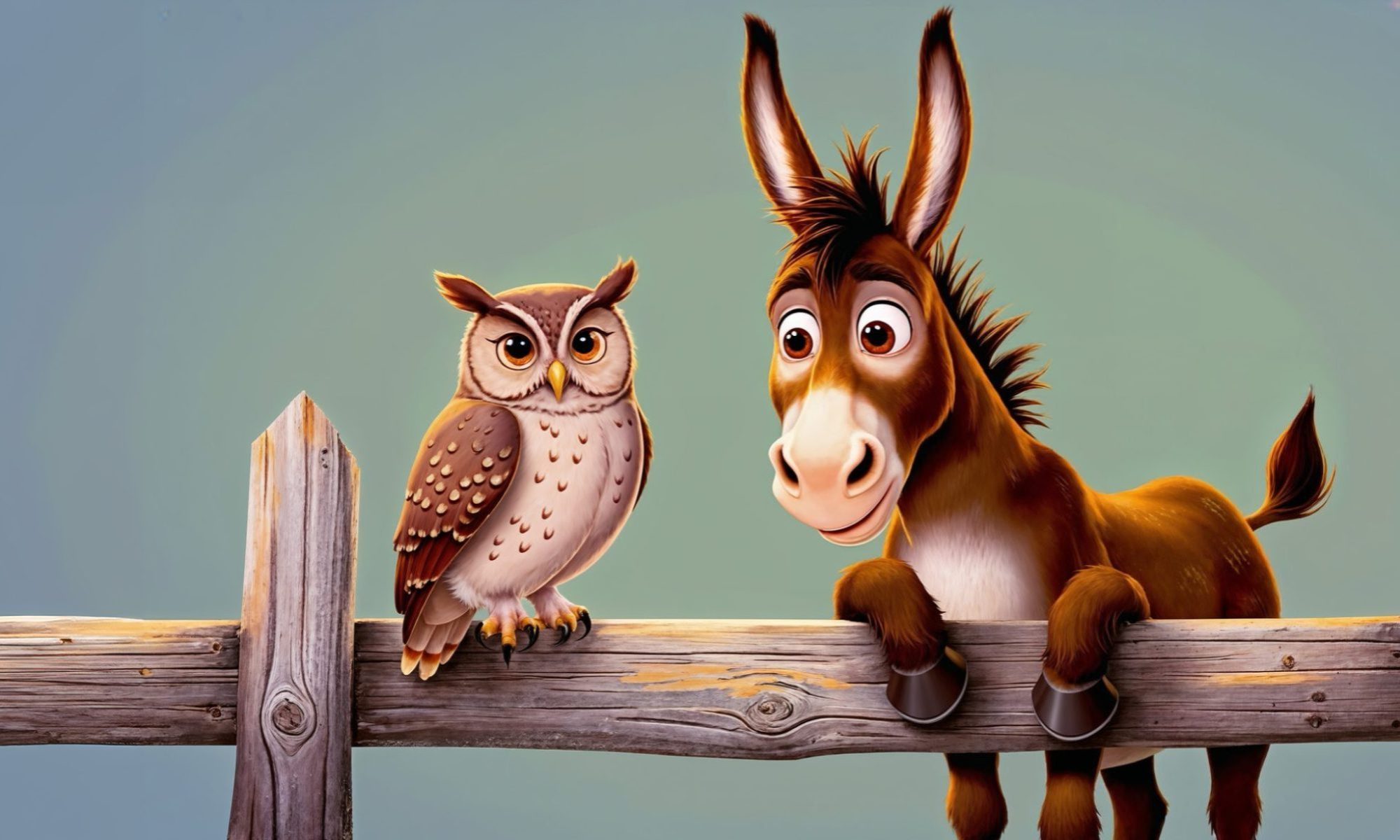
Welcome to our blog.  No doubt you have noticed the images of the owl and the ass above.  These are not random, of course.  We chose them because (at least in popular consciousness) they represent “wisdom” and “folly,” respectively.  If we had gone with random, then we’d have chosen images that are more easily drawn, like an egg and a pyramid, or a square and a tree, or maybe just a smiley face.  But no….  We had to go with purposeful and symbolic, thus leaving us in the quandary of deciding how to find some good original renderings of an owl and an ass.  The images you see were drawn by me (Jim).  Obviously, I’m no artist, as the drawings are primitive and lack pizzazz.  We briefly considered commissioning a professional artist to produce the images for us but decided against this because, for one thing, we don’t have a lot of extra cash lying around to fund this endeavor.  Frankly, we’d rather spend what we do have on chai, CDs, and diapers.  Also, we figure that since this is a homespun operation, my unwieldy drawings will do, at least for now.

However, in keeping with the interactive nature of this blog, we would like to invite you to send us your own original drawing(s)-whether a quick sketch or laboriously crafted painting-of an owl and/or an ass.  Make it comical or serious, minimalist or ornate.  Any style or mood will do.  Why?  Because this blog will be a thing of many moods-sometimes serious and (hopefully) sometimes funny.  You may submit your drawing(s) as an attachment to Jim at jmspiegel@taylor.edu.  There is no deadline.  We may or may not incorporate your drawing(s) into our blog nameplate, but if it’s interesting enough we’ll post it.  And we will give you credit for your work if we decide to use it.  But sorry-no cash remuneration.

Okay, enough of that.  A few words of explanation are in order regarding just why owls and asses commonly represent the wise and the foolish.  As for owls, they are nocturnal and can function very well in the dark.  Also, they are far-sighted, able to spot prey from hundreds of feet away, while having poor vision for things up-close.  These traits are good metaphors for wisdom, as wise people can maintain their integrity even in the midst of moral “darkness.”  A wise person also demonstrates a keen eye for what lies beyond, while not being distracted by immediate concerns.  The linkage between owls and wisdom probably also has to do with the solemn or studious look of the bird.  At any rate, in the West owls are commonly associated with wisdom, even dating back to ancient Greece, where Athena, the goddess of wisdom, was frequently depicted as holding an owl.

As for the ass or donkey, its scientific name is Equus asinus, from which we get the word “asinine.”  In ancient times, the ass was used to symbolize Dionysus, the Greek God of indulgence and excess.  And as we all know, fools are overindulgent and excessive.  Donkeys also have a reputation for being stubborn and unteachable.  This is not really accurate, but we’ll follow that folklore because, well, we need a good image for foolishness.  As with humans, in the animal kingdom it is sometimes difficult to distinguish stubbornness and stupidity from independence and single-mindedness.  But in most cases it is easy to tell the difference between the two, as the ways of the fool eventually come to ruin.

Who is wise and who is foolish?  To summarize the biblical contrast between them, the wise person is prudent, teachable, self-controlled, and morally insightful, while the fool is reckless, stubborn, self-indulgent, and morally thick-headed.  For more details, see the book of Proverbs.

The content of this blog will display the ways of the wise and foolish.  While we will seldom apply these tags to the ideas and people we discuss, we trust you’re wise enough to know which applies in each case.