Back in the mid-1980s when I was cutting my teeth as a student of philosophy, it was common to hear Christians worry aloud about the wisdom of studying in that area. Why expose yourself to so many godless thinkers and dangerous ideas? And isn’t philosophy about relying entirely on your own ability to reason rather than on the wisdom of God? I recall how as a college student I would sometimes struggle to defend what I was doing, though it seemed clear to me at the time that I was essentially following a divine call into the field. Now, three decades hence, it is gratifying to see the impact that Christians have had in the field of academic philosophy since my college days. In my latest book, Philosophy: Faithful Learning (P&R Publishing), I discuss just this.
 In the book—which is actually so short as to be more like a lengthy pamphlet—I review several of the major contributions that Christian philosophers (such as Alvin Plantinga, Richard Swinburne, Marilyn McCord Adams, William Alston, Linda Zagzebski, Robert Roberts, and William Lane Craig, to name just a few) have made to the field. These thinkers have profoundly impacted contemporary philosophy, not just in philosophy of religion but also in epistemology, ethics and other sub-fields of the discipline. Their work also powerfully demonstrates how real wisdom can be gleaned from careful, Christ-centered philosophical exploration into ultimate questions. So if you’ve never done much reading in philosophy or are curious about what it means to do “Christian philosophy,” I invite you to check it out. Just please don’t ask me why the publisher put Karl Marx on the cover. Some questions are beyond my pay grade even as an academic philosopher.
Crazy Busy: A Book Review
Kevin DeYoung is a busy man. He pastors a church, authors books, blogs daily, speaks at conferences, and is raising a large family. How does he find the time? He is, as the popular phrase and now title of his latest book goes, crazy busy. And yet, he did find time to write this book, which is, appropriately, very short at just over 100 pages, though its brevity is probably more for the sake of those who most need to read the book. People like me and perhaps you, too, who are crazy busy.
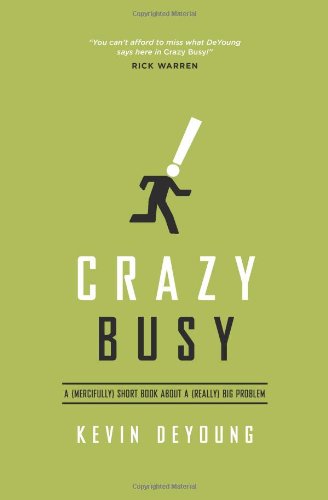 In our culture where professionals of all kinds are sometimes expected to be overworked and sleep-deprived, busyness might not necessarily be seen as a bad thing. So DeYoung begins by noting just why busyness is dangerous: It can ruin our joy, distract us from the most important things in life, and even mask deep spiritual rot. As he puts it, “extreme busyness in our lives may point to deeper problems—a pervasive people-pleasing, a restless ambition, a malaise of meaninglessness” (31).
DeYoung’s discussion is surprisingly confessional, acknowledging his own struggle with over-commitment, thus making him both the worst and the best person to write this book. The sin he identifies as a major root cause of the busyness disorder, as well as other sins, is pride. And in chapter three he explores some of the many manifestations of this vice, as “pride is the villain with a thousand faces” (35). These include perfectionism, the desire for prestige, and the need to please others.
After these diagnostics in the first half of the book DeYoung turns to offering some constructive counsel for warding off the temptation to over-commitment. It all comes down to setting priorities. An obvious truth, perhaps, but one that bears repeating because, as DeYoung notes, we’ll never be able to do all we want to accomplish and we will actually be more effective in serving others if we limit our commitments. This requires discipline, of course, not to mention humility and faith. Humility because we must recognize our own finitude. Faith because we must trust that God will ensure that the tasks we turn down will somehow get done.
In the Internet age there are greater temptations to busyness than ever before. And in chapter seven DeYoung discusses these. Not only are there temptations to addiction to on-line activity but also the concomitant threat of acedia or “purposelessness disguised as constant commotion” (82). So how shall we face this threat? DeYoung’s offers some wise practical counsel in suggesting that we “cultivate a healthy suspicion toward technology and ‘progress’” (85), even to the point that we deliberately opt for the older technologies in favor of new ones (e.g., writing a paper letter) or severely limit our use of them. In any case, he recommends that we “bring our Christian theology to bear” on all of the contemporary technologies that threaten to occupy us without adding much, if anything, in terms of quality to our lives.
Another crucial antidote to vicious busyness is rest, as DeYoung explains in chapter eight. Again obvious but often ignored, proper rest is essential to a healthy body as well as a healthy soul. Ironically, he notes, maintaining a life rhythm that involves adequate rest takes a lot of work. But for many of us it might just be a matter of being disciplined in certain areas where we fritter away time, such as watching television or surfing the Internet.
DeYoung concludes Crazy Busy by reminding us that work is good, a gift from God, and that we are supposed to be busy. What is needed is balance and an appropriate ordering of our lives, where we prioritize the right things, especially the time we spend daily in prayer and reading scripture. These two disciplines, says DeYoung, are the most important means of maintaining overall balance in one’s life. Again, his counsel here is hardly original but actually rather predictable. It is, nonetheless, valuable. Some advice is important enough to warrant the tedium of repetition.
Books I Read in 2013
I am one of those annoying people who becomes an evangelist for the books and authors I love. I will bore you with detailed descriptions of the plot, characters, and “fascinating” factoids you never wished you knew. This is why Jim need only read non-fiction books. He gets a blow by blow of all the (mainly fiction) books I read whether he likes it or not. This year I set out to be exceptionally annoying by attempting to read 30 books in one year. Last week, curled up in my favorite reading place (a cozy corner in my parents’ cabin in the Smokies, thanks for asking) I finished the last one. Actually, apparently I am a good reader but a bad mathematician because when I went back and counted there were a few more than 30. Oops.
Some I liked. Some I didn’t. Some I couldn’t put down. Some I wanted to put down but finished anyway. So here they are, the good, the bad and the somewhere in between (I included links to my favorites):
- Elizabeth the Queen: The Life of a Modern Monarch by Sally Bedell Smith: Technically I listened to this one rather than reading it, but in any case I’m not a fan. The author kept trying to convince me how amazing Queen Elizabeth is because she can stand still for long periods of time and not sweat.
- 1493: Uncovering the New World Columbus Created by Charles C. Mann: This is one of my all-time favorites. Pray that you don’t get stuck next to me at a dinner party if this book comes up in conversation.
- Can You Forgive Her? by Anthony Trollope: Trollope is no Dickens. He seems to lack a certain amount of moral conviction. Still, anything of his makes for a good read.
- Shadow of the Titanic: The Extraordinary Stories of Those Who Survived by Andrew Wilson: Blah. Moving on…
- The Book Thief by Markus Zusak: Love, love, love this book. A unique and sympathetic perspective on Germany during WWII which neither justifies nor demonizes. If you don’t read this book, I may stop talking to you for a while. I will eventually get over it when I read something else and run out of people to bore.
- Infidel by Ayaan Hirsi Ali: One of the best audio books I have ever listened to. Hirsi Ali’s voice is auditory crack. Amazing story and incredibly prescient.
- Wolf Hall by Hilary Mantel: Good enough to finish; not good enough to hook me on the series it is a part of.
- Ruth by Elizabeth Gaskell: Oh, Mrs. Gaskell, will you please be my friend in heaven and tell me stories like this one all day long?
- Thomas Jefferson: The Art of Power by Jon Meachan: I am a deeply loyal person and for sometime have thought you were either a John Adams fan or a Thomas Jefferson fan. I am still in the John Adams camp, but this book did help me to appreciate the brilliance of Thomas Jefferson as a politician.
- Bonhoeffer: Pastor, Martyr, Prophet, Spy by Eric Metaxas: I’ve been trying to finish this one for a few years now and finally managed to do it, thanks to many hours walking the grocery store aisles, ear buds in place and happy that someone else was pronouncing all those German names. I still struggle to understand why God chose not to spare such a great man but am glad to know more about his extraordinary journey.
- In the Company of Others by Jan Karon: Sweet but not as enjoyable as some of Karon’s earlier books.
- The Fault in Our Stars by John Green: Wouldn’t let any of my young adults read this one but a well-told story.
- Wherever I Wind Up: My Quest for Truth, Authenticity and the Perfect Knuckleball by R.A. Dickey: You don’t have to be a baseball fan to appreciate this gut-wrenchingly honest autobiography. So appreciate Dickey’s willingness to make himself vulnerable.
- The Silver Linings Playbook by Matthew Quick: Definitely Rated-R for strong language but I liked the movie and loved the book.
- The Host by Stephenie Meyer: Continues the author’s tradition of delivering an interesting, though badly written, story.
- 1491: New Revelations of the Americas Before Columbus by Charles C. Mann: See above review of 1493.
- Slaughterhouse-Five by Kurt Vonnegut: Not afraid to admit it…not a fan. There, I am officially uncool.
- The Eyre Affair by Jasper Fforde: Science-fiction meets literophil’s dream meets period drama? Just go with.
- Seven Men: And the Secret to Their Greatness by Eric Metaxas: An easy read best suited for avoiding eye contact with fellow plane travelers.
- The Alchemist by Paulo Coelho: I had to look up the plot to remember this one so that tells you something. Not a bad book, just easily forgotten.
- Gyspy Boy: My Life in the Secret World of Romany Gypsies by Mikey Walsh: This was almost more tragedy and abuse than I could take.
- Lost in a Good Book by Jasper Fforde: Features Miss Havashim as a leather jacket-wearing speed demon. Need I say more?
- The Aviator’s Wife by Benjamin Melanie: Not into historical fiction which takes great liberties with private thoughts and conversations.
- Blind Fury by Lynda La Plante: I love the show based on these books and didn’t have any more episodes to watch so this was the next best thing.
- Turn Homeward, Hannalee by Patricia Beatty: A cute and historically interesting young adult book.
- Lady Almina and the Real Downton Abbey: The Lost Legacy of Highclere Castle: Thought this was interesting until I did a little research and realized what a misleading PR piece this is by Lady Fiona Herbert, the current Countess of Carnarvon. Don’t think the ladies at book club have forgiven me yet for disillusioning them to the charms of Lady Almina. She’s no Cora Crawley, that’s for sure.
- Lucky Jim by Kingsley Amis: Funny story about this book. A friend recommended it years ago and I always felt guilty about having not read it. Finally did and let her know only to have her tell me she had never heard of it. So, if you were the person who actually recommended, thanks! I loved it.
- Call the Midwife: A True Story of the East End in the 1950s by Jennifer Worth: Fascinating. Can’t wait to read more by Worth this year.
- The Cuckoo’s Calling by Robert Galbraith a.k.a. J.K. Rowling: So, so good.
- The Elegance of the Hedgehog by Muriel Barbery: A bit too much of a lecture on philosophy and Japanese film for me, but worth the read.
- City of Bones, Ashes, Glass, and Lost Souls by Cassandra Clare (4 books for the price of 1): Ugh. Had no idea this was a five book series. Skipped one in the middle and still was four books too many.
- The End of Your Life Book Club by Will Schwalbe: How do you make a book about books interesting? Ask this guy. Touching story and a great resource for book recommendations. You will see several recommended by Schwalbe on my book list next year.
- Mad About the Boy by Helen Fielding: It’s Bridget Jones. Funny, raunchy, not to be read with your mother.
- The Hobbit by J.R.R. Tolkien: Can’t believe I ever thought this book was boring. My only regret is that now the movies seem even less interesting to me than before.
- W is for Wasted by Sue Grafton: Grafton is one of my favorite mystery writers. I have read every letter of her alphabet and will be sad to see Z come and go.
- The Monuments Men: Allied Heroes, Nazi Thieves, and the Greatest Treasure Hunt in History: Loved this book. Just ask all the people I have bored talking about it.
- The Queen of Katwe: A Story of Life, Chess, and One Extraordinary Girl’s Dream of Becoming a Grandmaster by Tim Crothers: Wow. This book helped me to see just how spoiled I really am. Truly inspiring.
So there you have it. Hopefully some of these books will make it to your favorite reading spot this year.
The Best and Worst of 2013
It’s been another exciting year, and we want to thank you all for reading and, if applicable, posting comments on our blog. Once again, we would like to close out the year with some summary remarks about good and bad stuff related to film, music, books, politics, and family.
Best and Worst Film Experiences:
Jim: This was a slow year for me in terms of watching films. Probably the best movie I watched all year was a very old one—The Killing Fields, a classic from 1984 featuring Sam Waterston in his signature role. As for the worst film I viewed this year, that would have to be Gravity. Though visually dazzling—the special effects are perhaps the best I’ve seen—it was almost entirely bereft of character development and a real story. Even Pacific Rim—also with brilliant special effects—had a far better story than Gravity, which is saying a lot (or, I should say, very little).
Amy: Going to see Hunger Games: Catching Fire with our two oldest boys on opening night ranks as my number one theatrical experience of the year. While decidedly not the most intellectually stimulating film I saw this year, I am enjoying Bailey and Sam’s maturation into appreciating more complex story lines and mature content in film. Since Jim stole my pick for worst film of the year, I will go with my second worst, which was City of Bones. I didn’t think it was possible for the film to be worse than the book, but I was wrong. However, I might have missed a few aspects of the film, since—after realizing it was reeeaaalllly bad—I speed watched the DVD in about 30 minutes. Ugh.
Jim’s Best and Worst Musical Experiences of the Year:
Topping my musical list this year are Vampire Weekend’s Modern Vampires of the City and Arcade Fire’s Reflektor. Coincidentally, both of these bands have a strong spiritual perspective, but this aspect of Vampire Weekend did not emerge until Modern Vampires, which is their third album. Musically, it is every bit as rich and textured as their first two albums, but now they are tackling sublime themes, and the result is beautiful. As for Arcade Fire, they’ve taken another dramatic musical turn, this time into a dance-funk direction, but it works. Somehow, for all of their stylistic explorations, this band always sounds like they’re playing to their strengths. As for the biggest disappointment of the year, it was the Killers’ Battle Born album. Somehow this once magical Las Vegas DuranDuran-inspired foursome has lost their edge and inspiration. Let’s hope they get it back.
Amy’s Best and Worst Eating Experiences of the Year:
When I think of the good dining experiences I had this year they have a lot less to do with the food we ate and more to do with the people with whom we shared those experiences. The worst experience of the year was not really an eating experience but rather our assistant pastor’s sermon on gluttony which has me doing some soul-searching regarding my relationship with food. Perhaps this shouldn’t be categorized as a “bad” experience, but I haven’t reached the spiritual maturity to call it “good” either.
Jim’s Favorite Sports Moments of the Year: It had to be watching Michigan State (my alma mater) defeat Ohio State in the Big Ten championship game. I’ve always really, really disliked the Buckeyes (because I’m also, and more fundamentally, a U-M fan, despite my love for MSU). Seeing the Detroit Tigers win their division for the 3rd consecutive year and also return to the American League Championship was a highlight as well.
Amy’ Favorite Sports Moments of the Year: My favorite sports moments are a little closer to home. I enjoyed watching Andrew’s and Bailey’s soccer teams go undefeated for the year and win their championships. Its fun to now have all of our kids playing at a level that is actually enjoyable to watch. Also, watching Andrew hit a home run in his coaches’ pitch league was fun, as well as seeing Sam play goalie on his soccer team—a role he embraced with relish.
Jim’s Most Disappointing Sports Moments of the Year: It’s a three-way tie between (1) watching the now predictable Detroit Lions’ late season swoon, (2) seeing the eventual NBA champion Miami Heat slip by the Indiana Pacers in the Eastern conference championship series, and (3) watching the Tigers falter to the bearded Beantowners. Big Poppi’s grand slam in game two turned the series, and the Tigers never recovered. But there are reasons to be hopeful again on all three counts: the Lions will be getting a new coach, the Pacers are much improved from last year and now have the best record in the NBA, and the Tigers have improved their roster considerably with some smart off-season moves. Hope springs eternal for this Detroit/Indy fan.
Satisfying Reads of the Year:
Jim: One would definitely be Thomas Nagel’s Mind and Cosmos. This long-time naturalist philosopher has shown fair-mindedness throughout his career in pointing out serious flaws with the naturalist paradigm. This penchant comes to full fruition in this book the subtitle of which is Why the Materialist Neo-Darwinian Conception of Nature is Almost Certainly False. Another is Herman Bavinck’s The Christian Family, which I reviewed on this blog recently. Profound, practical and, now after 100 years, rather counter-cultural.
Amy: With the kids in school and no home school prep to be done, I had a bit more time to read, so I was able to read over thirty books, which felt good. Among the highlights were Elizabeth Gaskell’s Ruth, Charles Mann’s 1491 and 1493, and Tolkien’s The Hobbit. In an upcoming post I will have more to say about all of the books I read.
Political High Point of the Year:
Jim: Watching Ted Cruz stand his ground in an effort to defund Obamacare. He was excoriated for this, of course. But now he’s being vindicated in what is, well, a political low point.
Amy: The federal government shutdown—because it seemed like there was a glimmer of hope that Republicans would stand their ground.
Political Low Point of the Year:
Jim: Obamacare. And it appears the worst is yet to come in 2014. Gulp.
Amy: Obamacare—especially the fact that so much has been made of the botched website when that’s just the tip of the iceberg.
Best 2013 Memories of Our Kids:
Amy: Our whole family and my dad kayaking the Hiawassee River in Tennessee, as well as camping at the Indiana Dunes with the kids.
Jim: Taking each of the kids, one at a time, out to breakfast. Something I try to do every summer. Also, I enjoyed (nearly) all of the baseball and softball practices I conducted with the kids.
Best Kids’ Quotes of the Year:
Andrew: “What’s so fun about life?”
Maggie: “Don’t you hate it when scientists just guess? I like knowing things.”
Sam: “You need to brain up.”
Bailey: After attending a seminar concerning sex and being asked what he learned: “I learned that when you’re married and you want to have sex with your wife, you have to talk to her for two hours beforehand.”
Most Satisfying Shared Experiences of the Year:
Jim: Purchasing our brand new 9-year-old Toyota Sienna was a highlight, though it was done under duress (our Honda Odyssey having just broken down). And refinishing the floor in what we are now calling our “den” was another highlight—domestic teamwork at its best. However, I fear I lost millions of brain cells in the process. Probably too much polyurethane for both of us, but just look at that shine!
Amy: Enjoying quiet moments together after dropping the kids off at school and watching Jim transform an old dresser into a bathroom vanity for my birthday. My ideas plus his elbow grease—a consistently strong combination when it comes to our home improvement.
New Year’s Resolutions:
Jim: To spend a week in the Bahamas with Amy (as well as the Taylor baseball and golf teams) in January. Okay, so that’s not really a resolution so much as a professional commitment. Hmm…how about I resolve to post more frequently on this blog—especially book reviews. Yep, that’s what I’ll do, Lord willing and the creek don’t rise.
Amy: To be in the best shape of my life when I turn 40 next December. Might not be saying much, but that’s my goal.
Happy 2014 everyone!
The Christian Family: A Book Review
The great Dutch Reformed theologian Herman Bavinck is most well-know for his four-volume Reformed Dogmatics (1906-11). In 1912 he wrote this relatively brief book which was not translated into English until last year (by Nelson Kloosterman, published by Christian’s Library Press). Better late than never, though now that I’ve read it I lament the fact that it took a century for such a profound book to become available in English. For all of Bavinck’s prowess as a systematic theologian, The Christian Family vividly demonstrates his practical wisdom, as he reflects on the origins of marriage, the roles of husbands and wives, the nurturing of children, and the place of marriage in society.
Bavinck’s view of the family is essentially Trinitarian, as becomes clear in the first chapter: “The two-in-oneness of husband and wife expands with a child into three-in-oneness. Father, mother, and child are one soul and one flesh, expanding and unfolding the one image of God, united within threefold diversity . . . within harmonic unity” (p. 8). Next, Bavinck reflects on the impact of sin on the family, especially 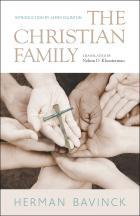 relationships between men and women. Then he devotes a chapter each to the family in the Old Testament and the family in the New Testament, highlighting the “spiritual elevation of women” with the birth of Christianity.
From there he discusses various threats to the family, and it is striking to see how, even 100 years later, Bavinck’s observations remain timely. The chief anti-family ideologies, he identifies, are (1) Darwinism, specifically its implication that family emerged naturalistically via natural selection as opposed to being divinely instituted, (2) social constructionism, which essentially follows from a naturalist view of human society, and (3) socialism, in particular the “ideal society” envisioned by Marxism, which invites a dismantling of society down to its foundations in order to eliminate all social differences. Such radical ideas of absolute equality are inevitably destructive, says Bavinck: “A society that is a genuine society, and as such is a complex organism of relationships and operations, cannot be anything but multiform” (126). And he adds that “because the organization of society possesses its starting point and stability in the family, the struggle against society ultimately leads to a struggle against the family” (127). Given all that we’ve seen in the West in the century since this book was first published, Bavinck’s words seem almost prescient.
In a chapter entitled “Marriage and Family,” Bavinck tackles the thorny issue of the differences between men and women. And it is fascinating to see him speak so frankly about an issue which today is so politicized as to make (published) frank talk about the issue virtually impossible. He even devotes a section to the unique sins to which men and women are each tempted in married life. For men, he says, the great temptation is infidelity, while for women it is stubbornness. And each of these sins, he points out, represents a playing out of the curse of the Fall and guarantees that in every marriage the husband and wife will each be a “cross” for the other to bear. This surely sounds pessimistic to the unmarried, but for anyone who is married it is more likely to be regarded as an encouraging realism. And lest this suggest that Bavinck is anything less than positive about marriage, I should emphasize that he takes a very hopeful and optimistic view, such as when he says, “as time progresses, and the years multiply, among the adventures and disappointments of life, the souls of husband and wife grow together more intimately, until marriage comes to be acknowledged more and more as the precious and priceless gift of God on this sinful, thorn-covered earth, and the estate of marriage becomes a cause for worship and gratitude” (p. 86).
In a chapter entitled “Family and Nurture,” Bavinck discusses the nurturing role of family and challenges the trend of surrendering the nurturing of children to government (another theme that is particularly apposite today). Such an approach is not only bad for children, says Bavinck, but also robs the parents of a powerful sanctifying force. Children are like “living mirrors,” since they “show their parents their own virtues and faults, force them to reform themselves, mitigating their criticisms, and teaching them how hard it is to govern a person” (p. 97). Amen to that. Bavinck goes on: “The family transforms ambition into service, miserliness into munificence, the weak into strong, cowards into heroes, coarse fathers into mild lambs, tenderhearted mothers into ferocious lionesses. Imagine there were no marriage and family, and humanity would, to use Calvin’s crass expression, turn into a pigsty” (p. 97).
The Christian Family is full of such wisdom and rhetorical flourishes. So both in terms of style and substance, it is a book that is quite unlike anything available today on the topic. To read it is to gain valuable insights about the issues Bavinck discusses and also to be struck by how much Western culture has changed in the last century when it comes to our views of marriage, family, and relationships between men and women. Yet it also reveals how certain truths about the family—both its blessings and challenges—are timeless.
Book Blurbs
This summer has been a book-reading bonanza for me. Book reading and exercise prevention. The fog of a tough homeschooling year has faded and I bathe my battle scars in a sea of literature. I am halfway through my book club reading list and still going strong. Here are some of the ones that stand out, for better or for worse.

 1491 and 1493 by Charles Mann: First a caveat about these two books. I didn’t technically read them. I listened to them. I know someone of you will consider this cheating. Sorry. But these books were my faithful and welcomed companions on my weekly Saturday escape to the recycling center and grocery store. I never thought that two historical non-fiction books would have me chuckling to myself down the cereal aisle but both had me spellbound. As the title dates would suggest, they are explorations of the state of North America before Columbus’ journey in 1492 and then how the world was impacted (economically, ecologically, culturally, etc.) by the “Columbian exchange.” Mann’s presentation of the issues is balanced enough to irritate both sides of various debates such as regarding when people first arrived in the Americas, whether Europeans responsible for the biological fallout of their journeys westward, and how we should approach the Amazon rainforest. I consider these must-reads.
Slaughterhouse Five by Kurt Vonnegut: I wanted to read something by Vonnegut and now I can say I have. Other than that, I don’t have a lot to say about this book. Maybe it is one better read in a group, where discussion and a variety of perspectives can bring out more from the text than when you read it alone. So it goes.
 Seven Men: And the Secret of Their Greatness by Eric Metaxas: I greatly enjoyed Metaxas’ Bonhoeffer so when I saw this book I was naturally curious. Metaxas has chosen seven men whom he feels have impacted our world deeply. He gives a brief biography and examination of their “greatness.” Some were familiar to me: George Washington, William Wilberforce, Dietrich Bonhoeffer, Jackie Robinson. Some I thought I knew but was surprised to learn some unexpected details or aspects of their lives: Eric Liddell, Pope John Paul II, Chuck Colson. The book was interesting but rather short. Definitely a good read for my kids as they search for role models. I would say Metaxas achieved his goal in leaving me wanting to know more about these uniquely humble and self-sacrificial men.
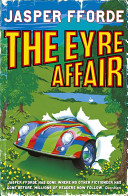 The Eyre Affair by Jasper Fforde: This was a book club selection and a very interesting read. Anything having to do with Jane Eyre has me at hello. One of a series, Fforde has created an alternative reality to our own, where time travel is possible as involves transporting oneself into the classics and potentially altering the endings of both history and fiction. A literature junkie’s dream come true, quite a few of the literary references went over my head but it made for a good sunny afternoon read.
Honorable Mentions: The Host by Stephenie Meyer (Meyer, author of the Twilight Series if you have been living under a rock for the last several years, continues her tradition of creating an interesting story that is poorly written.) The Aviator’s Wife by Melanie Benjamin (Another book club selection. Its very interesting to learn more about the lives of Charles and Anne Lindbergh, but I felt uncomfortable with the mixture of fiction and history. Think I would rather have read a biography.) The Silver Linings Playbook by Matthew Quick (Loved the movie. Loved the book more.)
New Book: God and Evil
When it comes to philosophy of religion, there are few topics as challenging, and interesting, as the problem of evil. At least as far back as the ancient thinker Epicurus, philosophers have been wrestling with the question, If God exists, then why is there evil? How can so much sin and suffering in the world be consistent with an all-powerful, perfectly good God? Much ink has been spilled on this issue, both critiquing religious belief because of this problem and offering reasons why God might permit evil.
At no time in history has there been so much published on the topic as there has been in the last few decades. Innovative formulations of the problem and equally innovative means of rebutting the objection continue to emerge, advancing the discussion in illuminating ways. The newly  published God and Evil: The Case for God in a World Filled with Pain (InterVarsity, 2013) is a welcome addition to the conversation. Edited by Chad Meister and James K. Dew, Jr., the book features contributions from over twenty scholars, dealing with a wide variety of issues.
The first part of the book features three chapters (by Greg Ganssle, Yena Lee, James Dew and Bruce Little) that distinguish different formulations of the problem of evil. This is followed by a section offering several defenses and theodicies, including the “free process” defense (Garry DeWeese), the Augustinian approach (Doug Geivett), the Leibnizian “best possible world” theodicy, (Jill Graper Hernandez), and the Irenaean “soul-making” theodicy (by yours truly).
The next section features chapters on a variety of issues, including original sin and primeval sin (Paul Copan), the hiddenness of God (Chad Meister), evil and prayer (Charles Taliaferro), evil and the resurrection of Jesus (Gary Habermas), evil in non-Christian religions (Win Corduan), evil and the new atheism (David Beck), and evil as evidence for Christianity (Greg Ganssle).
The fourth section addresses issues of special current interest, including evil and religious diversity (William Lane Craig), evil and the problem of Hell (Kyle Blanchette and Jerry Walls), evil and intelligent design (William Dembski), and evil and evolution (Karl Giberson and Francis Collins). The book concludes with an appendix featuring the transcript of a well-known debate on the problem of evil between William Lane Craig and Michael Tooley.
Naturally, I was delighted to be a part of this project, and I’m eager to dig into the book with the Philosophy of Religion class I am teaching this semester. It is especially gratifying to see all of the Taylor University connections represented in the volume, including my illustrious colleague Win Corduan, our former student Jill Graper Hernandez (now a professor at University of Texas at San Antonio), and Doug Geivett, whom I replaced at Taylor when he left for Talbott School of Theology two decades ago.
If you are looking for a book that will introduce you to current perspectives on evil and provide a rich set of resources for responding to the problem, God and Evil would be ideal. All of us who contributed were careful to write our chapters in an engaging style that is informative but does not bog down in technical detail. So the book will be of interest to both the lay reader as well as the seasoned scholar.
From the Garden to the City: A Book Review
A few months ago, author John Dyer came to Taylor University to speak on a theology of technology. Ironically, or perhaps appropriately, the morning he was scheduled to speak there was a power failure in the chapel auditorium! So the chapel service was hastily relocated to the football field, where Dyer gave a compelling talk on how a Christian worldview should inform the way we view and use technology.
Early in his book, From the Garden to the City (Kregel, 2011), John Dyer writes, “When we fail to recognize the impact of…technological change, we run the risk of allowing our tools to dictate our methods. Technology should not dictate our values or our methods. Rather, we must use technology out of our convictions and values” (p. 25). This passage summarizes a major theme in the book, in which Dyer draws from the likes of Jacques Ellul, Marshall McLuhan, and Neil Postman in explaining, as the book’s subtitle puts it, “the redeeming and corrupting power of technology.” As a professional web developer, Dyer is no luddite. And his theological training and sharp intuition for cultural critique uniquely equip him to treat this subject in a balanced and insightful way.
 Dyer begins with biblical anthropology, noting how God made humans rational and designed us for creative work, as evident in the cultural mandate in the first chapters of Genesis. And from the very beginning of human civilization, we have been acting on that mandate, making and remaking culture and using technology to do so. Dyer observes numerous ways in which key biblical events centered on technology, from Adam and Eve’s use of fig leaves to cover their nakedness to God’s “upgrade” to animal skins for clothing to the city construction of Cain to the diverse cultural innovations of Cain’s grandchildren to the infamous technological idolatry of the Tower of Babel. It appears that human technology always reflects both what is good and what is bad about human nature.
With Marshall McLuhan, Dyer rejects the naïve but popular notion that technology is always neutral. McLuhan calls this “the numb stance of the technological idiot” (p. 83). This is because, as McLuhan notes, all technology tends to: (1) magnify or extend something that humans do naturally, (2) eliminate something we used to do, (3) retrieve something from the past, and (4) create “the possibility of reversing into a more negative behavior when its overused” (p. 88). Everything from cars to cell phones vividly illustrate all of these tendencies.
Dyer’s book ultimately frames a theology of technology in terms of the biblical story of redemption—in terms of Creation, Fall, Redemption, and Restoration. Specifically, he tells us that (1) human technology is born out of and reflects the Imago Dei, (2) that we are prone to misuse our technology, (3) that technology may nonetheless be used redemptively, and (4) human technology will have a role in the final restoration of humanity, as we dwell in the New Jerusalem, the eschatological city of God.
Thanks to John Dyer for this balanced, biblically grounded discussion of the positive potentials and inherent dangers of technology. I highly recommend it to anyone interested in how to think Christianly about technology or, more broadly, how to do theological analysis of culture.
The Best and Worst of 2012
It’s been another exciting year, and we want to thank you all for reading and, if applicable, posting comments on our blog. Once again, we would like to close out the year with some summary remarks about good and bad stuff related to film, music, books, politics, and family.
Best Film Experiences:
- Jim: This year I was blown away by two films whose plots involved the silent film era: Hugo and The Artist. The former, directed by Martin Scorsese, is a powerfully redemptive story that is a visual and emotional delight. Even given his impressive filmography, I regard Hugo as one of Scorsese’s best. And The Artist is a true original at a time when Hollywood needed a breath of fresh air.
- Amy: What have I watched this year? Obviously nothing that great or I would be able to remember. I did love the experience of watching Lincoln, but I told Jim afterward, I don’t know if I loved it because it was a great movie or because it was such an amazing performance by Daniel Day Lewis. He is so good, it’s hard to evaluate the film as a whole. From a pure experience standpoint, gasping in shock surprise with several girlfriends and a theater full of shocked fellow watchers in Twilight: Breaking Dawn was a highlight.
Worst Film Experiences:
- Jim: I didn’t see any really bad films this year, but Hunger Games was a definite disappointment. I read the book, and then watched the film, and they were equally disappointing. The problem: none of the characters made any reference to God, prayer, the afterlife, etc. Given that death and physical trauma figure into the story so prominently, this is highly unrealistic and a significant flaw in the narrative.
- Amy: This year has seen a lot of disappointments for me, more in the shows that I watch than in films. Frankly I expect most movies to be bad but several favorites on the small screen turned into just another agenda driven lecture punctuated by commercialist drivel. I guess one of the worst would be Snow White and the Huntsman but was I really expecting that one to be good or did I just want to get out of the house? Hmm.
Best and Worst Musical Experiences of the Year:
- Jim: The new Dylan album, Tempest, was the highlight of the year for me. These days, every new Dylan album, especially given the fact that the man is so well along in years, is a treat. And the fact that his music is as good as ever is really astounding. Unprecedented, in fact. What other popular artist is still writing and recording great songs into his/her 70s? Another highlight was the Black Keys concert in Cincy that I attended last March. Those guys are finally getting the recognition they deserve. But will their popularity undermine their creativity from here forward? Time will tell.
- Amy: I don’t really do musical experiences. Concerts give me vertigo and my iPod is mostly full of stuff for the kids. But I did enjoy discovering The Tallest Man on Earth, The Temper Trap, Grace Potter and The Nocturnals, and Edward Sharpe and the Magnetic Zeros.
Jim’s Favorite Sports Moments of the Year: Seeing the Detroit Tigers win the American League Championship was definitely a thrill. But like 2006, they swept their way there (defeating those darn Yankees 4-0), while the Giants had to go the distance to defeat the Cardinals in the NLCS. So, just like 2006, the Tigers were hurt by the long layoff and got swept in the World Series. Hopefully, next year, the Tigers can win the ALCS in a more protracted series so they’ll be well-tuned for the World Series.
Jim’s Most Disappointing Sports Moments of the Year: Watching the Giants sweep the Tigers hurt, but the whole “Bounty-gate” debacle concerning the New Orleans Saints hurt even worse. Ugh.
Amy’s Best Eating Experience of the Year: Eating curried goat with my hubby in the Bahamas. I seriously would have licked the plate had no one been watching.
Amy’s Worst Eating Experience of the Year: I made the mistake of purchasing heavily scented yet temptingly discounted dishwasher detergent a few months back and paid dearly for my frugality when it “tainted” all of our dishes. No matter what we ate, all I tasted was synthetic lavender. Yuck.
Satisfying Reads of the Year:
- Jim: In the scholarly category, it’s Plantinga’s Where the Conflict Really Lies. As is typical for Plantinga, it is lucid and well-argued—the best treatment of science and religion I’ve ever read. Also, this year I resolved to read three classics every year, and this year they were Virgil’s Aeneid, George Eliot’s Silas Marner, and Eusebius’s History of the Church (which I am still reading). Three very different books, but each rich with insight and deserving of the moniker “classic.” I also greatly enjoyed reading another superb apologetics book by Paul Copan—When God Goes to Starbucks. He tackles some really challenging questions, such as regarding homosexuality and the Old Testament “holy wars,” and his responses are consistently insightful and sensitive.
- Amy: This has been a good book reading year for me. If I am going for mind-expanding, worldview-challenging it would be The Fountainhead. I realize she would think I am a mindless religious zombie but I still love Ayn Rand. I read a lot of history this year, my favorite being Destiny of the Republic about the assassination of James Garfield. For sheer pleasure, Roald Dahl’s Boy and Going Solo were pure delight.
Political High Point of the Year: Jim: Still waiting for one. Amy: Ditto.
Political Low Point of the Year: The presidential election. Nuff said.
Best 2011 Memories of Our Kids:
- Bailey: “There is no better feeling than picking up a heavy whipped cream can.”
- Sam: Through tears and cries of pain over a splinter “You promise it’s just a thin layer of tissue?”
- Maggie: “Mom, do you have a town inside your head where you go when you are bored?”
- Andrew as he hands us his front tooth after riding the bummer cars: “That was the most awkward time I ever lost a tooth.” And another good one from Andrew, when explaining that he would rather listen to Rascal Flats than my gospel choice: “I don’t like this one, no offense to God.”
Most Satisfying Shared Experiences of the Year:
- Jim: Our time in the Bahamas last January with the Taylor softball team.
- Amy: Redoing our upstairs bathroom.
New Year’s Resolutions:
- Jim: To take my wife out on even more dates and to avoid sugary carbonated soft drinks.
- Amy: To limit the number of times I begin sentences with the phrase “I am so sick and tired…” and to take time every day to remember what an awesome guy I married.
Happy 2013 everyone!
A Key to Balthasar—A Book Review
For many years I have been intending to dig into the work of the Catholic theologian Hans Urs von Balthasar (1905-1988), whose work, especially in theological aesthetics, has been profoundly influential. However, the Balthasar corpus is large, as he authored a trilogy of works, entitled The Glory of the Lord, Theo-Drama, and Theo-Logic. And each of these is massive, published in multiple volumes (The Glory of the Lord alone is comprised of seven volumes), which is forbidding, even for the serious scholar. Where does one begin? Aidan  Nichols’ pithy new book A Key to Balthasar (Baker, 2011) happily provides the answer. I don’t know what impressed me more about this text—the clarity of Nichols’ exposition or his restraint, as he manages to provide substantive windows into Balthasar’s theology in a mere 115 pages.
Nichols’ organizational approach is thematic, featuring three main sections, each of which is devoted to unpacking one of the three themes: beauty, goodness, and truth. This is the classic philosophical division of subjects, of course, but these are also the principal angles of approach that emerge in Balthasar’s work, as Nichols reads him.
In the chapter on beauty, Nichols stresses the uniqueness of Balthasar’s approach to the subject, noting that he resisted the empiricization and naturalization of aesthetics, aiming to preserve an appreciation of the transcendent nature of beauty. Balthasar was also concerned to emphasize the vital connection between the appreciation of beauty and the worship of God. Both of these concerns are reflected in Balthasar’s refusal to title his work “theo-aesthetics” in favor of the more pedestrian, but more descriptive, The Glory of the Lord. Third, and most distinctive, is the Christocentric nature of Balthasar’s aesthetic. The incarnation of God in Jesus Christ is the principal form of God in the world. However, the incarnation is not the only form of divine revelational beauty. And Balthasar’s purpose is to awaken us to just how pervasive is the beauty of God manifest in creational forms.
The next chapter concerns the theme of the good in Balthasar’s work, but it is more specifically a discussion of the theologian’s exploration of the divine drama in creation. Nichols notes Balthasar’s analysis of this drama in terms a triad of factors pertaining to the “production” of the drama of human history, and these correspond to the three divine Persons: Author=Father, Chief Actor=Son, Director=Holy Spirit. These are more than just metaphors for Balthasar, as he sees the world drama, especially in the work of Christ, as a fundamental expression of divine kenotic love. As a Catholic theologian, Balthasar was concerned to overcome the abstractions of neo-Thomism, but he also strove to avoid the pure concretizing impulse of naturalism. Instead, he aimed to create a theology to explore “being encountered concretely in the transcendentals.”
Nichols explains how Balthasar’s theme of divine drama leads to some fascinating explorations in Trinitarian theology, including (1) the gender fluidity of the Trinity, (2) the analogy of suffering in divine kenotic love, (3) the eschatological “homecoming” of the world to God, and (4) the notion that the world drama reflects an eternal intra-Trinitarian drama involving the Father, Son, and Holy Spirit. This is all extremely rich and imaginative stuff, at times teetering on the brink of heterodoxy, but, as far as I can tell, never crossing the line into heresy.
Nichols concludes the book with a short chapter on logic that explains Balthasar’s four-fold analysis of truth, which serves as a schematic for his “theo-logic.” The four aspects of truth developed by Balthasar are truth as nature (disclosure or unveiledness), truth as freedom (intentional self-manifestation), truth as mystery (the world’s “sign systems”) and participation (God in Christ in the world).
In so slim a volume Nichols can only provide the most general overview of Balthasarian themes. But he certainly succeeds in whetting the reader’s appetite for a more in-depth study.