Women’s Work

For years, when our children were small, Jim and I would share a hurried kiss and a “Have a good day” as he left for campus and I began a day at home with the kids. We used to joke that as we went our separate ways, each of us would look at the other with wistful pity and mutter under our breath “Sucker!”

Sure, there were days when, with a heart full of envy, I imagined him gathered around the water cooler (this was truly imagining because they didn’t have a water cooler) with his colleagues, discussing current events, quoting Plato and basking in the luxury of adult time. I am less sure that there were days where he sighed with regret as he pulled out of the driveway, watching the kids and I head out for a walk to the library or a playdate with friends. But for the most part, we were quite comfortable in our roles. He was the main breadwinner, supporting our family financially, not to mention influencing the minds of countless students and readers through his lectures, books, and articles. I was a stay-at-home mom, supporting our family through the various little tasks of home life, planning meals and doing laundry, not to mention educating our kids through elementary and middle school. We were, and still are, a great team, sharing the responsibilities and burdens, as well as the joys and rewards, of raising a family and pursuing a life of purpose and accomplishment.

I have no doubt that Jim, were he left on his own, would not have accomplished as much professionally without my support. Were he to have been a single dad, most of his time and energy would have gone into raising his kids, with little surplus for research and writing. I consider his accomplishments, all the publications, awards, etc., to be shared accomplishments in which I played a vital, though not equal, role. Obviously, he could have been a non-dad and had many more hours for his intellectual pursuits, but without the depth of experience, not to mention the love and encouragement, a family brings which I think has shaped him into a greater man than he would be otherwise.

Similarly, had I been a single mom I’m not sure the kids and I would have made it out of their formative years alive. Putting aside the obvious financial support Jim provided, allowing me the privilege of focusing on raising our family, his emotional and spiritual support was instrumental in my development as a wife, mother, and more generally as a human being. He is quick to credit me with influencing our kids to a greater degree than he has and that is perhaps somewhat true given the sheer quantity of time I was able to spend with them. But that time was made possible through the hours he spent lecturing, grading, doing research, and so on, not to mention the profound impact he has had on me as the spiritual head of our family. Our roles have shifted over the years, with the kids off to school, though I am still more focused on the daily routines of our family while he is focused on providing for our family through a myriad of ways.

This division of labor has worked, with varying degrees of success, for thousands of years. Men and women working together to nurture the next generation. Of course there have been abuses and imbalances of power, but the modern tendency to sneer at “women’s work” in the home as oppressive or demeaning is yet another symptom of the overall mass misogyny of our times. Nowhere is this more apparent in the current petition calling for the dismissal of Kansas City Chief’s player Harrison Butker over comments he made as the commencement speaker for Benedictine College which you may read in full here.

Those supporting this effort have called his comments “sexist, homophobic, anti-trans, anti-abortion and racist.” Well, they at least they got the anti-abortion part right. I won’t go into all their claims but would like to address their accusation that Butker’s remarks were sexist. Many

National Catholic Register

have pointed to the hypocrisy of those leading the charge for Butker’s firing given the numerous instances of domestic abuse and unlawful and violent behavior on the part of countless NFL players which has garnered little attention from the press or fans. What’s most interesting to me about the outcry on the part of some regarding Butker’s comments, however, is hypocrisy in another form.

They believe that a man celebrating the sacrifices and achievements of his wife is sexist. They believe that a woman’s value is to be found in her paycheck and not in her eternal investments in the lives of those entrusted to her care. In other words, they believe that women should be judged by the historically male dominated standards of career and, for lack of a better word, “worldly” accomplishments. Do they think that Butker holds his wife hostage at home? Do they think so little of women’s intellect that we are incapable of deciding for ourselves how we will divide our time and energy? Do they see so little value in the great joys of motherhood and homemaking? This seems the epitome of sexism!

In a world where men have decided that they can simply declare themselves women, invade our private spaces, steal our opportunities in sports and demand our acceptance of them as our equal, can we not at least acknowledge that being a modern woman can take many forms? Can we not celebrate those who work inside the home alongside those who choose to do so outside the home? In a world which demands acceptance of all manner of lifestyle choices, can we not allow for the rights of the traditional alongside the pantheon of “alternatives”?

The petition demanding his firing calls for unity rather than divisiveness. I couldn’t agree more; as our founding fathers put it, “Out of the many, one.” One body with many parts, all working together to function as a whole. This to me is the unity of purpose Harrison Butker wished to celebrate by praising his wife and all she has done from the sidelines to support and enable him and their family. In my eyes, she is playing the better game and winning. There are of course other roles that women can play, roles which hold great value and purpose. But I say Isabelle Butker is the star quarterback for her team. Perhaps you disagree but as for me, I’m a big fan!


Remembering my Friend, Ben Arbour

Aristotle said there are three kinds of friendships: those based on utility, those based on pleasure, and those based on a shared commitment to the good—wisdom and other moral virtues. Most of our friendships fall into the first two categories. Aristotle tells us that rare are those friendships truly grounded in a mutual pursuit of virtue. So I consider myself blessed to have had several of these friends. Humanly speaking, they are the principal reason I display any virtue or wisdom myself. Such friends are absolute treasures, benefitting us not only here but for all eternity. Because the joy and blessings they bring are so immense, losing them is especially difficult. Last week I lost such a friend—Ben Arbour, as he and his wife, Meg, perished in a car accident near their home in Fort Worth, Texas.

It was nine years ago that Ben introduced himself to me at a meeting of the Evangelical Theological Society. I was instantly struck by his exuberance, wit, and sharp critical mind. “You and I have a lot in common and we need to get to know each other,” he declared. Thus commenced our friendship, which he initially characterized as a mentoring relationship. But the truth is that I learned more from Ben than I ever taught him.

An irrepressible extrovert, Ben had a list of friends whom he would regularly call to discuss whatever was on his mind. And he constantly had a lot on his mind. Sometimes he would hit you with an argument he’d just dreamed up. Sometimes he would have a list of topics to discuss. Other times he would simply have a question. These conversations often pertained to some philosophical point, whether concerning the metaphysics of God and time, the ethics of human sexuality, or a practical implication of Berkeleyan idealism, but just as often his concerns were theological, ecclesial, or pastoral in nature.

I was just one person on Ben’s list of regular interlocutors. His philosophical-theological motor never turned off, seemingly even while he was at work, appropriately enough, as finance manager at Sewell Automotive. And sometimes he would begin these phone conversations by saying, “Jim, I have some great news.” To which I’d reply, “Yeah, what?” Then he would declare, “Jesus has risen from the dead, our sins are forgiven, and we will live forever with him for all eternity. Isn’t that great?” Indeed. And this reminder would suitably frame the discussion, debate, or goofy banter that would follow, just as Ben’s entire life was framed. He was a pure Gospel man.

Ben was also a multitrack thinker, known among his friends and colleagues for playing video games on his iPhone while attending highly technical conference presentations. The first time I witnessed this, I figured Ben was simply fatigued and had tuned out of the presentation. But when the speaker was finished and invited questions from the audience, Ben immediately piped up with the several apposite and incisive comments. This was typical for Ben, as I would eventually discover. It was also Ben’s routine, when especially intrigued or unsatisfied with the presenters’ responses to his questions, to pursue the discussion with the speaker outside of the conference room. And on at least two occasions he followed the presenters into the bathroom while doing so. I am thinking specifically of Robert Audi and Nicholas Wolterstorff, who, I am sure, handled Ben’s indefatigable questioning with grace and good humor.

Another fundamental aspect of Ben’s personality was his love for people, especially fellow Christians. He had a voracious appetite for fellowship, which always included rich conversation, clever wit, and good food. Ben was expert at two of these, and he tried to be a decent chef. I can’t say he always succeeded. But he did try. Thankfully, Meg more than made up for whatever Ben lacked in cooking skills.

Ben was also a sports fan, especially, and rather determinedly, of baseball. He frequently made known his conviction that baseball is the best of all sports (a conviction I share, so the matter occasioned no debate between us). Though seemingly trivial, somehow even this conviction of Ben’s was theological, and this carried through even to his rooting interests. For example, in the most recent World Series Ben pulled intensely for Los Angeles just because he was aware that Dodgers pitcher Clayton Kershaw is a committed Christian.

Ben was a great family man—a dedicated husband and father, and it was a joy to see him interact with his four sweet kids. In my last visit with the Arbours two weeks ago, I was struck by Ben’s tender, Socratic interaction with his youngest son, Noah, about some theological point. Ben’s fatherly care, his readiness to help Meg around the house, and the whole Arbour family dynamic of hospitality were a tangible testament to the man’s humility and genuine servant heart. “Mi casa es su casa,” Ben would say. And he meant it literally. The Arbour house constantly buzzed with guests, all of whom seemed to be special friends. One of Ben’s greatest pleasures was connecting his friends with one another. This was not merely some extrovert compulsion or professional networking but a ministry of catalyzing koinonia. It was a spiritual gift that easily surpassed that of the most socially inclined pastors I have known. Almost unconsciously effected, it was borne out of Ben’s boyish joy in the people of God.

Many a devout Christian talks a good game when it comes to intentionally and compellingly integrating the Gospel of Christ into every aspect of their life. Ben Arbour actually did this—to the delight of many and to the annoyance of some but to the benefit of everyone. Those who were close to Ben know how he was always encouraging, even when offering critical push back. Our final conversation two days before he died provides a good case in point. I had shared with Ben the possibility that I might take a teaching job at a school in Asia, which would require my being away from my family sixteen weeks each year. Rather than bluntly asserting that this was a bad idea, Ben simply said, “I don’t think I could handle being away from my wife that long. But maybe I’m just weak in that way.” This humble way of registering his reservations was particularly impactful. And it vividly illustrates the beauty of Ben Arbour as a third-level Aristotelian friend and faithful Christian brother

At this point I am still in the stage of grief that sometimes lingers in outright disbelief. It seems impossible that Ben is really gone. Eventually it will sink in, and I will grow accustomed to the fact that this world is no longer graced by his presence. In the meantime, I consciously remind myself of what Ben repeatedly reminded me: Jesus Christ has risen from the dead, our sins are forgiven, and we will live forever with him for all eternity. Crushing as it is for those of us who love them, Ben and Meg have together begun the next phase of their everlasting lives with Christ. Even now I can hear Ben’s voice: “Isn’t that great?” Yes, Ben. It surely is.

My Time at the Army War College National Security Seminar

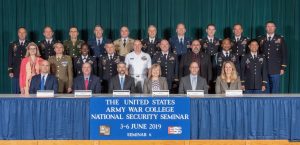
This past week I was honored to be guest at the Army War College National Security Seminar in Carlisle, Pennsylvania. The aim of the Army War College is “to educate and develop leaders for service at the strategic level while advancing knowledge in the global application of land power.” And the function of the National Security Seminar is to have those developing leaders interface with civilian leaders from diverse industries and organizations in order to mutually educate and inspire.

Each day there was a plenary session. These featured Ambassador Deborah McCarthy, director of NORTHCOM General Jeffrey Buchanan, Harvard University Professor of Government Jeffrey Frieden, and former Director of National Intelligence, James Clapper. Each speaker focused on one of the four instruments of national power (captured in the acronym “DIME”): diplomacy, information, military, and economics. Then we would break up into our various seminar groups, of which there were 24 total.  Each seminar consisted of about a dozen rising colonels who had just completed the Army War College 10-month training (which is a prerequisite for continuing promotion up to the highest levels of the military hierarchy). In addition to these officers, there were several international military brass—those in my seminar were from Spain, Algeria and Brazil. There were military officers from about 75 nations total at the NSS. During our seminar discussions, we wrangled over the nature and role of diplomacy, emerging changes in munitions and technology, foundational values of military enterprise, and the importance and challenges of U.S. military and civilian relationships.  Very rich stuff.

In the above photo are pictured everyone in my seminar. There you will see all of the military officers (including a Navy officer and an Air Force officer) and the six of us guests, each of us having been sponsored by one of the officers. One guest does counter-terrorism work with the Defense Intelligence Agency. Another is a judge who has served on the state Supreme Court in Idaho. Another is a nationally syndicated radio talk show host. And two others own or direct telecom and information security organizations.

All of us civilian guests were deeply impressed by the officers, whose collective knowledge regarding everything from federal intelligence to munitions to geopolitical dynamics is deep and extensive. Yet for all of their knowledge, experience and achievements, I was most impacted by their humility—every one of them. Truly inspiring.

I was one of just a handful of academics at the event (besides, of course, the professors who teach at the War College). It was good to see a fellow academic—Harvard scholar Jeffrey Frieden—give one of the plenary talks. He did a superb job explaining the pros and cons of economic globalization. Fascinating stuff, actually.

It is not an overstatement to say this experience was life-changing for me. I’ve always been a huge fan and supporter of the United States military (in part because my father served in WWII), but my time at the AWC NSS has taken that to a completely different level.

Berkeleyan Idealism and Christian Philosophy: My Overview in Philosophy Compass

Last year saw the publication of the two-volume Bloomsbury series on Idealism and Christianity, for which I was chief editor. My co-editors (Steve Cowan, Joshua Farris and Mark Hamilton) on the two volumes happily discovered that there is no shortage of Christian scholars today who espouse the idealist perspective, whichcoveraffirms that the physical world is entirely dependent on a conscious Mind (also known as “God”) or, otherwise put, consciousness is most real and the physical world is essentially divine ideas made public (i.e., perceivable by finite minds).

So far, our volumes have created just the sorts of conversations we intended to stimulate. In fact, one of our colleagues—Chad Meister, Philosophy professor at Bethel University—recently informed us that he has “converted” to Berkeleyan idealism. And many others are intrigued and attracted to idealism for a variety of reasons.

So these are exciting days for idealism (also known as “immaterialism”). So much so that I was commissioned to write an article for Philosophy Compass on idealism and Christian philosophy. Last week the article was published, and you can access it here. As I note in the abstract, my essay “provides an overview of some of the ways Christian philosophers have deployed immaterialism to solve problems and generate insights in metaphysics, philosophy of mind, philosophy of science, philosophy of religion, and philosophical theology.” Indeed, the explanatory power of idealism is formidable and is its most convincing feature. That is, at least in my judgment. Perhaps my article will be of some help to you as you look into it yourself.

My Latest Flatulence Research

One of my scholarly interests is flatulence.  That’s right, farts.  Well, to be precise, not farts simpliciter so much as the humor associated with passing gas.  My latest piece pertaining to the subject, entitled “From the Sumerians to Shakespeare to Twain: Why Fart Jokes Never Get Old,” was published today in The Conversation.

If you’re not familiar with The Conversation, it is a really cool web magazine, essentially the same format as a traditional news magazine (with news reports, commentaries, arts & culture pieces, etc.).  However, all of the content is written by scholars with expertise in the areas they write about, as opposed to having staff journalists with no expertise on a given topic attempting to summarize information they gather from scholars and other experts.  The Conversation has a very rigorous editorial process, too, which is refreshing.

The editors at The Conversation asked me to write this piece after seeing an article of mine in the journal Think, entitled “Why Flatulence is Funny.”  In this article I explore in depth the question that I briefly address toward the end of my Conversation article, namely why it is that farts are funny.

Also, you’ll be interested to know that my precious status as an international authority on the topic was secured with this report last year in the Helsingin Sanomat, which is the largest newspaper in Helsinki, Finland.  (You’ll want to read this one very carefully.)

So if you ever hear anyone call me a crap scholar, please correct them.  I’m actually a fart scholar.  There’s a substantive difference . . . so to speak.

Dolezal, Social Constructionism, and the Loss of Meaning

There has been quite a stir over last week’s revelation that Spokane, Washington NAACP leader Rachel Dolezal had lied about her race.  Yesterday, Dolezal resigned from her post.  Check out her Today Show interview this morning with Matt Lauer.

What you see in this interview is a reductio ad absurdum of social constructionism—the view that human beings actually construct reality via language.

As I watched the interview, noting the ways that Dolezal has decided to revise the meanings of various terms for her own purposes, I wondered, why should we think we understand what she means by any of the words she is using?  Might she be redefining every single term she uses, in fact?  Maybe so, for all we know.  So the entire conversation becomes meaningless.

This is what happens when we decide that terms and concepts are completely open to redefinition.  Human communication becomes impossible.

Thursday jumped loudly over the moon.

Chorgle epp yot yiggle snood, de freem ort lop ding wid.

2 + 2 = 5

The 2015 Annual CCT Conference

Last week I attended the conference of the Biola Center for Christian Thought, which is the annual capstone event at the CCT.  This year’s research theme was “Intellectual Virtue and Civil Discourse,” and the conference featured a number of noteworthy scholars who have done significant work in areas related to the theme.  Among them were Robert Audi (University of Notre Dame),

Robert Audi and Storm Bailey

Jason Baehr (Loyola Marymount University), Elaine Howard Ecklund (Rice University), George Marsden (University of Notre Dame, retired), Robert Roberts (Baylor University), Richard Mouw (Fuller Theological Seminary, retired), and Martin Marty (University of Chicago, retired).  In addition to the presentations by these plenary speakers, there were many other excellent presentations at breakout sessions.

Thanks to the John Templeton Foundation, I was honored to be a CCT research fellow during the Fall semester this past academic year.  My research project regards the virtue of open-mindedness, and I was able to make significant progress on what I hope will culminate in a monograph on the subject.  My presentation at the CCT conference, entitled “Open-

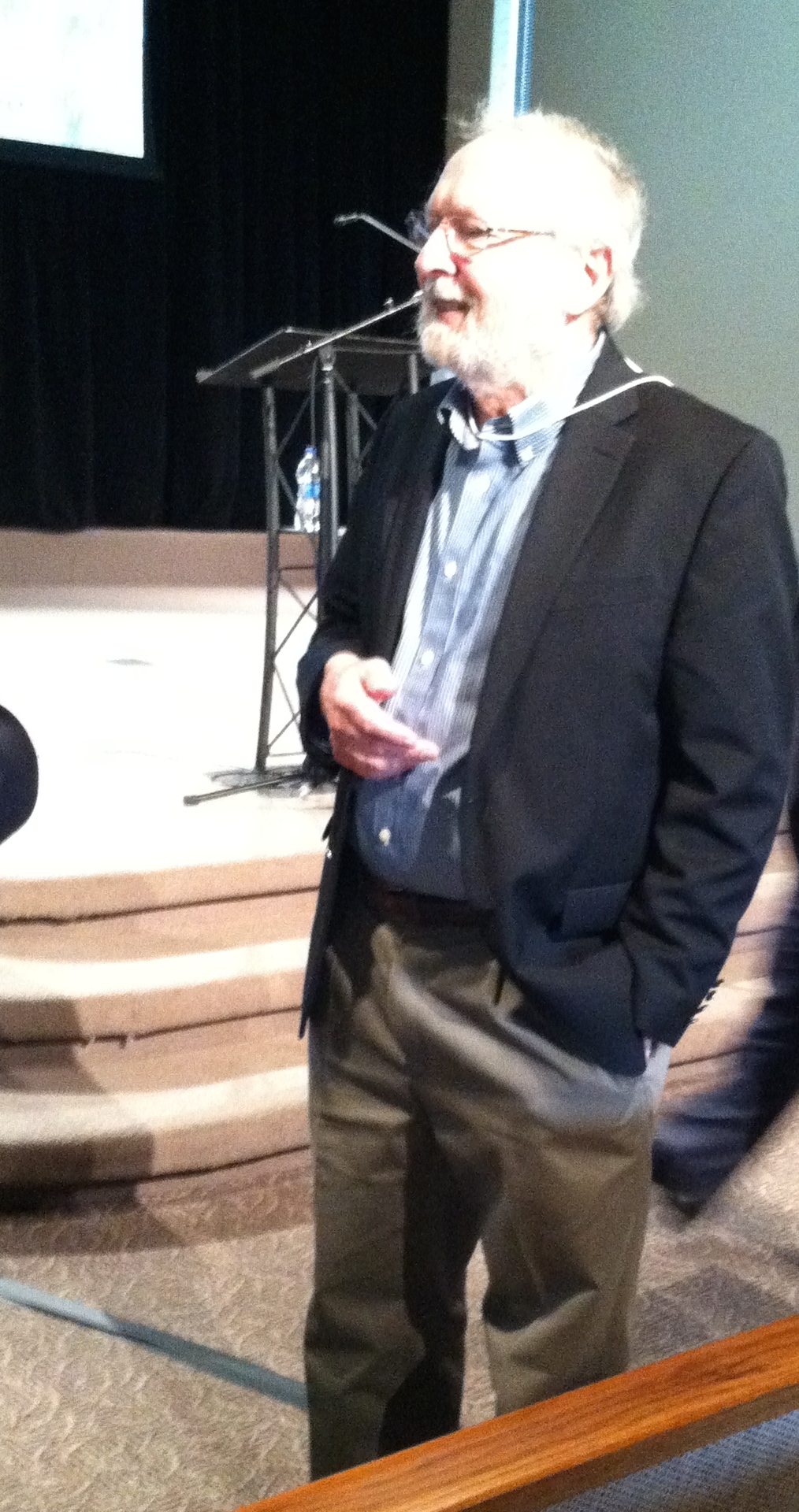
George Marsden
George Marsden

mindedness and Disagreement,” explored the connection between two topics that are germane to this year’s theme.  With regard to the issue of disagreement, the question is whether, or to what extent, confidence in your belief about an issue should be tempered by the fact that some epistemic peers disagree with you.  And, depending upon your view regarding the epistemic implications of peer disagreement, what does it mean to remain open-minded about the issue?  My session was well-attended, and I received helpful feedback, which I am looking forward to implementing in my paper as I revise it and eventually submit it for publication.

The most enjoyable thing about the conference was catching up with some of the scholars I’ve gotten to know through the CCT and other contexts, as well as becoming acquainted with a number of other scholars whom I’d never met before.  Some of these I had only admired from afar, such as the eminent

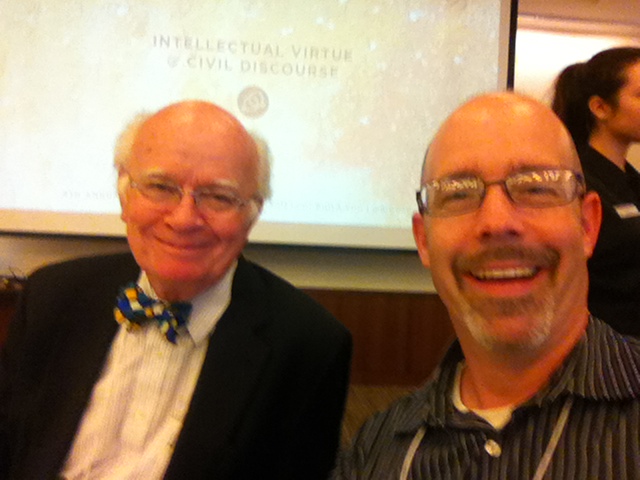
Martin Marty and me
Martin Marty and me

epistemologist Robert Audi and religious scholar Martin Marty, who might be the greatest living scholar in the English speaking world—author of more than 80 books, winner of numerous scholarly awards, member of two U.S. Presidential Commissions, and holder of 80 (yes, eighty) honorary doctorates.  Somehow I ended up sitting next to Marty at the evening banquet at the CCT conference, and I was struck by the warm humor and genuine humility of the man.  What an inspiration.

In fact, the word “inspiring” well captures my entire experience at the Biola Center for Christian Thought this year.  The CCT directors—Thomas Crisp, Steve Porter, and Gregg Ten Elshof—as well as staff members Evan Rosa and Laura Pelser, are all wonderful folks who know how to create a dynamic community atmosphere for rich scholarly research and dialogue.  The Center is currently accepting proposals for the 2016-17 research theme: “Humility: Moral, Religious, and Intellectual.”  If you do work related to this topic and would like an opportunity to dig a lot deeper, then consider submitting a proposal.  I guarantee that the experience would be a highlight of your academic career!

Thoughts on the Indiana Religious Freedom Restoration Act

Recently there has been a lot of controversy surrounding the Indiana Religious Freedom Restoration Act (RFRA).  This act declares, “a governmental entity may not substantially burden a person’s exercise of religion…[unless it] (1) is in furtherance of a compelling governmental interest; and (2) is the least restrictive means of furthering that compelling governmental interest.”  The law is very similar to more than twenty other such RFRA laws in other states, as well as a 1993 federal law, which states, “Government shall not substantially burden a person’s exercise of religion even if the burden results from a rule of general applicability.”

A few days ago I participated in a panel discussion of the issue at Taylor University.  In addition to some substantive Q&A with the audience, those of us on the panel addressed several prepared questions.  Below are my responses.

What is the nature of ‘religious freedom’?  

Legally speaking, religious freedom is the right to practice one’s faith without interference or censure by the government or fellow citizens.  The First Amendment says Congress cannot “prohibit the free exercise” of religion.  Morally speaking, we may agree that such freedom should be granted by governing authorities just to the extent that practicing one’s religion does not violate the basic rights of other people.  (This is also essentially affirmed in the French Declaration of the Rights of Man in 1789.)  And it is here that things get messy.  For some religious practices could be construed as violating someone’s rights.

What do laws like the Indiana RFRA aim to affect as far as religious freedom is concerned?

Although the principal context of the 1993 Federal RFRA concerned government encroachment onto Native American sacred land, this law and similar state laws have more generally been taken to aim at protecting a religious person’s freedom to abide by their religion’s core moral convictions.  In more recent years, as regards the whole issue of same-sex marriage and religious folks affirming the traditional Judeo-Christian view of marriage, this has been taken to include not being forced to commit the sin of complicity with immoral acts.

What does this legislation actually allow? 

This legislation allows a person the freedom to practice their faith without “substantial burden” being placed on them by the government.  And, in the legal context, a business or corporation may be construed as a “person”.  In last year’s landmark “Burwell v. Hobby Lobby Stores” Supreme Court decision, it was decided that for-profit corporations may hold religious beliefs.

What is it about the Indiana RFRA as opposed to the federal 1993 version that has provoked such ire?

This question commits the fallacy of complex question.  Did this law in particular provoke “such ire” or were there other factors that initiated and fanned the flames of controversy?  Since there is the 1993 federal law and more than thirty states have similar laws and legal provisions, many believe it is the latter.  Some speculate that the Indiana law was simply chosen by LGBT activists for practical reasons to generate national public attention to this issue—perhaps to prime the pump of public opinion as the Supreme Court is currently deliberating a case pertaining to the same-sex marriage issue.  And much of the controversy also seems to have been media driven.

Does the language of this particular version legally permit the service discrimination of certain minorities beyond the circumstances of participation in religious ritual and ceremony?

I don’t see how it could, since there is nothing about being a minority per se that presents a challenge to any reasonable religious practice.  Perhaps this is one of the reasons why the RFRA has not, until now, been controversial or faced any fundamental court challenges in the 22 years of its existence at the federal or state levels.

Do individuals have the moral right to treat individuals differently due to their sexual orientation or gender identity if such treatment is based on religious reasons?

I don’t think there is any theological basis for moral discrimination against people.  But I do think there are strong moral-theological reasons for discriminating against certain behaviors.  For example, a refusal to participate in some activities may be necessary to avoid moral complicity with behaviors essentially proscribed by one’s religion—for instance, if I am asked to support a same-sex wedding by providing a service such as a photography or baking.  But notice that even this doesn’t amount to discriminating on the basis of a person’s sexual orientation so much as it discriminates against the action of performing a same-sex wedding or, more specifically, the lifestyle choices that such a ceremony celebrates and even religiously enshrines.  Keep in mind that when performed by a minister in a church context such weddings are religious ceremonies.  So to insist that any person, such as a baker or photographer, lend their professional support to this sort of religious ceremony is essentially to insist that they embrace or approve of a particular religious practice.  So, ironically, in such contexts the RFRA actually protects people from religion or certain religious practices.

Should we be concerned about the manner in which the Indiana government responded to social pressure, ultimately amending the bill in the wake of serious backlash from national business? Isn’t this undemocratic?

Some say it amounts to public blackmail.  I would say that, generally speaking, the freedom to exert such pressures is part of the democratic process.  But that doesn’t mean they are always reasonable or coherent.  In this case, there are reasons to think it is arbitrary, because so many states and the federal government have similar laws, and hypocritical, because so many business leaders who have protested already do business in states that have such laws.

Is the ability of large businesses to effect such change a dangerous precedent regarding freedom of expression in general?

I think the more dangerous precedent is how such hysteria and duplicitous public criticism of the RFRA has gone unchecked and critiqued by major media and journalistic groups.

The ACLU has remarked that this legislation is a “solution in search of a problem” – Is there good reason for this legislation to exist in Indiana at this time?

I think so.  The GLBT movement and its rhetoric has advanced to the point that those who even voice dissent on the morality of same-sex relations are demonized or ostracized without any discussion or debate.  We’re approaching a state of dogma (again, about the moral issue) in the American cultural centers of power (federal government, state and local government, major media, public education, and entertainment industries) that would terrify and astound (the great proponent of liberty) John Stuart Mill, not to mention the U.S. founding fathers.  Where there is public suppression of views, political oppression of people is never far away.

Today we seem to be moving toward a situation where public expression of the traditional Judeo-Christian view of marriage and sexuality are essentially censored (suppressed via public pressure), and this is creating by contrast a new form of heresy.  If you don’t tow the line regarding the new progressive sexuality, then you are a moral heretic (never mind that your view has been affirmed by the overwhelming majority of scholars and ordinary folks in the East and West, both down through history and in most of the world today).

Ethics Bowl Regional Champs

This past weekend the Taylor Ethics Bowl team, which I coach, won the Central States Regional championship.  This is our students’ second regional championship in the last three years.  And all three teams that we entered finished in the top four (1st, 2nd, and 4th) out of a total of twenty teams.

The other schools that competed included Belmont University, Butler University, DePauw University, Eastern Kentucky University, Indiana University, Xavier College, Wright State University, University of Southern Indiana, Marian University, Illinois Wesleyan Universiby, St. Olaf College, IMG_1225and the College of Mount St. Joseph.  The cases debated in the competition, as always, covered a broad range of issues.  This year the issues were drug legalization, gay conversion therapy, the ethics of “street art,” racial bias in death penalty rulings, the justice of a student loan forgiveness act, and the ethics of medical experimentation on animals.

At regionals, the top four teams qualify for the national tournament in San Antonio, Texas, which will take place on February 28, 2013.  So, technically, all three of our teams qualified.  But since we can only send one team (with a maximum of 5 students) to nationals, we’ll have to select that team from among our twelve E-Bowlers who competed this past weekend.

It’s gratifying to coach such a talented bunch of students, and I’m excited about getting them prepared for the national competition.

Pressing Questions About Benghazi

Four Americans, including a U.S. Ambassador, were killed over six weeks ago, yet we still have not been told the truth regarding the circumstances surrounding their deaths, no thanks to news media that seems willing to let the story fade.  But the Benghazi story won’t go away, and for good reason.  President Obama has been asked a few questions by news journalists, but he consistently stonewalls, such as he does here in response to the question whether the Americans in Benghazi were denied requests for help.  In other interviews Obama has similarly avoided answering the question, which suggests that, indeed, the requests were denied.  After all, as commander-in-chief, he would know whether such requests were made, and if they weren’t, he would say so.  But if the requests were not denied, then actions would have been taken to protect the Americans.  But no such actions were taken…for seven hours.  Obama cannot feign ignorance on this one.  Thus, other pressing questions need to be asked as well, including the following:

  • Who gave the order to the U.S. counterterrorist forces not to defend the Americans under attack?
  • If someone beneath you disobeyed your orders to protect the Americans, then why have you not fired them or at least told us who is responsible?
  • Since it was clear from day one that this was a terrorist attack, not a mob protest of the film, then why did the White House press secretary, Jay Carney, and the UN Ambassador, Susan Rice, give the media the “film protest” line for several days?
  • Who directed Carney and Rice to tell the media it was about the film and not a terrorist attack?

These are potentially damning questions, of course.  Yet the news journalists from the mainstream media who have had the opportunity to question Obama have failed to ask these questions.  They are not doing their job, and the only plausible explanation is that they are protecting Obama.  Perhaps protecting him from some extremely serious charges, including treason.

In recent decades we have seen some major presidential scandals, such as Nixon’s Watergate and the Clinton-Lewinsky affair.  But there were no deaths involved in those scandals, let alone murder of a high-ranking U.S. official.  In Benghazi four Americans died, apparently because of the abject failure of the President to act on their behalf.  If ever a story deserved aggressive media scrutiny, this is it.

Fortunately, some members of Congress are keeping pressure on the President to clean and answer some of these questions.  At least they are doing their job.